
Global Self-Testing Market Leading Companies, Trends, and Future Outlook
Author:
Intellectual Market Insights Research
Published Date:
28 Oct 2026
Introduction
Self-testing lets people check their health at home, without visiting a clinic or waiting for lab results. Familiar examples include pregnancy tests, blood glucose meters, blood pressure monitors and COVID-19 rapid antigen kits, and the category now extends to cholesterol, sexually transmitted infections, HPV and genetic testing.
Demand is driven by the shift toward personalized, preventive healthcare, the need for fast and convenient results, and growing awareness of early diagnosis. The pandemic accelerated adoption and made home testing familiar to millions of consumers. This article looks at the global self-testing market, its segments, the companies shaping it and the outlook to 2032.
Market Overview and Forecast
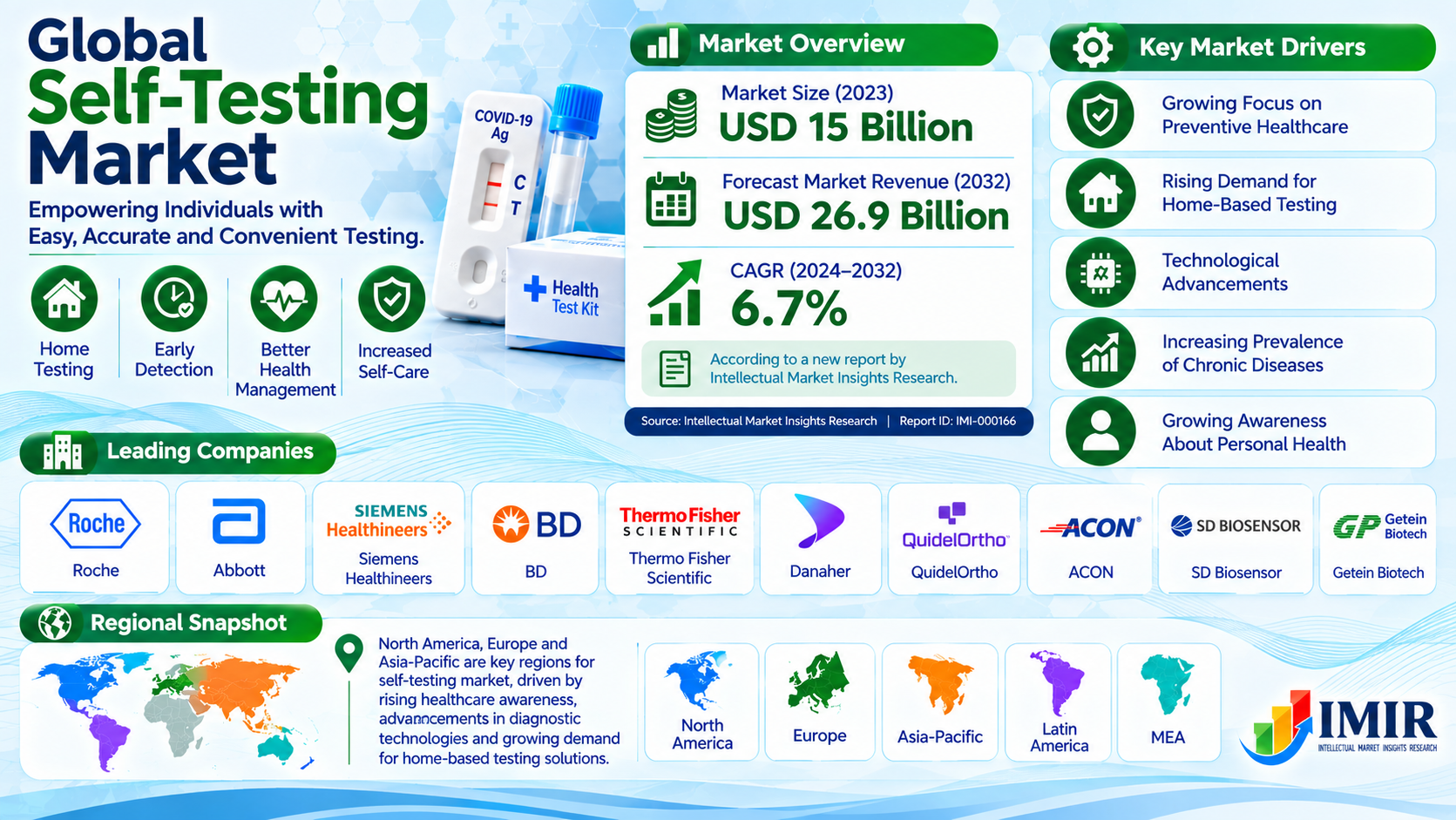
The global self-testing market earned approximately USD 15 Billion in 2023 and is projected to reach about USD 26.9 Billion by 2032, at a CAGR of nearly 6.7% from 2024 to 2032, according to Intellectual Market Insights Research.
| Parameter | Details |
|---|---|
| Market Size (2023) | Approx. USD 15 Billion |
| Projected Market Size (2032) | USD 26.9 Billion |
| CAGR (2024–2032) | 6.7% |
| Leading Region | North America; Asia-Pacific is the fastest-growing region |
| Key Segments (by Product Type) | Diagnostic Kits, Self-Monitoring Devices, Genetic Testing Kits |
| Key Segments (by End-User) | Individuals, Healthcare Providers, Pharmacies & Retailers |
| Key Segments (by Distribution Channel) | Online Retailers, Pharmacies and Drugstores, Direct-to-Consumer |
Why the Self-Testing Market Is Growing
1. Convenience and Accessibility
Consumers want to monitor their health from home without appointments, travel or waiting for lab results. This suits busy lifestyles and people living far from healthcare facilities.
2. Focus on Personalized and Preventive Healthcare
Rising interest in individualized care and predictive health tracking is encouraging people to test regularly rather than only when symptoms appear.
3. Technological Advances in Rapid Diagnostics
Faster, easier and more accurate tests are widening the range of conditions that can be checked at home.
4. Awareness of Early Diagnosis and Regular Monitoring
Greater understanding of the benefits of early detection is driving use of self-testing kits, supported by a steady stream of product launches.
5. The Lasting Impact of COVID-19
The pandemic made home testing mainstream. Public programs, such as the U.S. Home Test to Treat initiative, which offered free at-home rapid tests and telehealth services in selected communities until it ended in January 2024, helped normalize the practice.
6. Expanding Regulatory Approvals
Approvals from bodies such as the FDA and WHO, and CE marks in Europe, build confidence in self-tests and open new markets. In July 2022, for example, Innova received a CE mark for its rapid antigen self-test, supporting distribution across European markets.
Market Opportunities & Restraints
A key opportunity lies in innovation across new health areas. Self-testing began with simple products such as pregnancy and glucose tests and is now spreading to cardiovascular health, sexually transmitted infections and mental health. Biotechnology advances, mobile app integration and digital health connectivity will support more personalized use.
Funding and investment are adding momentum. In January 2022, Florida Atlantic University received USD 1.3 million in NIH funding to develop a rapid, automated HIV self-test, and in April 2022 India-based start-up Cervicheck received CDSCO approval to commercialize an HPV diagnostic kit in India.
On the restraint side, ensuring reliable results is the main challenge. A false negative or a misread result can lead to delayed treatment or unnecessary treatment, and can damage consumer trust. Manufacturers must keep improving accuracy, meet regulatory standards, and invest in user education and clear instructions.
Leading Companies in the Self-Testing Market
| Company | Headquarters | Role in Self-Testing |
|---|---|---|
| Geratherm Medical AG | Geratherm, Germany | Medical thermometers and monitoring devices for clinical and home use |
| Cardinal Health | Dublin, Ohio, USA | Healthcare products and distribution, including test kits |
| OraSure Technologies, Inc. | Bethlehem, Pennsylvania, USA | Rapid and self-test diagnostics, including oral-fluid HIV self-testing |
| bioLytical Laboratories Inc. | Richmond, British Columbia, Canada | Rapid point-of-care and self-test diagnostics |
| PRIMA Lab SA | Chiasso, Switzerland | Rapid diagnostic tests |
| BD (Becton, Dickinson and Company) | Franklin Lakes, New Jersey, USA | Diagnostics and medical technology, including rapid testing |
| Hoffmann-La Roche Ltd. | Basel, Switzerland | Diagnostics and diabetes care, including blood glucose monitoring |
| Bionime Corporation | Taichung, Taiwan | Blood glucose monitoring systems |
| Abbott | Abbott Park, Illinois, USA | Diagnostics, rapid tests and glucose monitoring |
| Everlywell, Inc. | Austin, Texas, USA | Direct-to-consumer at-home lab testing |
Competitive Landscape
The market combines global diagnostics and medical device leaders, such as Abbott, Roche and BD, with specialists in rapid and point-of-care testing, such as OraSure, bioLytical and PRIMA Lab, and consumer-first brands, such as Everlywell, that sell directly online. Established groups compete on regulatory approvals, brand trust and distribution reach, while newer entrants compete on convenience, digital experience and expanding test menus.
Distribution is a battleground. Pharmacies and retailers remain essential for reach, while online and direct-to-consumer channels are growing, allowing companies to combine testing with telehealth and app-based results.
Regional Analysis
North America
North America is among the largest markets. Consumer demand is high, healthcare infrastructure is well developed, and preventive care is a priority. Products such as COVID-19 kits, pregnancy tests and blood glucose monitors are household names, and FDA oversight supports confidence in quality and safety.
Europe
Europe is a considerable market, particularly Germany, the UK and France. Rising healthcare costs, an aging population and the shift toward home-based care are driving demand for affordable, accessible testing.
Asia-Pacific
Asia-Pacific is currently the fastest-growing region, led by China, India and Japan. Rapid urbanization, rising incomes and a growing middle class are boosting demand, while limited healthcare access in rural areas makes self-testing especially valuable. A health-conscious younger population adds momentum.
Latin America & Middle East and Africa
Both regions are emerging markets. Growth is supported by affordable healthcare solutions and expanding e-commerce, and should accelerate as awareness and affordability improve.
Emerging Trends in the Self-Testing Market
1. Expansion Beyond Basic Tests: Self-tests are moving into cardiovascular health, sexually transmitted infections, HPV and mental health assessments.
2. Digital Health Integration: Mobile apps and connected platforms are linking test results to telehealth and personal health records.
3. Direct-to-Consumer Models: Companies are selling testing kits and lab services straight to consumers online.
4. Regulatory Momentum: More approvals and CE marks are widening access and strengthening trust in home testing.
5. Chronic Disease Self-Monitoring: Glucose meters and blood pressure monitors continue to grow as chronic conditions become more common.
6. Investment in New Diagnostics: Public funding and start-up activity, such as rapid HIV and HPV tests, are broadening the product pipeline.
Future Outlook (2024–2032)
The self-testing market is expected to grow from about USD 15 Billion in 2023 to USD 26.9 Billion by 2032, a CAGR of 6.7% over 2024 to 2032. Growth will be supported by the focus on personalized and preventive care, advances in rapid diagnostics, awareness of early diagnosis, and expanding regulatory approvals.
Key themes through 2032 include wider test menus, closer integration with digital health and telehealth, rising adoption in Asia-Pacific and other emerging regions, and a continuing focus on accuracy and user education.
Frequently Asked Questions (FAQ)
1. What is the size of the global self-testing market?
The market earned about USD 15 Billion in 2023 and is projected to reach USD 26.9 Billion by 2032, at a CAGR of nearly 6.7% from 2024 to 2032.
2. What are the main product types in the self-testing market?
Diagnostic kits, self-monitoring devices and genetic testing kits. Diagnostic kits are the largest segment.
3. Who are the leading companies in the self-testing market?
Key players include Geratherm Medical AG, Cardinal Health, OraSure Technologies, bioLytical Laboratories, PRIMA Lab SA, BD, Hoffmann-La Roche, Bionime Corporation, Abbott and Everlywell.
4. Which region leads the market, and which is growing fastest?
North America is among the largest markets, while Asia-Pacific, led by China, India and Japan, is the fastest-growing region.
5. What is driving market growth?
Convenience, the shift to personalized and preventive healthcare, faster diagnostics, awareness of early detection, the lasting effect of COVID-19 and expanding regulatory approvals.
6. What are the main challenges?
Ensuring accurate, reliable results. False readings can delay treatment or lead to unnecessary treatment, so manufacturers must keep improving accuracy and educating users.
Conclusion
The self-testing market is growing steadily as consumers take a more active role in managing their health. Home testing has moved well beyond pregnancy and glucose tests, and the pandemic made it an everyday habit.
Companies that combine accurate, easy-to-use products with regulatory approvals, strong distribution and digital health integration will be best placed to benefit from growth through 2032.