
Global Smart Pills Technology Market Leading Companies, Trends, and Future Outlook
Author:
Intellectual Market Insights Research
Published Date:
29 Oct 2026
Introduction
Smart Pills are ingestible, capsule-sized devices that travel through the digestive tract and carry out a medical task. Some capture images of the gastrointestinal (GI) tract, some release medication at a targeted site, and others collect data such as temperature, pH or pressure, or track whether a patient has taken their medicine.
Smart pills reduce the need for invasive procedures such as conventional endoscopy and give clinicians a view of areas that are hard to reach, such as the small intestine. As GI disease burden grows and healthcare systems favor minimally invasive diagnostics, adoption is widening across hospitals, diagnostic centres and research institutions. This article looks at the global smart pills technology market, its segments, the companies shaping it and the outlook to 2028.
Market Overview and Forecast
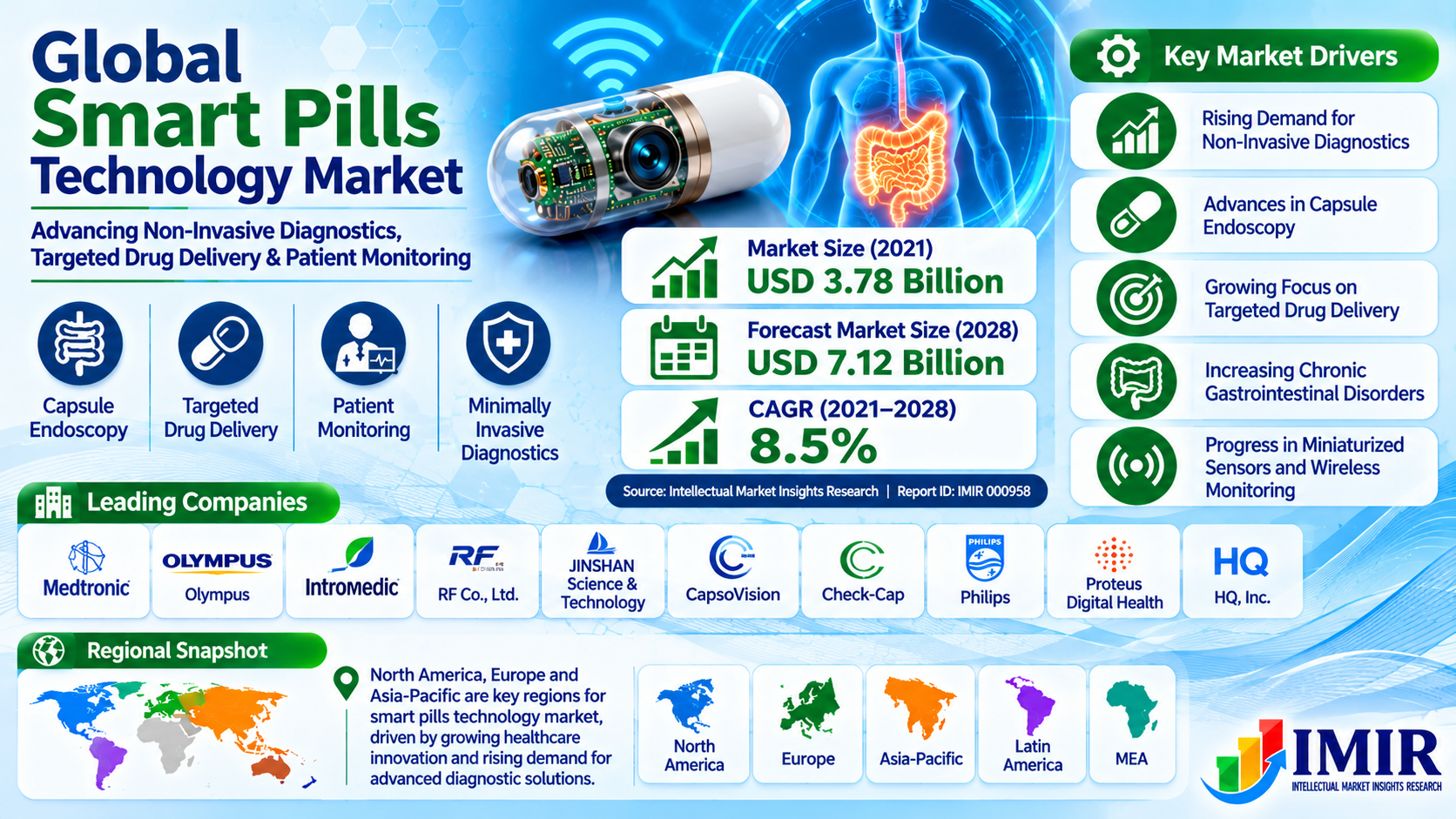
The global smart pills technology market was valued at USD 3.78 Billion in 2021 and is projected to reach USD 7.12 Billion by 2028, at a CAGR of 8.5% from 2021 to 2028, according to Intellectual Market Insights Research.
| Parameter | Details |
|---|---|
| Market Size (2021) | USD 3.78 Billion |
| Projected Market Size (2028) | USD 7.12 Billion |
| CAGR (2021–2028) | 8.5% |
| Leading Region | North America; Asia-Pacific expected to show significant growth |
| Key Segments (by Target Area) | Esophagus, Stomach, Small Intestine, Large Intestine |
| Key Segments (by Disease Indication) | Barrett’s Esophagus, Small Bowel Diseases, Colon Cancer, Others |
| Key Segments (by Application) | Capsule Endoscopy, Drug Delivery, Patient Monitoring |
| Key Segments (by End User) | Hospitals and Clinics, Diagnostic Centres, Research Centres |
Regional snapshot: North America holds the largest share of the market, driven by growing adoption of smart pills technology. Asia-Pacific is expected to grow significantly, supported by the presence of key technology companies in economies such as Japan and China.
Why the Smart Pills Technology Market Is Growing
1. Preference for Minimally Invasive Diagnostics
Patients and clinicians increasingly prefer swallowable capsules to procedures that need sedation or insertion of instruments, which improves comfort and willingness to be screened.
2. Rising Burden of GI Diseases
Conditions such as Barrett’s esophagus, small bowel diseases and colon cancer drive demand for earlier and more accessible screening and diagnosis.
3. Better Visualization of Hard-to-Reach Areas
Smart pills can image the small intestine, a region conventional endoscopy struggles to reach, which supports their use in small bowel diagnosis.
4. Advances in Miniaturization, Sensors and Wireless Technology
Smaller cameras, better sensors and wireless data transmission are improving image quality, battery life and the range of data a capsule can collect.
5. Growing Interest in Targeted Drug Delivery and Adherence Monitoring
Capsules that release drugs at a specific site, or confirm that a medication was taken, are opening new uses beyond diagnostics.
6. Expanding Healthcare Infrastructure and Awareness
More hospitals, diagnostic centres and research facilities are adopting advanced diagnostic tools, particularly in developing regions.
Market Opportunities & Restraints
A key opportunity lies in expanding beyond capsule endoscopy into drug delivery and patient monitoring, and in AI-assisted image analysis that reduces the time clinicians spend reviewing the thousands of images a capsule can capture.
On the restraint side, high device cost, limited reimbursement in some markets, regulatory approval requirements, and the inability to take biopsies or intervene during a capsule procedure are the main challenges. Capsule retention, where a capsule stays in the digestive tract longer than intended, is a safety consideration that clinicians manage through patient selection.
Leading Companies in the Smart Pills Technology Market
| Company | Headquarters | Role in Smart Pills Technology |
|---|---|---|
| Medtronic Plc. | Dublin, Ireland | Capsule endoscopy through its PillCam portfolio |
| Olympus Corporation | Tokyo, Japan | Capsule endoscopy systems alongside a broad endoscopy portfolio |
| IntroMedic Co., Ltd | Seoul, South Korea | Capsule endoscopy systems |
| RF Co., Ltd | Japan | Capsule endoscopy technology |
| JINSHAN Science and Technology | Chongqing, China | Capsule endoscopy systems, notably in the Chinese market |
| CapsoVision, Inc. | California, USA | Capsule endoscopy with panoramic imaging |
| Check-Cap | Israel | Capsule-based screening technology for the colon |
| Koninklijke Philips N.V. | Amsterdam, Netherlands | Healthcare technology company with a history in ingestible capsule development |
| Proteus Digital Health | California, USA | Ingestible sensor technology for medication adherence monitoring |
| HQ, Inc. | — | Listed as a key player in the report |
Competitive Landscape
Capsule endoscopy is dominated by a mix of global medical technology groups, such as Medtronic, Olympus and Philips, and specialist capsule developers, such as CapsoVision, Check-Cap, IntroMedic and JINSHAN. Established players compete on clinical evidence, hospital relationships and distribution reach, while specialists compete on imaging innovation, such as wider fields of view, and on new clinical applications.
Asia-based companies are gaining visibility through cost-competitive systems and growing domestic demand. Across the market, differentiation increasingly comes from software, including AI-assisted reading, and from expansion into drug delivery and monitoring.
Regional Analysis
North America
North America holds the highest share of the market, supported by strong adoption of smart pills technology, advanced healthcare infrastructure and the presence of leading developers.
Europe
Europe is a mature market with established gastroenterology practice and strong clinical research activity, with growth supported by wider adoption in hospitals and diagnostic centres.
Asia-Pacific
Asia-Pacific is expected to show significant growth, helped by the presence of key technology companies in economies such as Japan and China, and by improving healthcare access across the region.
Latin America & Middle East and Africa
Both regions are emerging markets where growth depends on healthcare investment, awareness and access to advanced diagnostic tools.
Emerging Trends in the Smart Pills Technology Market
1. AI-Assisted Image Interpretation: Software that flags abnormalities across thousands of capsule images is reducing review time and supporting more consistent reads.
2. Colon-Focused Capsules: Capsule technologies aimed at the large intestine are broadening the scope beyond the small bowel and esophagus.
3. Smart Drug Delivery Capsules: Capsules that release medication at a targeted site are moving from research toward clinical use.
4. Adherence Monitoring: Ingestible sensors that confirm medication intake are drawing interest from healthcare providers and researchers.
5. Improved Imaging and Battery Performance: Better cameras, wider fields of view and longer battery life are improving diagnostic completeness.
6. Growth in Research Use: Research centres are using smart pills to study GI physiology, drug absorption and disease progression.
Future Outlook (2021–2028)
The smart pills technology market is expected to grow from USD 3.78 Billion in 2021 to USD 7.12 Billion by 2028, at a CAGR of 8.5%. Growth will be supported by rising GI disease burden, the shift toward minimally invasive diagnostics, technology advances and wider use in drug delivery and patient monitoring.
Key themes through 2028 include broader adoption of AI-based analysis, expansion of colon and stomach applications, growing use in research settings, and rising competition from Asia-based developers.
Frequently Asked Questions (FAQ)
1. What is the size of the global smart pills technology market?
The market was valued at USD 3.78 Billion in 2021 and is projected to reach USD 7.12 Billion by 2028, at a CAGR of 8.5% from 2021 to 2028.
2. What are smart pills used for?
Smart pills are used for capsule endoscopy, targeted drug delivery and patient monitoring, including imaging the GI tract and tracking medication adherence.
3. Who are the leading companies in the smart pills technology market?
Key players include Medtronic Plc., Olympus Corporation, IntroMedic Co., Ltd, RF Co., Ltd, JINSHAN Science and Technology, CapsoVision, Inc., Check-Cap, Koninklijke Philips N.V., Proteus Digital Health and HQ, Inc.
4. Which region leads the market?
North America holds the highest share, while Asia-Pacific is expected to show significant growth.
5. What conditions can smart pills help diagnose?
Smart pills support diagnosis and screening for conditions such as Barrett’s esophagus, small bowel diseases and colon cancer.
6. What are the main challenges?
High device cost, limited reimbursement in some markets, regulatory requirements, and the inability to take biopsies or intervene during a capsule procedure.
Conclusion
The smart pills technology market is growing steadily as healthcare shifts toward minimally invasive, patient-friendly diagnostics. Capsule endoscopy remains the core application, while drug delivery and patient monitoring add new growth paths.
As imaging, sensors and AI analysis improve, companies that combine strong clinical evidence with innovative capsule design and software will be best placed to benefit from growth through 2028.