
Leading Companies in the Global Spacetech Market
Author:
Intellectual Market Insights Research
Published Date:
22 Sep 2026
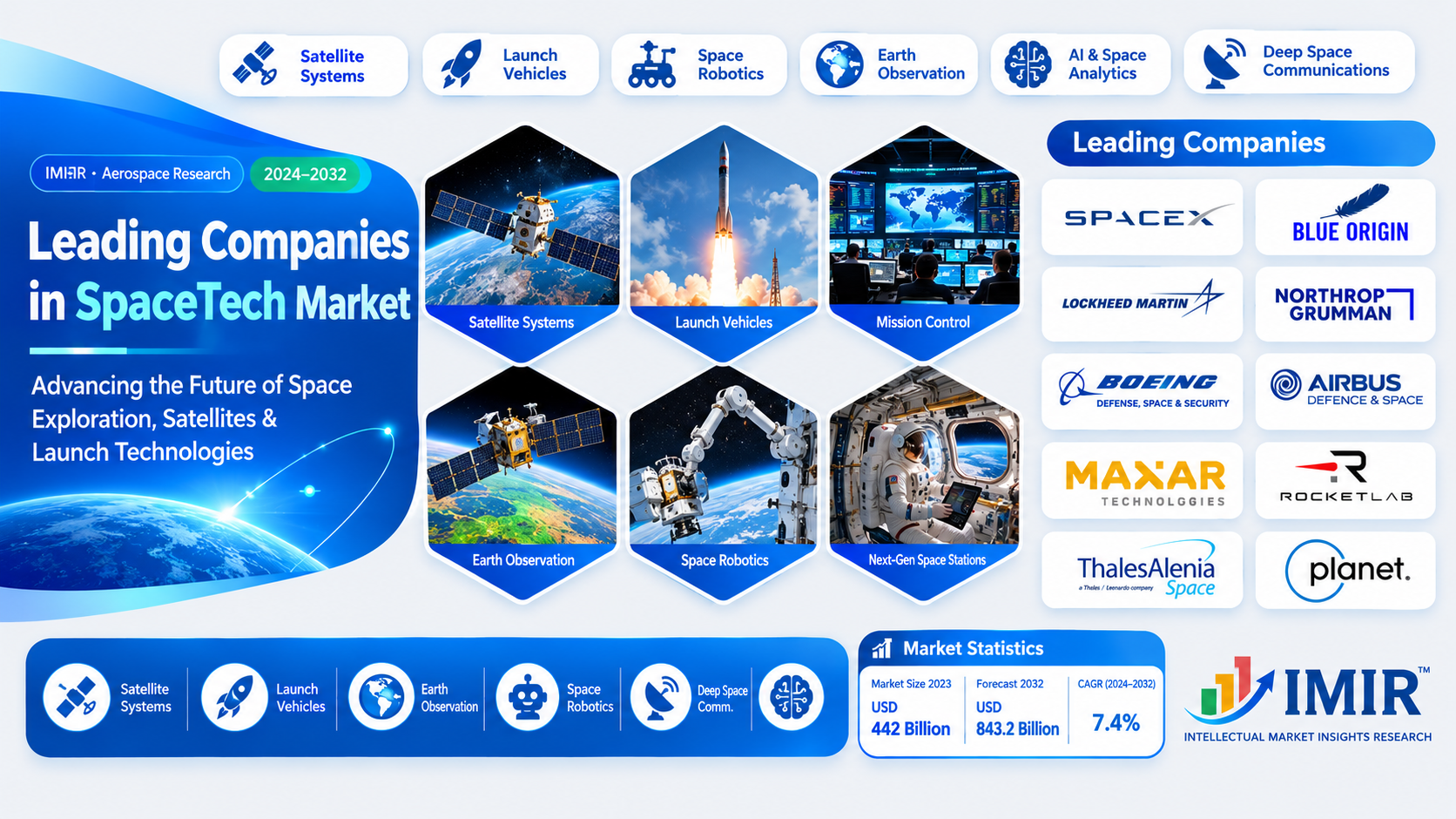
Leading Companies in the Global SpaceTech Market
The global spacetech industry has moved from a government-dominated frontier to a fast-commercializing sector, as reusable launch vehicles, satellite constellations, and in-orbit services attract record levels of private capital. Falling launch costs, growing demand for satellite connectivity and Earth observation, and expanding defense budgets are reshaping the competitive landscape, with a handful of established aerospace giants and a new wave of commercial disruptors capturing the bulk of market share.
A Snapshot of the Global Spacetech Market
Market-sizing estimates vary noticeably across research houses, largely because each defines "spacetech" scope differently (some include ground equipment and consumer satellite services, others don't). Taken together, the estimates paint a consistent growth picture even where the base numbers diverge:
- One estimate values the market at USD 611.45 billion in 2025, projecting growth to USD 1,141.12 billion by 2034 at a 7.2% CAGR, with the commercial segment leading and North America holding roughly 48% share.
- Another puts the market at $466.1 billion in 2024, forecasting growth to $769.7 billion by 2030 at a 9.3% CAGR, with data & analytics as the fastest-growing segment and government as the largest revenue contributor.
- A third estimate is considerably more conservative, sizing the market at USD 288.58 billion in 2025 and projecting USD 396.48 billion by 2031 at a 5.39% CAGR, framing it as the aggregated value of designing, manufacturing, launching and operating spacecraft and payloads, explicitly excluding consumer satellite-TV and terrestrial defense revenue.
- A fourth report values the market at USD 512.08 billion in 2025, rising to USD 1,081.74 billion by 2035 at a 7.77% CAGR, with North America at 55.67% share and Asia-Pacific the fastest-growing region at 9.59% CAGR.
Regardless of which figure is used, the direction is the same: high single-digit to low double-digit annual growth, driven by commercial rather than government demand.
Key Growth Drivers
- Falling launch costs from reusable rocket technology, which has made orbital access dramatically cheaper than a decade ago
- Satellite broadband constellations (Starlink, Kuiper, OneWeb) driving demand for mass satellite manufacturing
- Earth observation and data analytics, as satellite imagery feeds into agriculture, insurance, logistics, and climate monitoring
- National security and defense investment in proliferated, resilient satellite constellations rather than a few high-value assets
- Emerging commercial space stations and in-orbit manufacturing, as the ISS approaches retirement
- Early-stage space tourism and commercial spaceflight, still small in revenue but symbolically significant for investor sentiment
Key Company Profiles
SpaceX is the dominant force in the sector today. The company accounted for roughly 50% of the 325 orbital launches recorded globally in 2025, a year that also saw a 54% jump in spacecraft deployed versus 2024. SpaceX generated about $18.7 billion in FY2025 revenue and completed its IPO on June 12, 2026 — one of the largest in market history — with Starlink now serving more than ten million subscribers across roughly 160 countries, alongside its Starshield government/defense connectivity line. It also combined with Musk's AI company xAI in February 2026, consolidating space, connectivity, and AI under one roof.
Boeing remains a legacy heavyweight, having helped build the ISS and NASA's Space Launch System for the Artemis program, though cost overruns and schedule delays have weakened its position against faster-moving private rivals. Its Starliner crew capsule continues development for ISS crew rotation.
Lockheed Martin derives a large share of its overall revenue from the F-35 fighter program, but also runs a dedicated space systems segment producing satellites, plus equity income from its United Launch Alliance joint venture with Boeing. It also leads development of the Orion deep-space crew capsule for Artemis missions.
Northrop Grumman is a key NASA contractor, supplying the Cygnus cargo spacecraft for ISS resupply missions and co-developing the Lunar Gateway habitat, giving it a strong foothold in both government cargo logistics and lunar infrastructure.
Rocket Lab has grown from a small-launch specialist into a vertically integrated space systems company. It has completed more than 90 orbital launches via its Electron rocket — second only to SpaceX — and has expanded through acquisitions of satellite component makers into a broader end-to-end space supply chain business. Its upcoming Neutron rocket targets the medium-lift segment currently dominated by Falcon 9.
Blue Origin, founded by Jeff Bezos, is developing the New Shepard suborbital tourism vehicle alongside the heavier-lift New Glenn rocket intended to compete with Falcon Heavy, and has broader ambitions around lunar landings and a permanent human presence on the Moon.
Airbus, Maxar Technologies, Thales Alenia Space, L3Harris, and General Dynamics round out the major spacecraft and satellite-manufacturing tier. Rocket Lab itself names these firms — alongside Boeing, Lockheed, Northrop Grumman, and Raytheon — as its principal competitors in spacecraft solutions, while Ball Aerospace, Collins Aerospace, Honeywell Aerospace, GOMSpace, and Redwire compete at the components level.
Other notable players shaping specific niches include Planet Labs and Spire Global (Earth-observation data), Firefly Aerospace and Relativity Space (next-gen launch), Sierra Space (commercial space stations), and Astranis (small geostationary satellites) — all listed among the leaders in the broader global space economy alongside SpaceX, Boeing, Lockheed Martin, Northrop Grumman, and Airbus.
Regional Insights
North America continues to dominate the spacetech landscape, anchored by NASA, the U.S. Space Force, and the concentration of commercial launch and satellite manufacturers. North America held roughly 55.67% of the global market in 2025, with the U.S. alone valued at about USD 254.18 billion. Asia-Pacific, however, is the fastest-growing region — expected to expand at an 11.3% CAGR through 2030 as Japan, South Korea, and Australia invest heavily in satellite communication and navigation to build regional connectivity and technological independence.
Notable Trends
-
Reusability and cost compression: reusable rockets and software-defined satellites are steadily displacing fixed, single-use payload designs
- Proliferated constellations over "exquisite" satellites: national-security buyers are shifting toward large numbers of resilient satellites rather than a handful of exquisite, expensive ones
- In-orbit servicing and manufacturing: a small but fast-growing segment — the in-space manufacturing market alone is projected to grow from about $1.21 billion in 2025 to $3.51 billion by 2030 at a 23.6% CAGR, driven by on-orbit satellite servicing and commercial space-station expansion
- Private commercial space stations: companies developing habitats and research platforms as potential successors to the ISS
- Consolidation of space, connectivity, and AI: illustrated by SpaceX's 2026 combination with xAI
FAQ
How big is the global spacetech market?
Estimates range widely by scope, from roughly $290 billion to over $610 billion in 2025, depending on whether ground equipment and consumer services are included.
What is the growth rate of the spacetech market?
Most forecasts put the CAGR between 5.4% and 9.3% through 2030–2035, depending on the source and market definition.
Who are the leading companies in the spacetech market?
SpaceX, Boeing, Lockheed Martin, Northrop Grumman, Airbus, Rocket Lab, Blue Origin, Maxar Technologies, Thales Alenia Space, and L3Harris are consistently named among the market's leaders.
Which region dominates the spacetech market?
North America, driven by NASA, U.S. defense spending, and a concentration of commercial launch providers — though Asia-Pacific is growing fastest.
What is driving spacetech market growth?
Falling launch costs from reusable rockets, satellite broadband constellations, Earth-observation data demand, and rising defense investment in resilient satellite networks.