
Global Supply Chain Security Market Leading Companies, Trends, and Future Outlook
Author:
Intellectual Market Insights Research
Published Date:
22 Oct 2026
Introduction
Supply Chain Security covers the technologies, processes and policies that protect goods, data and partners as products move from raw-material suppliers to the end customer. It aims to prevent counterfeiting and fraud, ensure product authenticity, protect sensitive supply chain data, and build resilience against disruption.
Supply chains are now longer, more digital and more interconnected than ever. Each extra supplier, port, carrier or software platform adds another point of risk, so organizations are investing in traceability, authentication, cybersecurity and risk-monitoring solutions. This article looks at the global supply chain security market, the companies shaping it, and the forces driving growth toward 2034.
Market Overview and Forecast
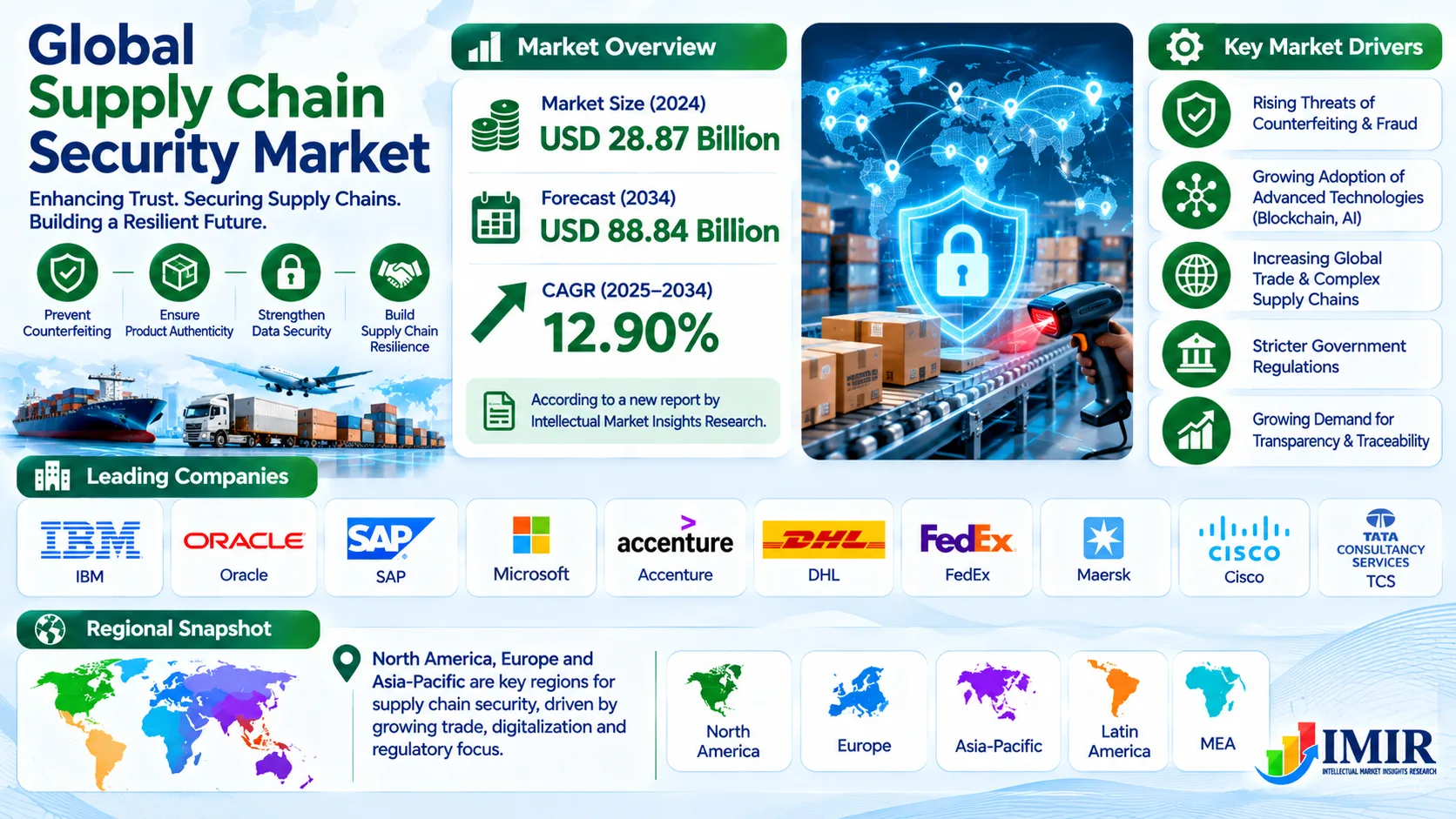
The global supply chain security market is projected to grow from USD 28.87 Billion in 2024 to USD 88.84 Billion by 2034, at a CAGR of 12.90% from 2025 to 2034, according to Intellectual Market Insights Research.
| Parameter | Details |
|---|---|
| Market Size (2024) | USD 28.87 Billion |
| Projected Market Size (2034) | USD 88.84 Billion |
| CAGR (2025–2034) | 12.90% |
| Key Regions | North America, Europe, Asia-Pacific, Latin America, Middle East & Africa |
| Key Focus Areas | Counterfeit prevention, product authenticity, data security, supply chain resilience |
Regional snapshot: North America, Europe and Asia-Pacific are the key regions for supply chain security, driven by growing trade, digitalization and regulatory focus.
Why the Supply Chain Security Market Is Growing
1. Rising Threats of Counterfeiting and Fraud
Counterfeit goods and fraud affect industries from pharmaceuticals and electronics to food and luxury products. Companies are adopting authentication, tamper-evidence and track-and-trace solutions to protect brands and consumers.
2. Growing Adoption of Advanced Technologies (Blockchain, AI)
Blockchain gives shared, tamper-resistant records of product movement, while AI helps detect anomalies, predict risks and monitor suppliers at scale.
3. Increasing Global Trade and Complex Supply Chains
More cross-border trade and multi-tier supplier networks mean more handoffs and less visibility, so security and monitoring tools become essential.
4. Stricter Government Regulations
Regulators in many regions are raising requirements for product safety, traceability, customs security and data protection, pushing companies to invest in compliant solutions.
5. Growing Demand for Transparency and Traceability
Customers, partners and regulators want to know where products come from and how they were handled, which is driving adoption of end-to-end traceability platforms.
Market Opportunities & Restraints
A key opportunity lies in integrated, technology-led platforms that combine traceability, authentication, cybersecurity and risk analytics in one solution. Vendors that connect these capabilities across logistics, manufacturing and enterprise software are well placed to win long-term contracts.
On the restraint side, high implementation costs, integration with legacy systems, and limited data-sharing between supply chain partners remain the main challenges. Smaller suppliers often lack the budget or technical capability to adopt advanced security tools, which can leave gaps in otherwise well-protected chains.
Leading Companies in the Supply Chain Security Market
The market includes technology providers, consulting firms and logistics companies, each covering a different part of the security chain.
| Company | Headquarters | Founded | Role in Supply Chain Security |
|---|---|---|---|
| IBM | Armonk, New York, USA | 1911 | Enterprise software, blockchain-based traceability, AI and security services |
| Oracle | Austin, Texas, USA | 1977 | Cloud supply chain management and data security platforms |
| SAP | Walldorf, Germany | 1972 | Supply chain planning and execution software with traceability capabilities |
| Microsoft | Redmond, Washington, USA | 1975 | Cloud, AI and cybersecurity services supporting digital supply chains |
| Accenture | Dublin, Ireland | 1989 | Consulting and implementation services for supply chain risk and resilience |
| DHL | Bonn, Germany | 1969 | Global logistics with secure transport and supply chain visibility services |
| FedEx | Memphis, Tennessee, USA | 1971 | Logistics, tracking and secure delivery solutions |
| Maersk | Copenhagen, Denmark | 1904 | Ocean freight and integrated logistics with a focus on end-to-end visibility |
| Cisco | San Jose, California, USA | 1984 | Network and cybersecurity solutions protecting connected supply chain systems |
| Tata Consultancy Services (TCS) | Mumbai, India | 1968 | IT services and digital supply chain transformation |
Competitive Landscape
The market is diverse. Technology majors such as IBM, Oracle, SAP, Microsoft and Cisco compete on platform breadth, cloud and AI capabilities, and cybersecurity strength. Consulting and IT services firms such as Accenture and TCS differentiate through implementation expertise and industry-specific solutions. Logistics leaders such as DHL, FedEx and Maersk compete on physical security, tracking and visibility across global networks.
Because supply chain security spans software, services and physical logistics, partnerships between these groups are common. Providers that can show measurable results in risk reduction, traceability and compliance are best positioned to gain share.
Regional Analysis
North America
North America is a key region, supported by advanced technology adoption, a strong base of enterprise software and cybersecurity vendors, and regulatory attention to supply chain integrity.
Europe
Europe benefits from a strong regulatory focus on product safety, data protection and sustainability, along with a large manufacturing and logistics base.
Asia-Pacific
Asia-Pacific is central to global manufacturing and trade, and growing digitalization is increasing demand for security and traceability solutions across the region.
Latin America & Middle East and Africa
Both regions are developing markets where growth is tied to expanding trade, logistics investment and gradual digital adoption.
Emerging Trends in the Supply Chain Security Market
1. Blockchain-Enabled Traceability: Shared digital ledgers are increasingly used to verify product origin and movement across multiple partners.
2. AI-Driven Risk Detection: AI and machine learning are helping companies spot anomalies, predict disruptions and screen suppliers faster.
3. End-to-End Visibility Platforms: Companies are moving from siloed tracking to unified platforms that cover suppliers, transport and inventory.
4. Convergence of Cyber and Physical Security: Digital threats to connected systems and physical threats such as theft and tampering are now managed together.
5. Compliance-Led Investment: Tighter regulation on traceability and data protection is turning security spending from optional to mandatory.
6. Resilience as a Strategic Priority: After repeated global disruptions, companies are building supplier diversification and risk monitoring into core planning.
Future Outlook (2025–2034)
The supply chain security market is expected to grow from USD 28.87 Billion in 2024 to USD 88.84 Billion by 2034, a CAGR of 12.90% over 2025 to 2034. Growth will be underpinned by rising counterfeiting risk, wider use of blockchain and AI, increasing trade complexity, tighter regulation, and the demand for transparency and traceability.
Key themes through 2034 include deeper integration of security into enterprise supply chain platforms, closer partnerships between technology, consulting and logistics providers, wider adoption of AI-based risk monitoring, and a stronger emphasis on resilience alongside security.
Frequently Asked Questions (FAQ)
1. What is the size of the global supply chain security market?
The market was valued at USD 28.87 Billion in 2024 and is projected to reach USD 88.84 billion by 2034, at a CAGR of 12.90% from 2025 to 2034.
2. Who are the leading companies in the supply chain security market?
Leading companies include IBM, Oracle, SAP, Microsoft, Accenture, DHL, FedEx, Maersk, Cisco and Tata Consultancy Services (TCS).
3. What is driving growth in the market?
Key drivers are rising threats of counterfeiting and fraud, adoption of advanced technologies such as blockchain and AI, increasing global trade and supply chain complexity, stricter government regulations, and growing demand for transparency and traceability.
4. Which regions are key for supply chain security?
North America, Europe and Asia-Pacific are key regions, driven by growing trade, digitalization and regulatory focus. Latin America and the Middle East & Africa are developing markets.
5. What are the main challenges?
High implementation costs, integration with legacy systems, and limited data-sharing between supply chain partners.
Conclusion
The supply chain security market is growing quickly as companies respond to counterfeiting, regulatory pressure and the rising complexity of global trade. Technology majors, consulting firms and logistics leaders each play a role, and the strongest offerings combine traceability, authentication, data security and resilience.
As blockchain, AI and integrated visibility platforms mature, companies that build security into the core of their supply chains will be best placed to benefit from growth through 2034.