
Global Surfactants Market Top Companies, Trends, and Future Outlook
Author:
Intellectual Market Insights Research
Published Date:
18 Sep 2026
Market Overview and Forecast
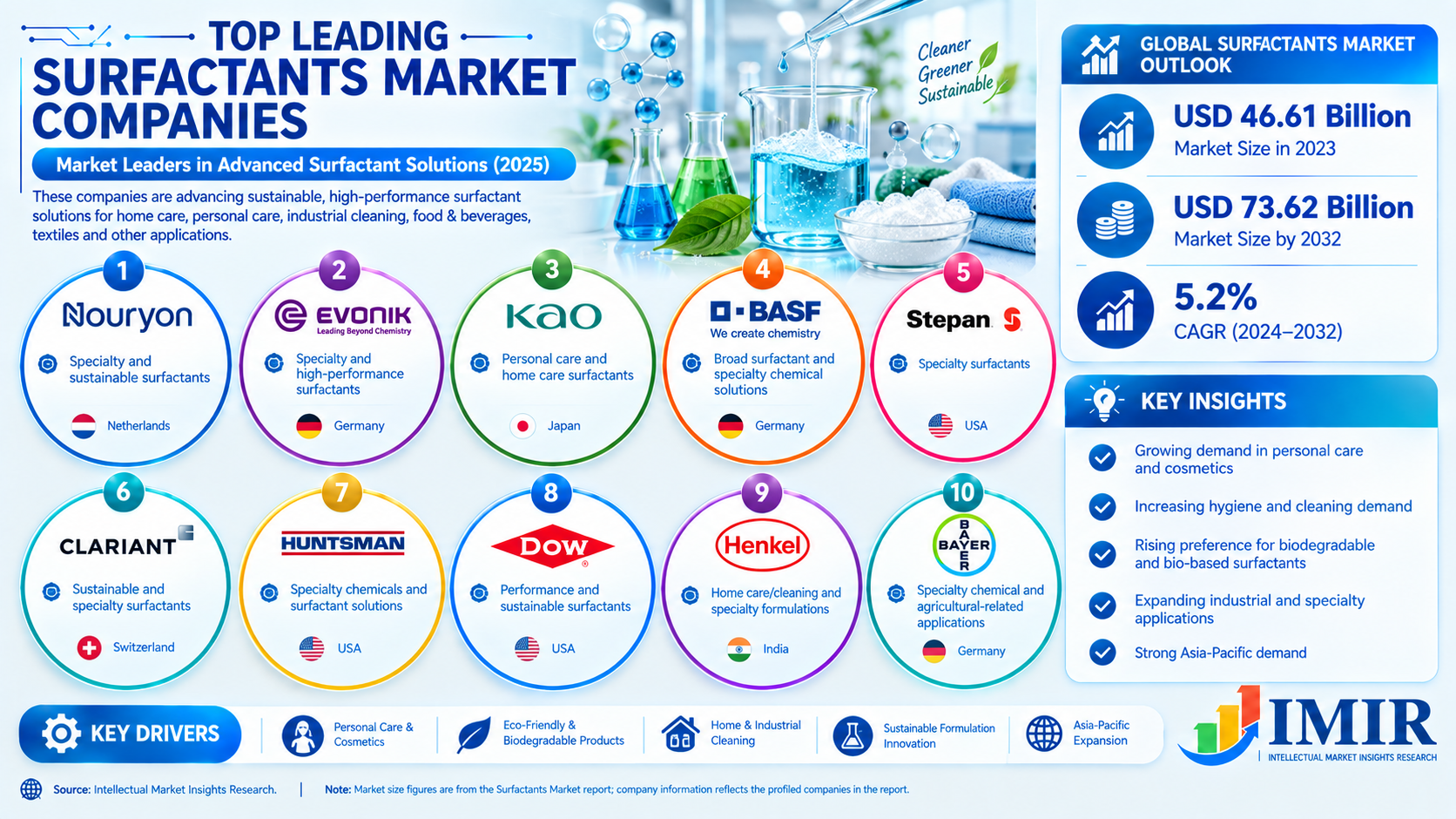
The global surfactants market size is poised to grow from USD 49.04 Billion in 2024 to USD 73.62 Billion by 2032, growing at a CAGR of 5.2% during the forecast period (2024–2032).
| Parameter | Details |
|---|---|
| Market Size (2024) | USD 49.04 Billion |
| Projected Market Size (2032) | USD 73.62 Billion |
| CAGR (2024–2032) | 5.2% |
| Forecast Period | 2024–2032 |
| Leading Region | Asia-Pacific (largest volume share); North America and Europe (steady demand) |
| Key Segments (by Type) | Anionic, Cationic, Nonionic, Amphoteric |
| Key Segments (by Application) | Personal Care, Home Care, Industrial Cleaning, Agrochemicals, Pharmaceuticals, Oilfield Chemicals |
Why the Surfactants Market Is Growing
1. Rising Demand in Personal Care and Home Care Products
Surfactants, which lower surface tension between two substances, are vital ingredients in detergents, shampoos, body wash, and other personal and home care products, and rising global consumption of these everyday products continues to drive steady baseline demand.
2. Growth in Industrial and Agrochemical Applications
Surfactants play a critical role as emulsifiers, foaming agents, and wetting agents across industrial cleaning, paints and coatings, and agrochemical formulations, with expanding industrial and agricultural activity supporting continued demand growth.
3. Technological Advancements in Surfactant Chemistry
Continuous innovation in surfactant formulation technology is improving performance characteristics such as foaming behavior, biodegradability, and compatibility with a wider range of end-use applications, supporting premium product development.
4. Rising Consumer Preference for Eco-Friendly, Bio-Based Surfactants
Growing consumer awareness of environmental sustainability is driving demand for bio-based and biodegradable surfactant alternatives to traditional petrochemical-derived formulations, particularly in personal care and home care applications.
5. Expansion of Oilfield and Specialty Industrial Applications
Surfactants used in oilfield chemicals, such as enhanced oil recovery formulations, and specialty industrial applications continue to expand demand beyond traditional consumer product categories.
6. Growing Middle-Class Population in Emerging Markets
Rising disposable incomes and expanding middle-class populations across Asia-Pacific and Latin America continue to drive higher consumption of personal care and home care products, directly benefiting surfactant demand.
Market Opportunities & Restraints
A key opportunity lies in bio-based and sustainable surfactant innovation: as consumer and regulatory pressure around environmental sustainability intensifies, manufacturers have significant opportunity to develop biodegradable, plant-derived surfactant alternatives that meet tightening environmental standards while commanding premium pricing in personal care and home care applications. On the restraint side, volatile raw material and petrochemical feedstock prices remain the primary headwind, as many surfactants are derived from petrochemical feedstocks whose prices fluctuate with broader energy markets, squeezing manufacturer margins and complicating long-term pricing strategies, particularly for producers without diversified bio-based feedstock alternatives.
Companies Associated with the Surfactants Market
| Company | Headquarters | Founded | Employees | Revenue | Overview |
|---|---|---|---|---|---|
| BASF SE | Ludwigshafen am Rhein, Germany | 1865 | Approx. 111,000 | Approx. EUR 65 Billion (total company) | One of the world's largest chemical companies, offering anionic, cationic, nonionic, and amphoteric surfactants across multiple end-use industries. |
| Dow Inc. | Midland, Michigan, USA | 1897/2019 | Approx. 36,000 | Multi-billion dollar materials science company | One of the world's leading surfactant manufacturers, serving personal care, home care, and industrial cleaning applications. |
| Evonik Industries AG | Essen, Germany | 2007 | Approx. 31,000 | Approx. EUR 14.1 Billion (2025) | A leading specialty chemical manufacturer with strong bio-based and sustainable surfactant offerings for personal care and industrial applications. |
| Stepan Company | Northbrook, Illinois, USA | 1932 | Approx. 2,000+ | Market cap approx. USD 1.45 Billion | One of the world's largest merchant producers of surfactants for detergents, shampoos, agricultural, and oilfield markets. |
| Clariant AG | Muttenz, Switzerland | 1995 | Approx. 10,281 | Approx. CHF 3.92 Billion (2025) | A Swiss specialty chemicals company offering surfactants through its Care Chemicals division for personal care and industrial markets. |
| Croda International plc | Snaith, England, UK | 1925 | Approx. 6,100 | Approx. GBP 1.7 Billion (2025) | A British specialty chemicals company offering surfactants and specialty ingredients for personal care, health care, and crop care. |
| Kao Corporation | Ch??, Tokyo, Japan | 1882 | Approx. 33,000+ | Multi-billion dollar diversified conglomerate | A Japanese personal care and chemicals leader manufacturing surfactants for its own brands and external industrial customers. |
| Solvay | Neder-Over-Heembeek, Brussels, Belgium | 1863 | Approx. 9,000 | Approx. EUR 4.88 Billion | A Belgian-French chemical company offering surfactants and specialty chemicals, following its December 2023 demerger that created Syensqo. |
| Huntsman Corporation | The Woodlands, Texas, USA | 1970 | Approx. 6,000–9,000 | Multi-billion dollar diversified chemical company | An American chemical manufacturer offering surfactants and performance chemicals for personal care, industrial, and agricultural applications. |
| Indorama Ventures Public Company Limited | Bangkok, Thailand | 1994/1995 | Approx. 25,000 | Multi-billion dollar petrochemical company | A Thailand-based global petrochemical producer with a surfactants and specialty chemicals portfolio serving personal and home care customers. |
Competitive Landscape
The global surfactants market brings together a mix of large diversified chemical majors and specialized surfactant producers. Global chemical giants BASF, Dow, and Evonik hold particularly strong positions, built on massive manufacturing scale, extensive R&D infrastructure, and broad surfactant portfolios spanning multiple chemistry types and end-use applications. Specialty and merchant surfactant producers including Stepan Company, Clariant, Croda International, and Solvay compete through deep category focus, bio-based and sustainable formulation expertise, and strong positions in personal care and specialty industrial segments. Diversified regional players Kao Corporation, Huntsman Corporation, and Indorama Ventures round out the competitive field, leveraging vertically integrated manufacturing and strong regional market positions across Asia-Pacific, North America, and other key markets. The market's structure continues to evolve through corporate restructuring, exemplified by Solvay's December 2023 demerger that created the specialty chemicals company Syensqo.
Regional Analysis
North America
North America represents a mature, steady surfactants market, supported by established personal care, home care, and industrial cleaning industries, alongside the presence of major manufacturers such as Dow, Stepan, and Huntsman Corporation.
Europe
Europe features a well-developed surfactants market, anchored by major players such as BASF, Evonik, Clariant, Croda, and Solvay, alongside strong regulatory frameworks driving continued innovation in sustainable and bio-based surfactant chemistry.
Asia-Pacific
Asia-Pacific represents the largest and fastest-growing surfactants market, driven by rising disposable incomes, expanding middle-class populations, and growing personal care and home care product consumption across China, India, and Southeast Asia, supported by major regional players such as Kao Corporation and Indorama Ventures.
Latin America & Middle East and Africa
Latin America and the Middle East & Africa represent emerging growth markets for surfactants, with demand tied to expanding personal care and home care product consumption, growing industrial and agricultural activity, and rising urbanization across the regions.
Emerging Trends in the Surfactants Market
1. Growth of Bio-Based and Biodegradable Surfactants: Rising consumer and regulatory pressure around environmental sustainability is driving increased development and adoption of bio-based, biodegradable surfactant alternatives to traditional petrochemical-derived formulations.
2. Expansion of Green Chemistry and Biotechnology Applications: Manufacturers such as Evonik continue to invest in green chemistry and biotechnology platforms to develop next-generation sustainable surfactant solutions for personal care and industrial applications.
3. Corporate Restructuring and Portfolio Realignment: Solvay's December 2023 demerger, which created the specialty chemicals company Syensqo, illustrates a broader industry trend of chemical conglomerates realigning their portfolios to sharpen strategic focus.
4. Rising Demand for Specialty and High-Performance Surfactants: Growing demand for specialty surfactants tailored to specific applications, such as enhanced oil recovery and high-performance industrial cleaning, is driving premium product development across the industry.
5. Vertical Integration and Regional Manufacturing Expansion: Diversified petrochemical producers such as Indorama Ventures continue to expand vertically integrated surfactant manufacturing capacity to capture value across the broader chemical supply chain.
Future Outlook (2025–2034)
Building on the underlying market's original 2024–2032 forecast window (USD 49.04 billion in 2024 to USD 73.62 billion by 2032 at a 5.2% CAGR), the market's steady growth momentum is expected to continue through 2034 as rising personal care and home care product consumption, industrial and agrochemical demand, and bio-based surfactant innovation remain long-term structural growth drivers. Extending the trend, continued moderate growth would be supported by expanding middle-class consumption in emerging markets, sustained sustainability-driven product innovation, and growing specialty and industrial surfactant applications.
Key investment themes for 2025–2034 include continued bio-based and sustainable surfactant innovation by global chemical majors such as BASF, Dow, and Evonik, growing specialty market positioning by focused producers such as Stepan, Clariant, and Croda, and sustained regional expansion by diversified players such as Kao Corporation and Indorama Ventures across high-growth Asia-Pacific markets. As sustainability-driven innovation, corporate portfolio realignment, and specialty application growth continue to reshape the industry, the companies that combine manufacturing scale with bio-based formulation innovation will be best positioned to capture growth through 2034.
Frequently Asked Questions (FAQ)
1. What is the current size of the global surfactants market?
The global surfactants market size is poised to grow from USD 49.04 billion in 2024 to USD 73.62 billion by 2032, growing at a CAGR of 5.2% during the forecast period 2024–2032.
2. Who are the top companies in the surfactants market?
Leading companies include BASF SE, Dow Inc., Stepan Company, Evonik Industries AG, Clariant AG, Solvay, Kao Corporation, Croda International plc, Huntsman Corporation, and Indorama Ventures Public Company Limited.
3. Which region dominates the surfactants market?
Asia-Pacific represents the largest and fastest-growing surfactants market, driven by rising disposable incomes and expanding personal care and home care product consumption across China, India, and Southeast Asia.
4. What is the forecast CAGR for the surfactants market?
The market is forecast to grow at a CAGR of 5.2% during the forecast period from 2024 to 2032.
5. What are the main growth drivers for this market?
Key drivers include rising demand in personal care and home care products, growth in industrial and agrochemical applications, technological advancements in surfactant chemistry, rising consumer preference for eco-friendly bio-based surfactants, and expansion of oilfield and specialty industrial applications.
6. What types of surfactants are covered in this market?
The market is segmented by type into anionic, cationic, nonionic, and amphoteric surfactants, each suited to different formulation and performance requirements across end-use applications.
7. What applications does the surfactants market serve?
Surfactants serve personal care, home care, industrial cleaning, agrochemicals, pharmaceuticals, and oilfield chemical applications, functioning as detergents, emulsifiers, foaming agents, and wetting agents across these industries.
Conclusion
The global surfactants market sits at the intersection of steady global consumer product demand and the ongoing shift toward sustainable, bio-based chemistry. With a projected size of USD 73.62 billion by 2032 at a 5.2% CAGR, the market offers steady, application-diverse growth across personal care, home care, industrial, and agrochemical segments.
BASF, Dow, and Evonik continue to lead on the strength of massive manufacturing scale and extensive R&D infrastructure, while specialty producers Stepan, Clariant, Croda, and Solvay compete through deep category focus and sustainable formulation expertise, and diversified regional players Kao Corporation, Huntsman Corporation, and Indorama Ventures round out a competitive field spanning Asia-Pacific, North America, and beyond. As bio-based innovation, corporate portfolio realignment, and specialty application growth continue to reshape the industry, the companies that combine manufacturing scale with sustainability-driven innovation will define market leadership through 2034 and beyond.