
Global Surgical Navigation Systems Market Top Companies
Author:
Intellectual Market Insights Research
Published Date:
18 Sep 2026
Market Overview
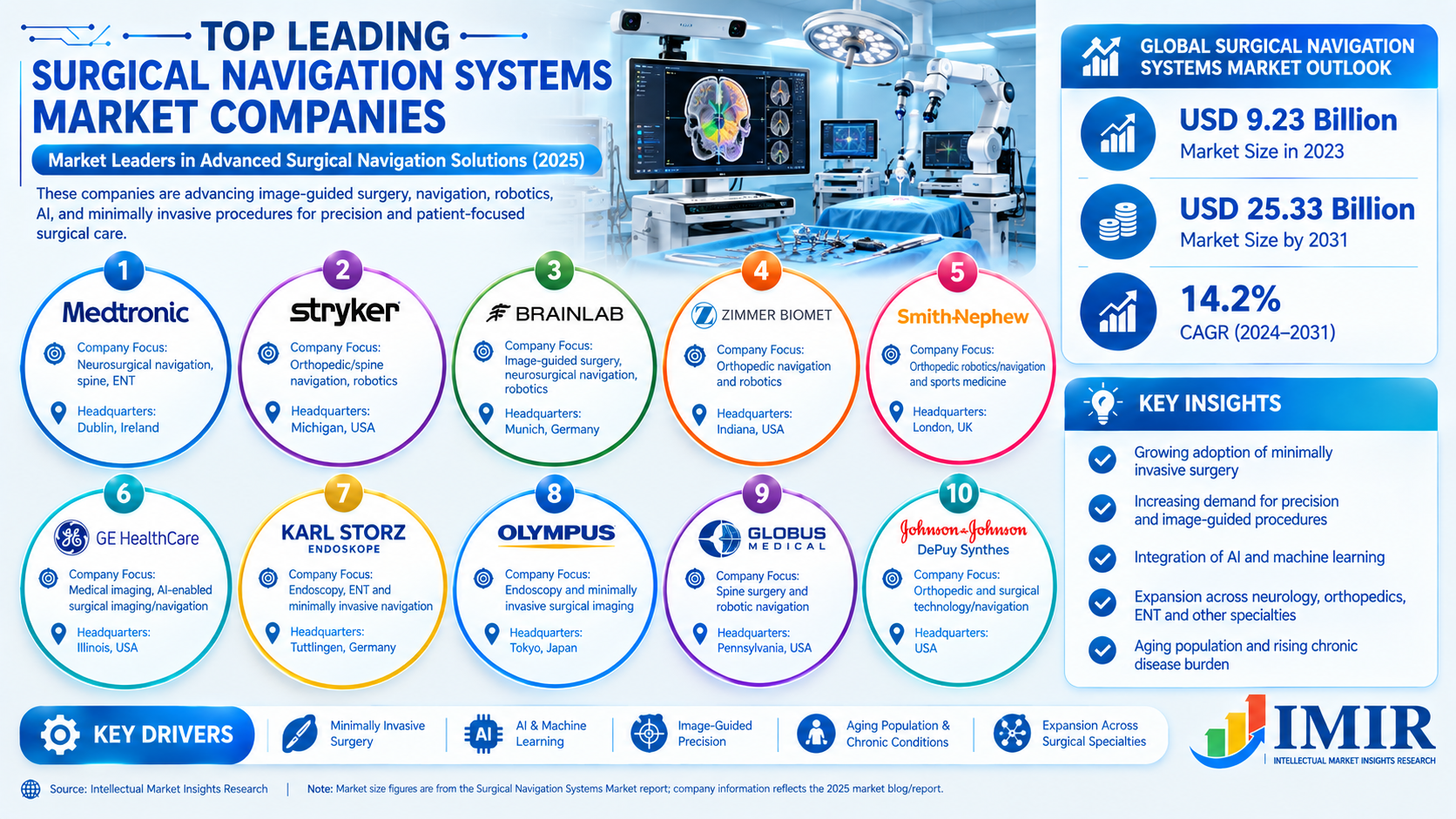
According to a new report by IMIR Market Research, the global market for surgical navigation systems was valued at approximately USD 9.23 Billion in 2023. Over the course of the forecast period (2024–2031), the market is expected to develop at a compound annual growth rate (CAGR) of 14.2%, reaching a value of USD 25.33 Billion by 2031.
| Parameter | Details |
|---|---|
| Market Size (2023) | USD 9.23 Billion |
| Projected Market Size (2031) | USD 25.33 Billion |
| CAGR (2024–2031) | 14.2% |
| Base Year | 2023 |
| Historic Year | 2018–2022 |
| Forecast Period | 2024–2031 |
| Leading Region | North America (40.6% revenue share in 2022); Asia-Pacific (fastest growth) |
| Key Segments (by Technology) | Electromagnetic, Optical, Others |
| Key Segments (by Application) | ENT, Orthopedic, Neurology, Dental, Others |
| Key Segments (by End-Use) | Hospitals, Ambulatory Surgical Centers |
Why the Surgical Navigation Systems Market Is Growing
1. Improvements in Minimally Invasive Surgery & Surgical Techniques
The growing popularity of minimally invasive surgeries and ongoing improvements in surgical techniques are driving the surgical navigation devices market. Compared to traditional open surgery, minimally invasive procedures offer less trauma, shorter hospital stays, quicker recovery times, and better patient outcomes, with surgical navigation systems providing real-time, three-dimensional imagery and navigation support that helps surgeons navigate instruments with submillimeter accuracy.
2. Increasing Prevalence of Chronic Illnesses and Population Aging
The aging global population and the increasing prevalence of chronic diseases are driving the surgical navigation systems market. The WHO reports that different types of arthritis affect 9.6% of men and 18% of women, and the majority of people with osteoarthritis find it difficult to move around and carry out regular tasks, driving demand for navigation-assisted joint replacement surgeries.
3. Growing Elderly Population Driving Joint Replacement Demand
The number of people over 60 is expected to rise at an unprecedented rate, which will raise the need for hip and knee replacement surgery, positively impacting market growth alongside a favorable regulatory framework and increased reimbursement coverage for orthopedic treatments.
4. Integration of Artificial Intelligence (AI) and Machine Learning
The growing incorporation of AI and machine learning into navigation platforms is driving the market, with AI-driven systems evaluating intraoperative sensor data and preoperative imaging to give surgeons real-time guidance and decision support during operations.
5. Expansion of Applications beyond Traditional Surgical Specialties
Surgical navigation systems are increasingly being used in specialties beyond their historical base in neurosurgery, orthopedics, and ENT surgery, including spine surgery, heart surgery, gastrointestinal surgery, and interventional radiology.
6. New Product Launches and Technological Developments
Continued new product launches, such as Royal Philips' February 2021 release of ClarifEye Augmented Reality Surgical Navigation for minimally invasive spine operations, are propelling market growth through improved patient outcomes.
Market Opportunities & Restraints
A key opportunity lies in AI integration and expansion into new surgical specialties: as navigation technology becomes more flexible and adaptive to various clinical workflows, manufacturers have significant opportunity to extend applications into spine surgery, cardiac surgery, and interventional radiology while incorporating advanced AI capabilities such as neural networks and autonomous navigation to improve surgical workflow efficiency and patient safety. On the restraint side, high cost of acquisition and implementation remains the primary headwind, as surgical navigation systems demand substantial financial outlay for hardware, software, and peripherals, plus recurring costs for software upgrades, maintenance, and staff training, which can delay adoption among healthcare providers operating under budgetary constraints or in resource-constrained settings.
Companies Associated with the Surgical Navigation Systems Market
| Company | Headquarters | Founded | Employees | Revenue | Overview |
|---|---|---|---|---|---|
| Stryker Corporation | Portage, Michigan, USA | 1941 | Approx. 53,000 | Approx. USD 25.12 Billion (2025) | A global medical technology leader offering surgical navigation systems for orthopedic, neurosurgical, and ENT procedures. |
| Medtronic plc | Galway, Ireland / Minneapolis, USA | 1949 | Approx. 95,000 | Approx. USD 33.54 Billion (2025) | A global medical device leader offering the StealthStation surgical navigation platform for neurosurgery, ENT, and spine surgery. |
| Johnson & Johnson (DePuy Synthes) | New Brunswick, New Jersey, USA | 1886 / 2012 | Approx. 138,000 (J&J) | Approx. USD 94.2 Billion (total company) | J&J's orthopedics division offering the VELYS digital surgery platform for navigation-assisted joint replacement procedures. |
| Zimmer Biomet Holdings, Inc. | Warsaw, Indiana, USA | 1927 | Approx. 17,000 | Approx. USD 8.23 Billion (2025) | A leading orthopedic device company offering the ROSA robotic surgical navigation system for knee, hip, and shoulder procedures. |
| Smith+Nephew plc | Watford, England, UK | 1856 | Approx. 18,000 | Approx. USD 6.16 Billion (2025) | A British medical equipment manufacturer offering surgical navigation and robotics-assisted technology for orthopedic procedures. |
| Siemens Healthineers AG | Erlangen, Germany | 2017 | Approx. 74,000 | Approx. EUR 23.4 Billion (FY2025) | A global medical technology company providing imaging equipment used alongside surgical navigation systems. |
| B. Braun Melsungen AG | Melsungen, Germany | 1839 | Approx. 64,000–66,800 | Approx. EUR 9.14 Billion (2024) | A German medical device company whose Aesculap division provides surgical navigation and neurosurgical solutions. |
| Corin Group | Cirencester, Gloucestershire, UK | 1985 | Approx. 700 | Approx. USD 175.5 Million | A UK-based orthopedic company offering the Apollo robotic-assisted surgical platform for total knee arthroplasty. |
| Amplitude Surgical | Valence, France | 1997 | Several hundred | Approx. EUR 100 Million+ | A French orthopedic device company offering navigation-compatible hip, knee, and extremities implant solutions. |
Competitive Landscape
The global surgical navigation systems market brings together a mix of large diversified medical technology conglomerates and specialized orthopedic device manufacturers. Global medical technology majors Medtronic, Stryker, Johnson & Johnson (DePuy Synthes), Siemens Healthineers, and B. Braun hold particularly strong positions, built on decades of surgical technology engineering expertise, extensive global service networks, and proprietary navigation platforms such as Medtronic's StealthStation and DePuy Synthes's VELYS digital surgery platform. Orthopedic-focused specialists Zimmer Biomet, Smith+Nephew, Corin Group, and Amplitude Surgical compete through dedicated joint replacement navigation and robotics platforms, such as Zimmer Biomet's ROSA system and Corin's Apollo platform, targeting the fast-growing hip and knee replacement navigation segment specifically.
Regional Analysis
North America
In 2022, North America held the highest revenue share, approximately 40.6%. The anticipated factor propelling regional expansion is the increasing incidence of neurological, ENT, and orthopedic problems, alongside growing demand for ambulatory surgery centers, a quality-driven healthcare model, a growing elderly population, and a well-established reimbursement system.
Europe
Europe represents a significant surgical navigation systems market, anchored by major manufacturers such as B. Braun, Siemens Healthineers, and Amplitude Surgical, alongside strong healthcare infrastructure and regulatory frameworks across Germany, France, and the UK.
Asia-Pacific
Asia Pacific's market is anticipated to increase at an exponential rate over the forecast period. The factors contributing to the highest growth rate in the regional market are developing economies, aging populations, and increased awareness of healthcare, with Japan, China, and India being the primary contributors given the high prevalence of orthopedic issues among the region's aging population.
Latin America & Middle East and Africa
Latin America and the Middle East & Africa represent emerging growth markets for surgical navigation systems, with demand tied to expanding healthcare infrastructure investment and growing adoption of minimally invasive surgical technologies.
Emerging Trends in the Surgical Navigation Systems Market
1. Integration of Artificial Intelligence and Machine Learning: AI-driven surgical navigation systems are increasingly using sophisticated algorithms to evaluate intraoperative sensor data and preoperative imaging, giving surgeons real-time guidance and predictive decision support during operations.
2. Expansion into Robotic-Assisted Surgery: Growing integration of surgical navigation with robotic-assisted platforms, exemplified by Zimmer Biomet's ROSA system and Corin's Apollo platform, is reshaping the orthopedic navigation segment.
3. Growth of Augmented Reality Surgical Navigation: New product launches such as Royal Philips' ClarifEye Augmented Reality Surgical Navigation system for minimally invasive spine operations illustrate a growing trend toward AR-enhanced navigation technology.
4. Entry of New Regional Players in Robotic Navigation: The January 2022 CE mark approval for Brain Navi Biotechnology's NaoTrac, a Taiwan-based robotic-assisted navigation robot, illustrates growing innovation and market entry from emerging regional players in the navigation robotics space.
5. Expansion of Applications Beyond Traditional Surgical Specialties: Surgical navigation technology continues to expand beyond its historical base in neurosurgery, orthopedics, and ENT into spine surgery, cardiac surgery, gastrointestinal surgery, and interventional radiology.
Future Outlook (2025–2034)
Building on the underlying report's original 2024–2031 forecast window (USD 9.23 billion in 2023 to USD 25.33 billion by 2031 at a 14.2% CAGR), the market's strong growth momentum is expected to continue through 2034 as aging populations, rising chronic disease prevalence, and continued AI and robotics integration remain long-term structural growth drivers. Extending the trend, continued strong double-digit growth would be supported by expanding robotic-assisted navigation adoption, growing application beyond traditional surgical specialties, and sustained healthcare infrastructure investment across emerging markets in Asia-Pacific.
Key investment themes for 2025–2034 include continued AI and robotics integration by global medical technology majors such as Medtronic, Stryker, and Johnson & Johnson, growing competition in the orthopedic navigation segment from specialists such as Zimmer Biomet, Smith+Nephew, and Corin Group, and increasing market entry from emerging regional innovators such as Brain Navi Biotechnology. As AI-enabled navigation, augmented reality, and robotic-assisted surgery continue to reshape the industry, the companies that combine deep surgical technology expertise with digital innovation will be best positioned to capture growth through 2034.
Frequently Asked Questions (FAQ)
1. What is the current size of the global surgical navigation systems market?
The global surgical navigation systems market was valued at approximately USD 9.23 billion in 2023 and is expected to reach USD 25.33 billion by 2031, growing at a CAGR of 14.2% from 2024 to 2031.
2. Who are the top companies in the surgical navigation systems market?
Leading companies include B. Braun Melsungen AG, Stryker Corporation, Medtronic plc, Corin Group, Siemens Healthineers AG, Smith+Nephew plc, Johnson & Johnson Services, Inc. (DePuy Synthes), Zimmer Biomet Holdings, Inc., and Amplitude Surgical.
3. Which region dominates the surgical navigation systems market?
North America held the highest revenue share of approximately 40.6% in 2022, while the Asia-Pacific market is anticipated to increase at an exponential rate over the forecast period due to developing economies and aging populations in Japan, China, and India.
4. What is the forecast CAGR for the surgical navigation systems market?
The market is expected to develop at a CAGR of 14.2% from 2024 to 2031.
5. What are the main growth drivers for this market?
Key drivers include improvements in minimally invasive surgery and surgical techniques, increasing prevalence of chronic illnesses and population aging, growing elderly population driving joint replacement demand, integration of AI and machine learning, and expansion of applications beyond traditional surgical specialties.
6. What technologies are used in surgical navigation systems?
The market is segmented by technology into electromagnetic, optical, and other navigation technologies, with electromagnetic systems holding the largest market share in 2022 due to affordability and ease of use, while optical systems are expected to grow dramatically due to superior tracking performance.
7. What applications does the surgical navigation systems market serve?
Surgical navigation systems serve ENT, orthopedic, neurology, dental, and other surgical applications across hospitals and ambulatory surgical centers, with neurology holding the greatest market share in 2022.
Conclusion
The global surgical navigation systems market sits at the intersection of rising minimally invasive surgery adoption and the ongoing shift toward AI-enabled, robotic-assisted surgical technology. With a projected size of USD 25.33 billion by 2031 at a 14.2% CAGR, the market offers strong, technology-driven growth across neurology, orthopedic, ENT, and dental application segments.
Medtronic, Stryker, and Johnson & Johnson (DePuy Synthes) continue to lead on the strength of decades of surgical technology engineering expertise and proprietary navigation platforms, while orthopedic-focused specialists Zimmer Biomet, Smith+Nephew, Corin Group, and Amplitude Surgical compete through dedicated joint replacement navigation and robotics solutions. As AI integration, augmented reality, and robotic-assisted surgery continue to reshape the industry, the companies that combine deep surgical technology expertise with digital innovation will define market leadership through 2034 and beyond.