
Leading Companies in the Global Synthetic Rubber Market
Author:
Intellectual Market Insights Research
Published Date:
27 Jul 2026
Introduction
Rubber sits quietly underneath almost every moving part of modern life the tire beneath a car, the seal inside an engine, the sole of a running shoe yet the industry that manufactures its synthetic form is anything but quiet. As natural rubber supply remains tied to weather, geography, and plantation cycles, chemical manufacturers have spent decades refining oil- and gas-derived alternatives that now underpin tires, industrial goods, footwear, and automotive components across the globe.
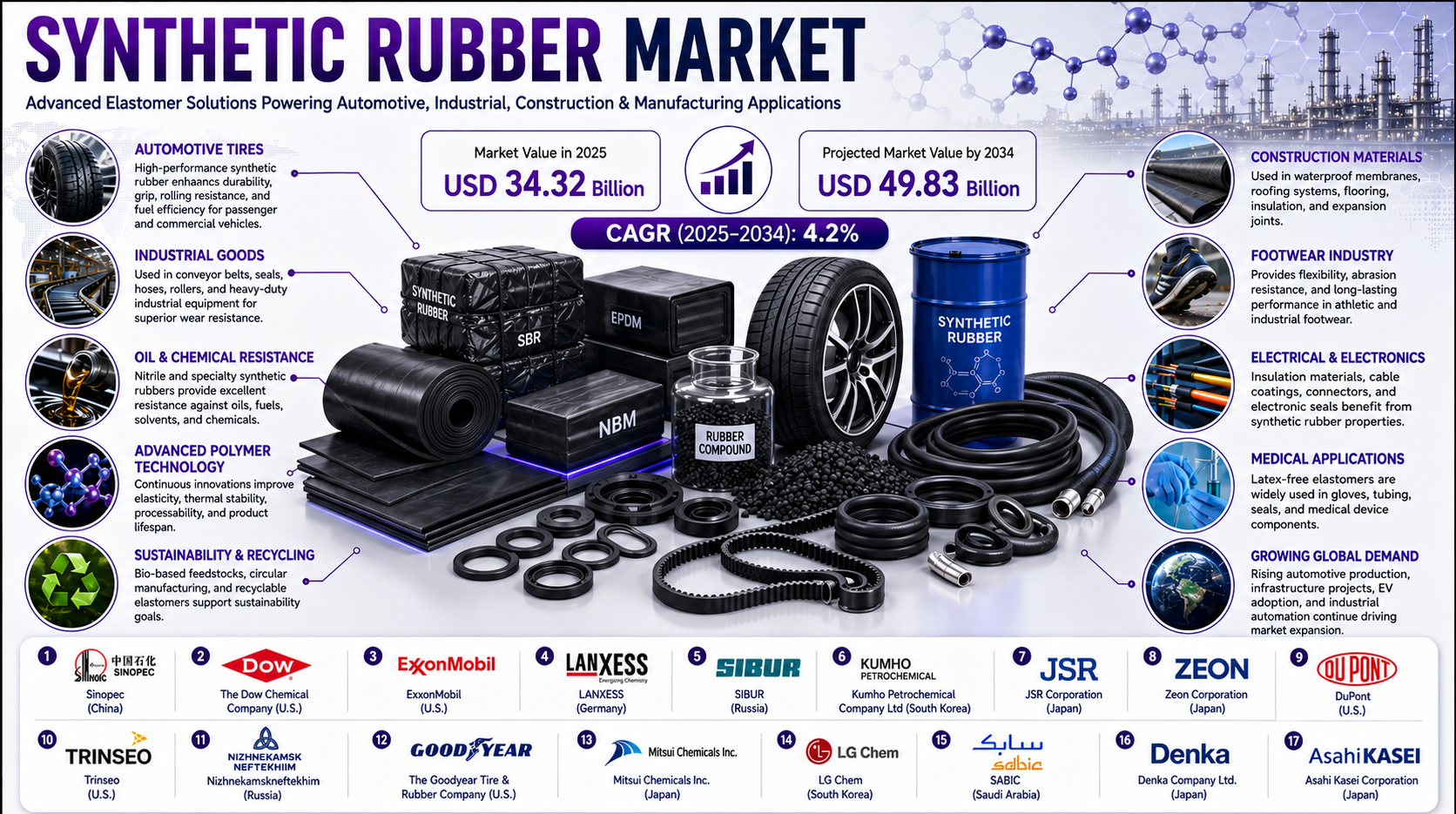
According to the latest market intelligence from Intellectual Market Insights Research (IMIR), the Synthetic Rubber Market was valued at USD 34.32 billion in 2025 and is projected to reach USD 49.83 billion by 2034, expanding at a CAGR of 4.2% across the forecast period of 2025–2034. This steady, compounding climb reflects not just the resilience of global tire demand but the growing sophistication of the polymer chemistry powering everything from high-performance automotive parts to everyday consumer goods.
At its core, the synthetic rubber market covers a family of elastomers engineered to replicate and, in many applications, surpass the properties of natural rubber. Product types include styrene-butadiene rubber (SBR), polybutadiene rubber (BR), butyl rubber (IIR), ethylene-propylene-diene rubber (EPDM), acrylonitrile-butadiene rubber (NBR), and styrene block copolymers (SBC) each formulated for distinct performance needs across tires, industrial goods, automotive non-tire parts, footwear, and textiles.
Growth in this market is being driven by several converging forces. First, the global automotive and tire industries remain the single largest demand engine, with rising vehicle production and replacement-tire cycles across Asia-Pacific sustaining consistent offtake. Second, industrial and construction activity is fueling demand for EPDM and NBR in gaskets, seals, hoses, and industrial goods. Third, footwear and consumer goods manufacturers continue to favor synthetic elastomers for their cost predictability, consistent quality, and tunable performance characteristics compared with natural rubber.
At the same time, the industry faces real headwinds: volatile feedstock (butadiene, styrene, and isoprene) pricing tied to crude oil and naphtha markets, tightening environmental regulation around petrochemical production, and rising interest in bio-based and circular rubber alternatives. Even so, the long-term outlook remains constructive, anchored by the irreplaceable role synthetic rubber plays in mobility, industrial manufacturing, and everyday consumer products.
This article profiles the leading companies shaping the global Synthetic Rubber Market in 2026, examines the competitive landscape, breaks down regional dynamics, and looks ahead at the trends that will define the industry through 2034.
Market Overview
|
Parameter |
Details |
|---|---|
|
Market Size (2025) |
USD 34.32 Billion |
|
Market Size (2034) |
USD 49.83 Billion |
|
CAGR (2025–2034) |
4.2% |
|
Forecast Period |
2025–2034 |
|
Base Year |
2024 |
|
Historical Data |
2015–2023 |
|
By Type |
Styrene Block Copolymer (SBC), EPDM, Butyl Rubber (IIR), SBR, Polybutadiene Rubber (BR), NBR |
|
By Application |
Tire, Industrial Goods, Consumer Goods, Automotive (Non-tire), Footwear, Textile, Others |
|
Key Regions |
North America, Europe, Asia-Pacific, Latin America, MEA |
|
Dominant Region |
Asia-Pacific |
|
Fastest Growing Region |
Asia-Pacific |
Key Market Drivers:
- Sustained growth in global tire production and replacement-tire demand
- Expanding automotive manufacturing, particularly across Asia-Pacific
- Rising industrial and construction activity boosting demand for EPDM and NBR
- Continuous innovation in polymer formulations for performance and durability
- Cost and supply-chain advantages of synthetic rubber over natural rubber
Key Market Opportunities:
- Growth of high-performance tires for electric vehicles requiring specialized rubber compounds
- Expansion of butyl rubber demand for tire inner liners and pharmaceutical stoppers
- Development of bio-based and sustainable synthetic rubber alternatives
- Untapped potential in Southeast Asia, Latin America, and Sub-Saharan Africa
Key Market Challenges:
- Volatility in feedstock prices tied to crude oil and naphtha markets
- Tightening environmental and emissions regulations on petrochemical producers
- Competition from natural rubber and emerging bio-based alternatives
- Overcapacity risk amid new production investments in China and the Middle East
Why the Synthetic Rubber Market Is Growing
The expansion of the synthetic rubber market reflects durable structural demand from some of the world's largest manufacturing sectors.
1. Automotive and Tire Industry Momentum
Tires remain the single largest application for synthetic rubber, consuming the bulk of global SBR and BR output. As global vehicle production recovers and expands, particularly across China, India, and Southeast Asia, tire manufacturers are scaling up procurement of synthetic elastomers to meet both original-equipment and replacement-tire demand.
2. Industrial and Construction Growth
EPDM and NBR find extensive use in gaskets, seals, hoses, conveyor belts, and other industrial components. As construction and industrial manufacturing activity expands across emerging economies, demand for these specialty synthetic rubbers is rising in parallel.
3. Consumer Goods and Footwear Demand
Styrene block copolymers and other synthetic elastomers are widely used in footwear soles, consumer goods, and textile applications, where consistent quality and cost control give synthetic rubber a durable advantage over natural alternatives.
4. Feedstock Integration by Major Petrochemical Players
Many of the market's leading producers Sinopec, Dow, ExxonMobil, and SIBUR among them operate integrated petrochemical value chains that give them direct access to butadiene and styrene feedstocks. This integration supports cost efficiency and capacity expansion, reinforcing the competitive position of large-scale producers.
5. Regional Manufacturing Shifts
Asia-Pacific's dominance as a manufacturing hub for tires, automotive components, and consumer goods is translating directly into synthetic rubber demand, with China, South Korea, and Japan hosting some of the world's largest production capacities.
6. Innovation in Specialty Elastomers
Producers are increasingly investing in specialty grades tailored for electric-vehicle tires, low-rolling-resistance compounds, and high-durability industrial applications, opening new value pools beyond commodity-grade rubber.
Top Companies in the Global Synthetic Rubber Market
- Sinopec (China)
- The Dow Chemical Company (U.S.)
- ExxonMobil (U.S.)
- LANXESS (Germany)
- SIBUR (Russia)
- Kumho Petrochemical Company Ltd (South Korea)
- JSR Corporation (Japan)
- Zeon Corporation (Japan)
- DuPont (U.S.)
- Trinseo (U.S.)
- Nizhnekamskneftekhim (Russia)
- The Goodyear Tire and Rubber Company (U.S.)
- Mitsui Chemicals Inc. (Japan)
- LG Chemical (South Korea)
- SABIC (Saudi Arabia)
- Denka Company Ltd. (Japan)
- Asahi Kasei Corporation (Japan)
1. Sinopec (China)
|
Category |
Details |
|---|---|
|
Company Name |
China Petroleum & Chemical Corporation (Sinopec) |
|
Headquarters |
Beijing, China |
|
Industry Focus |
Petrochemicals, Synthetic Rubber, Refining |
|
Global Presence |
Operations concentrated in China with growing international trade |
|
Company Overview |
Sinopec is one of the world's largest integrated energy and chemical companies, with a substantial synthetic rubber business built on its extensive refining and petrochemical infrastructure. Its scale gives it direct access to butadiene and styrene feedstocks, supporting cost-competitive production of SBR, BR, and other elastomer grades. |
|
Key Products & Services |
Styrene-butadiene rubber, polybutadiene rubber, butyl rubber, and other synthetic elastomers for tire and industrial applications. |
|
Market Position |
Among the largest synthetic rubber producers globally by volume, anchored by China's position as the world's largest tire-manufacturing market. |
|
Strategic Advantages |
Vertically integrated feedstock supply, massive production scale, strong domestic distribution, and proximity to the world's largest tire and automotive manufacturing base. |
2. The Dow Chemical Company (U.S.)
|
Category |
Details |
|---|---|
|
Company Name |
The Dow Chemical Company |
|
Headquarters |
Midland, Michigan, USA |
|
Industry Focus |
Specialty and Performance Chemicals, Synthetic Rubber |
|
Global Presence |
Operations across North America, Europe, Asia-Pacific, and Latin America |
|
Company Overview |
Dow is a global materials science leader with a longstanding presence in synthetic elastomers, supplying rubber and polymer solutions across tire, automotive, industrial, and consumer applications. The company leverages deep R&D capabilities to develop performance-differentiated rubber formulations. |
|
Key Products & Services |
Synthetic rubber and elastomer solutions, polyolefins, performance plastics, and specialty chemicals. |
|
Market Position |
A leading global supplier of performance elastomers, particularly valued for technical formulation expertise. |
|
Strategic Advantages |
Strong R&D infrastructure, diversified chemical portfolio, global manufacturing footprint, and long-standing relationships with major tire and automotive manufacturers. |
3. ExxonMobil (U.S.)
|
Category |
Details |
|---|---|
|
Company Name |
ExxonMobil Corporation |
|
Headquarters |
Spring, Texas, USA |
|
Industry Focus |
Energy, Petrochemicals, Synthetic Rubber |
|
Global Presence |
Operations across North America, Europe, Asia-Pacific, and the Middle East |
|
Company Overview |
ExxonMobil's chemical division is a major producer of butyl rubber and other synthetic elastomers, serving tire, industrial, and pharmaceutical-stopper applications. Its integration with upstream refining operations provides consistent feedstock access. |
|
Key Products & Services |
Butyl rubber, halobutyl rubber, and specialty elastomer grades for tires and industrial sealants. |
|
Market Position |
A leading global producer of butyl and halobutyl rubber, widely used in tire inner liners. |
|
Strategic Advantages |
Integrated feedstock supply chain, global refining and chemical infrastructure, and technical leadership in butyl rubber chemistry. |
4. LANXESS (Germany)
|
Category |
Details |
|---|---|
|
Company Name |
LANXESS AG |
|
Headquarters |
Cologne, Germany |
|
Industry Focus |
Specialty Chemicals, Synthetic Rubber |
|
Global Presence |
Operations across Europe, North America, Asia-Pacific, and Latin America |
|
Company Overview |
LANXESS is one of the world's leading specialty chemical companies with a dedicated high-performance rubber business, supplying EPDM, NBR, and other elastomers to tire and industrial customers worldwide. |
|
Key Products & Services |
EPDM, nitrile rubber, and other high-performance synthetic rubber grades for automotive, industrial, and construction applications. |
|
Market Position |
A leading specialty synthetic rubber producer, particularly strong in EPDM and nitrile rubber segments. |
|
Strategic Advantages |
Deep technical expertise in specialty elastomers, strong European manufacturing base, and diversified end-market exposure across automotive and industrial sectors. |
5. SIBUR (Russia)
|
Category |
Details |
|---|---|
|
Company Name |
PJSC SIBUR Holding |
|
Headquarters |
Moscow, Russia |
|
Industry Focus |
Petrochemicals, Synthetic Rubber |
|
Global Presence |
Operations concentrated in Russia with exports across Asia and other regions |
|
Company Overview |
SIBUR is one of Russia's largest integrated petrochemical companies and a major synthetic rubber producer, supplying SBR, BR, and other elastomer grades from its extensive domestic production base. |
|
Key Products & Services |
Styrene-butadiene rubber, polybutadiene rubber, and other synthetic elastomers for tire and industrial applications. |
|
Market Position |
One of the largest synthetic rubber producers by capacity in the Eastern European and Central Asian region. |
|
Strategic Advantages |
Access to low-cost domestic feedstock, large-scale integrated production facilities, and a strong regional distribution network. |
Competitive Landscape
The global synthetic rubber market is moderately consolidated at the top, with large integrated petrochemical companies commanding significant production capacity, while a broader set of specialty and regional producers compete on formulation expertise and application-specific performance.
Among the leading players, Sinopec, Dow, ExxonMobil, LANXESS, and SIBUR collectively represent a substantial share of global capacity, supported by vertically integrated feedstock access and large-scale manufacturing infrastructure. Specialty producers including Kumho Petrochemical, JSR Corporation, Zeon Corporation, Trinseo, and Mitsui Chemicals compete through technical differentiation, targeting high-value applications such as electric-vehicle tires, pharmaceutical-grade butyl rubber, and industrial specialty elastomers. Regional champions such as Nizhnekamskneftekhim, LG Chemical, and Asahi Kasei maintain strong domestic positions while expanding export activity.
Key Competitive Trends:
Capacity Expansion: Leading producers continue to invest in new and expanded production facilities, particularly across China, South Korea, and the Middle East, to meet growing tire and industrial demand.
Feedstock Integration: Companies with integrated access to butadiene, styrene, and isoprene feedstocks are gaining cost advantages over standalone rubber producers, reinforcing the competitive position of major petrochemical conglomerates.
Innovation Strategies: Producers are prioritizing R&D investment in low-rolling-resistance compounds for electric vehicles, sustainable and bio-based elastomer alternatives, and specialty grades for high-performance industrial applications.
Regional Analysis
North America
North America remains a mature and technically advanced synthetic rubber market, anchored by the United States. Demand is driven by a large automotive and tire manufacturing base, along with substantial industrial goods production. The region benefits from integrated feedstock supply through domestic petrochemical infrastructure, supporting producers such as Dow, ExxonMobil, and Trinseo.
Europe
Europe hosts several of the world's leading specialty synthetic rubber producers, including LANXESS, with strength particularly in EPDM and nitrile rubber for automotive and industrial applications. Stringent environmental regulations are pushing European producers toward sustainable production practices and lower-emission manufacturing processes.
Asia-Pacific
Asia-Pacific is both the largest and fastest-growing synthetic rubber market, driven by China, Japan, South Korea, and India. China's vast tire and automotive manufacturing base, supported by Sinopec's integrated production capacity, anchors regional demand. Japan and South Korea contribute significant specialty rubber production through companies such as JSR Corporation, Zeon Corporation, Kumho Petrochemical, and LG Chemical.
Latin America
Latin America represents an emerging growth opportunity, with Brazil and Mexico as the largest national markets. Expanding automotive manufacturing and industrial activity are gradually increasing regional demand for synthetic rubber, though the region remains reliant on imports for much of its supply.
Middle East & Africa
The Middle East is emerging as a growing production base for synthetic rubber, leveraging access to low-cost petrochemical feedstocks. Saudi Arabia, home to SABIC, is a key regional producer investing in expanded elastomer capacity. In Africa, demand remains nascent but is expected to grow alongside industrial and automotive sector development.
Emerging Trends Shaping the Synthetic Rubber Market
- Electric Vehicle Tire Demand The shift toward electric vehicles is driving demand for specialized low-rolling-resistance and high-load-bearing rubber compounds, creating opportunities for producers with advanced formulation capabilities.
- Sustainable and Bio-Based Rubber Growing environmental pressure is accelerating research into bio-based synthetic rubber alternatives derived from renewable feedstocks, alongside recycling and circular-economy initiatives for end-of-life rubber products.
- Feedstock Price Volatility Management Producers are increasingly hedging and diversifying feedstock sourcing strategies to manage exposure to volatile butadiene, styrene, and isoprene prices tied to crude oil markets.
- Capacity Expansion in Asia-Pacific and the Middle East New production investments are concentrated in China, South Korea, and the Middle East, reflecting both proximity to end-use industries and access to competitively priced feedstocks.
- Specialty Elastomer Development Growing demand for high-performance applications in automotive, industrial, and pharmaceutical sectors is driving innovation in specialty grades such as halobutyl rubber and advanced EPDM formulations.
Future Outlook (2026–2034)
The global Synthetic Rubber Market is positioned for steady, sustained growth through 2034, supported by durable demand from the automotive, industrial, and consumer goods sectors.
Growth Projections: The market is expected to grow from USD 34.32 billion in 2025 to USD 49.83 billion by 2034, at a CAGR of 4.2%, with Asia-Pacific continuing to lead as the dominant growth region.
Investment Opportunities: Compelling opportunities lie in specialty elastomers for electric vehicles, bio-based and sustainable rubber alternatives, capacity expansion in Asia-Pacific and the Middle East, and technical innovation in high-performance industrial applications.
Industry Transformation: The synthetic rubber industry is gradually shifting from a commodity-driven business toward one increasingly shaped by sustainability considerations and application-specific technical differentiation.
Regulatory Evolution: Environmental regulation around petrochemical production and emissions is expected to tighten globally, pushing producers toward cleaner manufacturing processes and greater investment in sustainable production technologies.
FAQ Section: Synthetic Rubber Market
Q1: What is the current size of the global Synthetic Rubber Market?
The global Synthetic Rubber Market was valued at USD 34.32 billion in 2025 and is projected to reach USD 49.83 billion by 2034, growing at a CAGR of 4.2% over the forecast period.
Q2: Who are the leading companies in the Synthetic Rubber Market?
The leading companies include Sinopec, The Dow Chemical Company, ExxonMobil, LANXESS, SIBUR, Kumho Petrochemical, JSR Corporation, Zeon Corporation, DuPont, Trinseo, Nizhnekamskneftekhim, The Goodyear Tire and Rubber Company, Mitsui Chemicals, LG Chemical, SABIC, Denka Company, and Asahi Kasei Corporation.
Q3: Which region dominates the Synthetic Rubber Market?
Asia-Pacific dominates the global Synthetic Rubber Market, driven by large-scale tire and automotive manufacturing in China, Japan, South Korea, and India, and is also expected to remain the fastest-growing region through 2034.
Q4: What are the primary growth drivers of the Synthetic Rubber Market?
Key drivers include growing global tire and automotive production, rising industrial and construction activity, cost advantages of synthetic rubber over natural rubber, and continuous innovation in specialty elastomer formulations.
Q5: What is the projected CAGR of the Synthetic Rubber Market?
The Synthetic Rubber Market is forecast to grow at a CAGR of 4.2% from 2025 to 2034.
Q6: What are the main types of synthetic rubber?
Key types include styrene-butadiene rubber (SBR), polybutadiene rubber (BR), butyl rubber (IIR), ethylene-propylene-diene rubber (EPDM), acrylonitrile-butadiene rubber (NBR), and styrene block copolymers (SBC).
Q7: What are the main applications of synthetic rubber?
The primary applications are tires (the largest segment), industrial goods, automotive non-tire components, consumer goods, footwear, and textiles.
Conclusion
The global Synthetic Rubber Market stands as a foundational pillar of the automotive, industrial, and consumer goods sectors, growing from USD 34.32 billion in 2025 to a projected USD 49.83 billion by 2034 at a CAGR of 4.2%. This steady growth trajectory reflects the enduring demand for tires and industrial elastomers, alongside the industry's ongoing evolution toward specialty, high-performance, and increasingly sustainable rubber formulations.
The companies profiled in this article from integrated petrochemical giants like Sinopec, Dow, and ExxonMobil, to specialty producers such as LANXESS, Kumho Petrochemical, and JSR Corporation collectively represent the depth and competitive intensity of a market that touches nearly every corner of modern manufacturing.
For investors, procurement professionals, and industry decision-makers, understanding the interplay between feedstock economics, regional manufacturing shifts, and the rise of electric-vehicle-driven demand will be essential to identifying where opportunity and risk lie in the years ahead. The synthetic rubber industry, while rooted in commodity chemistry, is steadily becoming a more technically differentiated and sustainability-conscious sector one that will continue to underpin global mobility and industry for decades to come.


