
Global Transplant Diagnostics Market: Top Companies, Trends, and Future Outlook
Author:
Intellectual Market Insights Research
Published Date:
26 Sep 2026
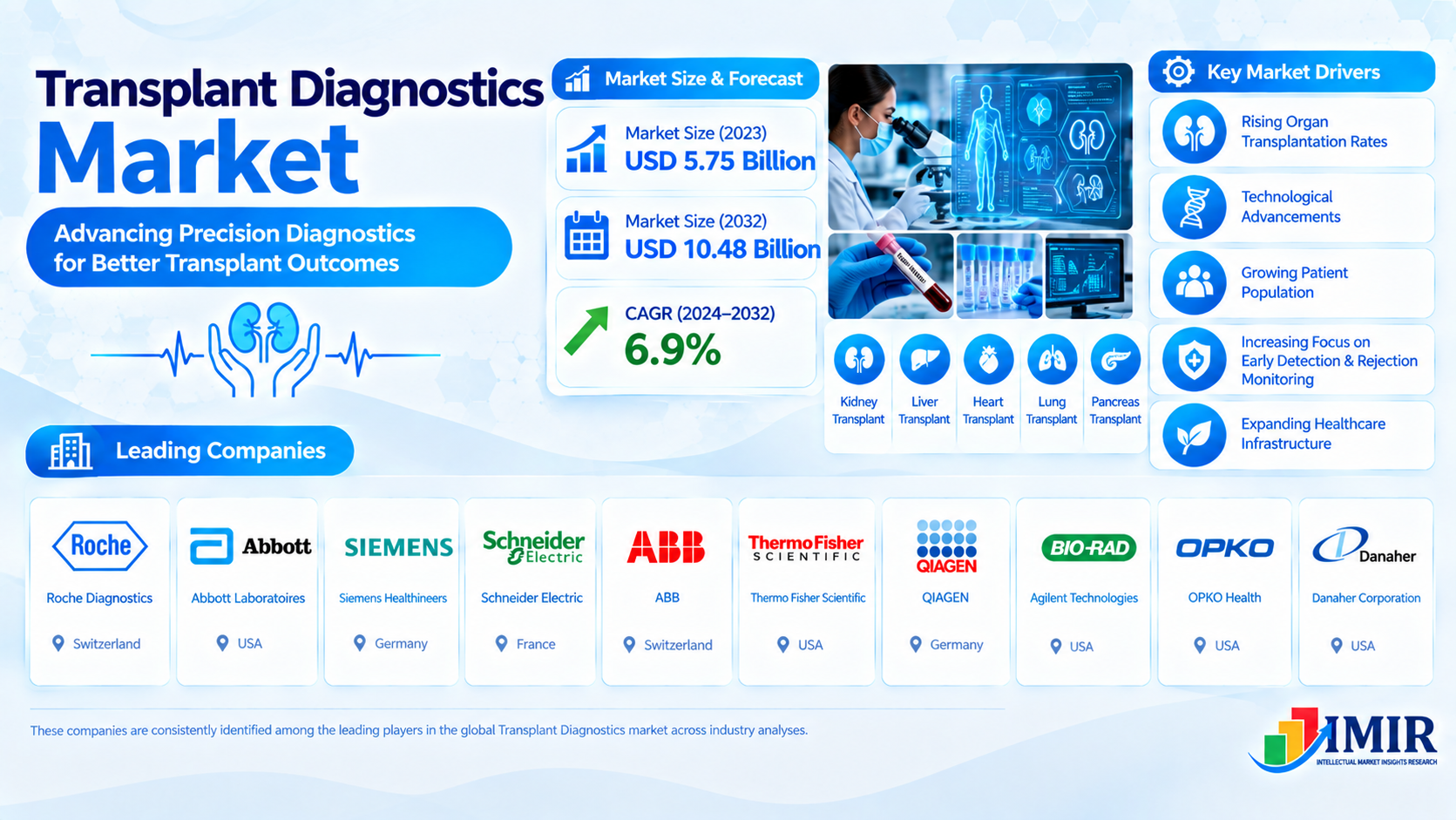
Global Transplant Diagnostics Market: Top Companies, Trends, and Future Outlook
Introduction
Transplant diagnostics encompass the specialized tests and technologies used to assess donor-recipient compatibility, screen for infectious disease transmission risk, and monitor for organ rejection before, during, and after solid organ and tissue transplantation. Spanning human leukocyte antigen (HLA) typing, antibody screening, crossmatching, chimerism testing, and increasingly sophisticated molecular tools such as next-generation sequencing (NGS) and donor-derived cell-free DNA (dd-cfDNA) assays, transplant diagnostics form the clinical backbone that makes safe, successful organ transplantation possible.
The global transplant diagnostics market spans reagents and consumables, instruments, and software and services, deployed across kidney, liver, heart, lung, and bone marrow transplantation applications in hospitals, transplant centers, and independent reference laboratories. With more than 144,000 solid organ transplants performed worldwide in 2023 and demand continuing to rise, this article provides a research-based analysis of the global transplant diagnostics market, the companies shaping it, and the regional and technological forces driving its growth toward 2032.
Market Overview
The Global Transplant Diagnostics Market is projected to expand from approximately USD 4.2 Billion in 2022 to approximately USD 8.3 Billion by 2032, growing at a CAGR of 7.2% during the forecast period (2023–2032).
| Parameter | Details |
|---|---|
| Market Size (2022) | Approx. USD 5.75 Billion |
| Projected Market Size (2032) | Approx. USD 10.48 Billion |
| CAGR (2023–2032) | 6.9% |
| Forecast Period | 2024–2032 |
| Leading Region | North America (approx. 38.7% revenue share in 2022); Asia-Pacific (fastest growth) |
| Key Segments (by Product) | Reagents & Consumables, Instruments, Software & Services |
| Key Segments (by Technology) | Molecular Assays (PCR, NGS, dd-cfDNA), Non-Molecular Assays (Serology, ELISA) |
| Key Segments (by Transplant Type) | Kidney, Liver, Heart, Lung, Bone Marrow, Others |
| Key Segments (by End-User) | Hospitals & Transplant Centers, Independent Reference Laboratories |
Why the Transplant Diagnostics Market Is Growing
1. Rising Global Organ Transplantation Volumes
The rising number of organ transplantation procedures worldwide, driven by growing kidney, liver, heart, and lung failure caused by chronic diseases, directly increases demand for pre- and post-transplant diagnostic testing at every stage of the transplant journey.
2. Growing Prevalence of Chronic Diseases Necessitating Transplantation
Chronic conditions such as kidney failure, liver cirrhosis, heart failure, and certain cancers continue to rise globally, creating a steadily expanding pool of patients who require organ transplantation and, by extension, comprehensive transplant diagnostic testing.
3. Shift from Serological to Molecular Diagnostics
The industry is undergoing a structural shift from traditional serological testing methods toward high-precision molecular assays, including PCR and next-generation sequencing, which offer superior accuracy in HLA typing and rejection risk assessment.
4. Adoption of Next-Generation Sequencing for HLA Typing
NGS is becoming the gold standard for high-resolution, comprehensive HLA typing, minimizing donor-recipient mismatches and improving long-term transplant outcomes, driving sustained demand for sequencing-based diagnostic platforms.
5. Rise of Donor-Derived Cell-Free DNA (dd-cfDNA) Monitoring
Growing clinical adoption of dd-cfDNA testing for non-invasive, early detection of organ rejection is expanding the post-transplant monitoring segment, reducing reliance on invasive biopsy procedures.
6. Increasing R&D Investment and Government/Private Funding
Rising funding from public and private organizations for transplant diagnostics R&D continues to accelerate the development and commercialization of more accurate, faster, and more automated diagnostic technologies.
Market Opportunities & Restraints
A key opportunity lies in specialized, transplant-exclusive diagnostic platforms: companies that maintain transplant exclusivity rather than treating it as one product line among many are seeing outsized growth, with CareDx reporting roughly 30% revenue growth in 2024 on the back of expanded AlloSure dd-cfDNA test indications and improved payer coverage, illustrating the commercial upside available to focused players in this space; additionally, emerging markets present a distinct opportunity, as Asia-Pacific is projected to register the fastest regional CAGR (exceeding 11% by some estimates), driven by Japan's work on gene-edited xenograft readiness and India's rapidly scaling transplant capacity, which reportedly achieves 85–90% one-year survival benchmarks. On the restraint side, the persistent gap between organ supply and transplant demand remains a structural headwind for the broader transplantation ecosystem, as the number of patients awaiting transplantation continues to exceed available donor organs in most major markets, while the high complexity and cost of advanced molecular and NGS-based diagnostic platforms can limit adoption among smaller transplant centers and laboratories operating with constrained budgets.
Companies Associated with the Transplant Diagnostics Market
| Company | Headquarters | Founded | Employees | Revenue | Overview |
|---|---|---|---|---|---|
| Thermo Fisher Scientific Inc. | Waltham, Massachusetts, USA | 1956 | Approx. 125,000+ | Approx. USD 44.56 Billion (total company) | A world leader in biotechnology and clinical diagnostics, offering transplant diagnostics for HLA typing and post-transplant monitoring. |
| F. Hoffmann-La Roche Ltd. | Basel, Switzerland | 1896 | Approx. 103,000+ | Approx. CHF 68.7 Billion (total company) | A leader in molecular and immunodiagnostics, focused on transplant infectious disease screening via automated cobas x800 systems. |
| Illumina, Inc. | San Diego, California, USA | 1998 | Approx. 8,970 | Approx. USD 4.37 Billion | A global NGS and genomic solutions leader; announced an NGS transplant panel collaboration with Eurofins Genomics in January 2025. |
| Bio-Rad Laboratories, Inc. | Hercules, California, USA | 1952 | Approx. 8,000 | Approx. USD 2.5+ Billion | A key PCR and molecular detection kit manufacturer; launched a new multiplex PCR transplant infectious agent assay in December 2024. |
| QIAGEN N.V. | Venlo, Netherlands / Hilden, Germany | 1984 | Approx. 5,967+ | Approx. USD 1.97+ Billion | Offers qPCR and digital PCR sample preparation kits optimized for pathogen and rejection marker detection. |
| Becton, Dickinson and Company (BD) | Franklin Lakes, New Jersey, USA | 1897 | Approx. 72,000 | Approx. USD 21.8 Billion | A global medical technology leader in diagnostic solutions, including transplant diagnostics and HLA typing. |
| CareDx, Inc. | Brisbane, California, USA | 1998 | Approx. 740 | ~30% YoY revenue growth (2024) | A transplant-exclusive diagnostics specialist behind the AlloSure dd-cfDNA rejection monitoring test. |
| Immucor, Inc. | Norcross, Georgia, USA | 1982 | Several hundred–low thousands | Not publicly disclosed | A global leader in transfusion and transplantation diagnostics specializing in HLA typing and crossmatching. |
| bioMérieux S.A. | Marcy-l'Étoile, France | 1963 | Approx. 15,000+ | Approx. EUR 3.8+ Billion | A French IVD company offering infectious disease screening relevant to transplant donor/recipient testing. |
| Werfen | Barcelona, Spain | 1966 | Approx. 7,000+ | Approx. USD 2.5+ Billion | A specialty diagnostics company that acquired NGS specialist Omixon Inc. for ~$25M in May 2024. |
Competitive Landscape
The global transplant diagnostics market exhibits moderate concentration, with diagnostics conglomerates and transplant-focused specialists competing for share. Diversified diagnostics giants Thermo Fisher, Roche, Abbott, and BD leverage multi-segment portfolios to supply instruments, reagents, and informatics bundles that embed them deeply across hospital laboratories, with Thermo Fisher's broad instrument-reagent-service bundling in particular encouraging labs to consolidate purchasing around fewer vendor relationships. Platform-centric molecular innovators Illumina and QIAGEN compete on sequencing and PCR platform maturity, ecosystem tools, and bioinformatics readiness, shifting procurement priorities from single-assay performance toward total system capability. Transplant-exclusive specialists CareDx and Immucor maintain complete category focus, with CareDx in particular posting roughly 30% revenue growth in 2024 on expanded AlloSure indications and payer wins, demonstrating that focused players can outgrow diversified giants in their core niche. Specialty and regional diagnostics players bioMérieux, Werfen, and Bio-Rad round out the competitive field, with M&A remaining an active growth lever, as shown by Werfen's 2024 acquisition of NGS specialist Omixon for approximately USD 25 million.
Regional Analysis
North America
North America dominates the global transplant diagnostics market, holding an estimated 38.7% revenue share, driven by advanced treatment methods, cutting-edge diagnostic technologies, extensive healthcare infrastructure, and high healthcare expenditure, with the United States as the key contributor to regional volume (more than 42,800 organ transplants performed in the U.S. in 2023 alone).
Europe
Europe represents a significant transplant diagnostics market, anchored by major players such as Roche, QIAGEN, bioMérieux, and Werfen, alongside well-established transplant infrastructure and regulatory frameworks across Switzerland, Germany, France, and Spain.
Asia-Pacific
Asia-Pacific is expected to register the fastest growth, with some estimates placing regional CAGR above 11%, as Japan pioneers gene-edited xenograft readiness and India scales transplant capacity while achieving 85–90% one-year survival benchmarks; governments across the region are investing in local bioprinting and NGS manufacturing to reduce import dependence and improve reagent accessibility.
Latin America & Middle East and Africa
Latin America and the Middle East & Africa represent emerging growth markets for transplant diagnostics, with adoption tied to improving healthcare access, expanding transplant center infrastructure, and increasing government investment in organ donation and transplantation programs.
Emerging Trends in the Transplant Diagnostics Market
1. Shift from Serological to Molecular Diagnostics: The industry continues its structural shift toward high-precision molecular assays, including PCR and NGS, over traditional serological methods, improving accuracy in donor-recipient matching and rejection risk assessment.
2. Rise of Non-Invasive Donor-Derived Cell-Free DNA (dd-cfDNA) Testing: Growing clinical and payer acceptance of dd-cfDNA tests, exemplified by CareDx's AlloSure platform, is reducing reliance on invasive biopsy procedures for post-transplant rejection monitoring.
3. Expansion of NGS-Based HLA Typing Partnerships: Illumina's January 2025 collaboration with Eurofins Genomics to co-develop NGS-based transplant diagnostic panels illustrates the industry's continued investment in higher-resolution, scalable sequencing-based typing solutions.
4. Consolidation Through Targeted Niche Acquisitions: Werfen's May 2024 acquisition of NGS specialist Omixon Inc. for approximately USD 25 million reflects an ongoing trend of larger diagnostics companies acquiring specialized transplant technology providers to expand their molecular testing portfolios.
5. Government Investment in Regional Manufacturing Self-Sufficiency: Governments in Asia-Pacific are increasingly investing in local bioprinting and NGS manufacturing capacity to reduce import dependence, a trend expected to reshape regional supply chains and reagent accessibility over the coming decade.
6. Payer Recognition of Precision Transplant Medicine: Growing payer recognition and reimbursement support for precision diagnostic tools, including expanded AlloSure indications, is sustaining double-digit revenue momentum for focused transplant diagnostics specialists even as broader market growth remains in the high single digits.
Future Outlook (2025–2034)
Building on the underlying market's trajectory (approximately USD 57 billion in 2022 growing toward approximately USD 10.48 billion by 2032 at a 6.9% CAGR), the market's growth is expected to continue at a similar pace through 2034 as rising global transplant volumes, molecular diagnostics adoption, and expanding dd-cfDNA monitoring remain long-term structural growth drivers. Extending the trend, continued mid-to-high single-digit growth would be supported by sustained NGS and PCR platform innovation, expanding payer coverage for precision transplant diagnostics, and accelerating adoption across fast-growing Asia-Pacific markets.
Key investment themes for 2025–2034 include continued molecular and NGS platform innovation by diversified leaders such as Thermo Fisher, Roche, and Illumina, sustained above-market growth by transplant-exclusive specialists such as CareDx as dd-cfDNA testing indications expand, and continued niche consolidation activity following the pattern set by Werfen's acquisition of Omixon. As non-invasive rejection monitoring, NGS-based HLA typing, and government-backed regional manufacturing investment continue to reshape the industry, the companies that combine deep transplant immunology expertise with molecular platform innovation will be best positioned to capture growth through 2034.
Frequently Asked Questions (FAQ)
1. What is the current size of the global transplant diagnostics market?
Global Transplant Diagnostics Market is expected to reach a value of USD 10.48 billion by 2032, at a CAGR of 6.9% over the forecast period (2024–2032).
2. Who are the top companies in the transplant diagnostics market?
Leading companies include Thermo Fisher Scientific Inc., F. Hoffmann-La Roche Ltd., Illumina, Inc., Bio-Rad Laboratories, Inc., QIAGEN N.V., Becton, Dickinson and Company (BD), CareDx, Inc., Immucor, Inc., bioMérieux S.A., and Werfen.
3. Which region dominates the transplant diagnostics market?
North America dominates the global transplant diagnostics market with an estimated 38.7% revenue share, while Asia-Pacific is expected to register the fastest growth, with some estimates placing regional CAGR above 11%.
4. What is the forecast CAGR for the transplant diagnostics market?
The market is forecast to grow at a CAGR of 6.9% from 2024 to 2032, according to the primary estimate used in this analysis; other independent sources place the CAGR in a broader 6%–8% range.
5. What are the main growth drivers for this market?
Key drivers include rising global organ transplantation volumes, growing prevalence of chronic diseases necessitating transplantation, the shift from serological to molecular diagnostics, adoption of next-generation sequencing for HLA typing, and the rise of donor-derived cell-free DNA (dd-cfDNA) monitoring.
6. What technologies are used in transplant diagnostics?
The market spans molecular assay technologies, including PCR, next-generation sequencing (NGS), and donor-derived cell-free DNA (dd-cfDNA) testing, alongside traditional non-molecular assays such as serology and ELISA-based testing.
7. Which transplant types drive the most demand for diagnostics?
Transplant diagnostics serve kidney, liver, heart, lung, and bone marrow transplantation, with more than 144,000 solid organ transplants performed worldwide in 2023 underscoring sustained demand for pre- and post-transplant diagnostic testing.
Conclusion
The global transplant diagnostics market sits at the intersection of rising global organ transplantation volumes and the ongoing shift toward precise, molecular, and increasingly non-invasive diagnostic technologies. With a projected size of approximately USD 8.3 billion by 2032 at a 7.2% CAGR, the market offers steady, clinically-anchored growth across HLA typing, crossmatching, and post-transplant rejection monitoring segments.
Thermo Fisher, Roche, BD, and Illumina continue to lead through diversified, deeply embedded diagnostics portfolios, while transplant-exclusive specialists CareDx and Immucor demonstrate that focused category expertise, exemplified by CareDx's roughly 30% revenue growth in 2024, can outpace the broader market. As NGS-based HLA typing, non-invasive dd-cfDNA monitoring, and continued niche M&A activity reshape the industry, the companies that combine deep transplant immunology expertise with molecular platform innovation will define market leadership through 2034 and beyond.