
Leading Companies in the Global Turbocharger Market 2025 An Industry Analysis
Author:
Intellectual Market Insights Research
Published Date:
31 Aug 2026
Introduction
Tightening emissions regulations, the industry's push toward smaller and more fuel-efficient engines, and steady growth in commercial and off-highway equipment are keeping turbocharging at the center of engine design decisions worldwide. A turbocharger uses exhaust-driven energy to force more air into an engine's cylinders, allowing manufacturers to extract more power from smaller-displacement engines while cutting fuel consumption and CO2 output a combination that has kept the technology relevant even as the industry electrifies.
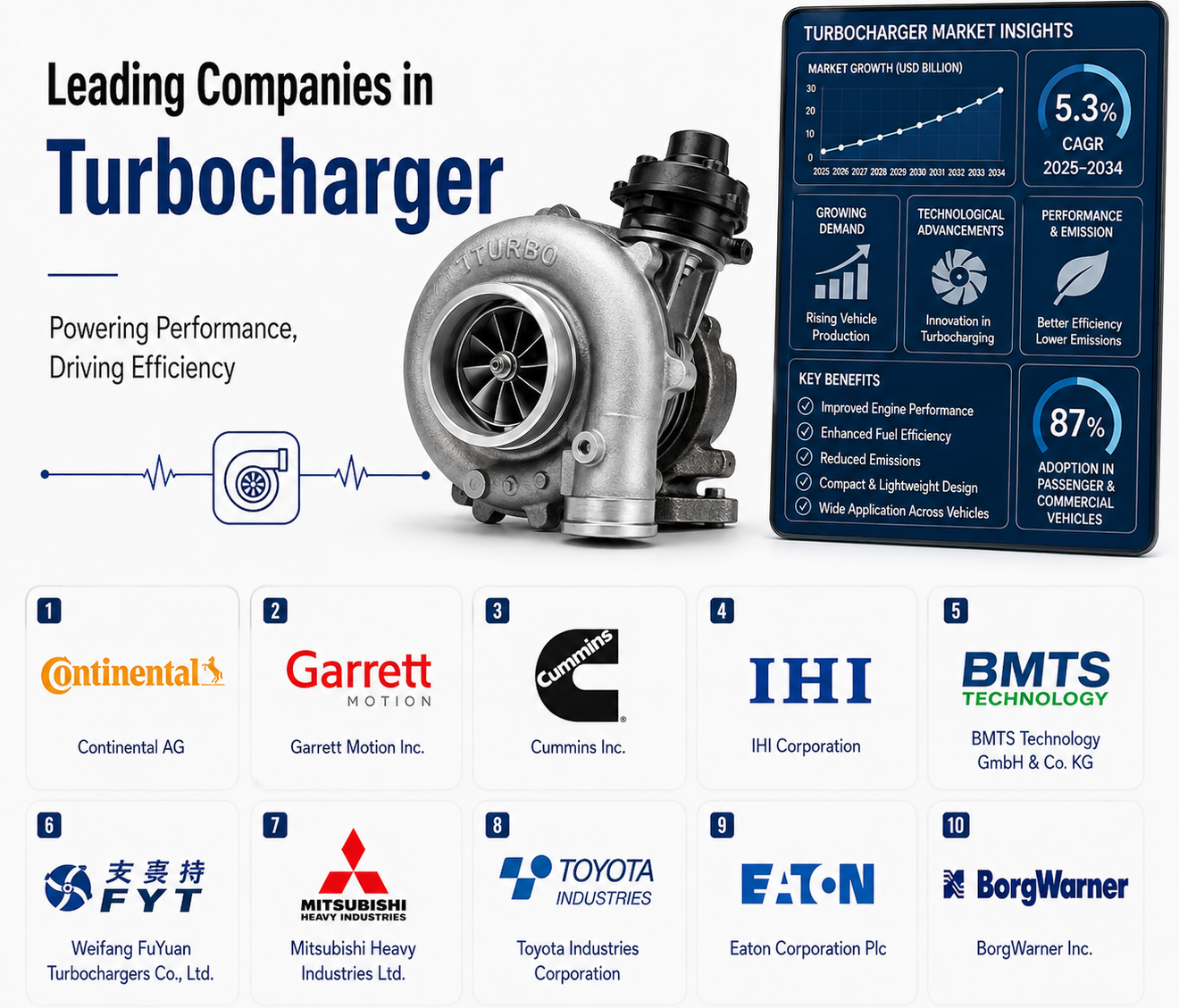
The global turbocharger market was valued at approximately USD 15.53 billion in 2025 and is projected to reach USD 23.83 billion by 2034, expanding at a compound annual growth rate (CAGR) of 5.3% over the forecast period, according to IMIR Market Research. Growth is being driven by continued engine downsizing, stricter emissions standards in both passenger and commercial vehicles, and rising demand for turbocharged engines in agricultural and construction machinery.
The competitive landscape blends large diversified automotive and industrial conglomerates with specialist turbocharger manufacturers that have built deep expertise in variable geometry, electric boosting, and actuation technology. Because turbochargers must be precisely engineered for each engine platform and meet exacting durability and emissions requirements, the market rewards suppliers that combine deep thermodynamic and materials engineering with long-standing OEM relationships.
Understanding which companies lead this technically demanding market is essential for OEMs, tier-one suppliers, and aftermarket players alike. This article provides a research-based analysis of the top companies in the global turbocharger market, their positioning, flagship offerings, and the regional and technological forces shaping the competitive landscape.
Market Overview
|
Parameter |
Details |
|---|---|
|
Market Size (2025) |
USD 15.53 Billion |
|
Projected Market Size (2034) |
USD 23.83 Billion |
|
CAGR (2025–2034) |
5.3% |
|
Base Year |
2024 |
|
Historic Period |
2019–2023 |
|
Forecast Period |
2025–2034 |
|
Leading Region |
Asia-Pacific, on the back of China and India's vehicle production base |
|
Fastest-Growing Region |
Asia-Pacific |
|
Key Growth Drivers |
Engine downsizing, tightening emissions regulations, rising commercial and off-highway vehicle output |
|
Key Challenges |
Long-term shift toward battery-electric powertrains in passenger cars; high engineering and validation costs per platform |
|
Key Opportunities |
Electric turbocharging/eBoosting, hybrid and range-extender applications, aftermarket growth, industrial and genset turbocharging |
Why the Turbocharger Market Is Growing
1. Continued Engine Downsizing
Automakers keep replacing larger, naturally aspirated engines with smaller turbocharged units that deliver comparable power with better fuel economy, making turbochargers a near-default feature on new gasoline and diesel platforms rather than a performance add-on.
2. Tightening Emissions Regulations
Standards such as Euro 7 and increasingly strict fuel-economy and CO2 targets in North America and Asia are pushing OEMs toward advanced boosting technologies, including variable-geometry turbines (VGT) and twin-turbo setups, to hit compliance targets without sacrificing drivability.
3. Growth in Commercial and Off-Highway Vehicles
Rising demand for turbocharged engines in light and heavy commercial vehicles, as well as agricultural and construction machinery, is expanding the addressable market beyond passenger cars into equipment that depends on high torque and efficient power delivery.
4. Electrification of the Boosting Function
Electrically actuated turbochargers and eBoosters are gaining traction as automakers hybridize powertrains, since electric boosting improves throttle response and reduces turbo lag in smaller, more efficient engine architectures.
5. Aftermarket Expansion
A large and aging global vehicle parc, particularly for diesel commercial vehicles, is sustaining steady replacement demand through OEM and independent aftermarket distribution networks.
6. Industrial and Power Generation Demand
Turbochargers used in gensets, marine engines, and industrial equipment are seeing renewed demand as backup and distributed power needs grow, including from data center and grid-support applications.
Top 10 Companies in the Global Turbocharger Market
- Continental AG
- Garrett Motion Inc.
- Cummins Inc.
- IHI Corporation
- BMTS Technology GmbH & Co. KG
- Weifang FuYuan Turbochargers Co., Ltd.
- Mitsubishi Heavy Industries Ltd.
- Toyota Industries Corporation
- Eaton Corporation Plc
- BorgWarner Inc.
1. Continental AG
|
Category |
Details |
|---|---|
|
Company Name |
Continental AG |
|
Headquarters |
Hanover, Germany |
|
Founded |
1871 |
|
Employees |
Approx. 78,000 (post-restructuring, 2025) |
|
Revenue |
Approx. €19.7 Billion (2025, group-wide) |
|
Company Overview |
Continental is a long-established German industrial group historically active in automotive electronics and turbocharger-related actuation and sensor systems through its former Automotive division. In 2025, that division was spun off as an independent company, Aumovio SE, leaving Continental focused on tires and industrial rubber products. |
|
Key Products |
Turbocharger actuators, boost-pressure sensors, and electronic control systems historically supplied to turbocharger and engine manufacturers. |
|
Market Position |
A long-standing tier-one electronics and sensor supplier to the turbocharger value chain, now operating primarily through its Aumovio spin-off for automotive electronics. |
|
Recent Developments |
Completed the 2025 spin-off of its Automotive Technologies business into Aumovio SE, a separately listed company, as Continental refocuses on its core tire and ContiTech businesses. |
|
Strategic Advantages |
Deep legacy engineering relationships across global OEMs and a long history in vehicle electronics and sensing technology relevant to turbocharger control systems. |
2. Garrett Motion Inc.
|
Category |
Details |
|---|---|
|
Company Name |
Garrett Motion Inc. (formerly Honeywell Turbo Technologies) |
|
Headquarters |
Rolle, Switzerland |
|
Founded |
1954 (as part of Garrett AiResearch); independent since 2018 |
|
Employees |
Approx. 7,000–9,000 across more than 20 countries |
|
Revenue |
Approx. USD 3.6–3.7 Billion |
|
Company Overview |
Garrett Motion is a pure-play turbocharging specialist and one of the most recognized names in the industry, with roots going back more than 70 years to early turbo development for mining and commercial vehicles. |
|
Key Products |
Gasoline, diesel, and variable-geometry turbochargers; electric boosting and eCompressor technology; fuel cell compressors for hydrogen vehicles; automotive software. |
|
Market Position |
A global technology leader in turbocharging with an installed base of roughly 150 million turbochargers in use worldwide and a large OEM and aftermarket distribution network spanning more than 150 countries. |
|
Recent Developments |
Continued expansion of industrial turbocharging, including genset applications, alongside new light-vehicle turbo awards and ongoing share buybacks returning capital to shareholders in 2025–2026. |
|
Strategic Advantages |
Singular focus on turbocharging and boosting technology, deep OEM engineering relationships, and an early lead in electric boosting for hybrid and fuel-cell applications. |
3. BorgWarner Inc.
|
Category |
Details |
|---|---|
|
Company Name |
BorgWarner Inc. |
|
Headquarters |
Auburn Hills, Michigan, United States |
|
Founded |
1928 |
|
Employees |
Approx. 10,000–20,000 across roughly 72 locations |
|
Revenue |
Approx. USD 14.3 Billion (group-wide, 2025); Turbos & Thermal Technologies segment sales of roughly USD 5.9 Billion |
|
Company Overview |
BorgWarner is a diversified global powertrain supplier whose Turbos & Thermal Technologies segment is a major source of group revenue, supplying turbochargers alongside a broader portfolio spanning drivetrain, electrification, and battery systems. |
|
Key Products |
Variable turbine geometry (VTG) turbochargers, eBoosters, twin-turbo systems, and exhaust gas recirculation (EGR) coolers for passenger and commercial vehicles. |
|
Market Position |
One of the largest global turbocharger suppliers by segment revenue, with a broad OEM customer base spanning combustion, hybrid, and commercial vehicle platforms. |
|
Recent Developments |
Secured new VTG turbocharger conquest awards for Euro 7-compliant commercial vehicles, and applied its turbocharging and thermal management expertise to a new turbine generator system for AI data center and microgrid power. |
|
Strategic Advantages |
Broad product diversification that bundles turbocharging with thermal, electrification, and power-electronics capabilities, plus large-scale manufacturing and global OEM reach. |
4. Cummins Inc.
|
Category |
Details |
|---|---|
|
Company Name |
Cummins Inc. (turbochargers supplied through its Components segment / Cummins Turbo Technologies) |
|
Headquarters |
Columbus, Indiana, United States |
|
Founded |
1919 |
|
Employees |
Approx. 67,000–70,000 (group-wide) |
|
Revenue |
Approx. USD 33.7–34.1 Billion (group-wide, 2024–2025) |
|
Company Overview |
Cummins is a diversified engine and power systems manufacturer whose Cummins Turbo Technologies unit designs and manufactures turbochargers for diesel engines above 3 liters, serving heavy-duty, industrial, and off-highway applications globally. |
|
Key Products |
Fixed-geometry and variable-geometry turbochargers for medium- and heavy-duty diesel engines, developed under the Cummins Turbo Technologies (formerly Holset) brand. |
|
Market Position |
A leading turbocharger supplier for the heavy-duty and industrial diesel segment, tightly integrated with Cummins' own engine platforms as well as third-party OEMs. |
|
Recent Developments |
Continued integration of turbocharging with Cummins' broader Components segment, which also includes aftertreatment, fuel systems, and filtration, as the company advances its Destination Zero emissions strategy. |
|
Strategic Advantages |
Deep vertical integration with Cummins' own engine business, decades of heavy-duty diesel engineering heritage, and a global manufacturing footprint spanning China, India, Brazil, the UK, and the US. |
5. IHI Corporation
|
Category |
Details |
|---|---|
|
Company Name |
IHI Corporation |
|
Headquarters |
Tokyo, Japan |
|
Founded |
1853 |
|
Employees |
Approx. 28,000 (group-wide) |
|
Revenue |
Approx. ¥1.63 Trillion (group-wide, FY2024/25, record year) |
|
Company Overview |
IHI is a diversified Japanese heavy-industry group whose Industrial Systems & General-Purpose Machinery segment includes vehicular turbochargers alongside rotating machinery, material handling, and industrial equipment, sitting within a broader portfolio spanning aero engines, energy, and infrastructure. |
|
Key Products |
Turbochargers for passenger, commercial, and industrial diesel and gasoline engines, supplied globally including through its IHI Turbo America subsidiary. |
|
Market Position |
One of the world's largest turbocharger manufacturers, with a long manufacturing history and a global production and distribution footprint across Asia, Europe, and the Americas. |
|
Recent Developments |
Reported record group revenue in its fiscal year ending March 2025, while consolidating its European vehicular turbocharger operations and divesting non-core businesses to focus resources on higher-growth segments. |
|
Strategic Advantages |
Century-plus engineering heritage across rotating and thermal machinery, a diversified group structure that supports R&D investment, and an established global turbocharger manufacturing base. |
Competitive Landscape
The global turbocharger market is moderately consolidated, spanning pure-play turbocharging specialists such as Garrett Motion, diversified automotive suppliers such as BorgWarner and Continental (through its former automotive electronics business, now Aumovio), and diversified industrial conglomerates such as Cummins, IHI, Mitsubishi Heavy Industries, and Toyota Industries that build turbochargers alongside broader engine and machinery portfolios.
Engineering Depth as a Barrier to Entry: Turbocharger design requires precise matching to each engine platform's thermodynamic and durability requirements, favoring established suppliers with decades of OEM validation experience and large-scale manufacturing capability.
Specialization vs. Diversification: Specialists like Garrett Motion compete on singular focus and deep turbocharging IP, while diversified players like BorgWarner, Cummins, and IHI compete on the ability to bundle turbochargers with adjacent engine, thermal, or electrification systems.
Electrification Reshaping Product Roadmaps: Suppliers are increasingly investing in electric boosting, eBoosters, and fuel-cell compressor technology to stay relevant as OEMs hybridize powertrains, rather than relying solely on conventional exhaust-driven turbocharging.
Heavy-Duty and Industrial Demand as an Anchor Market: Given steady demand from commercial vehicles, agricultural and construction machinery, and industrial gensets, companies with strong relationships in these segments, such as Cummins and IHI, hold a structural advantage in capturing large, recurring order volumes.
Regional Analysis
Asia-Pacific
Asia-Pacific is the largest and fastest-growing regional market, underpinned by China's position as the world's largest vehicle producer and India's rapidly expanding passenger and commercial vehicle manufacturing base, both of which continue to scale turbocharged engine production.
Europe
Europe remains a mature but technologically demanding market, driven by some of the world's strictest emissions standards and a large base of turbocharged diesel and gasoline passenger vehicles, sustaining steady replacement and next-generation platform demand.
North America
North America represents a steady market supported by fuel-economy and emissions standards for light and heavy commercial vehicles, along with strong demand for turbocharged diesel engines in trucking, agriculture, and construction equipment.
Latin America, Middle East, and Africa
These regions represent smaller but developing markets, with demand tied to growing commercial vehicle fleets, agricultural mechanization, and gradual tightening of vehicle emissions standards.
Emerging Trends in the Turbocharger Market
1. Electric and Hybrid Boosting: Electrically assisted turbochargers and eBoosters are increasingly being paired with hybrid powertrains to eliminate turbo lag and improve efficiency, extending the relevance of boosting technology into electrified vehicle architectures.
2. Variable Geometry Turbine (VGT) Adoption: VGT systems are gaining share over simpler waste-gate designs as OEMs seek finer control over boost pressure to meet tightening emissions and fuel-economy requirements.
3. Expansion into Industrial and Power Generation: Turbocharger suppliers are extending their technology into gensets, marine propulsion, and even data center power systems, turning engineering expertise built for vehicles into new industrial revenue streams.
4. Twin-Turbo and Multi-Stage Systems: Twin-turbo and sequential turbocharging setups are growing in higher-performance and heavy-duty applications where a single turbocharger cannot deliver the required response and power across the full engine operating range.
5. Aftermarket Digitization: Turbocharger manufacturers are investing in broader aftermarket distribution networks and digital diagnostics to capture replacement demand from an aging global commercial vehicle fleet.
Future Outlook (2025–2034)
The global turbocharger market's trajectory toward USD 23.83 billion by 2034 reflects the durability of internal combustion and hybrid powertrains across passenger, commercial, and industrial applications, even as full battery-electric adoption accelerates in certain regions. The 5.3% CAGR forecast through 2034 assumes continued tightening of emissions regulations, steady growth in commercial and off-highway vehicle production, and expanding use of electric boosting technology in hybrid architectures.
Key investment themes include continued growth in electric and hybrid boosting systems, expansion into industrial and power-generation applications, and steady aftermarket demand from a large global vehicle parc. Leading companies including Garrett Motion, BorgWarner, Cummins, and IHI are likely to retain strong market positions by combining deep engineering expertise with diversified end-market exposure, while specialist and regional players continue to compete for share as turbocharged engine production expands across Asia-Pacific.
Frequently Asked Questions (FAQ)
1. What is the current size of the global turbocharger market?
The global turbocharger market was valued at approximately USD 15.53 billion in 2025 and is projected to reach USD 23.83 billion by 2034, growing at a CAGR of 5.3%.
2. Who are the top companies in the turbocharger market?
Leading companies include Continental AG, Garrett Motion, Cummins, IHI Corporation, BMTS Technology, Weifang FuYuan Turbochargers, Mitsubishi Heavy Industries, Toyota Industries, Eaton Corporation, and BorgWarner.
3. Which region dominates the turbocharger market?
Asia-Pacific leads the market and is expected to grow fastest, driven by China and India's large and expanding vehicle manufacturing bases.
4. What is the forecast CAGR for the turbocharger market?
The market is forecast to grow at a CAGR of 5.3% from 2025 to 2034.
5. What are the main growth drivers for this market?
Key drivers include continued engine downsizing, tightening emissions regulations, and rising turbocharged engine adoption in commercial and off-highway vehicles.
6. What challenges does the turbocharger industry face?
The industry's main long-term challenge is the gradual shift toward battery-electric passenger vehicles in some markets, alongside the high engineering and validation costs required for each new engine platform.
7. Which segment drives the most turbocharger demand?
Passenger cars remain the largest vehicle segment, but commercial vehicles, agricultural machinery, and construction machinery are significant and growing contributors to overall demand.
Conclusion
The global turbocharger market sits at the intersection of tightening emissions regulation and the automotive industry's ongoing push for smaller, more efficient engines. With a projected size of USD 23.83 billion by 2034 at a 5.3% CAGR, the sector offers steady growth potential for companies that can combine deep thermodynamic and materials engineering with the manufacturing scale to serve global OEM platforms.
Specialists like Garrett Motion compete on singular technology depth, while diversified players such as BorgWarner, Cummins, and IHI leverage broader engine, thermal, and electrification portfolios to win platform business. The companies that successfully extend turbocharging into electric boosting, hybrid architectures, and industrial power generation will define market leadership through 2034 and beyond.


