Leading Companies in the Global Unit Dose Packaging Market
Author:
Intellectual Market Insights Research
Published Date:
03 Oct 2026
Global Unit Dose Packaging Market: Top Companies, Trends, and Future Outlook
Introduction
Unit dose packaging refers to pharmaceutical and nutraceutical packaging formats, including blister packs, prefilled syringes, single-dose vials, sachets, and stick packs, that contain a single, pre-measured dose of medication or supplement. By improving dosing accuracy, enhancing product safety, extending shelf life, and reducing the risk of contamination or medication errors, unit dose packaging has become an essential standard across hospital pharmacies, retail pharmacies, and increasingly, nutraceutical and personal care products.
The global unit dose packaging market spans plastic, glass, paper, and aluminum materials, in solid, liquid, powder, and gel product formats, serving pharmaceutical, cosmetic and personal care, and nutraceutical end-use industries. This article provides a research-based analysis of the global unit dose packaging market, the companies shaping it, and the regulatory and technological forces driving its growth toward 2032.
Market Overview
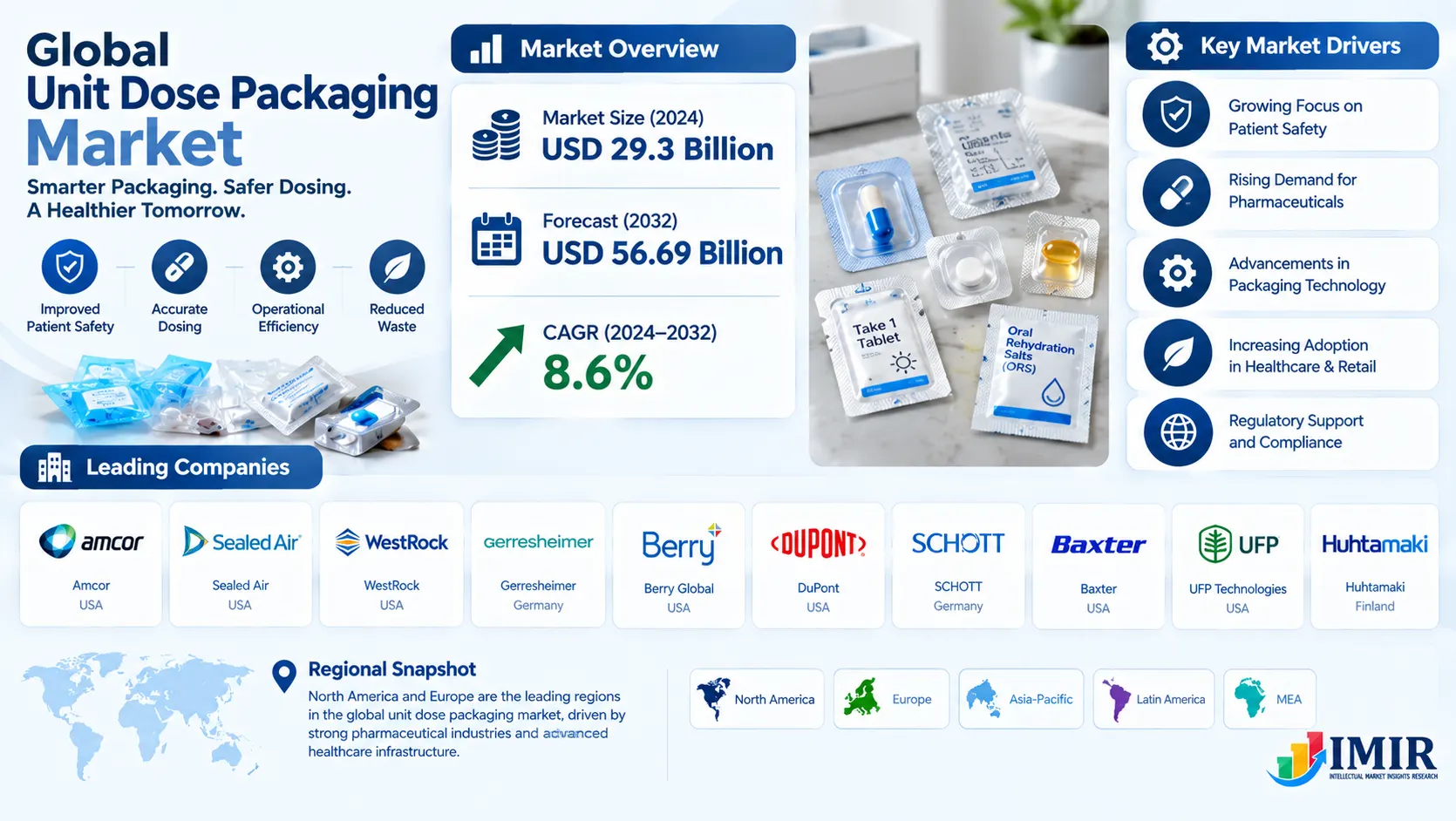
The Global Unit Dose Packaging Market is valued at USD 29.3 Billion in 2024 and is projected to reach USD 56.69 Billion by 2032, growing at an 8.6% CAGR from 2024 to 2032.
| Parameter | Details |
|---|---|
| Market Size (2024) | USD 29.3 Billion |
| Projected Market Size (2032) | USD 56.69 Billion |
| CAGR (2024–2032) | 8.6% |
| Forecast Period | 2024–2032 |
| Leading Region | North America (dominant share, approx. 42%); Asia-Pacific (fastest growth, driven by India, China, Southeast Asia) |
| Key Segments (by Material Type) | Plastic, Glass, Paper, Aluminium |
| Key Segments (by Product Type) | Solid, Powder, Gel, Liquid |
| Key Segments (by End-Use Industry) | Pharmaceuticals, Cosmetic & Personal Care, Nutraceuticals |
Why the Unit Dose Packaging Market Is Growing
1. Rising Demand for Accurate Dosing and Enhanced Patient Safety
Unit dosage packaging is gaining popularity due to its benefits of accurate dosing, enhanced product safety, and user convenience, directly addressing medication error concerns that remain a persistent challenge across healthcare systems.
2. Pharmaceutical Companies Investing in Advanced Packaging Formats
To enhance patient safety, improve medication adherence, and minimize dose errors, pharmaceutical companies are investing in new packaging formats like prefilled syringes, single dose vials, and stick packs, broadening the range of unit dose solutions available to patients and providers.
3. Growth in Biologics, Insulin, and Vaccine Demand
Growing demand for biologics, insulin, and vaccines is driving growth in the vials and ampoules segment, as these sensitive, often injectable therapies require precise, contamination-resistant single-dose packaging solutions.
4. Stringent Regulatory Standards for Pharmaceutical Distribution
Rising demand for correct pharmaceutical distribution, stringent regulatory standards, and developments in packaging technology are major drivers of market expansion, as regulators increasingly mandate unit dose formats for high-risk medications.
5. Rising Demand for Single-Serving Vitamins and Personal Care Items
Rapid urbanization and a rising middle class are driving demand for single-serving vitamins and personal care items, extending unit dose packaging's reach well beyond traditional pharmaceutical applications into the broader nutraceutical and wellness market.
6. Innovation in Smart Packaging Features
Smart features like QR codes, Near Field Communication (NFC), and Radio Frequency Identification (RFID) provide extensive product information and are increasingly being integrated into unit dose packaging to support traceability, anti-counterfeiting, and patient engagement.
Market Opportunities & Restraints
A key opportunity lies in personalized medicine and smart packaging integration: as the industry trends toward personalized medicine and more effective inventory management, packaging providers that successfully integrate smart features such as QR codes, NFC, and RFID directly into unit dose formats stand to capture premium value from pharmaceutical customers seeking better traceability, anti-counterfeiting protection, and patient engagement capabilities, while growing demand for biologics, insulin, and vaccines continues to expand the vials and ampoules segment specifically. On the restraint side, high validation costs and strict documentation requirements remain a persistent headwind, as high-barrier medicines require separate, specialized pack structures and packaging suppliers must compete on proven materials and reliable inspection records across tightly regulated medicine programs, with the resulting validation cost and documentation burden limiting the ability of weaker or smaller competitors to enter the pharmaceutical unit dose packaging segment.
Companies Associated with the Unit Dose Packaging Market (Details in Table)
| Company | Headquarters | Founded | Employees | Revenue | Overview |
|---|---|---|---|---|---|
| Amcor plc | Zurich, Switzerland | 1896 | Approx. 77,000 | Approx. USD 23.5 Billion (TTM) | Global packaging leader; Flexible/Rigid Packaging segments; scale significantly expanded by 2025 Berry Global combination. |
| Gerresheimer AG | Düsseldorf, Germany | 1864 | Approx. 13,528 | Approx. USD 2.5–2.6 Billion | Primary medicine packaging and drug delivery device partner; developed new injectable packaging solutions in Oct 2023. |
| West Pharmaceutical Services, Inc. | Exton, Pennsylvania, USA | 1923 | Approx. 8,200+ | Approx. USD 1.85+ Billion | Specializes in elastomer components, containment solutions, and injectable drug delivery systems. |
| Corning Incorporated | Corning, New York, USA | 1851 | Approx. 50,000+ | Multi-billion dollar diversified company | Specialty glass pioneer; long-term Valor Glass vial packaging supply agreement with Pfizer. |
| Stevanato Group S.p.A. | Piombino Dese, Italy | 1949 | Approx. 6,500+ | Approx. EUR 1+ Billion | Glass primary packaging (vials, syringes, cartridges) for pharma and biotech. |
| SCHOTT Pharma AG & Co. KGaA | Mainz, Germany | 1884/2023 | Approx. 4,500+ | Approx. EUR 1+ Billion | Leading pharmaceutical glass packaging provider; vials, ampoules, syringes, cartridges. |
| Nipro Corporation | Osaka, Japan | 1954 | Approx. 30,000+ | Multi-billion dollar diversified company | Japanese medical device maker; glass vials and prefillable syringes. |
| Constantia Flexibles Group GmbH | Vienna, Austria | 1950 | Approx. 8,500+ | Approx. EUR 1.3+ Billion | Flexible packaging (sachets, stick packs, pouches) for pharma and nutraceutical needs. |
| Klöckner Pentaplast Group | Montabaur, Germany | 1965 | Approx. 4,500+ | Approx. EUR 1+ Billion | Rigid/flexible packaging films, including core pharmaceutical blister packaging films. |
| Becton, Dickinson and Company (BD) | Franklin Lakes, New Jersey, USA | 1897 | Approx. 72,000 | Approx. USD 21.8 Billion (2025) | Prefillable syringes and safety-engineered injection/drug delivery devices. |
Competitive Landscape
The global unit dose packaging market is fragmented, bringing together large diversified packaging conglomerates, specialty pharmaceutical glass manufacturers, and medical device companies. Global packaging giants Amcor and Gerresheimer hold particularly strong positions, with Amcor's scale significantly expanded following its 2025 combination with Berry Global, creating one of the largest diversified packaging companies serving pharmaceutical, food, and consumer end markets. Specialty pharmaceutical glass manufacturers Corning, Stevanato Group, SCHOTT Pharma, and Nipro compete through deep materials science expertise in vials, syringes, cartridges, and ampoules, with Corning's long-term Valor Glass supply agreement with Pfizer illustrating the strategic, multi-year nature of relationships in this segment. Flexible packaging specialists Constantia Flexibles and Klöckner Pentaplast provide sachets, stick packs, pouches, and blister films that serve as the dominant format for solid oral dose pharmaceuticals and the broader nutraceutical market. Medical device and drug delivery leaders West Pharmaceutical Services and BD round out the competitive field, specializing in prefillable syringes, elastomer components, and safety-engineered injection devices critical to the injectable unit dose segment.
Regional Analysis
North America
North America dominated the Unit Dose Packaging Market with a market share of approximately 42%, driven by stringent regulatory standards, advanced pharmaceutical manufacturing infrastructure, and the presence of major companies such as West Pharmaceutical Services, Corning, and BD.
Europe
Europe represents a significant unit dose packaging market, anchored by major manufacturers including Gerresheimer, SCHOTT Pharma, Stevanato Group, Constantia Flexibles, and Klöckner Pentaplast, alongside strict regulatory frameworks through the European Medicines Agency.
Asia-Pacific
Asia-Pacific is expected to register significant growth, driven by growing pharmaceutical production in India, China, and Southeast Asia for domestic consumption and export requiring unit dose blister packaging, alongside the presence of major regional manufacturers such as Nipro Corporation in Japan.
Latin America & Middle East and Africa
Latin America and the Middle East & Africa represent emerging growth markets for unit dose packaging, with adoption tied to expanding pharmaceutical manufacturing capacity, rising healthcare infrastructure investment, and growing regulatory emphasis on medication safety.
Emerging Trends in the Unit Dose Packaging Market
1. Growth of Smart and Connected Packaging: Integration of QR codes, NFC, and RFID technology into unit dose packaging is providing extensive product information, supporting traceability, anti-counterfeiting, and improved patient engagement.
2. Expansion into Nutraceutical and Personal Care Applications: Rapid urbanization and a rising global middle class are driving demand for single-serving vitamins and personal care items, broadening unit dose packaging's reach well beyond traditional pharmaceutical applications.
3. Consolidation Among Major Packaging Conglomerates: Amcor's 2025 combination with Berry Global, significantly expanding its scale and healthcare packaging capabilities, illustrates the ongoing wave of consolidation among large diversified packaging companies competing for pharmaceutical customers.
4. Innovation in Ready-to-Fill Glass Technologies: Leading firms including SCHOTT and Gerresheimer continue to push industry developments through innovations in glass composition and ready-to-fill technologies, improving manufacturing efficiency for injectable drug packaging.
5. Growth in Blow-Fill-Seal (BFS) Technology Adoption: Innovations such as Blow-Fill-Seal technology continue to improve package efficiency and automation for liquid and semi-liquid unit dose pharmaceutical formats.
6. Sustainable and Recyclable Packaging Material Development: Growing environmental consciousness and regulatory pressure continue to drive packaging manufacturers toward lighter, recyclable, and reusable materials incorporating a growing percentage of recycled content.
Future Outlook (2025–2034)
Building on the underlying market's original 2024–2032 forecast window (USD 29.3 billion in 2024 to USD 56.69 billion by 2032 at an 8.6% CAGR), the market's growth momentum is expected to continue through 2034 as rising biologics and injectable drug demand, expanding pharmaceutical manufacturing capacity in emerging markets, and continued smart packaging innovation remain long-term structural growth drivers. Extending the trend, continued high single-digit growth would be supported by sustained regulatory emphasis on medication safety, growing nutraceutical and personal care unit dose adoption, and continued consolidation among major packaging and glass manufacturing companies.
Key investment themes for 2025–2034 include integration execution following Amcor's landmark combination with Berry Global, continued specialty glass and ready-to-fill technology innovation by Corning, Stevanato Group, SCHOTT Pharma, and Gerresheimer, and growing smart packaging and traceability technology adoption across the industry. As biologics growth, nutraceutical expansion, and sustainable material innovation continue to reshape the market, the companies that combine manufacturing scale with specialized pharmaceutical packaging expertise will be best positioned to capture growth through 2034.
Frequently Asked Questions (FAQ)
1. What is the current size of the global unit dose packaging market?
The Global Unit Dose Packaging Market is valued at USD 29.3 billion in 2024 and is projected to reach USD 56.69 billion by 2032, growing at an 8.6% CAGR from 2024 to 2032.
2. Who are the top companies in the unit dose packaging market?
Leading companies include Amcor plc, Gerresheimer AG, West Pharmaceutical Services, Inc., Corning Incorporated, Stevanato Group S.p.A., SCHOTT Pharma AG & Co. KGaA, Nipro Corporation, Constantia Flexibles Group GmbH, Klöckner Pentaplast Group, and Becton, Dickinson and Company (BD).
3. Which region dominates the unit dose packaging market?
North America dominated the Unit Dose Packaging Market with a market share of approximately 42%, while Asia-Pacific is expected to register significant growth driven by expanding pharmaceutical production in India, China, and Southeast Asia.
4. What is the forecast CAGR for the unit dose packaging market?
The market is forecast to grow at an 8.6% CAGR from 2024 to 2032.
5. What are the main growth drivers for this market?
Key drivers include rising demand for accurate dosing and enhanced patient safety, pharmaceutical companies investing in advanced packaging formats, growth in biologics, insulin, and vaccine demand, stringent regulatory standards, and rising demand for single-serving vitamins and personal care items.
6. What materials and formats are used in unit dose packaging?
The market is segmented by material type into plastic, glass, paper, and aluminium, and by product type into solid, powder, gel, and liquid formats, with blister packaging and vials/ampoules among the most common packaging formats.
7. What major consolidation has recently shaped the unit dose packaging market?
Amcor completed a major combination with Berry Global in 2025, significantly expanding its scale and healthcare packaging capabilities and creating one of the largest diversified packaging companies serving the pharmaceutical sector.
Conclusion
The global unit dose packaging market sits at the intersection of rising patient safety requirements and the ongoing expansion of biologics, injectable, and nutraceutical product categories. With a projected size of USD 56.69 billion by 2032 at an 8.6% CAGR, the market offers strong, regulation-driven growth across plastic, glass, paper, and aluminium packaging formats.
Amcor and Gerresheimer continue to lead on the strength of massive manufacturing scale, with Amcor's position further strengthened by its 2025 combination with Berry Global, while specialty glass manufacturers Corning, Stevanato Group, SCHOTT Pharma, and Nipro compete through deep materials science expertise in vials and syringes. As smart packaging technology, sustainable materials, and continued industry consolidation reshape the market, the companies that combine manufacturing scale with specialized pharmaceutical packaging innovation will define market leadership through 2034 and beyond.