
Leading Companies in the Global Vocal Biomarkers Market
Author:
Intellectual Market Insights Research
Published Date:
30 Aug 2026
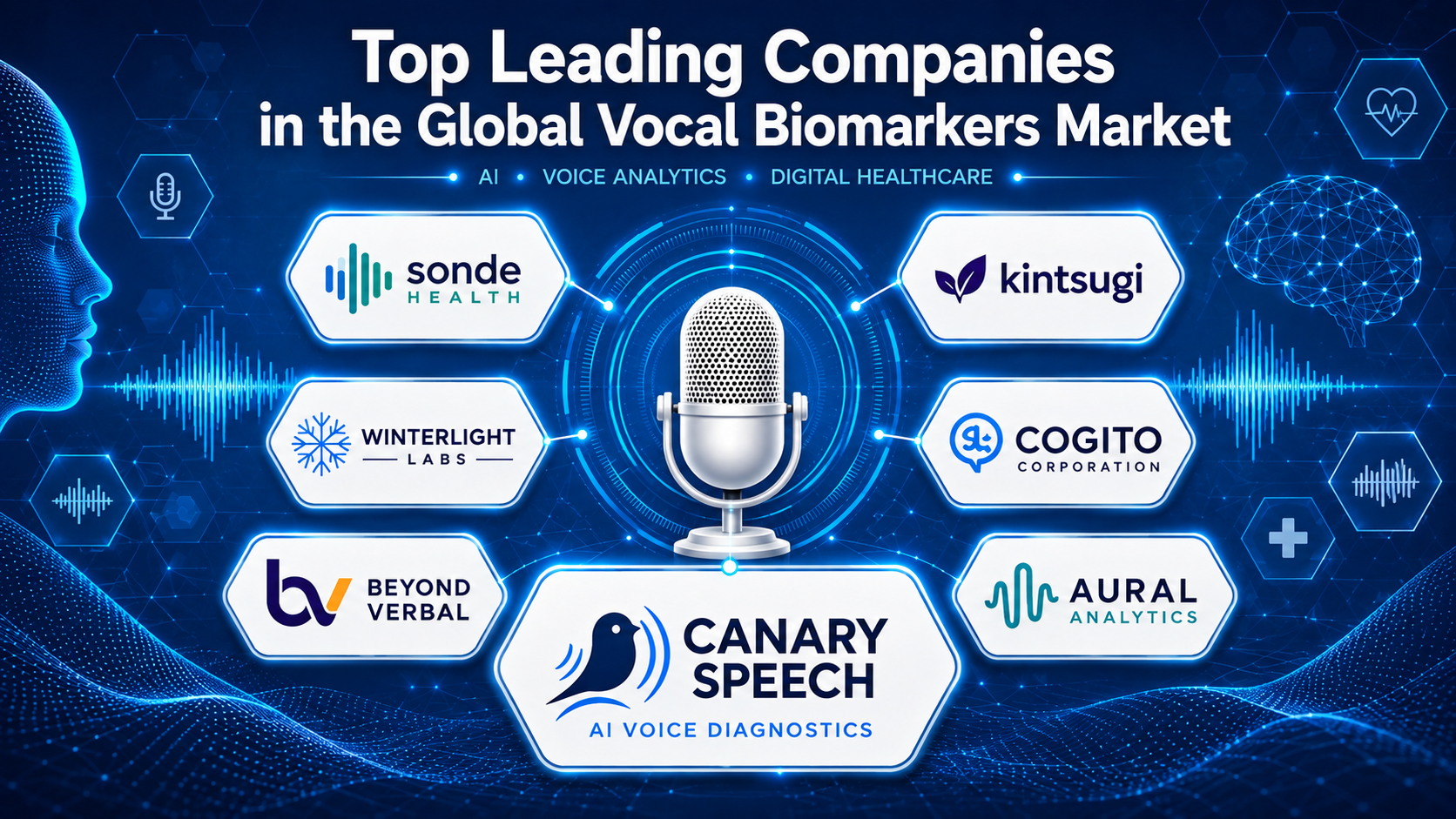
Leading Companies in the Global Vocal Biomarkers Market
Global Vocal Biomarkers Market was valued in the low single-digit billions of dollars in 2026 and is expected to more than triple over the following decade, growing at a compound annual growth rate (CAGR) in the mid-to-high teens. According to one widely cited estimate from SNS Insider, the market stood at approximately USD 0.58 billion in 2023 and is projected to reach USD 2.14 billion by 2032 a CAGR of 5.9% across the 2024–2032 forecast window. Growth is being driven by the rise of telehealth and remote patient monitoring, expanding clinical validation of voice-based screening tools, growing regulatory acceptance of digital biomarkers, and the integration of AI-powered voice analytics into mental health, neurology, and chronic disease care pathways.
Vocal biomarker technology sits at the intersection of digital health, artificial intelligence, and clinical neuroscience, drawing competitors that range from small, founder-led speech-science startups to publicly listed neuroscience technology companies and corporate-venture-backed health tech firms. Understanding which organizations lead this space is essential for digital health investors, pharmaceutical and payer partnership teams, and healthcare technology analysts. This article provides a research-based analysis of the leading companies in the global vocal biomarkers market, their positioning, flagship offerings, and the competitive and regional forces shaping the category.
Market Overview
| Parameter | Details |
|---|---|
| Market Size (2025) | USD 0.58 Billion |
| Projected Market Size (2032) | USD 2.14 Billion |
| CAGR (2024–2032) | 5.9% (comparable estimates across research firms range from roughly 1% to 10%) |
| Leading Region | North America (~5% of 2026 revenue) |
| Fastest-Growing Region | Asia-Pacific |
| Key Growth Drivers | Telehealth and remote patient monitoring adoption, mental health screening demand, AI-powered diagnostics, growing regulatory acceptance of digital biomarkers |
| Key Challenges | Limited large-scale clinical validation, reimbursement and regulatory uncertainty, data privacy concerns, audio-quality and background-noise sensitivity |
| Key Opportunities | Neurological disease monitoring (Parkinson's, Alzheimer's/dementia), respiratory and cardiovascular screening, pharmaceutical clinical-trial endpoints, ambient workplace and call-center monitoring |
Why the Vocal Biomarkers Market Is Growing
1. Expansion of Telehealth and Remote Patient Monitoring
As care increasingly moves outside the clinic, voices offer a way to passively screen and monitor patients using devices they already own, a smartphone or a telehealth call, without additional hardware.
2. Rising Demand for Mental Health Screening
Growing recognition of anxiety, depression, and other behavioral health conditions is pushing payers and providers toward objective, scalable screening tools that can flag risk earlier than periodic clinical visits allow.
3. Advances in AI and Machine Learning
Improvements in deep learning and acoustic feature extraction have made it possible to detect subtle vocal changes tied to disease, changes that would be imperceptible to a human listener, with increasing accuracy from just seconds of speech.
4. Growing Regulatory Acceptance of Digital Biomarkers
Regulatory bodies including the FDA have begun granting clearances and Breakthrough Device designations to voice-based diagnostic tools, lending clinical credibility and opening pathways to reimbursement.
5. Expansion Into Neurological and Cardiovascular Applications
Beyond mental health, vocal biomarkers are increasingly being validated for Parkinson's disease, cognitive decline and dementia, congestive heart failure, and respiratory conditions such as COPD, broadening the addressable clinical market.
6. Integration With Wearables and Ambient Monitoring
Vocal biomarker technology is increasingly being embedded into call-center software, device chipsets, and ambient listening systems, enabling continuous, passive monitoring rather than one-off assessments.
Top 10 Companies in the Vocal Biomarkers Market
1. Sonde Health
| Category | Details |
|---|---|
| Company Name | Sonde Health, Inc. |
| Headquarters | Boston, Massachusetts, U.S. |
| Founded | 2015 (co-founded by PureTech Health) |
| Employees | Approx. 11–50 |
| Funding | Approx. USD 35.25 Million raised to date, including a USD 19.25 Million Series B |
| Company Overview | Sonde Health is a health technology company built around one of the largest health-labeled voice datasets in the industry, with more than 1.2 million voice samples collected from over 85,000 subjects across four continents, used to detect subtle physiological changes in the voice. |
| Key Products | Enterprise vocal biomarker platform covering respiratory conditions (asthma, COPD), mental health (depression, anxiety), and mild cognitive impairment; a voice-based cognitive fitness tracker. |
| Market Position | One of a small number of vocal biomarker companies to secure a U.S. government contract (an SBIR Phase II award to develop voice-based mental health monitoring for U.S. Air Force personnel) and to embed its technology directly into device chipsets. |
| Recent Developments | Continued expansion of enterprise licensing across telehealth, pharmaceutical, and remote-patient-monitoring customers; launch of a voice-based cognitive fitness tracker. |
| Strategic Advantages | Largest labeled multi-condition voice dataset in the sector, multi-vertical licensing model, and backing from PureTech Health's biopharmaceutical research infrastructure. |
2. Canary Speech
| Category | Details |
|---|---|
| Company Name | Canary Speech, Inc. |
| Headquarters | Provo, Utah, U.S. |
| Founded | 2016/2017 |
| Employees | Approx. 11–50 |
| Funding | Approx. USD 22.3 Million raised to date, including a USD 13 Million Series A led by Cortes Capital |
| Company Overview | Canary Speech is an AI-powered voice biomarker company that uses patented, real-time vocal analysis of natural conversation to screen for cognitive and behavioral conditions without disrupting the patient-clinician interaction. |
| Key Products | API-first vocal biomarker platform analyzing just 20 seconds of conversational speech; Canary Ambient, a continuous ambient-listening monitoring tool. |
| Market Position | Named to TIME's list of the World's Top HealthTech Companies in 2025; holds nine issued patents protecting its vocal biomarker technology. |
| Recent Developments | Launch of Canary Ambient continuous monitoring (October 2025) targeting workplace-violence risk detection in healthcare settings; multilingual expansion including a Spanish-language vocal biomarker model developed with SBX. |
| Strategic Advantages | Deep patent portfolio, API-first integration approach that eases enterprise adoption, and strategic partners spanning health systems, telecoms, and pharmaceutical research. |
3. Ellipsis Health
| Category | Details |
|---|---|
| Company Name | Ellipsis Health, Inc. |
| Headquarters | San Francisco, California, U.S. |
| Founded | 2017 |
| Funding | Approx. USD 75 Million raised to date, including a USD 45 Million Series A extension in 2025 |
| Company Overview | Ellipsis Health pioneered a speech-based "voice vital sign" that quantifies depression and anxiety at scale by analyzing both what a patient says (natural language processing) and how they say it (acoustic features). |
| Key Products | Sage, an AI care manager that conducts virtual care-management calls, screens for behavioral health risk, and supports clinical workflows for payers and providers. |
| Market Position | Backed by tier-one investors including Khosla Ventures, Salesforce's Marc Benioff, and CVS Health, with deployments across health plans including Aetna. |
| Recent Developments | Launch of the Sage AI Care Manager product and a USD 45 Million funding round (2025) to accelerate adoption among healthcare providers and payers. |
| Strategic Advantages | Combined acoustic-plus-linguistic detection model, strong payer and provider relationships, and a pivot toward a broader AI care-management platform built on its voice biomarker foundation. |
4. Cambridge Cognition (incl. Winterlight Labs)
| Category | Details |
|---|---|
| Company Name | Cambridge Cognition Holdings plc |
| Headquarters | Cambridge, United Kingdom |
| Founded | Incorporated 2012 (business tracing back over 30 years of cognitive-assessment research); acquired Toronto-based Winterlight Labs (founded 2015) in January 2023 |
| Employees | Approx. 51–200 |
| Revenue | Approx. USD 12.4 Million (trailing twelve months) |
| Company Overview | Cambridge Cognition is a publicly listed (LSE/AIM: COG) digital neuroscience company that measures clinical outcomes in neurological and psychiatric disorders; its 2023 acquisition of Winterlight Labs added free-speech, voice-based cognitive assessment technology to its CANTAB cognitive-testing platform. |
| Key Products | CANTAB cognitive assessment battery; NeuroVocalix/Winterlight voice analysis tool for detecting cognitive change from short, natural speech samples; electronic clinical outcome assessment (eCOA) tools. |
| Market Position | An established, publicly traded supplier to pharmaceutical sponsors and CROs running CNS clinical trials, now expanded into voice-based cognitive and dementia screening through the Winterlight acquisition. |
| Recent Developments | Continued integration of Winterlight's free-speech analysis technology into Cambridge Cognition's broader clinical-trial and healthcare-delivery product suite. |
| Strategic Advantages | Public-company scale and balance sheet, decades of scientific validation behind CANTAB, and an enlarged voice-biomarker offering following consolidation with a specialist acquisition. |
5. audEERING GmbH
| Category | Details |
|---|---|
| Company Name | audEERING GmbH |
| Headquarters | Gilching (Munich), Germany |
| Founded | 2012 (spin-off of the Technical University of Munich) |
| Employees | Approx. 60–70 |
| Ownership | Majority stake acquired by Agile Robots SE in March 2025 |
| Company Overview | audEERING is a German voice-AI company focused on emotion recognition and vocal biomarker analysis, capturing roughly 7,000 acoustic parameters spanning phonatory, articulatory, and prosodic aspects of speech. |
| Key Products | devAIce, a lightweight SDK/Web API for emotion and vocal biomarker detection; AI SoundLab, a GDPR-compliant audio data collection tool; the widely used open-source openSMILE toolkit. |
| Market Position | Positions itself as one of the leading European companies in intelligent audio analysis and emotional AI, with an established client base spanning automotive, healthcare, robotics, and market research. |
| Recent Developments | Majority acquisition by robotics firm Agile Robots SE (2025), extending applications of its voice-analysis technology into robotics and human-machine interaction. |
| Strategic Advantages | Deep academic research roots, broad multi-industry client base (Huawei, BMW, GfK, Red Bull Media House among past and present clients), and privacy-focused data tooling. |
6. Cordio Medical
| Category | Details |
|---|---|
| Company Name | Cordio Medical Ltd. |
| Headquarters | Or Yehuda, Israel |
| Founded | 2013 |
| Funding | Approx. USD 18 Million raised in its most recent round |
| Company Overview | Cordio Medical developed HearO, a smartphone application that analyzes daily speech samples to detect the early buildup of lung fluid associated with congestive heart failure (CHF) deterioration, often more than ten days before clinical symptoms appear. |
| Key Products | HearO, a cloud-based CHF monitoring app validated across three published clinical studies involving more than 700 patients. |
| Market Position | A clinical-cardiology-focused specialist; HearO has received FDA Breakthrough Device designation, positioning Cordio among the more clinically advanced vocal biomarker companies pursuing U.S. regulatory clearance. |
| Recent Developments | Progress toward FDA approval for the CHF indication, with plans to expand into COPD and bipolar disorder monitoring once cleared. |
| Strategic Advantages | Strong peer-reviewed clinical evidence base, a defined cardiology niche with a large addressable patient population, and an active FDA regulatory pathway. |
7. Modality.AI
| Category | Details |
|---|---|
| Company Name | Modality.AI, Inc. |
| Headquarters | San Francisco, California, U.S. |
| Founded | 2018 |
| Employees | Approx. 29 |
| Funding | Approx. USD 5–6 Million raised to date |
| Company Overview | Modality.AI has built a conversational AI platform, featuring a virtual guide named "Tina," that objectively assesses central nervous system (CNS) conditions by analyzing a patient's speech, facial expressions, and motor function during a structured, self-driven conversation. |
| Key Products | A multimodal audio-visual biomarker platform used in pharmaceutical clinical trials for Parkinson's disease, ALS, depression, schizophrenia, and autism spectrum disorder. |
| Market Position | Describes itself as the only commercial technology offering remote, AI-powered audio-visual assessment of neurological and psychiatric conditions for pharma clinical trials, backed by more than 58 peer-reviewed publications. |
| Recent Developments | Ongoing clinical trial collaborations, including studies with the U.S. Department of Veterans Affairs and pharmaceutical sponsors, and the addition of a Chief Medical Officer with a background in Parkinson's disease research. |
| Strategic Advantages | Multimodal (not voice-only) assessment approach, deep integration with pharmaceutical and CRO clinical-trial workflows, and a strong scientific publication record supporting clinical credibility. |
8. Linus Health (incl. Aural Analytics)
| Category | Details |
|---|---|
| Company Name | Linus Health, Inc. |
| Headquarters | Boston, Massachusetts, U.S. |
| Founded | 2019; acquired Scottsdale, Arizona-based Aural Analytics (founded 2015) in March 2024 |
| Employees | 130+ |
| Funding | Approx. USD 105 Million raised to date, including a USD 55 Million Series B (2025) at a USD 420 Million valuation |
| Company Overview | Linus Health is a digital brain-health company that modernizes traditional cognitive assessments (such as the Clock Drawing Test) with AI; its acquisition of Aural Analytics added a clinical-grade speech-analytics platform built on more than 25 years of NIH- and NSF-funded speech-neuroscience research. |
| Key Products | An AI-enhanced digital cognitive assessment platform combining drawing-, speech-, and motor-based tasks to detect early signs of cognitive impairment and Alzheimer's-related pathology. |
| Market Position | One of the best-funded companies in the broader digital cognitive-assessment and vocal-biomarker space, partnering with health systems, life-sciences companies, and research institutions including the Davos Alzheimer's Collaborative. |
| Recent Developments | Closed a USD 55 Million Series B in 2025; published peer-reviewed studies validating its AI as an early digital biomarker for Alzheimer's pathology. |
| Strategic Advantages | Substantial capitalization relative to sector peers, a broadened multimodal (drawing plus speech) cognitive-assessment portfolio following the Aural Analytics acquisition, and strong academic and health-system partnerships. |
Competitive Landscape
The global vocal biomarkers market remains fragmented and largely privately held, populated by venture-backed startups, a handful of larger digital-health platforms built through acquisition, and one publicly listed neuroscience technology company (Cambridge Cognition). No single company yet commands the kind of dominant, diversified position that established players hold in more mature medical device categories.
Clinical Niche Specialization: Most leading companies have concentrated on a specific clinical domain, mental health screening (Ellipsis Health, historically Kintsugi), cognitive decline and dementia (Cambridge Cognition/Winterlight, Linus Health/Aural Analytics), or cardiovascular and respiratory monitoring (Cordio Medical), rather than competing head-to-head across every indication.
Consolidation Is Reshaping the Field: Acquisition activity has already begun reshaping the competitive set. Cambridge Cognition's 2023 purchase of Winterlight Labs and Linus Health's 2024 acquisition of Aural Analytics illustrate how larger, better-capitalized digital-health platforms are absorbing specialist voice-biomarker technology rather than building it from scratch. audEERING's 2025 acquisition by robotics firm Agile Robots signals interest from outside traditional healthcare as well.
Market Volatility Among Early Movers: The category has also seen setbacks. Kintsugi, an early and closely watched mental-health voice-biomarker startup that raised roughly USD 30 million, ceased commercial operations in February 2026 after concluding that U.S. regulatory and reimbursement timelines made the business difficult to sustain, subsequently open-sourcing its models and research. This underscores that clinical promise alone has not guaranteed commercial durability for standalone vocal biomarker companies.
Regulatory Pathway as a Differentiator: Companies pursuing formal regulatory clearance, such as Cordio Medical's FDA Breakthrough Device designation and Sonde Health's SBIR government contracts, are positioning themselves to differentiate on clinical credibility as the category matures beyond consumer wellness applications.
Regional Analysis
North America
North America holds the largest share of the global vocal biomarkers market, accounting for roughly 40% of 2025 revenue, supported by a dense concentration of vocal biomarker startups, well-developed telehealth infrastructure, and substantial venture capital investment in AI-driven digital health.
Europe
Germany and the U.K. anchor European activity, home to established players such as audEERING and Cambridge Cognition, supported by strong academic research ecosystems in computational linguistics and cognitive neuroscience.
Asia-Pacific
Asia-Pacific is expected to register the fastest growth over the forecast period, driven by expanding telehealth adoption, rising healthcare digitization, and growing investment in AI-powered diagnostics across China, Japan, and South Korea.
Middle East and Rest of World
Israel has emerged as a notable hub for vocal biomarker innovation, home to companies including Cordio Medical and the now-merged Beyond Verbal and Healthymize (Vocalis Health), reflecting the country's broader digital-health and AI startup ecosystem.
Emerging Trends in the Vocal Biomarkers Market
1. Multimodal Convergence: Companies are increasingly pairing voice analysis with facial expression, motor function, and drawing-based assessments (as seen at Modality.AI and Linus Health) rather than relying on voice alone.
2. Ambient and Continuous Monitoring: Products such as Canary Ambient signal a shift from one-off vocal assessments toward continuous, passive monitoring embedded in everyday interactions like call-center conversations.
3. Consolidation Around Capitalization: As standalone startups face reimbursement and regulatory hurdles, better-funded platforms are acquiring specialist vocal-biomarker technology to add capability rather than compete from scratch.
4. Expanding Regulatory Engagement: More companies are pursuing FDA clearances and Breakthrough Device designations, moving the category from consumer wellness positioning toward clinical-grade diagnostic tools.
5. Open-Sourcing as an Exit Strategy: Kintsugi's decision to release its models and research publicly after ceasing commercial operations may set a precedent for how promising but commercially strained voice-biomarker technology gets preserved for the research community.
Future Outlook (2024–2032)
The vocal biomarkers market's trajectory toward roughly USD 214 billion by 2032 reflects durable structural tailwinds: the continued shift of care outside the clinic, growing acceptance of AI in clinical decision support, and expanding indications beyond mental health into neurology, cardiology, and respiratory medicine. At the same time, the sector's relatively small current revenue base and the recent closure of a well-funded, clinically validated player like Kintsugi are reminders that commercial durability, not just scientific promise, will determine which companies capture this growth.
Companies that combine clinical validation, a defined regulatory pathway, and either sufficient capitalization or a strategic acquirer, such as Sonde Health, Canary Speech, Cambridge Cognition, Linus Health, and Cordio Medical, appear best positioned to lead the category through the next decade, while further consolidation among smaller specialist startups is likely as the market matures.
Frequently Asked Questions (FAQ)
1. What is the current size of the global vocal biomarkers market?
Estimates vary by research firm and market-scope definition, but a widely cited figure places the market at approximately USD 1.59 billion in 2025, projected to reach USD 6.22 billion by 2035 at a CAGR of roughly 14.6%. Other research firms estimate figures ranging from about USD 0.5 billion to USD 3.4 billion for 2024–2025, reflecting differences in which technologies and indications are counted.
2. Who are the leading companies in the vocal biomarkers market?
Leading companies include Sonde Health, Canary Speech, Ellipsis Health, Cambridge Cognition (which acquired Winterlight Labs), audEERING, Cordio Medical, Modality.AI, and Linus Health (which acquired Aural Analytics).
3. Which region leads the vocal biomarkers market?
North America leads in revenue share, accounting for roughly 40% of the global market in 2025, while Asia-Pacific is expected to register the fastest growth over the forecast period.
4. What conditions can vocal biomarkers help detect?
Current and emerging applications include depression and anxiety, Parkinson's disease, cognitive decline and dementia, congestive heart failure, COPD and other respiratory conditions, and general behavioral or emotional state monitoring.
5. What are the main challenges facing the vocal biomarkers industry?
Key challenges include the need for larger-scale clinical validation, regulatory and reimbursement uncertainty, data privacy concerns around voice data, and sensitivity to background noise and audio quality in real-world settings, all of which have contributed to commercial setbacks for some early-stage companies.
6. Has any major vocal biomarker company failed or been acquired?
Yes. Kintsugi, a well-funded mental-health voice-biomarker startup, ceased commercial operations in February 2026 and open-sourced its technology after concluding the regulatory and reimbursement path was too costly to sustain as a standalone business. Meanwhile, Winterlight Labs was acquired by Cambridge Cognition in 2023, Aural Analytics was acquired by Linus Health in 2024, and audEERING was majority-acquired by Agile Robots in 2025, illustrating an active consolidation trend.
7. What is driving growth in the vocal biomarkers market?
Primary growth drivers include expanding telehealth and remote patient monitoring, rising demand for objective mental health screening tools, advances in AI-based acoustic analysis, and growing regulatory acceptance of digital biomarkers, including FDA clearances and Breakthrough Device designations.
Conclusion
The global vocal biomarkers market sits at the intersection of digital health, artificial intelligence, and clinical neuroscience, a young but fast-growing category projected to more than triple in size by 2035. Unlike more mature medical technology markets, leadership here is still being decided: some early pioneers have consolidated into larger, better-capitalized platforms, while at least one prominent, clinically validated startup has already ceased commercial operations despite raising tens of millions of dollars.
Companies led by Sonde Health, Canary Speech, Ellipsis Health, Cambridge Cognition, audEERING, Cordio Medical, Modality.AI, and Linus Health are not just building voice-analysis algorithms, they are actively navigating clinical validation, regulatory clearance, and reimbursement pathways to prove that vocal biomarkers can become a durable part of mainstream healthcare rather than a promising but commercially fragile niche. The organizations that successfully balance scientific rigor, regulatory strategy, and capital efficiency will define market leadership through 2035 and beyond.