
Leading Companies in the Global WebRTC Market
Author:
Intellectual Market Insights Research
Published Date:
30 Sep 2026
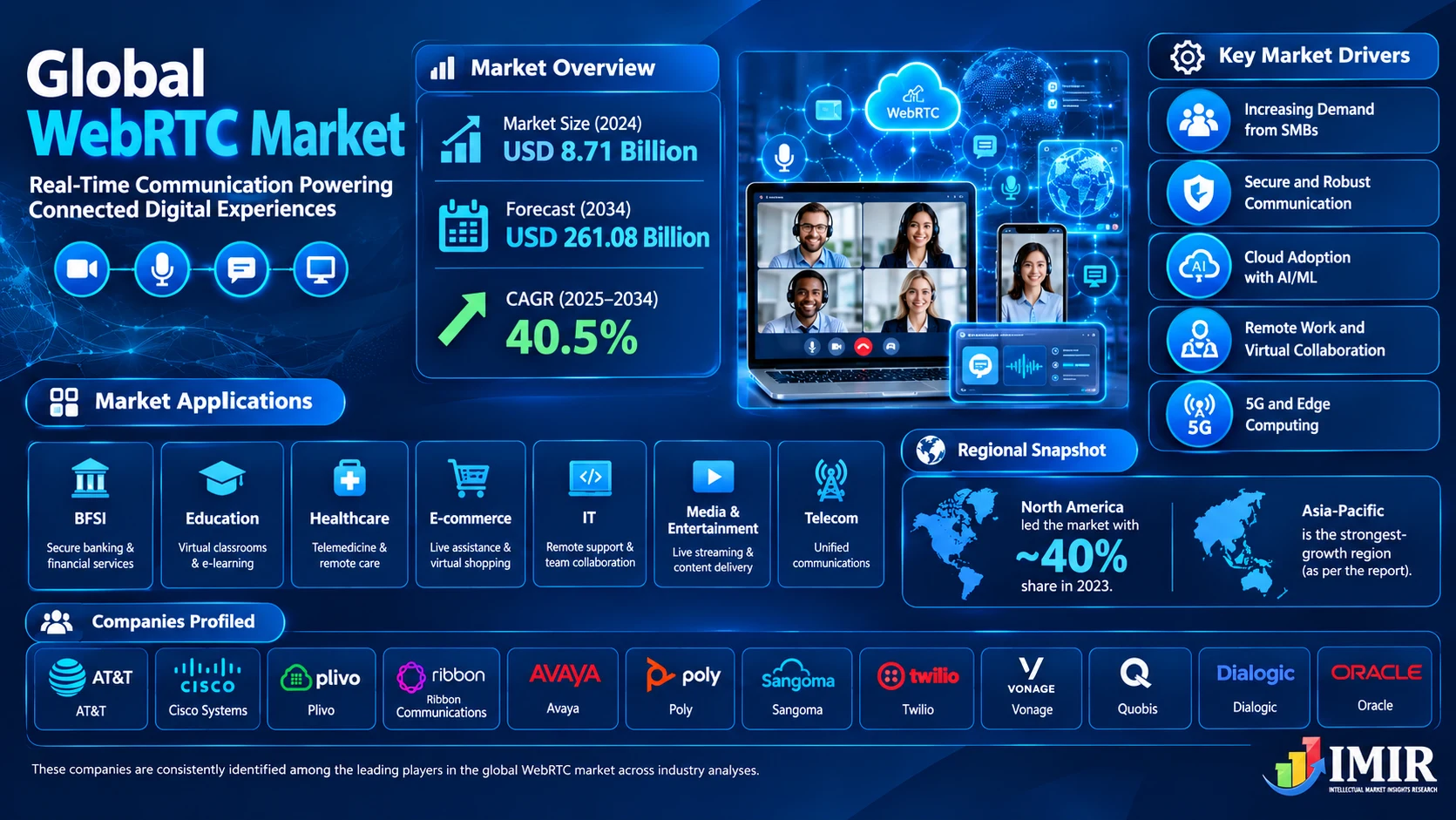
Global WebRTC Market: Top Companies, Trends, and Future Outlook
Introduction
WebRTC (Web Real-Time Communication) is an open-source technology standard that enables real-time voice, video, and data-sharing capabilities directly within web browsers and mobile applications, without requiring plugins, downloads, or proprietary software. Originally developed by Google and standardized alongside Mozilla and other browser makers, WebRTC now underpins a vast share of the video calling, live streaming, voice messaging, and file-sharing features embedded in everyday consumer and enterprise applications.
The global WebRTC market spans voice calling and conferencing, messaging and file sharing, and video calling and conferencing solutions, deployed across on-premises and cloud-based architectures for small, medium, and large enterprises in IT and telecom, BFSI, retail, healthcare, media and entertainment, and public sector verticals. This article provides a research-based analysis of the global WebRTC market, the companies shaping it, and the technological forces driving its growth toward the mid-2030s.
Market Overview
Published estimates for the global WebRTC market vary substantially by research provider and scope, but converge on a picture of very rapid growth from a base in the high single-digit to mid-teens of billions of dollars:
| Parameter | Details |
|---|---|
| Market Size (2024–2025) | Approx. USD 7–15 Billion (estimates vary meaningfully by source and scope) |
| Projected Market Size (2032–2034) | Approx. USD 67–189 Billion (estimates vary meaningfully by source and scope) |
| CAGR | Approx. 20%–39% (estimates vary widely; several sources cluster around 35–39%) |
| Leading Region | North America (largest share, approx. 37–39%); Asia-Pacific (fastest growth) |
| Key Segments (by Solution) | Voice Calling & Conferencing, Messaging & File Sharing, Video Calling & Conferencing, Others |
| Key Segments (by Deployment Mode) | On-Premises, Cloud-Based |
| Key Segments (by Enterprise Size) | Small and Medium Enterprises, Large Enterprises (Large Enterprises held over 68% share in 2023 per one estimate) |
| Key Segments (by Vertical) | IT & Telecom, BFSI, Retail, Public Sector, Media & Entertainment, Manufacturing, Healthcare, Others |
Why the estimates differ so widely: the spread in published figures (from roughly USD 7 billion to USD 15 billion for the base year, and CAGRs from 20% to nearly 40%) largely reflects differences in scope, i.e., whether a study counts only dedicated WebRTC platform vendors and APIs, or the much broader universe of applications (video conferencing tools, telehealth platforms, in-app calling features, etc.) that embed WebRTC as an underlying technology. Every major forecaster agrees on the direction: this is one of the fastest-growing categories in enterprise communications software.
Why the WebRTC Market Is Growing
1. Surge in Video Conferencing and Remote Collaboration
The lasting shift toward remote and hybrid work has embedded video conferencing and real-time collaboration tools into everyday business operations, sustaining strong underlying demand for the WebRTC technology that powers most browser-based calling features.
2. Rising Mobile Application Adoption and Digitalization
Increased adoption of mobile applications, combined with the broader wave of digitalization sweeping most industries, continues to expand the number of apps embedding real-time voice, video, and messaging features built on WebRTC.
3. Embedded Communication in Vertical-Specific Applications
Industries such as telehealth, e-commerce customer support, on-demand services, and BFSI increasingly embed real-time voice and video communication directly into their own applications rather than routing users to third-party calling apps, driving demand for developer-friendly WebRTC APIs and SDKs.
4. Growth of Live Interactive Streaming and Social Audio
Rising popularity of live interactive streaming, social audio rooms, and creator-economy applications continues to expand demand for low-latency, real-time engagement infrastructure built on WebRTC.
5. Enterprise Investment in AI-Driven Compliance and Integration
Growing investment in AI-driven compliance monitoring, corporate single sign-on, and knowledge-base integration is deepening WebRTC specialization and penetration within large enterprises, particularly Fortune 500 companies.
6. Full-Stack Platform Competition Driving Innovation
The WebRTC market's moderate concentration, with full-stack platform providers competing against niche specialists, continues to drive rapid feature innovation, competitive pricing, and expanding use-case coverage across the ecosystem.
Market Opportunities & Restraints
A key opportunity lies in embedded, developer-first communication APIs: as more industries seek to build real-time voice, video, and messaging directly into their own applications rather than relying on third-party tools, WebRTC API and SDK providers have significant opportunity to capture recurring, usage-based revenue by making real-time communication a simple, embeddable building block rather than a standalone product, a model already validated at scale by full-stack platform providers. On the restraint side, network reliability, quality-of-service, and security/compliance complexity remain primary headwinds, as WebRTC applications can be sensitive to network conditions and require careful engineering to maintain call quality at scale, while enterprises in regulated industries such as BFSI and healthcare demand robust encryption, compliance certifications, and audit capabilities that add engineering complexity and cost for smaller providers.
Companies Associated with the WebRTC Market
| Company | Headquarters | Founded | Employees | Revenue | Overview |
|---|---|---|---|---|---|
| Agora, Inc. | Santa Clara, California, USA | 2014 | Approx. 1,200 | Approx. USD 150 Million (2024) | Real-time engagement platform powering voice, video, and live interactive streaming via Programmable Video and Voice SDKs. |
| Twilio Inc. | San Francisco, California, USA | 2008 | Approx. 5,587 | Approx. USD 5.07 Billion (2025) | Leading CPaaS provider offering programmable voice, video, messaging, and WebRTC-based communication APIs. |
| Vonage Holdings Corp. (Ericsson) | Holmdel, New Jersey, USA | 2001 | Approx. 2,000–2,800 | Approx. USD 1.2–1.4 Billion | WebRTC-powered communications API suite; now a subsidiary of Ericsson following its 2022 acquisition. |
| Cisco Systems, Inc. | San Jose, California, USA | 1984 | Approx. 80,000+ | Multi-billion dollar diversified company | Integrates WebRTC into its Webex collaboration platform and broader unified communications portfolio. |
| Oracle Corporation | Austin, Texas, USA | 1977 | Approx. 160,000+ | Multi-billion dollar diversified company | Advanced cloud-based communications platforms integrating WebRTC for secure, scalable business communication. |
| AT&T Inc. | Dallas, Texas, USA | 1983 | Approx. 140,000+ | Multi-billion dollar diversified company | Major telecom presence in WebRTC-based API and enterprise communications initiatives. |
| 8x8, Inc. | Campbell, California, USA | 1987 | Approx. 1,900+ | Approx. USD 500+ Million | Cloud communications and contact center company offering unified communications and CPaaS built on WebRTC. |
| Google LLC | Mountain View, California, USA | 1998 | Tens of thousands (Alphabet) | Multi-billion dollar diversified company | Original developer of WebRTC; drives adoption through Chrome and continued open-source project stewardship. |
| Dyte | Bengaluru, India | 2020 | Startup scale | Not publicly disclosed | Rising innovator providing customizable SDKs for video calling, streaming, and collaboration tools in emerging markets. |
| Temasys | Singapore | 2013 | Small specialized team | Not publicly disclosed | Provides WebRTC infrastructure and SDKs for enterprises seeking embedded real-time communication features. |
Competitive Landscape
The global WebRTC market demonstrates moderate concentration, with full-stack platform providers competing against niche specialists. Established CPaaS and full-stack platform leaders Twilio, Vonage, and Agora hold particularly strong positions, having built developer-friendly APIs and SDKs that make embedding real-time voice, video, and messaging into third-party applications straightforward, backed by broad global infrastructure and customer bases. Diversified technology and telecom giants Cisco, Oracle, AT&T, and Google integrate WebRTC into much larger collaboration, cloud, and telecom platforms, leveraging existing enterprise relationships rather than competing purely on WebRTC-specific features; Google in particular occupies a unique position as WebRTC's original developer and open-source steward. Emerging and specialized providers Dyte and Temasys compete through deep customization, competitive pricing, and focus on specific enterprise or emerging-market use cases, illustrating how the market remains open to newer entrants despite the presence of well-capitalized incumbents. The 2022 acquisition of Vonage by Ericsson illustrates a broader trend of telecom infrastructure companies acquiring cloud communications platforms to add software-based, API-driven revenue streams to traditional network equipment and carrier services businesses.
Regional Analysis
North America
North America dominates the global WebRTC market, holding an estimated 37–39% revenue share, driven by early enterprise adoption of cloud communications, the presence of leading platform providers such as Twilio, Vonage, Cisco, Oracle, AT&T, and Google, and strong IT and telecom sector demand for embedded real-time communication.
Europe
Europe represents a significant WebRTC market, supported by strong enterprise digitalization initiatives and telecom sector investment, with Ericsson's ownership of Vonage reflecting the region's growing stake in the cloud communications platform space.
Asia-Pacific
Asia-Pacific is expected to register the fastest growth, driven by rapid mobile application adoption, rising digitalization across emerging economies such as India and China, and the presence of innovative regional providers such as Dyte (India) and Temasys (Singapore).
Latin America & Middle East and Africa
Latin America and the Middle East & Africa represent emerging growth markets for WebRTC, with adoption tied to expanding mobile internet penetration, growing digital service adoption, and increasing enterprise investment in embedded communication technology.
Emerging Trends in the WebRTC Market
1. AI-Driven Compliance and Enterprise Integration: Growing investment in AI-driven compliance monitoring, corporate single sign-on, and knowledge-base integration is deepening WebRTC specialization within large enterprises, particularly Fortune 500 companies seeking more sophisticated, compliant communication infrastructure.
2. Consolidation Through Telecom-Cloud Communications Acquisitions: Ericsson's 2022 acquisition of Vonage illustrates a broader trend of telecom infrastructure companies acquiring cloud communications platforms to diversify into software-based, API-driven revenue streams.
3. Growth of Embedded, Developer-First Communication APIs: The continued rise of CPaaS (Communications Platform as a Service) models, led by providers such as Twilio and Agora, reflects the industry's shift toward treating real-time communication as an embeddable building block rather than a standalone application.
4. Expansion of Live Interactive Streaming and Social Audio: Rising popularity of live interactive streaming and social audio applications continues to expand demand for low-latency, real-time engagement infrastructure built on WebRTC technology.
5. Emergence of Regional and Vertical-Specific Innovators: Companies such as Dyte in India and Temasys in Singapore illustrate the growing trend of regional and vertical-specific WebRTC innovators competing alongside global full-stack platform providers.
Future Outlook (2025–2034)
Given the wide range of published forecasts for this market (from roughly USD 67 billion to USD 189 billion by the early-to-mid 2030s, at CAGRs of approximately 20% to 39%), the underlying consensus across independent research is that WebRTC-enabled communication will continue to grow very rapidly through 2034, driven by the compounding effects of rising mobile and digital adoption, growing enterprise integration of embedded communication, and the expansion of use cases from basic voice and video calling into live streaming, social audio, and AI-enhanced collaboration tools.
Key investment themes for 2025–2034 include continued CPaaS platform expansion by leaders such as Twilio, Vonage, and Agora, deepening WebRTC integration into broader enterprise collaboration and cloud platforms by Cisco, Oracle, and Google, and continued emergence of regional and vertical-specific innovators such as Dyte and Temasys. As AI-driven compliance features, live interactive streaming, and continued telecom-cloud communications consolidation reshape the industry, the companies that combine developer-friendly, embeddable communication APIs with enterprise-grade reliability and compliance will be best positioned to capture growth through 2034.
Frequently Asked Questions (FAQ)
1. What is the current size of the global WebRTC market?
Published estimates vary substantially by source and scope, ranging from approximately USD 7 billion to USD 15 billion for the 2024/2025 base year, with projections reaching anywhere from USD 67 billion to USD 189 billion by 2032–2034, at CAGRs ranging from approximately 20% to nearly 40% depending on the research provider and market definition used.
2. Who are the top companies in the WebRTC market?
Leading companies include Agora, Inc., Twilio Inc., Vonage Holdings Corp. (now part of Ericsson), Cisco Systems, Inc., Oracle Corporation, AT&T Inc., 8x8, Inc., Google LLC, Dyte, and Temasys.
3. Which region dominates the WebRTC market?
North America dominates the global WebRTC market with an estimated 37–39% revenue share, while Asia-Pacific is expected to register the fastest growth, driven by rapid mobile application adoption and digitalization across emerging economies.
4. What is the forecast CAGR for the WebRTC market?
Independent research estimates range widely from approximately 20% to nearly 40% CAGR depending on the source and market scope used, reflecting significant differences in how narrowly or broadly the market is defined.
5. What are the main growth drivers for this market?
Key drivers include the surge in video conferencing and remote collaboration, rising mobile application adoption and digitalization, embedded communication in vertical-specific applications, growth of live interactive streaming, and enterprise investment in AI-driven compliance and integration.
6. What solutions make up the WebRTC market?
The market is segmented by solution into voice calling and conferencing, messaging and file sharing, and video calling and conferencing, deployed across on-premises and cloud-based architectures.
7. What is WebRTC and who developed it?
WebRTC (Web Real-Time Communication) is an open-source technology standard originally developed by Google that enables real-time voice, video, and data-sharing capabilities directly within web browsers without requiring plugins or additional software.
Conclusion
The global WebRTC market sits at the intersection of surging demand for embedded, real-time communication and the broader digital transformation sweeping virtually every industry. While published size and growth estimates vary widely depending on market scope, every major forecaster agrees this remains one of the fastest-growing categories in enterprise communications software, with growth extending well into the 2030s.
Twilio, Vonage, and Agora continue to lead through developer-friendly CPaaS platforms that make real-time communication easy to embed into any application, while Cisco, Oracle, AT&T, and Google integrate WebRTC into much broader enterprise and consumer technology ecosystems. As AI-driven compliance features, live streaming expansion, and continued telecom-cloud consolidation reshape the industry, the companies that combine embeddable, developer-first communication APIs with enterprise-grade reliability will define market leadership through 2034 and beyond.