
Leading Companies of Global Wood Adhesives Market
Author:
Intellectual Market Insights Research
Published Date:
10 Sep 2026
Introduction
Wood adhesives form the invisible backbone of the global furniture, flooring, and construction industries, bonding wood substrates together to create everything from engineered wood panels and plywood to finished furniture, doors, and windows. Formulated to deliver high bonding strength, moisture and temperature resistance, and compatibility across a range of wood types, these adhesives come in liquid, solid, and hot-melt forms tailored to specific manufacturing and assembly requirements.
The global wood adhesives market spans a range of resin chemistries, including urea-formaldehyde (UF), melamine-urea-formaldehyde (MUF), phenol-formaldehyde (PF), isocyanates, polyurethane, polyvinyl acetate (PVA), and soy-based adhesives, deployed across flooring, furniture, window and door manufacturing, and housing component applications. This article provides a research-based analysis of the global wood adhesives market, the companies shaping it, and the regional and technological forces driving its growth toward 2035.
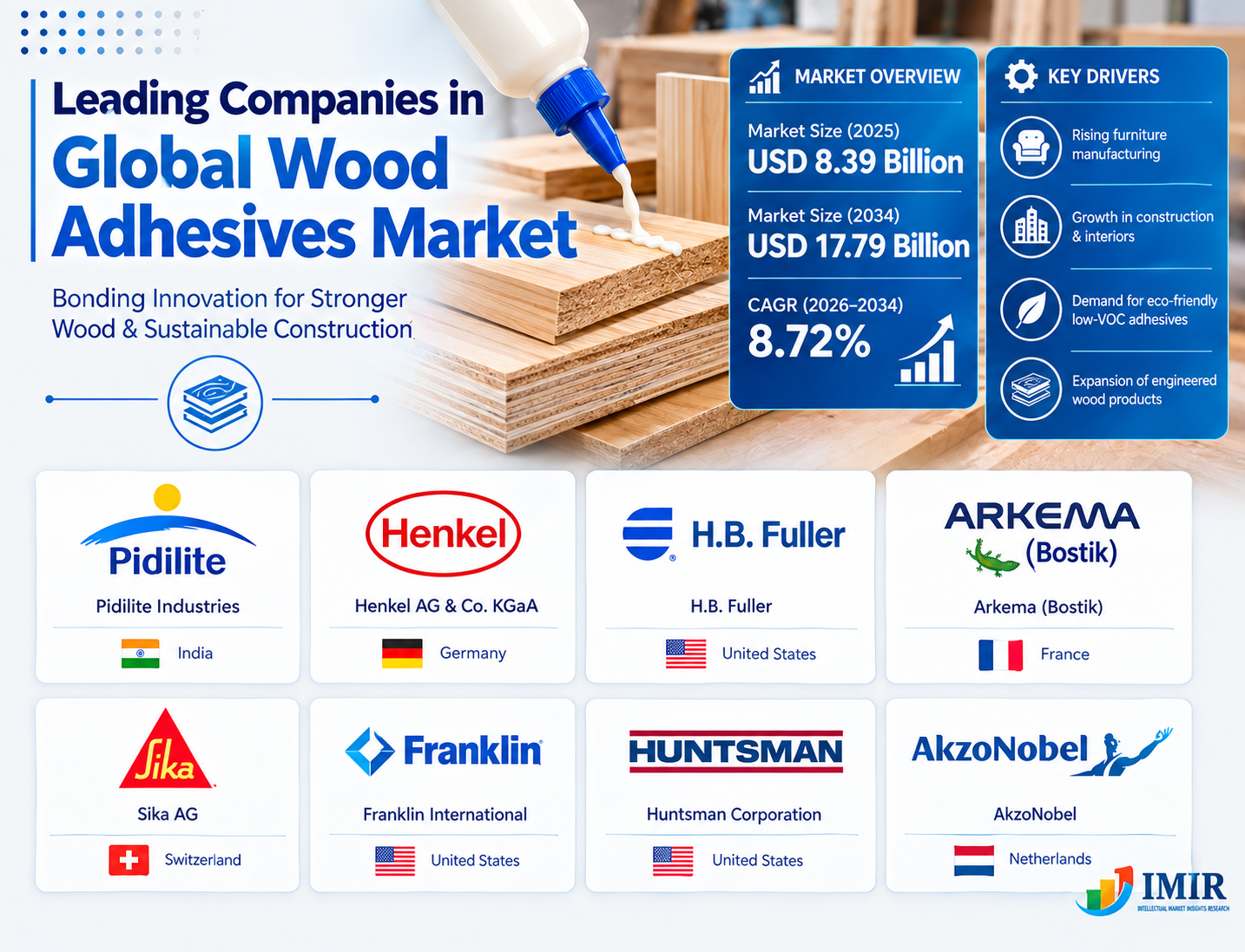
Market Overview
|
Parameter |
Details |
|---|---|
|
Market Size (2025) |
USD 4.5 Billion |
|
Projected Market Size (2035) |
USD 7.9 Billion |
|
CAGR (2026–2034) |
5.9% |
|
Base Year |
2025 |
|
Forecast Period |
2026–2034 |
|
Leading Region |
Asia-Pacific (largest share); North America and Europe (steady growth) |
|
Key Segments (by Type) |
Urea-formaldehyde (UF), Melamine-urea-formaldehyde (MUF), Phenol-formaldehyde (PF), Isocyanates, Polyurethane, Polyvinyl Acetate (PVA), Soy-based, Others |
|
Key Segments (by Application) |
Flooring, Furniture, Window and Doors, Housing Components, Others |
Why the Wood Adhesives Market Is Growing
Booming Global Construction Industry
Rapid urbanization, population growth, and infrastructure development are driving sustained demand for engineered wood products, structural panels, and wood-based building components, each of which relies heavily on high-performance wood adhesives.
Rising Demand for Engineered Wood Products
Growing preference for plywood, oriented strand board (OSB), and particleboard over solid wood, driven by cost efficiency and sustainability considerations, is expanding the addressable market for wood adhesive formulations tailored to these engineered products.
Growth in Furniture Manufacturing
Rising disposable incomes and growing demand for quality wooden furniture, particularly in emerging economies across Asia-Pacific, are fueling demand for furniture-grade adhesives with strong bonding performance and aesthetic compatibility.
Regulatory Pressure Toward Low-Formaldehyde and Eco-Friendly Formulations
Increasingly stringent regulations on formaldehyde emissions are pushing manufacturers toward soy-based, polyvinyl acetate, and other low-emission adhesive technologies, opening opportunities for innovation in sustainable bonding chemistry.
Expansion of Do-It-Yourself (DIY) and Home Renovation Activity
Growing consumer interest in home improvement and DIY woodworking projects is driving demand for consumer-grade wood glues and adhesives sold through retail and hardware channels.
Technological Advancements in Adhesive Performance
Continuous innovation in resin chemistry is improving bond strength, moisture resistance, and curing speed, allowing wood adhesives to meet the performance demands of modern manufacturing processes and more demanding structural applications.
Market Opportunities & Restraints
A key opportunity lies in sustainable and bio-based adhesive innovation: rising demand for durable, eco-friendly bonding solutions is opening space for soy-based and other bio-derived adhesive chemistries that meet tightening formaldehyde emission regulations while maintaining the performance characteristics manufacturers require, particularly as builders and furniture makers increasingly market their products on sustainability credentials. On the restraint side, volatile raw material prices remain the primary headwind, as wood adhesives rely on petrochemical-derived resins and other inputs whose costs fluctuate with broader commodity markets, squeezing manufacturer margins and complicating long-term pricing strategies, particularly for smaller regional producers without the scale to hedge input cost volatility.
Companies Associated with the Wood Adhesives Market
- Henkel AG & Co. KGaA
- H.B. Fuller Company
- Arkema Group (Bostik)
- Sika AG
- Franklin International (Titebond)
- 3M Company
- Ashland Global Holdings Inc.
- Wacker Chemie AG
- Jowat SE
- Pidilite Industries Ltd.
Henkel AG & Co. KGaA
|
Category |
Details |
|---|---|
|
Headquarters |
Düsseldorf, Germany |
|
Founded |
1876 |
|
Employees |
Approx. 47,000+ (group-wide) |
|
Revenue |
Approx. EUR 21.5 Billion (total company, 2024); Adhesive Technologies segment approx. EUR 10.7–11 Billion |
|
Overview |
Henkel’s Adhesive Technologies business is one of the largest adhesives suppliers in the world, serving industries including automotive, electronics, packaging, and building and construction under brands such as Loctite, Technomelt, and Ceresit. |
|
Recent Developments |
In January 2026, Henkel signed an agreement to acquire ATP Adhesive Systems, a Swiss manufacturer of high-performance water-based specialty tapes, further strengthening its adhesive technologies portfolio |
H.B. Fuller Company
|
Category |
Details |
|---|---|
|
Headquarters |
St. Paul, Minnesota, USA |
|
Founded |
1887 |
|
Employees |
Approx. 7,100 |
|
Revenue |
Approx. USD 3.47 Billion (2025) |
|
Overview |
H.B. Fuller is a global leader in adhesive technologies, manufacturing more than 20,000 products across construction, engineering, hygiene, packaging, and woodworking applications from 77+ facilities worldwide. |
|
Recent Developments |
Continues to be recognized as one of the largest adhesives and sealants manufacturers globally, with its Construction Adhesives division serving woodworking and building material customers across more than 30 market segments. |
Arkema Group (Bostik)
|
Category |
Details |
|---|---|
|
Headquarters |
Colombes, France (Bostik: Puteaux, France) |
|
Founded |
1889 (Bostik); acquired by Arkema in 2015 |
|
Employees |
Approx. 7,000 (Bostik) |
|
Revenue |
Approx. EUR 2.7 Billion (Bostik segment, 2024) |
|
Overview |
Bostik, Arkema’s Adhesive Solutions segment, is a leading global adhesives and sealants specialist serving construction, industrial, and consumer markets from more than 45 countries. |
|
Recent Developments |
Continues integrating its 2025 acquisition of Ashland’s Performance Adhesives business and has expanded its pressure-sensitive adhesives offering, leveraging Arkema’s broader specialty materials portfolio. |
Sika AG
|
Category |
Details |
|---|---|
|
Headquarters |
Baar, Switzerland |
|
Founded |
1910 |
|
Employees |
Approx. 34,000+ |
|
Revenue |
Approx. CHF 11–12 Billion |
|
Overview |
Sika is a global specialty chemicals company supplying adhesives, sealants, and construction chemicals, including wood-bonding and flooring adhesive solutions used across construction and industrial manufacturing. |
|
Recent Developments |
Continues expanding its global manufacturing footprint through targeted acquisitions, strengthening its position in construction and industrial adhesive segments. |
Franklin International (Titebond)
|
Category |
Details |
|---|---|
|
Headquarters |
Columbus, Ohio, USA |
|
Founded |
1935 (as The Franklin Glue Company) |
|
Employees |
Approx. 400–500 |
|
Revenue |
Approx. USD 128.8 Million |
|
Overview |
Franklin International is a fourth-generation family-owned manufacturer and among the largest privately held adhesive companies in the United States, best known for its Titebond brand of wood glues, construction adhesives, and sealants. |
|
Recent Developments |
Celebrated its 90th anniversary in 2025, having grown from a single Columbus, Ohio facility into a company distributing products across more than 60 countries through its Construction and Industrial (Franklin Adhesives & Polymers) divisions. |
Competitive Landscape
The global wood adhesives market brings together a mix of large diversified specialty chemical companies and focused adhesive manufacturers. Global specialty chemical majors Henkel, H.B. Fuller, Arkema (Bostik), and Sika hold particularly strong positions, built on broad adhesive technology portfolios spanning construction, industrial, and consumer applications alongside dedicated wood-bonding product lines. Focused adhesive and sealant specialists such as Franklin International (Titebond) compete through deep category focus, strong brand recognition among woodworkers and contractors, and family-owned agility in the North American market. A broader base of diversified chemical and specialty players, including 3M, Ashland, Wacker Chemie, Jowat, and Pidilite Industries, round out the competitive field, competing on resin chemistry innovation, regional manufacturing footprint, and price-competitive positioning across the fragmented global wood adhesives supply base.
Regional Analysis
North America
North America remains a mature and steady wood adhesives market, supported by established furniture manufacturing, home construction, and renovation activity, along with the presence of major players such as H.B. Fuller and Franklin International.
Europe
Europe features a well-established wood adhesives market, driven by strong furniture and construction industries in Germany, France, and the UK, alongside strict environmental regulations pushing continued innovation in low-formaldehyde adhesive chemistries.
Asia-Pacific
Asia-Pacific holds the largest and fastest-growing share of the wood adhesives market, driven by rapid urbanization, expanding furniture manufacturing capacity, and rising construction activity across economies such as China, India, and Southeast Asia.
Latin America & Middle East and Africa
Latin America and the Middle East & Africa represent emerging growth markets for wood adhesives, with demand tied to expanding construction activity, growing furniture manufacturing capacity, and rising urbanization across the regions.
Emerging Trends in the Wood Adhesives Market
1. Shift Toward Bio-Based and Soy-Based Adhesives: Growing regulatory and consumer pressure around formaldehyde emissions is accelerating adoption of soy-based and other bio-derived adhesive chemistries as alternatives to traditional formaldehyde-based resins.
2. Growth of Engineered Wood Products: Rising demand for plywood, oriented strand board, and particleboard is driving continued innovation in adhesives specifically engineered for these composite wood product manufacturing processes.
3. Consolidation Among Global Adhesive Manufacturers: Continued acquisition activity, such as Arkema/Bostik’s integration of Ashland’s Performance Adhesives business and Henkel’s planned acquisition of ATP Adhesive Systems, reflects ongoing consolidation as larger players seek to broaden their specialty adhesive portfolios.
4. Rising DIY and Home Renovation Demand: Growing consumer interest in home improvement projects continues to support demand for retail wood glue and adhesive products, benefiting established consumer brands such as Titebond.
5. Focus on Low-VOC and Sustainable Formulations: Manufacturers are increasingly prioritizing zero and ultra-low formaldehyde- and VOC-emitting resin chemistries to secure preferential customer purchase and meet tightening global emissions standards.
Future Outlook (2026–2034)
The global wood adhesives market’s trajectory toward USD 7.9 billion by 2035 reflects steady, construction- and furniture-driven growth across a diverse range of resin chemistries and applications. The 5.9% CAGR forecast through 2035 assumes continued global construction activity, growing engineered wood product adoption, and ongoing innovation in low-emission, sustainable adhesive formulations.
Key investment themes include continued portfolio expansion and consolidation among global specialty chemical majors such as Henkel, H.B. Fuller, Arkema, and Sika, sustained brand strength among focused specialists like Franklin International in the consumer and woodworking segment, and growing demand for bio-based and low-formaldehyde adhesive technologies as environmental regulations tighten worldwide. As Asia-Pacific construction and furniture manufacturing activity continues to expand, the companies that combine global manufacturing scale with sustainable formulation innovation will be best positioned to capture growth through 2035.
Frequently Asked Questions (FAQ)
1. What is the current size of the global wood adhesives market?
The global wood adhesives market was valued at approximately USD 4.5 billion in 2025 and is projected to reach approximately USD 7.9 billion by 2035, growing at a CAGR of approximately 5.9% from 2024 to 2035, based on independent industry research.
2. Who are the top companies in the wood adhesives market?
Leading companies include Henkel AG & Co. KGaA, H.B. Fuller Company, Arkema Group (Bostik), Sika AG, Franklin International (Titebond), 3M Company, Ashland Global Holdings, Wacker Chemie AG, Jowat SE, and Pidilite Industries Ltd.
3. Which region dominates the wood adhesives market?
Asia-Pacific holds the largest share of the wood adhesives market, driven by rapid urbanization and expanding furniture manufacturing and construction activity in economies such as China and India.
4. What is the forecast CAGR for the wood adhesives market?
The market is forecast to grow at a CAGR of approximately 5.9% from 2026 to 2034.
5. What are the main growth drivers for this market?
Key drivers include the booming global construction industry, rising demand for engineered wood products, furniture manufacturing growth, regulatory pressure toward eco-friendly formulations, and expanding DIY and home renovation activity.
6. What are the key resin types used in wood adhesives?
The market is segmented by type into urea-formaldehyde (UF), melamine-urea-formaldehyde (MUF), phenol-formaldehyde (PF), isocyanates, polyurethane, polyvinyl acetate (PVA), soy-based, and other adhesive chemistries.
7. What are the primary applications of wood adhesives?
Wood adhesives are primarily used in flooring, furniture manufacturing, window and door production, and housing component assembly, in addition to a range of other woodworking and construction applications.
Conclusion
The global wood adhesives market sits at the intersection of steady global construction and furniture demand and the ongoing shift toward sustainable, low-emission bonding technologies. With a projected size of approximately USD 7.9 billion by 2035 at a CAGR of approximately 5.9%, the market offers steady, application-diverse growth across flooring, furniture, and housing component segments.
Henkel, H.B. Fuller, Arkema (Bostik), and Sika continue to lead on the strength of diversified global adhesive technology portfolios, while focused specialists like Franklin International’s Titebond brand maintain strong positions in the consumer and woodworking segment. As bio-based formulation innovation, engineered wood product growth, and regulatory pressure around emissions continue to reshape the industry, the companies that combine manufacturing scale with sustainable chemistry innovation will define market leadership through 2035 and beyond.