
Top 10 Companies in the India Pan Masala Market Driving Industry Growth in 2026
Author:
Intellectual Market Insights Research
Published Date:
27 Jul 2026
Introduction
India's fast-moving consumer goods landscape includes few categories as culturally embedded, commercially resilient, and controversially discussed as pan masala. A blend of areca nut, slaked lime, catechu, and flavorings sometimes with added tobacco pan masala is consumed across the country as a post-meal digestive aid and social mouth freshener, spanning price points from mass-market sachets to premium, celebrity-endorsed brands.
Download brochure link: https://www.intellectualmarketinsights.com/report/india-pan-masala-market-size-and-share-analysis/imi-007582
The India pan masala market was valued at approximately USD 54.67 billion in 2025 and is projected to reach USD 77.51 billion by 2034, expanding at a compound annual growth rate (CAGR) of 5.1% over the forecast period, according to Intellectual Market Insights Research. This growth trajectory reflects rising disposable incomes, expanding retail and e-commerce distribution, and continued cultural relevance of the product even as the industry navigates tightening state-level regulation and shifting health consciousness among consumers.
Pan masala's appeal lies in its accessibility and ritual role: a small sachet, priced for impulse purchase, sold through paan shops, kirana stores, and increasingly through modern retail chains. Brands compete less on the base ingredient list which is largely standardized and more on flavor profile, packaging, and marketing. Bollywood and cricket endorsements remain the industry's most visible growth lever, alongside aggressive expansion into semi-urban and rural markets via improved road and digital infrastructure.
Understanding which companies lead this dynamic, high-volume market is essential for FMCG investors, distributors, and industry analysts. This article provides a research-based analysis of the top companies in the India pan masala market, their positioning, flagship products, and the regional and regulatory forces shaping the competitive landscape.
Market Overview
|
Parameter |
Details |
|---|---|
|
Market Size (2025) |
USD 54.67 Billion |
|
Projected Market Size (2034) |
USD 77.51 Billion |
|
CAGR (2025–2034) |
5.1% |
|
Base Year |
2025 |
|
Forecast Period |
2025–2034 |
|
Leading Consumption Region |
North India (Uttar Pradesh, Madhya Pradesh, Bihar, Delhi) |
|
Fastest-Growing Region |
West India (Maharashtra, Gujarat) |
|
Key Growth Drivers |
Rising disposable income, retail/e-commerce expansion, celebrity-led marketing, flavor innovation |
|
Key Challenges |
State-level bans and packaging restrictions, health-related regulatory scrutiny, raw material cost volatility |
|
Key Opportunities |
Tobacco-free premium variants, export growth to Gulf and diaspora markets, modern retail penetration |
Why the Pan Masala Market Is Growing
1. Rising Disposable Income and Retail Expansion
Growing incomes across urban and semi-urban India are broadening pan masala consumption beyond its traditional base. Modern retail chains and organized kirana networks are giving branded pan masala more shelf visibility in Tier II and Tier III towns, a segment that was historically served mostly by loose, unbranded product.
2. Celebrity-Led and Culturally-Rooted Marketing
Pan masala brands have long relied on high-profile film and cricket endorsements to build mass recall. Campaigns built around flavor craftsmanship and heritage rather than the product's more contentious associations continue to reinforce premium positioning for leading brands.
3. Flavor and Product Innovation
Manufacturers are diversifying beyond classic supari-and-lime formulations into saffron, cardamom, and other aromatic variants, alongside sugar-free and tobacco-free lines aimed at health-conscious and export-market consumers.
4. Rural and Semi-Urban Penetration
Improved road connectivity and digital payment infrastructure have expanded distributor reach into previously underserved rural markets, where pan masala remains deeply embedded in everyday social custom.
5. Export Demand from the Indian Diaspora
Gulf countries, the UK, and Canada represent meaningful export markets, driven by demand from Indian diaspora communities, even as some destination markets tighten import and labeling regulations.
6. Regulatory-Driven Product Reformulation
Partial and full state-level bans on gutkha and certain pan masala formulations have pushed leading manufacturers toward tobacco-free and reformulated products, opening a differentiated premium segment less exposed to the strictest regulatory categories.
Top 10 Companies in the India Pan Masala Market
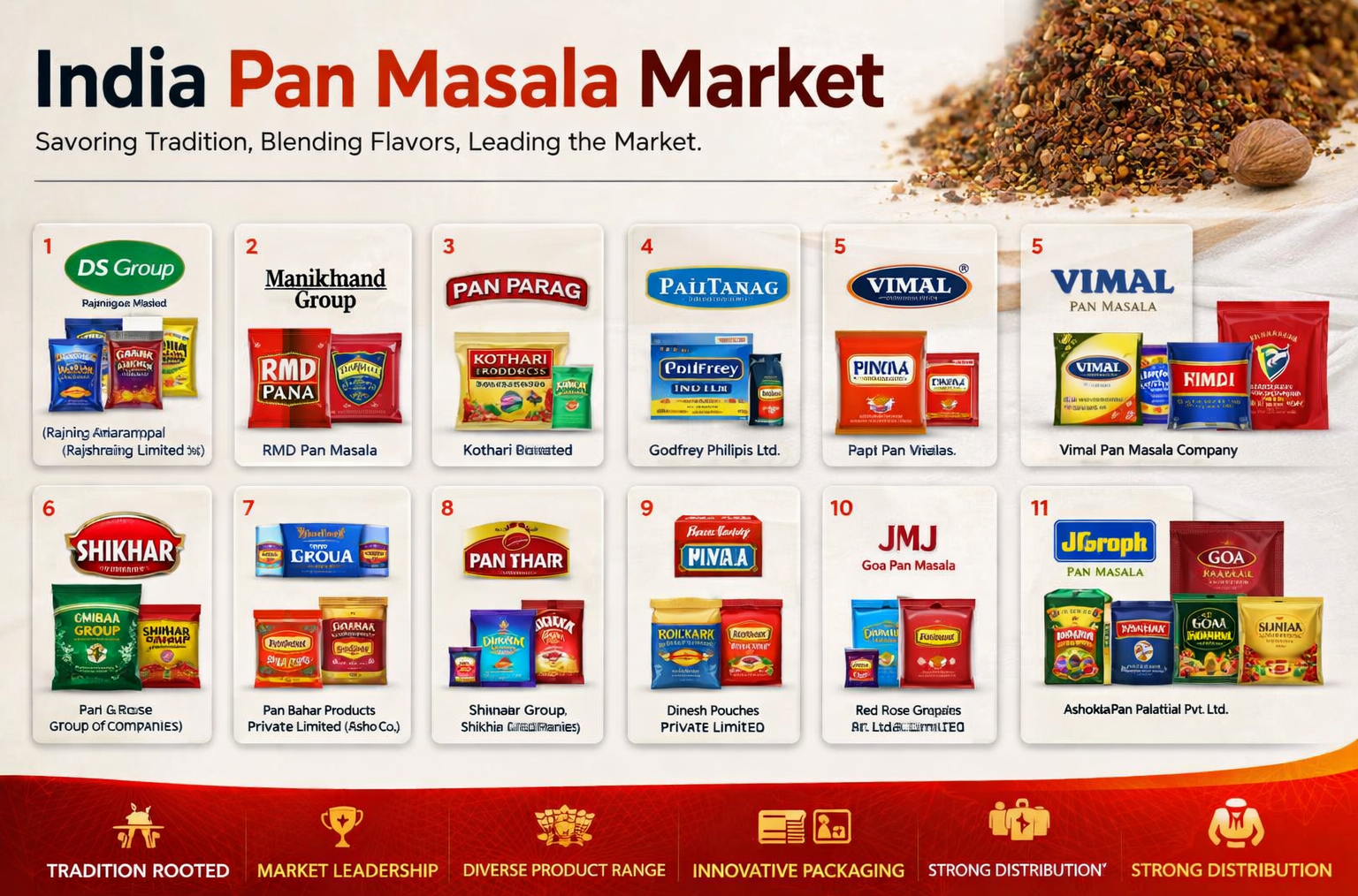
- DS Group (Dharampal Satyapal Limited) Rajnigandha, Rajshree, Pass Pass
- Manikchand Group RMD Pan Masala
- Kothari Products Limited Pan Parag
- Godfrey Phillips India Ltd. Pan Vilas
- Vimal Pan Masala Company (KR Group)
- Pan Bahar Products Private Limited (Ashok & Co.)
- Shikhar Group Shikhar Pan Masala
- Dinesh Pouches Private Limited
- Red Rose Group of Companies
- JMJ Group Goa Pan Masala
1. DS Group (Dharampal Satyapal Limited)
|
Category |
Details |
|---|---|
|
Company Name |
Dharampal Satyapal Limited (DS Group) |
|
Headquarters |
Noida, Uttar Pradesh, India |
|
Founded |
1929 |
|
Employees |
5,000+ |
|
Revenue (2024) |
Approx. USD 1.1 Billion |
|
Company Overview |
DS Group is India's most diversified pan masala and mouth freshener conglomerate, with additional interests spanning confectionery, agro-forestry, and hospitality. Its flagship brands enjoy strong nationwide brand recall and loyalty. |
|
Key Products |
Rajnigandha, Rajshree, Pass Pass mouth fresheners, Baba Elaichi, Tulsi mix; Catch Spices and Pulse confectionery outside the core segment. |
|
Market Position |
Widely regarded as the category leader in premium pan masala, with Rajnigandha frequently cited as India's largest-selling pan masala brand. |
|
Recent Developments |
Continued investment in tobacco-free premium variants and expansion of its confectionery portfolio through acquisitions, diversifying revenue beyond core pan masala. |
|
Strategic Advantages |
Nearly a century of brand heritage, extensive pan-India distribution, high-profile marketing campaigns, and export presence across 40+ countries. |
2. Manikchand Group
|
Category |
Details |
|---|---|
|
Company Name |
Manikchand Group |
|
Headquarters |
Pune, Maharashtra, India |
|
Founded |
1959 |
|
Employees |
4,000+ |
|
Revenue (2024) |
Approx. USD 700 Million |
|
Company Overview |
Manikchand Group is one of India's longest-standing pan masala manufacturers, known for strong mass-market appeal across both urban and rural India. |
|
Key Products |
RMD Pan Masala, RMD Gold, Manikchand Gutka, alongside a packaged drinking water business (Oxyrich). |
|
Market Position |
A top-three player by volume, with particularly strong penetration in central and western India. |
|
Recent Developments |
Ongoing diversification into packaged beverages alongside its core pan masala business. |
|
Strategic Advantages |
Deep rural distribution network, long-standing brand trust, and diversified revenue base. |
3. Kothari Products Limited
|
Category |
Details |
|---|---|
|
Company Name |
Kothari Products Limited |
|
Headquarters |
Kanpur, Uttar Pradesh, India |
|
Founded |
1969 |
|
Employees |
2,500+ |
|
Revenue (2024) |
Approx. USD 400 Million |
|
Company Overview |
Kothari Products is best known for its flagship Pan Parag brand, one of the earliest organized pan masala brands in India. |
|
Key Products |
Pan Parag, Meetha Mazaa, Gulab Pan Masala. |
|
Market Position |
A legacy brand with strong recognition, particularly in North India. |
|
Recent Developments |
Continued flavor-line extensions targeting younger consumers. |
|
Strategic Advantages |
Long operating history, established distributor relationships, and strong regional brand equity. |
4. Godfrey Phillips India Ltd.
|
Category |
Details |
|---|---|
|
Company Name |
Godfrey Phillips India Ltd. |
|
Headquarters |
Mumbai, Maharashtra, India |
|
Founded |
1844 (Pan Vilas launched 2009) |
|
Employees |
3,500+ |
|
Revenue (2024) |
Approx. USD 300 Million (pan masala segment) |
|
Company Overview |
Godfrey Phillips is a diversified tobacco and consumer products company that entered pan masala with its Pan Vilas brand, positioned on ingredient quality. |
|
Key Products |
Pan Vilas, Pass Pass (licensed line), Jai Pan Masala. |
|
Market Position |
A premium-positioned entrant leveraging the company's broader consumer products distribution network. |
|
Recent Developments |
Continued premiumization strategy within the Pan Vilas line. |
|
Strategic Advantages |
Established distribution infrastructure from its core tobacco business and strong quality-control credentials. |
5. Vimal Pan Masala Company (KR Group)
|
Category |
Details |
|---|---|
|
Company Name |
Vimal Pan Masala Company (KR Group) |
|
Headquarters |
Gujarat, India |
|
Founded |
1983 |
|
Employees |
2,000+ |
|
Revenue (2024) |
Approx. USD 200 Million |
|
Company Overview |
Vimal has grown rapidly through aggressive celebrity-led marketing, positioning itself in the mid-premium flavored segment popular with younger consumers. |
|
Key Products |
Vimal Pan Masala, Vimal Elaichi, Vimal Silver, flavored supari. |
|
Market Position |
A fast-growing challenger brand with expanding presence beyond its North Indian stronghold. |
|
Recent Developments |
High-visibility advertising campaigns featuring leading Bollywood actors to drive brand awareness. |
|
Strategic Advantages |
Strong marketing execution, sensory-forward flavor positioning, and rapid retail expansion. |
Competitive Landscape
The India pan masala market is moderately fragmented, with DS Group and Manikchand Group commanding the largest combined share, while Kothari Products, Godfrey Phillips, Vimal, Pan Bahar, and a long tail of regional players compete for the remaining volume.
Brand-Led Premiumization: Unlike commodity FMCG categories, pan masala competition centers heavily on brand equity and celebrity association rather than price alone, allowing leading players to sustain premium pricing on flagship SKUs.
Regulatory Pressure as a Differentiator: State-level bans on gutkha and certain tobacco-mixed formulations have pushed manufacturers toward tobacco-free reformulations, creating a growing premium segment somewhat insulated from the strictest bans.
Regional Champions: Beyond the national majors, regional brands such as Shikhar (Western and Central India) and JMJ Group's Goa Pan Masala maintain strong positions in their home markets through value pricing and localized distribution.
Diversification as Risk Management: Leading groups including DS Group and Manikchand have diversified into confectionery, packaged water, and hospitality, reducing reliance on a category that faces persistent regulatory and reputational headwinds.
Regional Analysis
North India
North India particularly Uttar Pradesh, Madhya Pradesh, Bihar, and Delhi remains the largest consumption base, with brands such as Rajnigandha and Pan Bahar holding especially strong recall in this region.
West India
Maharashtra and Gujarat show strong and growing urban demand, with brands like Vimal built around this regional base before expanding nationally.
East India
West Bengal and Odisha lean toward classic, moderately sweet flavor profiles, representing steady but less flavor-experimental demand.
South India
Consumption is comparatively lower in southern states but is gradually increasing alongside urbanization, giving national brands room for incremental share gains.
International Markets
The Middle East, United Kingdom, and Canada are key export destinations, driven largely by Indian diaspora demand. DS Group and Manikchand have the most developed international distribution among Indian pan masala manufacturers, though regulatory barriers around tobacco-adjacent products are tightening in several destination markets.
Emerging Trends in the Pan Masala Market
1. Tobacco-Free and Reformulated Products: Growing health consciousness and state bans are accelerating the shift toward tobacco-free premium variants across major brands.
2. Flavor Premiumization: Saffron, cardamom, and other aromatic variants are increasingly used to justify premium pricing and differentiate otherwise similar base formulations.
3. Modern Retail and E-Commerce Penetration: Organized retail chains are giving branded pan masala more shelf space, particularly in Tier II and Tier III cities, gradually shifting volume away from loose, unbranded product.
4. Sustainable and Biodegradable Packaging: Leading manufacturers are piloting biodegradable sachet materials and partnering with international packaging firms to improve shelf life and reduce environmental impact.
5. Regional and Vernacular Marketing: Brands are increasingly localizing campaigns by language and regional influencer partnerships to deepen penetration in semi-urban and rural markets.
Future Outlook (2025–2034)
The India pan masala market's trajectory toward USD 77.51 billion by 2034 reflects a durable combination of cultural entrenchment, rising incomes, and expanding distribution set against a backdrop of tightening state-level regulation. The 5.1% CAGR forecast through 2034 assumes continued premiumization and reformulation toward tobacco-free products, alongside steady volume growth in rural and semi-urban markets.
Key investment themes include the scaling of tobacco-free product lines, continued export growth into Gulf and diaspora markets, and diversification by leading conglomerates into adjacent FMCG categories to manage category-specific regulatory risk. Leading companies DS Group, Manikchand Group, and Kothari Products are likely to retain leadership, while brands with strong regional or export footholds, such as Vimal and Pan Bahar, will continue to compete for incremental share.
Frequently Asked Questions (FAQ)
1. What is the current size of the India pan masala market?
The India pan masala market was valued at approximately USD 54.67 billion in 2025 and is projected to reach USD 77.51 billion by 2034, growing at a CAGR of 5.1%.
2. Who are the top companies in the India pan masala market?
Leading companies include DS Group (Rajnigandha), Manikchand Group (RMD), Kothari Products (Pan Parag), Godfrey Phillips India (Pan Vilas), Vimal Pan Masala Company, Pan Bahar Products, Shikhar Group, Dinesh Pouches, Red Rose Group, and JMJ Group.
3. Which region dominates pan masala consumption in India?
North India especially Uttar Pradesh, Madhya Pradesh, Bihar, and Delhi leads consumption, while West India (Maharashtra, Gujarat) shows the strongest urban growth.
4. What is the forecast CAGR for the pan masala market?
The market is forecast to grow at a CAGR of 5.1% from 2025 to 2034.
5. What are the main growth drivers for this market?
Key drivers include rising disposable income, expanding organized retail and e-commerce distribution, celebrity-led marketing, and flavor innovation.
6. What challenges does the pan masala industry face?
The industry faces state-level bans and restrictions on tobacco-mixed formulations, tightening health-related regulation, and reputational scrutiny tied to associated health risks.
7. Are tobacco-free pan masala variants growing?
Yes. Regulatory pressure and rising health consciousness are pushing major manufacturers to expand tobacco-free premium product lines.
Conclusion
The India pan masala market sits at the intersection of deep cultural tradition and mounting regulatory scrutiny. With a projected size of USD 77.51 billion by 2034 at a 5.1% CAGR, the sector continues to offer substantial volume and brand-value growth, even as leading players increasingly compete on reformulation, premiumization, and diversification rather than volume alone.
Companies led by DS Group, Manikchand Group, and Kothari Products are not just defending market share they are actively reshaping their portfolios toward tobacco-free products and adjacent FMCG categories to manage regulatory exposure. The manufacturers that successfully balance cultural relevance, brand equity, and evolving compliance requirements will define market leadership through 2034 and beyond.