
Leading Semiconductor Foundry Market Companies
Author:
Intellectual Market Insights Research
Published Date:
12 Sep 2026
Introduction
The semiconductor foundry business sits at the physical heart of the global electronics industry — it is where chip designs from fabless companies like Apple, Nvidia, AMD, and Qualcomm are actually turned into silicon. Rather than owning and operating their own fabrication plants, fabless semiconductor firms contract "pure-play" foundries to manufacture wafers on their behalf, while integrated device manufacturers (IDMs) run their own fabs and sometimes offer spare capacity to outside customers as well.
Foundries compete across a wide spread of process nodes, from leading-edge 10/7/5 nm nodes used in flagship smartphones, AI accelerators, and high-performance computing, down to mature 16/14 nm and 20 nm nodes that remain the backbone of automotive, industrial, and consumer electronics applications. This article looks at the global semiconductor foundry market, the companies that define it, and the regional and technology trends shaping its path toward 2032.
Market Overview
| Parameter | Details |
|---|---|
| Market Size (2023) | USD 101,354 Million |
| Projected Market Size (2032) | USD 165,236.89 Million |
| CAGR (2023–2032) | 6.3% |
| Base Year | 2023 |
| Historic Year | 2018–2022 |
| Forecast Period | 2023–2032 |
| Leading Region | North America (highest revenue share); Asia-Pacific (significant growth) |
| Key Segments (by Technology) | 10/7/5 nm, 16/14 nm, 20 nm |
| Key Segments (by Industry) | Automotive, Aerospace, Industrial, Consumer Electronics & Healthcare, Pure IDMs |
| Key Segments (by Foundry Type) | Pure Play Foundry, IDMs |
Why the Semiconductor Foundry Market Is Growing
1. Rising Demand for Fabless Manufacturing
As more semiconductor design companies adopt the fabless business model to avoid the enormous capital cost of building and operating fabs, demand for outsourced foundry capacity keeps expanding across nearly every end-use category.
2. Expansion of Advanced Node Technologies
Continued migration toward 10/7/5 nm and smaller nodes to support AI accelerators, high-performance computing, and premium smartphones is driving sustained capital investment in leading-edge fabrication capacity.
3. Growing Semiconductor Content in Automotive
The electrification and increasing digitalization of vehicles — including advanced driver-assistance systems, infotainment, and electric powertrains — is significantly increasing semiconductor content per vehicle and expanding foundry demand from the automotive segment.
4. Government-Backed Fab Investment
Strategic government programs such as the U.S. CHIPS Act, the EU Chips Act, and similar initiatives in Japan, India, and China are accelerating new fab construction and capacity expansion by major foundry players worldwide.
5. Growth in Consumer Electronics and IoT
Rising demand for smartphones, wearables, and connected IoT devices continues to expand the addressable base for mature and mid-range process nodes supplied by pure-play and IDM foundries alike.
6. Increasing Reliance on Specialty and Mature-Node Processes
Sustained demand for analog, power management, and mixed-signal chips used in industrial and healthcare applications is supporting continued utilization of mature 16/14 nm and 20 nm foundry capacity.
Market Opportunities & Restraints
A key opportunity lies in regional capacity diversification: as governments incentivize domestic chip manufacturing through subsidies and tax credits, foundries have significant opportunity to build new fabs across the United States, Europe, Japan, and India, reducing geographic concentration risk and capturing new customer relationships tied to "friend-shoring" supply chain strategies. On the restraint side, high capital intensity and geopolitical export restrictions remain the primary headwinds, as building a leading-edge fab now costs tens of billions of dollars and requires years of lead time, while U.S. and allied export controls on advanced lithography equipment and chip technology continue to constrain capacity expansion and market access for certain foundries, particularly those based in China.
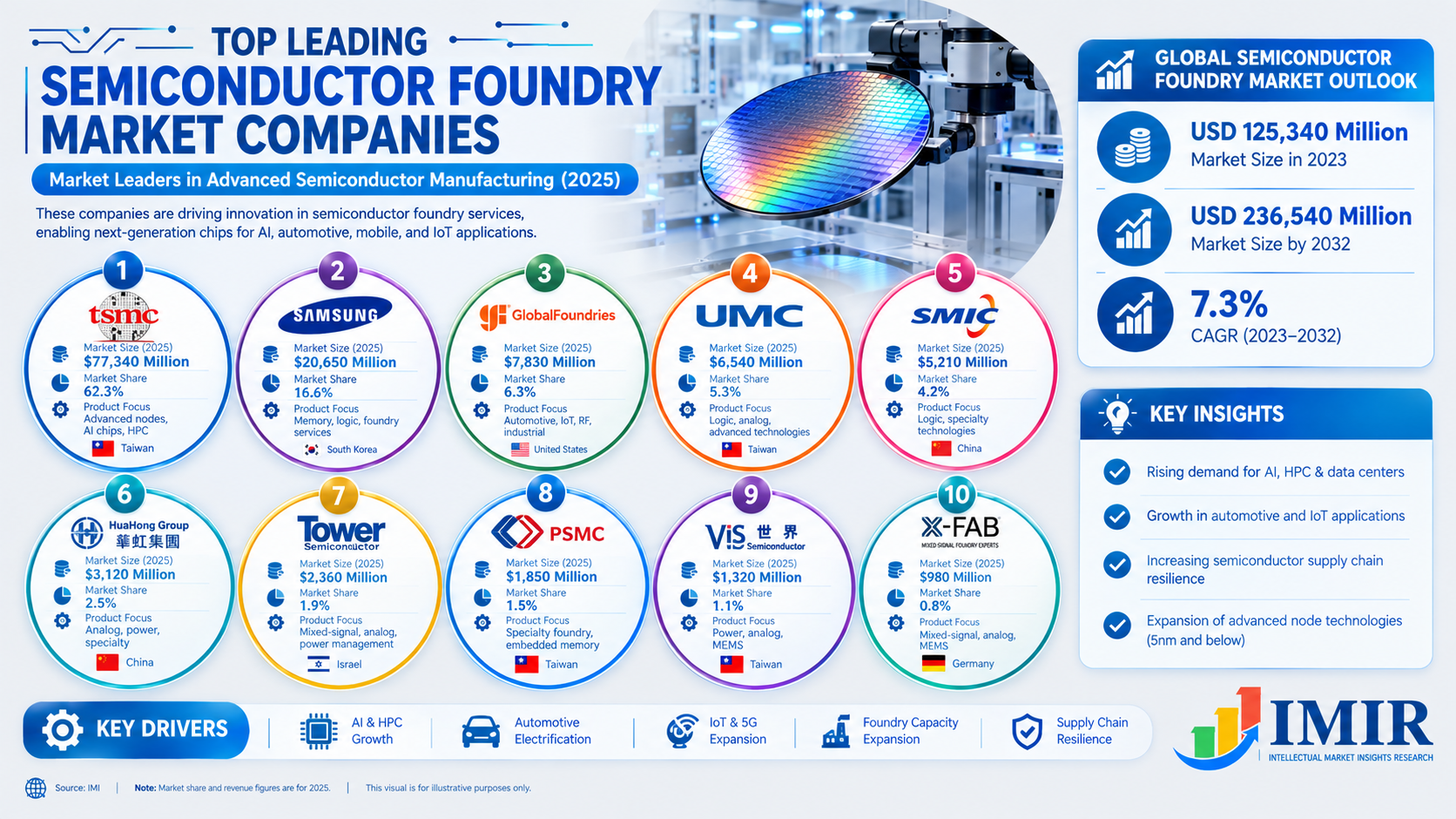
Companies Associated with the Semiconductor Foundry Market (Details in Table)
| Company | Headquarters | Founded | Employees | Revenue (2025) | Overview |
|---|---|---|---|---|---|
| Taiwan Semiconductor Manufacturing Company (TSMC) Limited | Hsinchu, Taiwan | 1987 | Approx. 90,000+ | Approx. USD 121–133 Billion | The world's largest dedicated pure-play foundry, holding roughly 70% of the global foundry market, and the leading supplier of advanced 3nm/5nm/7nm process technology to customers including Apple, AMD, and Nvidia. |
| Samsung Electronics Co., Ltd. | Suwon, South Korea | 1969 | Approx. 259,000+ (company-wide) | Approx. USD 234–291 Billion (company-wide) | A diversified technology conglomerate whose Device Solutions division operates a major foundry business alongside memory and system LSI, competing with TSMC at the most advanced logic nodes. |
| GlobalFoundries Inc. | Malta, New York, USA | 2009 | Approx. 14,000 | Approx. USD 6.8 Billion | A leading specialty foundry focused on feature-rich, mature process technologies for smart mobile devices, automotive, and communications infrastructure; majority-owned by Mubadala Investment Company. |
| Semiconductor Manufacturing International Corporation (SMIC) | Shanghai, China | 2000 | Approx. 20,000 | Approx. USD 8–9 Billion | China's largest semiconductor foundry and the world's third-largest by revenue, operating fabs in Shanghai, Beijing, Tianjin, and Shenzhen and serving AI, automotive, and consumer electronics customers. |
| United Microelectronics Corporation (UMC) | Hsinchu, Taiwan | 1980 | Approx. 20,000 | Approx. USD 7.6 Billion | Taiwan's first semiconductor company and a leading specialty foundry with 12 manufacturing facilities across Taiwan, Singapore, China, and Japan. |
| STMicroelectronics NV | Geneva, Switzerland | 1987 | Approx. 49,000 | Approx. USD 11.8 Billion | A major European semiconductor manufacturer combining internal fabrication with foundry-style capacity for automotive ICs, power and discrete components, and MEMS sensors. |
| TowerJazz (Tower Semiconductor Limited) | Migdal Haemek, Israel | 1993 | Approx. 5,000 | Approx. USD 1.4–1.6 Billion | A leading specialty foundry focused on analog, RF, and high-performance analog process technologies, with manufacturing operations in Israel, the U.S., and Japan through its TPSCo joint venture. |
| Vanguard International Semiconductor Corporation | Hsinchu, Taiwan | 1994 | Approx. 5,000+ | Approx. USD 1.3–1.6 Billion | A Taiwanese specialty foundry focused on high-voltage, ultra-high-voltage, and mixed-signal process technologies serving power management, display driver, and sensor customers. |
| Magnachip Semiconductor | Cheongju, South Korea | 2004 | Approx. 1,300 | Not separately disclosed | A South Korean specialty foundry and analog/power semiconductor supplier serving display driver, power management, and automotive customers. |
| Powerchip Semiconductor Manufacturing Corp. (PSMC) | Hsinchu, Taiwan | 2019 | Approx. 5,000+ | Not separately disclosed | A Taiwanese foundry specializing in memory and logic manufacturing for consumer electronics, computing, and industrial applications. |
| Fujitsu Semiconductor Limited | Yokohama, Japan | 2008 | - | Not separately disclosed | A Japanese specialty semiconductor manufacturer with a legacy foundry business now largely integrated into Japan's broader domestic chipmaking ecosystem. |
Note: Company revenue and headcount figures reflect the most recently available public data at the parent-company or business-segment level and may combine foundry operations with other business lines for diversified companies such as Samsung and STMicroelectronics.
Competitive Landscape
The global semiconductor foundry market is dominated by a small group of leading-edge pure-play foundries, chief among them TSMC, which alone commands roughly 70% of global foundry revenue on the strength of its advanced node leadership and blue-chip fabless customer base. Samsung Electronics stands as TSMC's principal competitor at the most advanced process nodes, leveraging its integrated memory, foundry, and system LSI operations. GlobalFoundries and SMIC occupy strong positions in mature and specialty process technologies, with SMIC's growth increasingly shaped by China's domestic chip self-sufficiency push amid tightening export controls. Specialty and mature-node foundries such as UMC, TowerJazz, Vanguard International Semiconductor, Magnachip, and Powerchip round out the competitive field, focusing on analog, power management, display driver, and automotive-grade processes where deep process know-how and long-lived customer programs matter more than sheer leading-edge scale. STMicroelectronics and Fujitsu Semiconductor add further diversity as IDMs with meaningful in-house and foundry-adjacent manufacturing capacity.
Regional Analysis
North America
North America holds the highest revenue share in the semiconductor foundry market, supported by the growing adoption of semiconductor foundry services, a strong base of fabless design companies, and expanding domestic fab investment under programs such as the U.S. CHIPS Act, including GlobalFoundries' operations in New York.
Asia-Pacific
The Asia-Pacific region is expected to witness significant growth, driven by the presence of key semiconductor foundry companies in economies such as Japan, China, Taiwan, and South Korea, including TSMC, Samsung, SMIC, and UMC, alongside continued government investment in domestic chipmaking capacity.
Europe
Europe represents a growing semiconductor foundry market, anchored by STMicroelectronics' manufacturing footprint and supported by the EU Chips Act's push to expand regional semiconductor manufacturing capacity and reduce reliance on Asian supply chains.
Latin America & Middle East and Africa
Latin America and the Middle East & Africa remain smaller, emerging markets for semiconductor foundry services, with growth tied to expanding electronics assembly, automotive manufacturing, and broader industrial digitalization across the regions.
Emerging Trends in the Semiconductor Foundry Market
1. Race to Sub-3nm Process Nodes: TSMC and Samsung continue to push leading-edge process development toward 2nm and beyond, intensifying competition for the most advanced AI, high-performance computing, and premium smartphone workloads.
2. Geographic Diversification of Fab Capacity: Government incentive programs are driving foundries to build new fabs outside their traditional home bases, including TSMC's expansion into the United States and Japan and GlobalFoundries' continued investment in its U.S. and European facilities.
3. Rising Importance of Automotive-Grade Foundry Capacity: Growing semiconductor content in electric and increasingly autonomous vehicles is pushing foundries such as GlobalFoundries, STMicroelectronics, and TowerJazz to expand dedicated automotive process technology.
4. Export Controls Reshaping Competitive Dynamics: Tightening U.S. and allied restrictions on advanced lithography equipment and chip technology exports to China continue to shape SMIC's technology roadmap and are accelerating China's push for domestic semiconductor self-sufficiency.
5. Continued Specialization in Mature and Analog Nodes: Foundries such as UMC, Vanguard International Semiconductor, and Magnachip continue to deepen specialization in mature-node analog, power management, and display driver technologies rather than competing head-on at the leading edge.
6. Growing Foundry Capacity for AI Accelerators: Surging demand for AI chips from customers such as Nvidia and AMD is driving leading-edge foundries, particularly TSMC, to prioritize capacity allocation toward advanced packaging and high-performance compute nodes.
Future Outlook (2023–2032)
The global semiconductor foundry market's trajectory toward USD 165,236.89 million by 2032 reflects sustained demand growth driven by the ongoing shift to fabless manufacturing, rising semiconductor content across automotive and consumer electronics, and continued government-backed investment in domestic fabrication capacity. The 6.3% CAGR forecast through 2032 assumes continued leading-edge node development, sustained AI-driven demand for advanced process technology, and gradual geographic diversification of global fab capacity away from concentration in a small number of regions.
Key investment themes include continued leadership consolidation around TSMC and Samsung at the most advanced nodes, ongoing capacity expansion by GlobalFoundries and SMIC in mature and specialty processes, and ongoing government incentive programs shaping where new fab capacity is built. As advanced packaging, AI accelerator demand, and geopolitical supply chain considerations continue to reshape the industry, the foundries that combine deep process technology expertise with geographically diversified manufacturing footprints will define market leadership through 2032 and beyond.
Frequently Asked Questions (FAQ)
1. What is the current size of the global semiconductor foundry market?
The global semiconductor foundry market was valued at approximately USD 101,354 million in 2023 and is projected to reach around USD 165,236.89 million by 2032, growing at a CAGR of 6.3% during the forecast period 2023–2032.
2. Who are the top companies in the semiconductor foundry market?
Leading companies include Taiwan Semiconductor Manufacturing Company (TSMC) Limited, Samsung Electronics, GlobalFoundries Inc., Semiconductor Manufacturing International Corporation (SMIC), United Microelectronics Corporation (UMC), STMicroelectronics NV, TowerJazz (Tower Semiconductor Limited), Vanguard International Semiconductor Corporation, Magnachip Semiconductor, Powerchip Semiconductor Manufacturing Corp., and Fujitsu Semiconductor Limited.
3. Which region dominates the semiconductor foundry market?
North America holds the highest revenue share in the semiconductor foundry market, while the Asia-Pacific region is expected to witness significant growth due to the presence of key companies in economies such as Japan, China, Taiwan, and South Korea.
4. What is the forecast CAGR for the semiconductor foundry market?
The market is forecast to grow at a CAGR of 6.3% from 2023 to 2032.
5. What are the main growth drivers for this market?
Key drivers include the rising adoption of the fabless manufacturing model, expansion of advanced process node technologies, growing semiconductor content in automotive applications, and government-backed investment in domestic fab capacity.
6. What is the difference between a pure-play foundry and an IDM?
A pure-play foundry, such as TSMC or UMC, manufactures chips exclusively for outside customers based on their designs, while an integrated device manufacturer (IDM), such as Samsung or STMicroelectronics, designs and manufactures its own semiconductor products in-house, sometimes also offering spare foundry capacity to external customers.
7. What process technologies does the semiconductor foundry market cover?
The market spans a range of process technologies, including leading-edge 10/7/5 nm nodes for AI, high-performance computing, and premium smartphones, as well as more mature 16/14 nm and 20 nm nodes widely used in automotive, industrial, and consumer electronics applications.
Conclusion
The global semiconductor foundry market sits at the intersection of the ongoing shift toward fabless manufacturing and the world's growing dependence on advanced and mature-node chips across nearly every industry. With a projected size of USD 165,236.89 million by 2032 at a CAGR of 6.3%, the market offers steady, technology-driven growth shaped as much by geopolitics as by process innovation.
TSMC and Samsung continue to lead on the strength of advanced-node manufacturing capability and deep fabless customer relationships, while GlobalFoundries, SMIC, and UMC round out a competitive field built around mature and specialty process technologies. As leading-edge node development, government-backed fab investment, and export control dynamics continue to reshape the industry, the foundries that combine deep process expertise with geographically resilient manufacturing footprints will define market leadership through 2032 and beyond.


