
Medical Tourism Market: Size, Trends & Key Companies
Author:
Intellectual Market Insights Research
Published Date:
25 Sep 2026
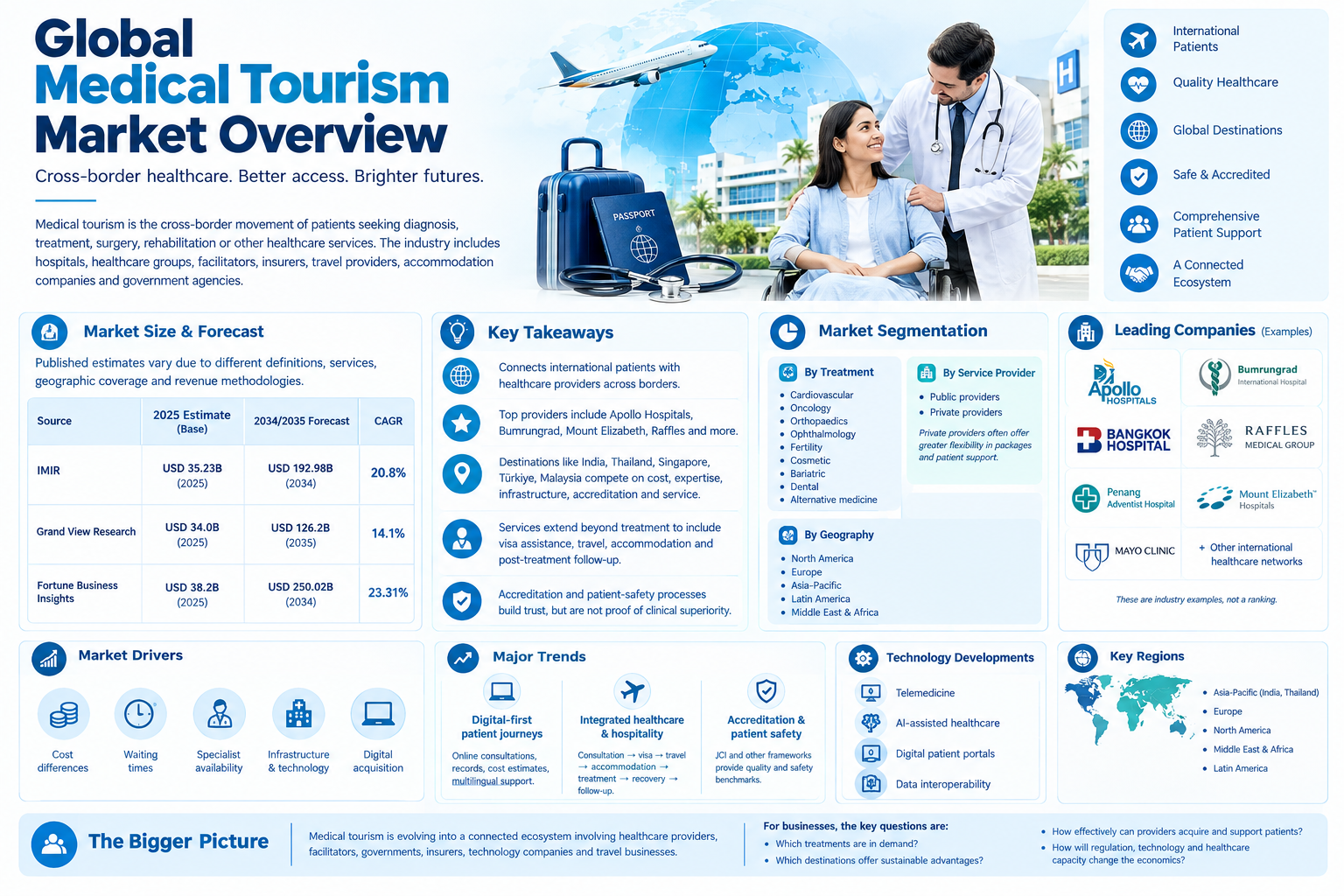
Executive Summary of Medical tourism
Medical tourism is the cross-border movement of patients seeking diagnosis, treatment, surgery, rehabilitation, or other healthcare services. The industry includes hospitals, healthcare groups, medical-tourism facilitators, insurers, travel providers, accommodation companies, and government agencies.
The market is expanding, but published estimates differ substantially because research firms use different definitions, services, geographic coverage, and revenue methodologies.
IMIR's existing market study estimates the global medical tourism market at USD 29.16 billion in 2024, reaching USD 35.23 billion in 2025 and USD 192.98 billion by 2034, representing a reported 20.8% CAGR.
A newer 2026 estimate from Grand View Research puts the market at USD 34.0 billion in 2025, forecasting USD 126.2 billion by 2035 at a 14.1% CAGR. Fortune Business Insights reports USD 38.2 billion in 2025 and projects USD 250.02 billion by 2034 at 23.31% CAGR.
These differences demonstrate why market size should be interpreted according to the underlying scope and methodology rather than treated as a single universally accepted number.
Key takeaways
- Medical tourism connects international patients with healthcare providers across borders.
- Prominent providers include Apollo Hospitals, Bumrungrad International Hospital, Mount Elizabeth Hospitals, Raffles Medical Group and other international healthcare networks.
- India, Thailand, Singapore, Türkiye, Malaysia and other destinations compete through combinations of cost, specialist expertise, infrastructure, accreditation and patient services.
- International patient services increasingly extend beyond treatment to include visa assistance, travel coordination, interpretation, accommodation and post-treatment follow-up.
- Accreditation and measurable patient-safety processes are important trust signals, but accreditation alone should not be interpreted as proof that a particular provider is clinically superior.
What Are the Top Medical Tourism Companies?
The medical tourism industry does not have one universally accepted ranking of “top” companies.
Instead, prominent participants can be grouped into international hospital groups, specialist hospitals, healthcare networks and medical-tourism facilitators.
Examples identified in IMIR's market research include Apollo Hospitals Enterprise, Bumrungrad International Hospital, Bangkok Hospital, Raffles Medical Group, Penang Adventist Hospital and Mount Elizabeth Hospitals.
Other internationally oriented healthcare organizations include Mayo Clinic, which reports that patients from more than 130 countries receive care through its international patient services.
The relevant comparison for business research is therefore not simply company size. Decision-makers should examine:
|
Evaluation factor |
Why it matters |
|
International patient volume |
Indicates cross-border demand |
|
Medical specialties |
Shows treatment-market focus |
|
International patient services |
Reduces travel and coordination friction |
|
Accreditation |
Provides an external quality/safety framework |
|
Physician expertise |
Important for complex treatment decisions |
|
Geographic reach |
Determines accessibility |
|
Digital consultation |
Enables pre-travel assessment |
|
Post-treatment coordination |
Addresses continuity-of-care risk |
Medical Tourism Market Definition
Medical tourism refers to patients travelling outside their usual country of residence to obtain medical treatment.
The broader medical-travel ecosystem can include:
- Hospitals and clinics
- Physicians and specialist networks
- Medical-tourism facilitators
- Insurance and financing providers
- Airlines and accommodation providers
- Government tourism and healthcare agencies
- Visa and immigration services
- Telemedicine and digital-health platforms
This distinction matters because a medical tourism company may refer to a healthcare provider itself or a business that facilitates treatment travel.
Medical Tourism Market Size and Forecast
There is no single globally standardized market-size figure.
Different research organizations produce materially different estimates:
|
Source |
Base/2025 estimate |
Forecast |
CAGR |
|
IMIR |
$35.23B in 2025 |
$192.98B by 2034 |
20.8% |
|
Grand View Research |
$34.0B in 2025 |
$126.2B by 2035 |
14.1% |
|
Fortune Business Insights |
$38.2B in 2025 |
$250.02B by 2034 |
23.31% |
Why do estimates differ?
The estimates should not be averaged into one number.
Differences can result from:
- Market definition
- Treatment categories included
- Inclusion or exclusion of wellness tourism
- Revenue versus patient-spending measurement
- Geographic coverage
- Base-year selection
- Forecast methodology
- Treatment of intermediaries and ancillary services
IMIR analysis: The divergence itself is an important market signal. Companies using these figures for investment or strategic planning should first normalize the definitions before comparing forecasts.
Market Segmentation
Medical tourism can be analyzed through several dimensions.
By treatment
Common categories include:
- Cardiovascular treatment
- Oncology
- Orthopaedics
- Ophthalmology
- Fertility treatment
- Cosmetic procedures
- Bariatric treatment
- Dental treatment
- Alternative medicine
IMIR's market report uses these treatment categories in its market segmentation.
By service provider
The market can also be segmented into:
- Public healthcare providers
- Private healthcare providers
Private providers often have greater flexibility in designing international-patient services, pricing packages and dedicated patient-support functions. IMIR identifies private providers as an important segment of the market.
By geography
Major regional markets include:
- North America
- Europe
- Asia-Pacific
- Latin America
- Middle East and Africa
Key Medical Tourism Companies and Healthcare Providers
Apollo Hospitals
Apollo Hospitals operates an international patient service covering pre-arrival consultation, treatment coordination, travel arrangements and post-treatment support.
Apollo states that it has cared for patients from 150+ countries and provides international-patient services across multiple specialties.
Its international-patient journey includes medical-record assessment, consultations, visa support, accommodation coordination, airport assistance and post-treatment follow-up.
Bumrungrad International Hospital
Bumrungrad International Hospital in Thailand is another established participant in international healthcare.
The hospital reports more than 1,200 physicians and surgeons across more than 55 specialties and subspecialties and provides services for international patients.
Mayo Clinic
Mayo Clinic operates international patient services for patients travelling to the United States.
The organization states that international patients arrive from more than 130 countries and highlights international appointment support, costs and insurance, travel information, and patient resources.
Other prominent organizations
IMIR's market research identifies companies and hospitals including:
- Bangkok Hospital
- Raffles Medical Group
- Penang Adventist Hospital
- Mount Elizabeth Hospitals
- Apollo Hospitals Enterprise
- Bumrungrad International Hospital
- MIOT Hospital
- Mission Hospital
These should be treated as industry examples rather than a quality ranking.
Major Market Drivers
1. Healthcare cost differences
Treatment-price differences between countries can influence patients' decisions, particularly for elective procedures and treatments that are expensive or poorly covered by insurance in the patient's home country.
2. Waiting times
Long waiting periods for selected procedures can encourage patients to investigate providers in other countries.
3. Specialist availability
International patients may travel to access particular physicians, specialist centres, technologies or procedures.
4. Healthcare infrastructure
Investment in advanced hospitals, diagnostic equipment and specialist centres supports destination competitiveness.
5. Digital patient acquisition
Search engines, social media, teleconsultations and online reviews have made it easier for patients to research foreign providers before travelling.
Major Trends in Medical Tourism
Digital-first patient journeys
International treatment increasingly starts before the patient boards a flight.
Hospitals can use:
- Online consultations
- Digital medical-record submission
- Remote second opinions
- Online cost estimates
- Appointment scheduling
- Multilingual support
Apollo, for example, describes pre-travel telemedicine consultation and digital submission of medical information as part of its international-patient journey.
Integrated healthcare and hospitality
Medical tourism increasingly involves more than clinical treatment.
Providers may coordinate:
Consultation → visa → travel → accommodation → treatment → recovery → discharge → follow-up
This creates opportunities for partnerships across healthcare, travel, hospitality and technology.
Accreditation and patient safety
International accreditation is an important trust mechanism.
Joint Commission International states that its accreditation evaluates organizations against standards relating to quality and patient safety.
However, accreditation should be considered one factor among several when assessing providers.
Technology Developments
Technology is changing medical tourism in four important areas:
- Telemedicine — enables preliminary consultations before travel.
- AI-assisted healthcare — can support diagnostic and administrative workflows, subject to clinical validation and regulation.
- Digital patient portals — improve access to records, appointments and treatment information.
- Data interoperability — can make cross-border transfer of relevant clinical information easier.
The commercial implication is significant: the patient acquisition journey increasingly begins online, making digital experience part of the competitive landscape.
Regional Analysis
Asia-Pacific
Asia-Pacific remains a major medical-tourism region because of its combination of healthcare infrastructure, specialist services, pricing and established international-patient programs.
India and Thailand are important examples.
India
India has developed a dedicated Medical Value Travel ecosystem and government initiatives supporting international patients.
According to India's Ministry of Tourism, medical-purpose foreign tourist arrivals reached 644,387 in 2024. For January–November 2025, the provisional figure was 450,633.
India also provides e-medical and e-medical-attendant visas for eligible foreign nationals.
Importantly, the Ministry stated in February 2026 that it does not maintain revenue data specifically attributable to medical tourism and has not conducted a study assessing the industry's current status and growth potential.
That limitation should be clearly disclosed in market analysis.
Europe
Europe competes through specialist healthcare, established medical infrastructure and cross-border accessibility.
North America
North America includes major specialist healthcare institutions that attract international patients seeking complex or highly specialized treatment.
Middle East
Countries including the UAE and Saudi Arabia are investing in healthcare infrastructure and positioning themselves as regional healthcare destinations.
Challenges and Restraints
Medical tourism has several structural risks.
Regulatory differences
Licensing, malpractice rules, insurance arrangements and healthcare regulations vary across countries.
Continuity of care
A patient may receive treatment in one country but require follow-up care thousands of kilometres away.
Clinical risk
Travelling while ill and undergoing treatment away from one's usual healthcare system can introduce additional logistical and clinical considerations.
Information asymmetry
Patients may struggle to independently compare provider quality, outcomes, pricing and physician expertise.
Reputation risk
Hospitals and facilitators depend heavily on patient trust. Poor communication or unexpected costs can damage reputation.
Opportunities for Medical Tourism Companies
The strongest opportunities extend beyond simply attracting patients.
Opportunity 1: End-to-end patient coordination
Providers can differentiate through a complete journey from first consultation to post-treatment care.
Opportunity 2: International referral networks
Partnerships with physicians, insurers and healthcare organizations can create reliable referral channels.
Opportunity 3: Digital international-patient platforms
Patient portals can centralize:
- Medical records
- Quotes
- Appointments
- Visa documentation
- Travel details
- Treatment plans
- Follow-up information
Opportunity 4: Specialized treatment destinations
Countries and providers can build strong positions around specific specialties rather than attempting to compete across every treatment category.
Regulatory and Industry Considerations
Medical tourism operates across multiple regulatory systems.
Organizations should consider:
- Medical licensing
- Patient consent
- Data protection
- Medical visas
- Insurance coverage
- Malpractice liability
- Advertising rules
- Clinical accreditation
- Cross-border medical records
- Post-treatment responsibility
JCI provides accreditation frameworks for hospitals, academic medical centres, laboratories, ambulatory organizations and other healthcare settings.
For India, government initiatives include the Medical Value Travel portal and e-medical visa arrangements.
IMIR Analysis: What Businesses Should Watch
The evidence suggests that medical tourism is evolving from a hospital-selection market into a broader cross-border healthcare ecosystem.
What changed?
Patients can now conduct substantial research before travelling through digital consultations, hospital websites, online reviews and international patient departments.
Why does it matter?
The competitive battle is no longer limited to clinical infrastructure. Patient acquisition, digital experience, transparency and coordination increasingly influence the journey.
Who is affected?
- Hospitals
- Medical-tourism facilitators
- Insurers
- Travel companies
- Hospitality providers
- Healthcare technology companies
- Governments
What should businesses monitor?
Key indicators include:
- International patient arrivals
- Treatment-specific demand
- Average patient acquisition cost
- International-patient conversion rates
- Waiting times
- Treatment pricing
- Referral volumes
- Digital consultation volumes
- Patient satisfaction
- Follow-up completion
What could change the forecast?
Forecasts could change materially if:
- Visa policies change
- Healthcare regulations tighten
- Air connectivity changes
- Currency movements alter treatment economics
- Insurance coverage expands
- Major healthcare investments accelerate
- Economic conditions reduce discretionary medical travel
Future Outlook
Medical tourism is likely to become increasingly integrated with digital healthcare, international patient management and specialized hospital networks.
The biggest strategic shift may be the movement toward end-to-end cross-border care, where hospitals compete not only on treatment capability but also on accessibility, information, coordination and post-treatment support.
However, market forecasts should be interpreted cautiously because published estimates vary considerably.
For decision-makers, the most useful approach is to monitor patient flows, treatment demand, destination competitiveness and provider-level performance rather than relying on one headline market-size estimate.
Methodology
This article combines:
- IMIR market research
- Government of India data
- Joint Commission International information
- Healthcare-provider disclosures
- Published market research estimates
- Company information relating to international patient services
Market estimates are presented separately rather than blended because their scopes and methodologies differ.
Limitations
Medical tourism lacks a universally standardized global market definition.
India's Ministry of Tourism also states that it does not maintain dedicated medical-tourism revenue data or a study assessing the industry's current market size and growth potential.
Company-reported patient volumes are not necessarily comparable because organizations may use different definitions of an international patient.
Frequently Asked Questions
1. What are medical tourism companies?
Medical tourism companies include hospitals, healthcare groups, specialist clinics and facilitators that help international patients obtain treatment outside their home country.
2. Which countries are major medical tourism destinations?
Major destinations include countries such as India, Thailand, Singapore, Malaysia, Türkiye, the United States and several European and Middle Eastern markets.
3. What services do medical tourism companies provide?
Services may include medical consultation, treatment coordination, visa assistance, airport transfers, accommodation, interpretation, billing support and post-treatment follow-up.
4. Why do patients choose medical tourism?
Common factors include treatment cost, specialist availability, waiting times, technology, physician expertise and access to procedures unavailable or difficult to obtain locally.
5. Is medical tourism only about low-cost treatment?
No. Patients may also travel for specialized expertise, advanced technology, particular physicians, shorter waiting times or procedures unavailable in their home country.
6. What is medical value travel?
Medical value travel broadly describes international travel undertaken to obtain healthcare services, often emphasizing the overall value of treatment, access and patient experience.
7. Is accreditation important for medical tourism?
Accreditation can provide an external framework for evaluating healthcare quality and patient-safety processes. It should be considered alongside physician expertise, treatment outcomes, transparency and other relevant factors.
8. What is the size of the medical tourism market?
Published estimates differ substantially. IMIR estimates $35.23 billion for 2025, while Grand View Research estimates $34.0 billion and Fortune Business Insights reports $38.2 billion.
9. How important is India to medical tourism?
India is an established medical-travel destination. Government data recorded 644,387 foreign tourist arrivals for medical purposes in 2024.
10. What are the biggest challenges?
Regulatory differences, continuity of care, patient safety, cross-border records, insurance, travel logistics and information transparency are important challenges.
Conclusion
The global medical tourism industry is developing into a connected ecosystem involving healthcare providers, facilitators, governments, insurers, technology companies and travel businesses.
Companies such as Apollo Hospitals, Bumrungrad International Hospital and Mayo Clinic demonstrate different models for serving international patients. Their approaches show that medical tourism increasingly involves the complete patient journey rather than treatment alone.
For businesses evaluating the market, the key questions are not simply “Which companies are the biggest?” but:
Which treatments are generating international demand? Which destinations offer sustainable advantages? How effectively can providers acquire and support international patients? And how will regulation, technology and healthcare capacity change the economics?