
MedTech Leading Companies: Top Players, Trends, and Future Outlook
Author:
Intellectual Market Insights Research
Published Date:
23 Sep 2026
Introduction
MedTech, short for medical technology, is a broad industry encompassing the devices, diagnostics, digital health solutions, and care technologies used to prevent, diagnose, monitor, and treat medical conditions. From diagnostic imaging systems like MRI and CT scanners to patient monitoring devices, surgical instruments, orthopedic implants, and connected digital health platforms, MedTech sits at the center of modern healthcare delivery, touching nearly every point of the patient journey from screening to treatment to long-term monitoring.
The global MedTech industry spans medical devices, in-vitro diagnostics (IVDs), digital health, and care technologies, deployed across hospitals, diagnostic centers, ambulatory surgical centers, and increasingly, patients' homes through wearables and remote monitoring tools. This article provides a research-based analysis of the global MedTech industry, the companies shaping it, and the regional and technological forces driving its growth toward 2034.
Market Overview and Forecast
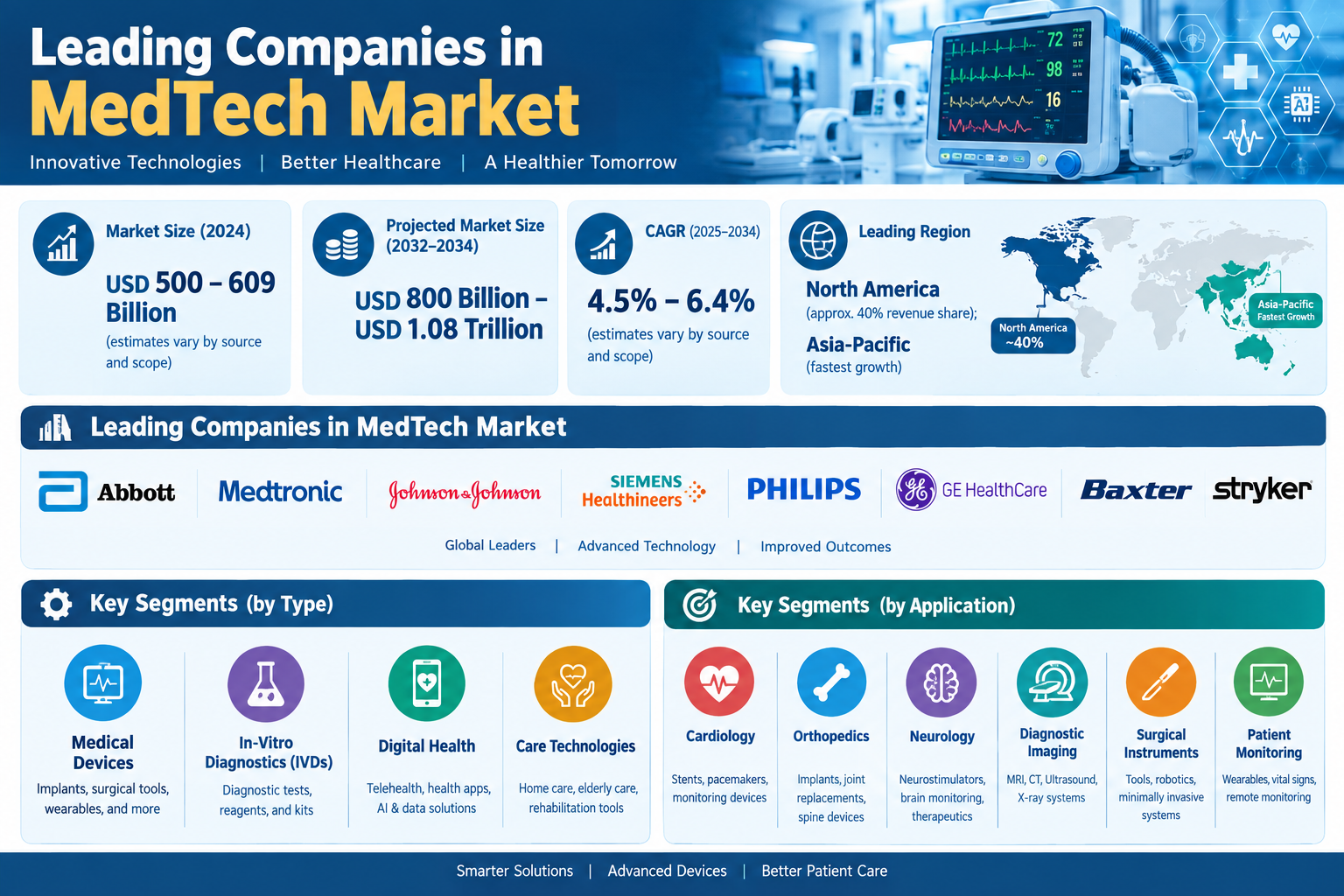
Market size estimates for the global MedTech industry vary across research providers depending on scope, but most independent sources converge on a market in the high hundreds of billions of dollars in 2024–2025, growing at a low-to-mid single-digit CAGR:
| Parameter | Details |
|---|---|
| Market Size (2024) | Approx. USD 500–609 Billion (estimates vary by source and scope) |
| Projected Market Size (2032–2034) | Approx. USD 800 Billion – USD 1.08 Trillion |
| CAGR (2025–2034) | Approx. 4.5%–6.4% (estimates vary by source and scope) |
| Leading Region | North America (approx. 40% revenue share); Asia-Pacific (fastest growth) |
| Key Segments (by Type) | Medical Devices, In-Vitro Diagnostics (IVDs), Digital Health, Care Technologies |
| Key Segments (by Application) | Cardiology, Orthopedics, Neurology, Diagnostic Imaging, Surgical Instruments, Patient Monitoring |
Medical Devices represent the largest segment, holding roughly a 50–55% share of total MedTech revenue, followed by In-Vitro Diagnostics at approximately 25–35%, with Digital Health, particularly telemedicine and wearables, emerging as the fastest-growing sub-segment at an estimated 15% CAGR, reflecting surging demand for remote patient monitoring.
Why the MedTech Market Is Growing
1. Aging Global Population and Rising Chronic Disease Burden
Populations over 65 are growing at accelerating rates across both developed and emerging economies, driving sustained long-term demand for diagnostic equipment, surgical instruments, orthopedic devices, and remote patient monitoring solutions to manage age-related and chronic conditions.
2. Rising Volumes of Surgical and Interventional Procedures
Growing global demand for surgical and interventional procedures, combined with expansion of minimally invasive and image-guided techniques, continues to drive adoption of advanced surgical tools, robotic-assisted surgery platforms, and precision medical devices.
3. Growth of Wearable Sensors and Remote Monitoring
Wearable sensors, smart diagnostics, and remote monitoring technologies are enabling earlier disease detection and more proactive management of chronic conditions, improving patient outcomes while reducing the need for in-person hospital visits.
4. Increasing Demand for Minimally Invasive Procedures
Patients and healthcare providers increasingly prefer minimally invasive procedures for their faster recovery times, reduced pain, and fewer complications, driving sustained demand for advanced surgical tools and robotic-assisted surgery technology.
5. AI Integration in Diagnostics and Clinical Decision Support
Continued integration of artificial intelligence into diagnostic imaging, clinical decision support, and workflow-support tools is improving diagnostic accuracy and clinical efficiency across radiology, pathology, and other diagnostic specialties.
6. Expansion of Emphasis on Reducing Post-Procedural Complications
Growing clinical and regulatory emphasis on reducing post-procedural complications continues to drive adoption of more sophisticated monitoring, diagnostic, and surgical technologies designed to improve patient safety outcomes.
Market Opportunities & Restraints
A key opportunity lies in AI-enabled diagnostics and connected, data-driven devices: as companies integrate AI diagnostics, remote monitoring, and data interoperability into their device portfolios, they are positioned for sustained margin growth, particularly as procurement priorities shift toward connected, software-enabled medical devices with higher unit values. On the restraint side, complex and fragmented global regulatory requirements remain a primary headwind, as companies must navigate different rules across different countries, a process that is time-consuming and expensive; regulatory scrutiny is intensifying further around AI/ML-enabled devices, where a significant share of devices reviewed in 2024 lacked transparent safety and effectiveness data, with more than 40% not disclosing clinical validation details, potentially slowing market access for new technologies.
Companies Associated with the MedTech Market
| Company | Headquarters | Founded | Employees | Revenue (2025) | Overview |
|---|---|---|---|---|---|
| Medtronic plc | Galway, Ireland / Minneapolis, USA | 1949 | Approx. 95,000 | Approx. USD 33.54 Billion | A global medical device leader across cardiac, neuroscience, diabetes, and surgical technology. |
| Johnson & Johnson (MedTech) | New Brunswick, New Jersey, USA | 1886 | Approx. 138,000 (group) | Approx. USD 94.2 Billion (total company) | A global healthcare conglomerate offering orthopedics, surgical robotics, and digital surgery platforms through its MedTech segment. |
| Abbott Laboratories | Abbott Park, Illinois, USA | 1888 | Approx. 115,000 | Approx. USD 44.3 Billion | A diversified medical devices and diagnostics leader, with Medical Devices as its largest revenue segment (48%). |
| Stryker Corporation | Portage, Michigan, USA | 1941 | Approx. 53,000 | Approx. USD 25.12 Billion | A global medical technology leader in orthopedics, surgical equipment, and navigation systems. |
| Boston Scientific Corporation | Marlborough, Massachusetts, USA | 1979 | Approx. 59,000 | Approx. USD 20.1 Billion | A global medical device innovator focused on cardiology, endoscopy, and other interventional specialties. |
| GE HealthCare Technologies, Inc. | Chicago, Illinois, USA | 2023 | Approx. 54,000 | Approx. USD 20.6 Billion | The world's sixth-largest medical device company, providing imaging, patient care, and diagnostics solutions. |
| Siemens Healthineers AG | Erlangen, Germany | 2017 | Approx. 74,000 | Approx. EUR 23.4 Billion (FY2025) | A global leader in diagnostic imaging, laboratory diagnostics, and AI-powered clinical decision support. |
| Becton, Dickinson and Company (BD) | Franklin Lakes, New Jersey, USA | 1897 | Approx. 72,000 | Approx. USD 21.8 Billion | A medical technology company manufacturing devices, instrument systems, and reagents across three core divisions. |
| Zimmer Biomet Holdings, Inc. | Warsaw, Indiana, USA | 1927 | Approx. 17,000 | Approx. USD 8.23 Billion | An orthopedic device leader offering the ROSA robotic surgical navigation system for joint replacement. |
| B. Braun Melsungen AG | Melsungen, Germany | 1839 | Approx. 64,000–66,800 | Approx. EUR 9.14 Billion (2024) | A medical device company whose Aesculap division provides surgical navigation and neurosurgical solutions. |
Competitive Landscape
The global MedTech industry brings together a small group of large, diversified medical technology conglomerates alongside specialized device and diagnostics manufacturers. Global MedTech majors Medtronic, Johnson & Johnson, Abbott, and Stryker hold particularly strong positions, built on decades of R&D investment, broad product portfolios spanning multiple therapeutic areas, and extensive global commercial and regulatory infrastructure. Diagnostic imaging and technology leaders GE HealthCare and Siemens Healthineers compete through advanced imaging platforms and AI-powered diagnostic tools, both having been spun off from larger industrial parent companies (GE and Siemens, respectively) to sharpen their healthcare technology focus. Orthopedic and surgical specialists Zimmer Biomet, B. Braun, and Boston Scientific compete through deep category focus in joint replacement, surgical navigation, and interventional cardiology, while BD rounds out the competitive field with its broad medical device, life sciences, and interventional product portfolio.
Regional Analysis
North America
North America led the MedTech market with an estimated 40% share of total revenue, driven by advanced healthcare infrastructure, high healthcare spending, early adoption of new medical technologies, and the presence of major manufacturers such as Medtronic, Johnson & Johnson, Abbott, and Stryker.
Europe
Europe represents a significant MedTech market, holding an estimated 30% revenue share, anchored by major players such as Siemens Healthineers and B. Braun, alongside a well-established regulatory framework through the EU Medical Device Regulation (MDR).
Asia-Pacific
Asia-Pacific, holding an estimated 20% revenue share, emerged as the fastest-growing region, driven by increasing healthcare access, expanding hospital infrastructure, and rising government investment in medical technology adoption.
Latin America & Middle East and Africa
Latin America and the Middle East & Africa, together contributing the remaining share of global MedTech revenue, represent emerging growth markets, with adoption tied to expanding healthcare infrastructure investment and growing access to advanced medical technologies.
Emerging Trends in the MedTech Market
1. Growth of AI-Powered Diagnostic Imaging: Companies such as Siemens Healthineers have launched updated AI-powered diagnostic imaging solutions with enhanced clinical-decision and workflow-support tools for radiology, reflecting the industry's broader shift toward AI-assisted diagnostics.
2. Expansion of Digital Health and Remote Monitoring: Digital Health, particularly telemedicine and wearables, is the fastest-growing MedTech sub-segment, growing at an estimated 12% CAGR, reflecting surging demand for remote patient monitoring and connected health devices.
3. Rising Regulatory Scrutiny of AI/ML-Enabled Devices: Growing regulatory attention on AI/ML-enabled medical devices, with more than 40% of devices reviewed in 2024 lacking transparent clinical validation data, is prompting closer scrutiny of safety and effectiveness disclosures across the industry.
4. Continued Corporate Portfolio Realignment: Spin-offs such as GE HealthCare (from General Electric in 2023) and Siemens Healthineers (from Siemens AG in 2017) illustrate an ongoing industry trend of large industrial conglomerates separating their healthcare technology businesses to sharpen strategic focus.
5. Growth of Connected, Software-Enabled Medical Devices: Procurement priorities are shifting toward connected, software-enabled medical devices with higher unit values, as companies that integrate AI diagnostics, remote monitoring, and data interoperability into their device portfolios position themselves for sustained margin growth.
Future Outlook (2025–2034)
The global MedTech market's trajectory toward the high hundreds of billions to over a trillion dollars by the early-to-mid 2030s reflects sustained demand growth driven by aging populations, rising chronic disease prevalence, and continued innovation in AI-enabled diagnostics and connected devices. Estimates of the forecast CAGR range from approximately 4.5% to 6.4% depending on the source and market scope, but the underlying trend across independent research is consistent: steady, innovation-driven growth led by digital health and AI-enabled diagnostics rather than traditional device categories alone.
Key investment themes for 2025–2034 include continued AI and digital health integration by global majors such as Medtronic, Johnson & Johnson, and Abbott, growing diagnostic imaging innovation led by GE HealthCare and Siemens Healthineers, and increasing regulatory focus on AI/ML-enabled device validation and safety transparency. As aging populations, minimally invasive procedure adoption, and connected device innovation continue to reshape the industry, the companies that combine deep clinical and regulatory expertise with AI and digital health innovation will be best positioned to capture growth through 2034.
Frequently Asked Questions (FAQ)
1. What is the current size of the global MedTech market?
Independent market research estimates place the global MedTech market at approximately USD 500–609 billion in 2024, with projections to reach approximately USD 800 billion to USD 1.08 trillion by 2032–2034, though estimates vary meaningfully by source and market scope.
2. Who are the top companies in the MedTech market?
Leading companies include Medtronic plc, Johnson & Johnson, Abbott Laboratories, Stryker Corporation, Boston Scientific Corporation, GE HealthCare Technologies, Inc., Siemens Healthineers AG, Becton, Dickinson and Company (BD), Zimmer Biomet Holdings, Inc., and B. Braun Melsungen AG.
3. Which region dominates the MedTech market?
North America led the MedTech market with an estimated 40% share of total revenue, while Asia-Pacific emerged as the fastest-growing region, driven by increasing healthcare access and technological advancements.
4. What is the forecast CAGR for the MedTech market?
Independent research estimates range from approximately 4.5% to 6.4% CAGR through the early-to-mid 2031s, depending on the source and market scope used.
5. What are the main growth drivers for this market?
Key drivers include the aging global population and rising chronic disease burden, rising volumes of surgical and interventional procedures, growth of wearable sensors and remote monitoring, increasing demand for minimally invasive procedures, and AI integration in diagnostics and clinical decision support.
6. What segments make up the MedTech market?
The market is segmented by type into Medical Devices, In-Vitro Diagnostics (IVDs), Digital Health, and Care Technologies, with Medical Devices holding the largest share at approximately 50–55%.
7. What applications does the MedTech market serve?
MedTech serves cardiology, orthopedics, neurology, diagnostic imaging, surgical instruments, and patient monitoring applications, with Cardiology holding one of the largest application shares at approximately 30%.
Conclusion
The global MedTech market sits at the intersection of rising healthcare demand and the ongoing shift toward AI-enabled, connected, and minimally invasive medical technology. With most independent estimates pointing to steady growth into the high hundreds of billions to over a trillion dollars by the early-to-mid 2030s, the market offers a resilient, innovation-driven growth profile across medical devices, diagnostics, and digital health segments.
Medtronic, Johnson & Johnson, Abbott, and Stryker continue to lead on the strength of decades of R&D investment and broad clinical portfolios, while GE HealthCare and Siemens Healthineers compete through advanced diagnostic imaging and AI-powered clinical tools, and Zimmer Biomet, B. Braun, Boston Scientific, and BD round out a competitive field spanning orthopedics, surgical navigation, and interventional medicine. As AI-driven diagnostics, digital health expansion, and evolving regulatory scrutiny continue to reshape the industry, the companies that successfully integrate connected, data-driven innovation into their device portfolios will define market leadership through 2034 and beyond.