
Top 10 Next-Generation Batteries Market Companies 2026
Author:
Intellectual Market Insights Research
Published Date:
30 Jul 2026
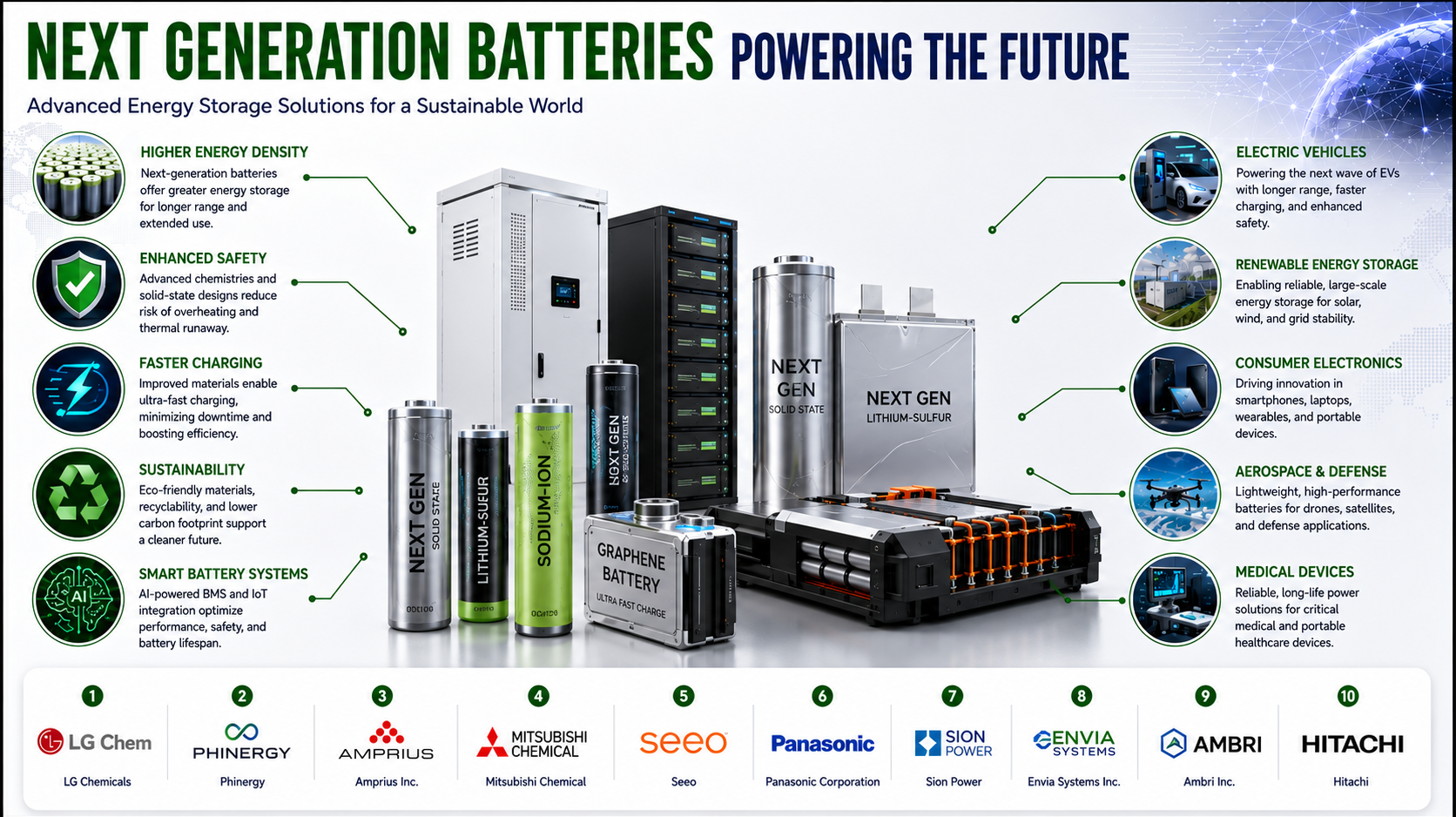
Top 10 Companies in the Global Next-Generation Batteries Market Driving Industry Growth in 2026
Introduction
The race to replace conventional lithium-ion cells with safer, denser, and longer-lasting energy storage has become one of the most closely watched contests in the global energy and mobility landscape. As electric vehicles, renewable power grids, drones, and next-generation electronics push existing battery chemistries to their limits, a wave of solid-state, lithium-sulfur, sodium-ion, lithium-air, and graphene-based technologies is emerging to meet the gapand the companies building them are attracting outsized investor and government attention.
According to the latest market intelligence from Intellectual Market Insights Research (IMIR), the Next Generation Batteries Market was valued at approximately USD 7.3 billion in 2024 and is expected to reach USD 17.4 billion by 2034, growing at a compound annual growth rate (CAGR) of 9.1% over the 2025–2034 forecast period. This more-than-doubling of market value reflects the urgency with which automakers, electronics makers, defense agencies, and utilities are moving beyond conventional lithium-ion technology.
At its core, the next-generation batteries market spans solid-state batteries, lithium-sulfur (Li-S) batteries, sodium-ion batteries, lithium-air batteries, and graphene-based batteries, each offering a distinct combination of energy density, safety, cost, and charging speed advantages over incumbent chemistries.
The industry's growth is being propelled by multiple converging forces. First, the electric vehicle industry's relentless pursuit of longer range, faster charging, and improved safety is pulling solid-state and lithium-sulfur technologies out of the lab and into production roadmaps. Second, the consumer electronics sector's demand for thinner, longer-lasting, and safer batteries in smartphones, laptops, and wearables is driving silicon-anode and graphene innovation. Third, the renewable energy boom is creating enormous demand for grid-scale storage, where cost-effective chemistries like sodium-ion are gaining ground.
Investment activity remains intense, with automotive giants, materials conglomerates, and specialized battery start-ups all allocating significant capital toward solid electrolytes, silicon anodes, and next-generation cell architectures. Government-backed decarbonization policies across North America, Europe, and Asia-Pacific are further accelerating capital flows into battery manufacturing and R&D.
The industry also faces real headwinds: long development and commercialization cycles, stringent safety certification requirements from bodies such as the FAA, UL, and ISO, and the capital intensity of scaling new chemistries from laboratory prototypes to mass production are all slowing the pace of adoption. Nevertheless, the long-term trajectory of the market remains firmly positive, underpinned by decarbonization mandates, the electrification of transport, and the essential role advanced batteries play in the future of clean energy.
This article profiles the top 10 companies shaping the global Next-Generation Batteries Market in 2026, provides a competitive landscape analysis, examines regional dynamics and emerging trends, and offers a forward-looking outlook for the industry.
Market Overview
|
Parameter |
Details |
|---|---|
|
Market Size (2024) |
USD 7.3 Billion |
|
Market Size (2034) |
USD 17.4 Billion |
|
CAGR (2025–2034) |
9.1% |
|
Forecast Period |
2025–2034 |
|
Base Year |
2024 |
|
By Battery Type |
Solid-State Batteries, Lithium-Sulfur (Li-S) Batteries, Sodium-Ion Batteries, Lithium-Air Batteries, Graphene-Based Batteries |
|
By Application |
Electric Vehicles, Consumer Electronics, Renewable Energy Storage, Aerospace & Defense, Medical Devices |
|
Key Regions |
North America, Europe, Asia-Pacific, Latin America, MEA |
|
Dominant Region |
Asia-Pacific (64.48% revenue share in 2023) |
|
Fastest Growing Region |
Asia-Pacific |
Key Market Drivers:
- Rising demand for thinner, longer-life, and safer batteries in consumer electronics
- Expanding use of high-energy, lightweight batteries in logistics, surveillance, and agricultural drones
- Growing electric vehicle production requiring higher energy density and faster charging
- Government decarbonization policies and clean-energy incentives worldwide
- Rapid expansion of renewable energy generation requiring grid-scale storage
- Increasing R&D investment from automakers, materials companies, and battery specialists
- Growing demand for safe, long-life power sources in medical and portable devices
Key Market Opportunities:
- Battery repurposing and recycling for sustainable, cost-effective supply chains
- Smart, AI-enabled energy storage systems for grids and connected devices
- Solid-state batteries for extended-range electric vehicles
- Lithium-sulfur batteries for aerospace and defense applications
- Sodium-ion batteries for low-cost grid and EV storage in resource-constrained regions
- Graphene-based batteries for ultra-fast charging industrial applications
Key Market Challenges:
- Long development and commercialization cycles for new battery chemistries
- Extensive certification requirements from bodies such as the FAA, UL, and ISO
- High capital requirements for specialized manufacturing facilities and supply chains
- Laboratory innovation racing ahead of scalable, cost-effective mass production
- Dependence on critical raw materials and evolving global supply chains
Why the Next-Generation Batteries Market Is Growing
The trajectory of the next-generation batteries market is the result of powerful technological and policy shifts reshaping how the world generates, stores, and consumes energy.
1. Advancing Battery Technology for Consumer Electronics
Increased consumer demand for thinner, longer-life, and safer batteries is driving innovation in notebooks, smartphones, and wearables, with companies pursuing silicon-anode and graphene-based chemistries to improve efficiency and longevity while reducing e-waste.
2. Powering the Future of Drones with Advanced Batteries
The growing use of drones in logistics, surveillance, and agriculture requires high-energy, lightweight batteries capable of supporting long flight times, rapid charging, and durable performance across demanding operating environments.
3. Electric Vehicle Range and Safety Demands
Automakers are investing heavily in solid-state and lithium-sulfur batteries to extend EV range, reduce charging time, and improve safety, with several manufacturers targeting well over 500 miles of range on a single charge.
4. Sustainable Supply Chains Through Recycling and Repurposing
Technological advances in battery recycling and repurposing are extending battery life, recovering valuable materials like lithium, cobalt, and nickel, and reducing dependence on constrained raw-material supplies.
5. Smart Energy Storage Integration
Intelligent storage systems combining advanced batteries, AI, and real-time monitoring are improving grid balancing, renewable energy integration, and predictive maintenance across power and device applications.
6. Renewable Energy Expansion
The rapid growth of solar and wind generation is creating strong demand for grid-scale storage technologies such as sodium-ion batteries that can smooth out the intermittency of renewable power.
7. Government Decarbonization Policies
Clean-energy incentives, EV subsidies, and domestic battery manufacturing programs across the U.S., EU, China, and other markets are accelerating capital investment in next-generation battery production.
8. Aerospace and Defense Demand
Lightweight, high-energy-density batteries are increasingly critical for drones, satellites, and defense systems, with lithium-sulfur chemistries seeing growing interest for space and aerospace applications.
9. Medical Device Power Requirements
Safe, long-life power sources are essential for implantable and portable medical devices, pushing solid-state battery development for life-support and diagnostic equipment.
10. Materials Science Breakthroughs
Continuous advances in solid electrolytes, silicon anodes, and graphene conductivity are shortening the gap between laboratory prototypes and commercially viable next-generation cells.
Top 10 Companies in the Global Next-Generation Batteries Market
- LG Chem (LG Energy Solution)
- Panasonic Corporation
- Mitsubishi Chemical
- Hitachi
- Amprius Inc.
- Phinergy
- Sion Power
- Seeo
- Envia Systems Inc.
- Ambri Inc.
1. LG Chem
|
Category |
Details |
|---|---|
|
Company Name |
LG Chem |
|
Headquarters |
Seoul, South Korea |
|
Founded |
1947 |
|
Industry Focus |
Chemicals, Advanced Materials, Battery Technology |
|
Global Presence |
Manufacturing and R&D operations across Asia, North America, and Europe |
|
Company Overview |
LG Chem is one of the world's largest chemical and battery materials companies, with its battery business built into a global leader in advanced cell technology, supplying automakers and electronics manufacturers worldwide. The company invests heavily in solid-state electrolytes and next-generation cathode materials. |
|
Key Products & Services |
Lithium-ion and next-generation battery materials, solid-state electrolyte development, cathode and separator materials. |
|
Market Position |
A top-tier global supplier to major automakers, with deep R&D capacity spanning both current and next-generation chemistries. |
|
Recent Developments |
Continued investment in solid-state battery R&D and expanded manufacturing capacity across North America and Asia to support EV demand. |
|
Strategic Advantages |
Deep materials science expertise, global manufacturing scale, long-standing automaker partnerships, and strong R&D pipeline. |
2. Panasonic Corporation
|
Category |
Details |
|---|---|
|
Company Name |
Panasonic Corporation |
|
Headquarters |
Osaka, Japan |
|
Founded |
1918 |
|
Industry Focus |
Electronics, Energy, Battery Manufacturing |
|
Global Presence |
Operations across Japan, North America, Europe, and Asia-Pacific |
|
Company Overview |
Panasonic is a longtime lithium-ion battery leader and a key EV battery supplier, now expanding into next-generation chemistries including higher-nickel and silicon-anode cells to boost energy density for automotive partners. |
|
Key Products & Services |
EV battery cells, energy storage systems, advanced anode and cathode materials. |
|
Market Position |
A leading global EV battery supplier with deep manufacturing scale and automotive relationships. |
|
Recent Developments |
Ongoing investment in higher energy-density cell chemistries and expanded gigafactory capacity to serve growing EV demand. |
|
Strategic Advantages |
Decades of battery manufacturing experience, strong automotive partnerships, and large-scale production capability. |
3. Mitsubishi Chemical
|
Category |
Details |
|---|---|
|
Company Name |
Mitsubishi Chemical |
|
Headquarters |
Tokyo, Japan |
|
Founded |
1933 |
|
Industry Focus |
Chemicals, Advanced Materials |
|
Global Presence |
Global operations across Asia, North America, and Europe |
|
Company Overview |
Mitsubishi Chemical develops advanced materials for next-generation battery applications, including separators, electrolytes, and specialty chemicals that support solid-state and high-energy-density cell development. |
|
Key Products & Services |
Battery separators, electrolyte materials, specialty chemicals for advanced battery systems. |
|
Market Position |
A key upstream materials supplier supporting battery manufacturers' shift toward next-generation chemistries. |
|
Recent Developments |
Expanding R&D partnerships focused on solid-state electrolyte materials and advanced separator technology. |
|
Strategic Advantages |
Strong materials science heritage, diversified chemicals portfolio, and established supply relationships with battery makers. |
4. Hitachi
|
Category |
Details |
|---|---|
|
Company Name |
Hitachi |
|
Headquarters |
Tokyo, Japan |
|
Founded |
1910 |
|
Industry Focus |
Industrial Technology, Energy, Infrastructure |
|
Global Presence |
Operations across Asia, North America, and Europe |
|
Company Overview |
Hitachi applies its broad industrial and energy infrastructure expertise to next-generation battery systems, with a focus on grid-scale storage integration and smart energy management technologies. |
|
Key Products & Services |
Energy storage systems, grid integration technology, industrial battery solutions. |
|
Market Position |
A diversified industrial conglomerate with growing presence in energy storage and smart grid solutions. |
|
Recent Developments |
Expanding involvement in renewable energy storage projects and smart grid battery integration. |
|
Strategic Advantages |
Broad industrial technology base, strong engineering capability, and established utility and infrastructure relationships. |
5. Amprius Inc.
|
Category |
Details |
|---|---|
|
Company Name |
Amprius Technologies |
|
Headquarters |
Fremont, California, USA |
|
Founded |
2008 |
|
Industry Focus |
Silicon-Anode Battery Technology |
|
Global Presence |
Manufacturing operations in the United States, with customers across aerospace, defense, and consumer electronics |
|
Company Overview |
Amprius is a specialist developer of silicon-anode lithium-ion batteries offering significantly higher energy density than conventional graphite-anode cells, serving high-performance applications such as drones, aerospace, and electric aviation. |
|
Key Products & Services |
High-energy-density silicon-anode battery cells for aerospace, defense, and industrial applications. |
|
Market Position |
A specialist innovator recognized for pushing the energy-density limits of lithium-ion technology through silicon-anode design. |
|
Recent Developments |
Expanding domestic manufacturing capacity to meet growing demand from aerospace, defense, and drone customers. |
|
Strategic Advantages |
Proprietary silicon-anode technology, strong positioning in high-performance niche applications, and U.S.-based manufacturing base. |
Competitive Landscape
The global next-generation batteries market is characterized by a mix of large, diversified materials and electronics conglomerates and a growing tier of specialist technology innovators pursuing specific next-generation chemistries.
Among the diversified giants, LG Chem, Panasonic, Mitsubishi Chemical, and Hitachi bring scale manufacturing, deep materials science expertise, and long-standing automaker and utility relationships to bear on the shift toward solid-state, higher-density, and grid-scale battery technologies. At the same time, specialist innovators such as Amprius, Phinergy, Sion Power, Seeo, Envia Systems, and Ambri are pursuing focused technology bets, silicon-anode cells, metal-air batteries, lithium-sulfur chemistries, solid polymer electrolytes, and liquid-metal grid storage, each targeting specific application niches where their technology offers a decisive advantage.
The competitive landscape is also shaped by automakers and technology giants such as Toyota, Tesla, CATL, and BYD, who are directly investing in solid-state, sodium-ion, and next-generation lithium chemistries to secure their own supply chains and differentiate their vehicle and product offerings.
Key Competitive Trends:
Mergers and Acquisitions: Larger materials and electronics companies continue to acquire or partner with specialist battery start-ups to accelerate access to solid-state, silicon-anode, and other next-generation technologies without building capability from scratch.
Partnerships and Collaborations: Automakers are increasingly forming joint ventures and long-term supply partnerships with battery technology developers to secure next-generation cell supply and co-develop proprietary chemistries.
Innovation Strategies: Leading players are investing in solid-state electrolytes, silicon-anode and graphene-based materials, sodium-ion cost-reduction efforts, and metal-air and liquid-metal architectures as core innovation priorities.
Regional Analysis
North America
North America's next-generation batteries market is expanding rapidly, driven by escalating EV demand, strong government support for clean energy programs, and heavy investment in battery manufacturing infrastructure. The U.S. leads regional growth as automakers such as Tesla and General Motors invest in solid-state and lithium-metal battery development, while domestic companies increasingly partner with international battery makers to strengthen supply chains.
Europe
Europe's next-generation batteries market is being propelled by strict environmental policies and strong government support for clean energy and electric vehicles. Germany and France anchor the region's battery research and manufacturing investment, supported by the European Union Green Deal and a broader push to reduce dependence on overseas battery supply chains. France, in particular, is investing in domestic battery manufacturing as part of its carbon-neutrality goals.
Asia-Pacific
Asia-Pacific held the largest revenue share of the global market at 64.48% in 2023, led by Japan, China, and South Korea's dominance in battery manufacturing, research, and development. China remains the world's largest producer and consumer of next-generation batteries, with companies such as CATL and BYD leading solid-state and lithium-ion alternative development, supported by strong government EV subsidies and manufacturing investment.
Latin America
The Central & South America next-generation batteries market is gradually expanding as countries such as Brazil and Chile invest in renewable energy and electromobility projects. While still at a nascent stage compared with North America and Asia, rising demand for energy storage and electric vehicles is expected to fuel steady growth, supported by partnerships with international battery makers.
Middle East & Africa
The Middle East and Africa region is seeing rising demand for next-generation batteries tied to renewable energy storage and electric vehicle adoption. Saudi Arabia's Vision 2030 initiative is driving investment in solar, wind, and EV charging infrastructure, while South Africa and the UAE are gradually adopting next-generation battery technologies as part of broader clean-energy transitions.
Emerging Trends Shaping the Next-Generation Batteries Market
- Rise of Solid-State Battery Commercialization Automakers such as Toyota are investing heavily in solid-state technology to enable faster charging and greater EV range, positioning solid electrolytes as the leading next-generation chemistry.
- Lithium-Sulfur for Aerospace and EVs Higher energy-to-weight ratios are making lithium-sulfur batteries increasingly attractive for aerospace applications, including consideration for space exploration missions, as well as long-range EVs.
- Sodium-Ion as a Cost-Effective Alternative Companies such as CATL are advancing sodium-ion batteries for grid storage and low-cost EVs, particularly in regions with limited lithium resources.
- Graphene and Silicon-Anode Innovation Fast-charging graphene-based batteries and high-density silicon-anode cells are gaining traction in consumer electronics and industrial applications requiring rapid energy release.
- Battery Recycling and Circular Supply Chains Advances in hydrometallurgical and direct recycling technologies are improving material recovery rates for lithium, cobalt, and nickel, reducing manufacturing costs and environmental impact.
- Smart, AI-Integrated Energy Storage Bidirectional charging and IoT-based battery monitoring are enabling predictive maintenance and more efficient integration of storage with renewable energy grids.
Future Outlook (2026–2034)
The global Next-Generation Batteries Market is positioned for sustained growth through the 2025–2034 forecast period, underpinned by decarbonization mandates, EV electrification, and the essential need for safer, higher-density energy storage.
Growth Projections: Based on current trajectory, the market is expected to grow from USD 7.3 billion in 2024 to USD 17.4 billion by 2034, reflecting a CAGR of 9.1%. Asia-Pacific will likely remain the dominant and fastest-growing regional engine, followed by steady expansion across North America and Europe.
Investment Opportunities: The most compelling investment opportunities lie in solid-state battery commercialization; lithium-sulfur batteries for aerospace and EV applications; sodium-ion batteries for cost-sensitive grid and EV markets; battery recycling and circular supply chains; and smart, AI-integrated energy storage systems.
Industry Transformation: The next-generation batteries industry will increasingly look like a technology-differentiated, application-specific sector rather than a single commodity category, with companies competing on chemistry-specific advantages tailored to EVs, aerospace, grid storage, and consumer electronics.
Future Technologies: Key emerging developments likely to reshape the industry over the next decade include mass-produced solid-state cells, viable lithium-air chemistries, advanced silicon-anode and graphene materials, and further integration of AI-driven battery management systems.
Regulatory Evolution: Certification and safety standards from bodies such as the FAA, UL, and ISO will continue to shape commercialization timelines. Companies that proactively invest in compliance, testing, and transparent supply chains will be best positioned to navigate the evolving regulatory landscape.
FAQ Section: Next-Generation Batteries Market
Q1: What is the current size of the global Next-Generation Batteries Market?
The global Next-Generation Batteries Market was valued at approximately USD 7.3 billion in 2024 and is projected to reach USD 17.4 billion by 2034, growing at a CAGR of 9.1% over the 2025–2034 forecast period.
Q2: Who are the leading companies in the Next-Generation Batteries Market?
Leading companies include LG Chem, Panasonic Corporation, Mitsubishi Chemical, Hitachi, Amprius Inc., Phinergy, Sion Power, Seeo, Envia Systems Inc., and Ambri Inc.
Q3: Which region dominates the Next-Generation Batteries Market?
Asia-Pacific dominates the global market, holding a 64.48% revenue share in 2023, led by Japan, China, and South Korea, while North America and Europe remain mature, fast-growing markets supported by strong EV and clean-energy policies.
Q4: What are the primary growth drivers of the Next-Generation Batteries Market?
Key drivers include rising demand for advanced consumer electronics batteries, growth in drone applications, electric vehicle range and safety requirements, government decarbonization policies, and expanding renewable energy storage needs.
Q5: What is the projected CAGR of the Next-Generation Batteries Market?
The Next-Generation Batteries Market is forecast to grow at a CAGR of 9.1% from 2025 to 2034.
Q6: What battery types are covered in the Next-Generation Batteries Market?
Key battery types include solid-state batteries, lithium-sulfur (Li-S) batteries, sodium-ion batteries, lithium-air batteries, and graphene-based batteries.
Q7: What are the main applications for next-generation batteries?
The primary applications are electric vehicles, consumer electronics, renewable energy storage, aerospace and defense, and medical devices.
Conclusion
The global Next-Generation Batteries Market stands as one of the most strategically important and rapidly evolving sectors within the broader energy and mobility landscape. Growing from USD 7.3 billion in 2024 to a projected USD 17.4 billion by 2034 at a CAGR of 9.1%, the market's trajectory reflects the convergence of electric vehicle electrification, renewable energy expansion, consumer electronics innovation, and government-backed decarbonization policy.
The companies profiled in this article, spanning diversified materials and electronics leaders like LG Chem, Panasonic, Mitsubishi Chemical, and Hitachi, alongside specialist innovators such as Amprius, Phinergy, Sion Power, Seeo, Envia Systems, and Ambri, collectively represent the full ecosystem of innovation, investment, and competitive intensity shaping this market in 2026 and beyond.
For investors, procurement professionals, industry analysts, and strategic decision-makers, understanding the dynamics of this market, from the promise of solid-state and lithium-sulfur breakthroughs to the challenges of long commercialization cycles and capital-intensive manufacturing, is essential for identifying where opportunity lies and where risk must be managed. The next-generation batteries industry is not merely a component business: it is a technology-defined sector whose evolution will shape how the world generates, stores, and consumes clean energy for decades to come.