
Nuclear Medicine Market Size, Share, Growth & Top 20 Companies (2025–2034)
Author:
Intellectual Market Insights Research
Published Date:
04 Jul 2026
Introduction
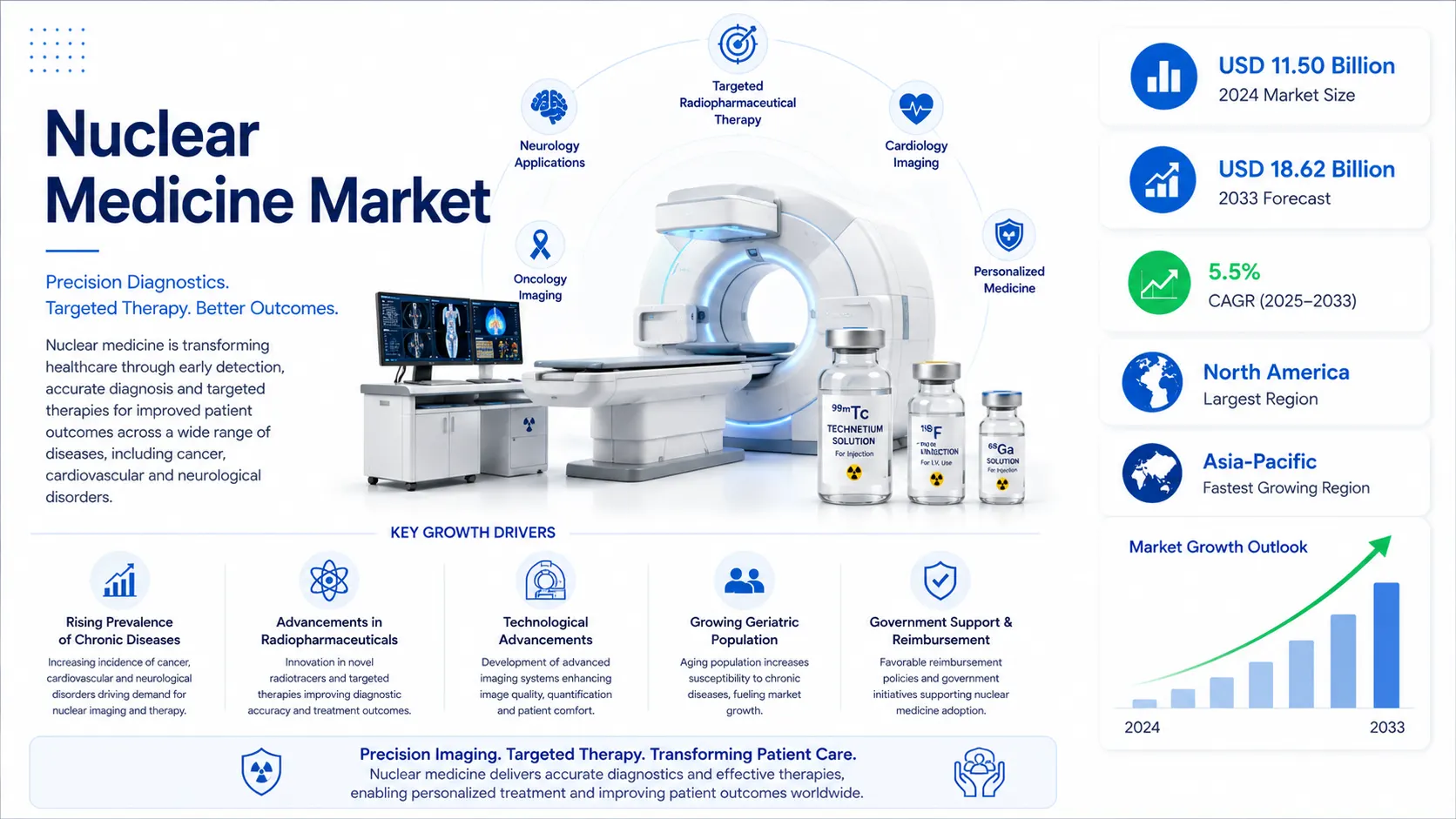
Nuclear medicine sits at an unusual intersection of physics, pharmacology, and oncology, and in 2026 it is arguably one of the fastest-moving corners of the entire healthcare industry. What used to be a niche diagnostic specialty built around a handful of gamma-camera scans has turned into a genuine growth engine for global healthcare systems, propelled by an idea that sounds almost too elegant to be true: use the same radioactive molecule to find a tumor and then, in a slightly different form, to destroy it. That idea — theranostics — is why the Nuclear Medicine Market is now valued at USD 9.8 billion and is on a path to more than double, reaching USD 25.4 billion by 2034 at a 10.1% CAGR.
A few forces are converging at once. Cancer incidence continues to climb worldwide, and the World Health Organization has flagged close to 20 million new cases annually, a number that keeps oncology departments hunting for better ways to stage disease early and monitor treatment response. Cardiovascular disease follows a similar trajectory, and myocardial perfusion imaging remains one of the most widely reimbursed nuclear medicine procedures in the world. On the supply side, governments have started treating medical isotope production as a matter of strategic importance rather than a niche industrial concern — the U.S. Department of Energy's Isotope Program, the European Union's SAMIRA initiative, and India's Department of Atomic Energy are all funding new production capacity for isotopes like Technetium-99m, Gallium-68, and Lutetium-177.
At the same time, the commercial success of therapies such as Novartis's Pluvicto (for metastatic prostate cancer) and Lutathera (for neuroendocrine tumors) has proven that radioligand therapy can be a genuine blockbuster category, not just a research curiosity. That has triggered a wave of consolidation and capacity investment across the supply chain — from cyclotron operators and isotope producers to radiopharmacies and imaging equipment manufacturers — as companies race to secure Lu-177 and actinium-225 supply for the next generation of alpha- and beta-emitting therapeutics.
This article walks through where the nuclear medicine market stands today, what is driving and restraining it, how it breaks down by segment and region, and profiles the Top 20 companies shaping its future — from imaging giants like GE HealthCare and Siemens Healthineers to pure-play radiopharmaceutical specialists like Curium, Lantheus, and Telix. We also map the market's connections to adjacent industries — oncology therapeutics, diagnostic imaging, genetic testing, and isotope production — that are evolving alongside it.
Nuclear Medicine Market Overview
Nuclear medicine uses small, carefully calibrated amounts of radioactive material — radiopharmaceuticals — to diagnose and treat disease at the molecular level, something that structural imaging techniques like standard CT or MRI cannot do on their own. A radiotracer is introduced into the body, where it concentrates in specific tissues or binds to particular cell receptors; a gamma camera (for SPECT) or PET scanner then detects the emitted radiation to build an image of organ function, blood flow, or tumor metabolism. On the therapeutic side, radioisotopes such as Lutetium-177 and Iodine-131 are engineered to bind to disease-specific targets and deliver a therapeutic radiation dose directly to malignant cells, largely sparing healthy tissue.
The global market's USD 9.8 billion base (2024) breaks down primarily between diagnostic and therapeutic radiopharmaceuticals, with the diagnostics segment accounting for the clear majority of procedure volume — the IAEA estimates that more than 80% of nuclear medicine procedures worldwide are diagnostic, with Technetium-99m dominating that share. The therapeutics segment is smaller in volume but is growing fastest, powered by expanding indications for Lu-177 and Ac-225 based radioligand therapies in prostate cancer, neuroendocrine tumors, and increasingly other solid tumors.
North America remains the largest regional market, underpinned by dense installed bases of PET/CT and SPECT/CT systems, favorable CMS reimbursement for oncology and cardiology imaging, and a concentrated cluster of radiopharmaceutical manufacturers and academic medical centers. Europe and Asia-Pacific are following different but complementary paths: Europe through coordinated public funding (Euratom's SAMIRA program) and faster EMA approval pathways for radiopharmaceuticals, and Asia-Pacific through rapid hospital infrastructure build-out in China, India, and Japan alongside growing domestic isotope production capability.
Market Dynamics
Growth Drivers
- Public-sector investment in radioisotope infrastructure. Governments have moved decisively to reduce reliance on a handful of aging research reactors for isotope supply. The U.S. Department of Energy's Isotope Program and Advanced Nuclear Medicine Initiative are funding non-HEU (highly enriched uranium) based Mo-99 production, while the EU's SAMIRA initiative has allocated more than €60 million toward radiopharmaceutical training and infrastructure. These programs are shortening supply chains and reducing the risk of the isotope shortages that periodically disrupted the sector in the 2010s.
- Expanding reimbursement for hybrid imaging. The U.S. Centers for Medicare & Medicaid Services has broadened coverage for PET tracers used in cancer staging and myocardial perfusion imaging, a pattern echoed by public insurers in Canada, Germany, Japan, and the UK's NHS PET-CT service. Better reimbursement directly expands the addressable patient population for both diagnostic and therapeutic procedures.
- Rising cancer and cardiovascular disease burden. With global cancer incidence trending toward nearly 30 million new cases annually by 2040, demand for precise, early-stage diagnostic tools and targeted therapies is structurally increasing rather than cyclical.
- Commercial validation of radioligand therapy. Pluvicto's rapid revenue growth for Novartis has proven out the commercial model for targeted radionuclide therapy, drawing new capital and R&D investment from pharmaceutical majors, specialty biotechs, and isotope suppliers alike.
Market Restraints
- Isotope supply chain fragility. A meaningful share of global Mo-99 supply still depends on a small number of research reactors, including some approaching end-of-life. Unplanned outages at facilities like Belgium's BR2 or South Africa's SAFARI-1 can ripple through global supply within days, given the short half-life of Tc-99m (roughly six hours) and its parent Mo-99 (about 66 hours).
- Regulatory and radiation-safety complexity. Transport, storage, and administration of radiopharmaceuticals are governed by dense, often country-specific regulatory frameworks. Compliance costs are proportionally heavier for smaller diagnostic centers and hospitals in lower-income regions, slowing adoption.
- Workforce shortages. Nuclear medicine physicians, radiochemists, nuclear pharmacists, and medical physicists remain in short supply in many countries, and formal training pipelines have not scaled at the same pace as equipment installations, leaving some imaging capacity underutilized.
Market Opportunities
- Isotope self-reliance strategies. The U.S., Canada, India, and Australia are each pursuing domestic production of Tc-99m, Lu-177, and Ga-68 to de-risk supply, creating opportunities for isotope producers and cyclotron operators willing to invest in new capacity.
- AI-enabled image interpretation and dosimetry. Programs funded by the NIH and the European Commission's Horizon Europe are backing AI platforms that improve diagnostic accuracy and streamline PET/SPECT workflow — a meaningful opportunity for software vendors and imaging OEMs able to embed these tools into existing scanner fleets.
- Expansion into emerging markets. The IAEA's "Atoms for Health" initiative and its Africa-focused AFRA program are actively building out nuclear medicine capacity across more than 40 member states, opening long-horizon growth opportunities as these health systems mature.
Market Challenges
Balancing the economics of high-cost therapeutics (a single course of Lu-177-based therapy can exceed USD 50,000) against payer willingness to reimburse remains an open industry challenge, as does scaling manufacturing of short-half-life isotopes fast enough to meet clinical demand without excessive waste.
Top 20 Leading Companies in the Global Nuclear Medicine Market
- GE HealthCare
- Siemens Healthineers
- Curium Pharma
- Lantheus Holdings, Inc.
- Cardinal Health, Inc.
- Bracco Imaging S.p.A.
- Novartis AG
- Bayer AG
- Telix Pharmaceuticals Limited
- IBA (Ion Beam Applications) / IBA RadioPharma Solutions
- Eckert & Ziegler Radiopharma GmbH
- NorthStar Medical Radioisotopes, LLC
- BWXT Medical Ltd.
- Nordion (Canada) Inc.
- Jubilant Pharmova Limited (Jubilant DraxImage)
- SOFIE Biosciences
- Isoray, Inc.
- Philips Healthcare (Royal Philips)
- Canon Medical Systems Corporation
- Advanced Accelerator Applications (AAA), a Novartis company
1. GE HealthCare
Headquarters: Chicago, Illinois, USA | Spun off from General Electric: 2023
GE HealthCare is one of the two or three companies capable of supplying a hospital's entire nuclear imaging chain — SPECT, PET/CT, and increasingly PET/MR systems — alongside a global service network. Its Imaging segment generates billions in quarterly revenue from SPECT/CT and PET/CT sales, and the company has pushed into compact PET/CT systems aimed at smaller and rural facilities to widen access. GE HealthCare also took full control of Nihon Medi-Physics, consolidating its radiopharmacy network in Japan, the world's most cyclotron-dense country. Its competitive advantage lies in combining hardware, software, and an established global installed base, giving it unmatched reach into hospital procurement decisions and positioning it as a long-term partner rather than a single-purchase vendor.
2. Siemens Healthineers
Headquarters: Erlangen, Germany | Parent: Siemens Healthineers AG
Siemens Healthineers' molecular imaging and nuclear medicine portfolio sits inside its broader Imaging division, which reported tens of billions in annual revenue, with hybrid PET/CT and PET/MR systems seeing particularly strong demand across the Americas and Europe. The company has leaned heavily into AI, announcing a 2025 collaboration to develop imaging algorithms that improve PET scan accuracy. Siemens' competitive edge comes from deep integration between its scanner hardware and its syngo software ecosystem, plus a large European and North American installed base that gives it early access to hospital upgrade cycles.
3. Curium Pharma
Headquarters: Paris, France | Ownership: Private equity (CapVest)
Curium describes itself as the world's largest pure-play nuclear medicine company, delivering SPECT, PET, and therapeutic radiopharmaceutical solutions to more than 14 million patients annually through manufacturing sites across Europe and the United States. Its 2025 acquisition of Turkey-based Eczac?ba??-Monrol expanded its PET network from 34 to 46 sites and significantly increased its Lutetium-177 manufacturing capacity, directly supporting pipeline candidates for prostate cancer and neuroendocrine tumors. Curium's competitive advantage is vertical integration across isotope production, radiopharmaceutical manufacturing, and distribution logistics — a structure built specifically to withstand the short half-lives that make this industry so supply-chain sensitive.
4. Lantheus Holdings, Inc.
Headquarters: Bedford, Massachusetts, USA | Listed: NASDAQ (LNTH)
Lantheus is best known for PYLARIFY, a PSMA-targeted PET imaging agent for prostate cancer that has become one of the most widely used diagnostic radiopharmaceuticals in the U.S., alongside its long-standing DEFINITY ultrasound contrast agent. The company has used its PYLARIFY cash flow to expand its radiopharmaceutical pipeline into therapeutic candidates, positioning itself to move from a diagnostics-first company toward a broader theranostics player. Its U.S. distribution network and manufacturing scale give it a strong domestic competitive position.
5. Cardinal Health, Inc.
Headquarters: Dublin, Ohio, USA
Cardinal Health operates one of the largest nuclear pharmacy networks in the United States, supplying hospitals and imaging centers with ready-to-use radiopharmaceutical doses on tight delivery windows dictated by isotope half-lives. Rather than developing radiopharmaceuticals itself, Cardinal's advantage is logistics and last-mile distribution — a less visible but essential part of the value chain, since a Tc-99m dose that arrives late is a dose that has partially decayed away. Its scale in radiopharmacy distribution makes it a critical partner for manufacturers seeking U.S. market access.
Related Markets
Nuclear medicine does not operate in isolation — it sits inside a broader ecosystem of diagnostic imaging, oncology therapeutics, and isotope-adjacent industries. Where a verified Intellectual Market Insights report exists, it is linked below.
Medical Imaging Market — The broader imaging category (X-ray, MRI, ultrasound, and nuclear imaging) that nuclear medicine sits within; growth in one segment often drives capital equipment budgets across the whole category.
Diagnostic Imaging Services Market — Covers the outpatient and hospital service delivery layer where nuclear medicine procedures are actually performed and billed.
CT Scanner Market — CT is the structural imaging half of hybrid PET/CT and SPECT/CT systems central to modern nuclear medicine.
Next-Gen Micro-CT Scan Market — Adjacent high-resolution imaging technology increasingly used in preclinical radiopharmaceutical research.
Radiotherapy Market — External-beam radiotherapy is a complementary (and sometimes competing) cancer treatment modality to targeted radionuclide therapy.
Oncology Pharmaceuticals Market — The broader oncology drug category that radioligand therapies are increasingly classified within.
Targeted Therapy Market — Radioligand therapy is a specialized form of targeted therapy, sharing many of the same growth drivers.
Immuno-Oncology Drug Market — A complementary oncology approach often used alongside or sequenced with radiopharmaceutical treatment.
Monoclonal Antibody Therapeutics Market — Many next-generation radioligand therapies use antibody or peptide carriers similar to those developed for monoclonal antibody drugs.
Solid Tumor Oncogenesis Market — Underlying biology research that informs new radiopharmaceutical target selection.
Computational Oncology Market — AI and computational tools increasingly applied to PET/SPECT image analysis and dosimetry.
Oncology-Based Preclinical CRO Market — Preclinical research partners supporting radiopharmaceutical drug development pipelines.
Haematological Cancer Market and Acute Myeloid Leukemia Market — Blood cancer indications increasingly explored for targeted radionuclide therapy.
Cervical Cancer Market — An oncology indication where PET/CT staging plays a growing diagnostic role.
Genetic Testing Market and Direct-to-Consumer Genetic Testing Market — Biomarker identification that increasingly informs which patients are eligible for targeted radioligand therapies.
Portable Ultrasound Devices Market and Point-of-Care Ultrasound Market — Complementary point-of-care imaging modalities often used alongside nuclear medicine in diagnostic pathways.
Ophthalmology Devices Market — A separate but comparably regulated medical imaging device category.
Augmented Reality and Virtual Reality in Healthcare Market — AR/VR is increasingly layered onto nuclear imaging data for surgical planning and training.
Medical Refrigerators Market and Medical Batteries Market — Supporting infrastructure for radiopharmaceutical storage and portable imaging equipment.
Key Industry Trends
- Theranostics convergence. The line between diagnosis and therapy is blurring, with the same molecular target (such as PSMA) used first to image a tumor and then to treat it with a therapeutic isotope.
- Alpha-emitter expansion. Actinium-225 and lead-212 based therapies are moving from research into commercial supply chains, offering higher-energy, shorter-path radiation that may improve tumor control while reducing collateral damage.
- Vertical integration through M&A. Curium/Monrol and GE HealthCare/Nihon Medi-Physics illustrate a broader pattern of companies acquiring upstream isotope or radiopharmacy capacity to de-risk supply.
- AI-assisted dosimetry and image interpretation. Personalized dosimetry tools are emerging to optimize therapeutic radionuclide doses on a per-patient basis, a step toward more precise, value-based nuclear medicine care.
- Reimbursement modernization. Regulators and payers are adjusting separate payment categories for higher-cost diagnostic radiopharmaceuticals, improving hospital economics for adoption.
Segment Analysis
By Type: Diagnostic radiopharmaceuticals hold the larger share of the market today, driven by sheer procedure volume in oncology, cardiology, and neurology. Therapeutic radiopharmaceuticals are the faster-growing segment as Lu-177 and I-131 based treatments expand beyond their original indications.
By Application: Oncology is the dominant application, followed by cardiology (largely myocardial perfusion imaging) and a fast-growing neurology segment built around amyloid-PET tracers for Alzheimer's disease diagnosis.
By Modality: SPECT retains the largest installed base globally — the IAEA estimates over 26,000 SPECT cameras are in clinical use — owing to its affordability and long track record, while PET is the fastest-growing modality thanks to superior resolution for oncology and neurology use cases.
By End User: Hospitals and specialty clinics remain the primary setting for nuclear medicine procedures given the infrastructure and radiation-safety protocols required, while diagnostic imaging centers are the fastest-growing end-user segment as outpatient PET/SPECT access expands.
Regional Analysis
- North America leads the market on the strength of its isotope production infrastructure, DOE- and NIH-backed research programs, and CMS reimbursement policy.
- Europe is advancing through Euratom's SAMIRA funding and EMA's faster approval pathway for radiopharmaceuticals, with Germany, France, and the UK as focal markets.
- Asia-Pacific is the fastest-growing region, driven by cyclotron build-out in China, India's DAE/BRIT isotope production, and Japan's long-standing PET radiopharmaceutical research base.
- Latin America is developing steadily, led by Brazil's CNEN/FINEP-backed PET centers and Mexico's ININ isotope production for thyroid and renal diagnostics.
- Middle East & Africa is an early-stage but expanding market, anchored by Gulf-state hospital investment and South Africa's NECSA/SAFARI-1 reactor, a key global Mo-99 and I-131 supplier.
Competitive Landscape
The nuclear medicine competitive landscape spans several distinct but overlapping tiers: diversified imaging-equipment OEMs (GE HealthCare, Siemens Healthineers, Philips, Canon Medical), pure-play radiopharmaceutical manufacturers and radiopharmacy networks (Curium, Lantheus, Cardinal Health, Jubilant DraxImage), isotope producers and cyclotron operators (NorthStar, BWXT Medical, Nordion, Eckert & Ziegler, IBA), and large pharmaceutical companies that have moved into radioligand therapy through acquisition (Novartis, Bayer). The market is moderately fragmented, and vertical integration — securing isotope supply, manufacturing, and distribution under one roof — has become the dominant competitive strategy, exemplified by Curium's 2025 acquisition of Monrol to lock in Lu-177 capacity.
Frequently Asked Questions
1. How big is the nuclear medicine market in 2024–2025? The global nuclear medicine market was valued at USD 9.8 billion in 2024 and is projected to reach USD 25.4 billion by 2034, growing at a CAGR of 10.1%.
2. What is driving nuclear medicine market growth? Rising cancer and cardiovascular disease prevalence, expanding government-backed isotope production, broader reimbursement for PET/SPECT imaging, and the commercial success of radioligand therapies like Pluvicto and Lutathera.
3. What is the difference between diagnostic and therapeutic radiopharmaceuticals? Diagnostic radiopharmaceuticals (such as Tc-99m and F-18 FDG) are used to visualize organ function or disease using imaging equipment, while therapeutic radiopharmaceuticals (such as Lu-177 and I-131) deliver a targeted radiation dose intended to treat disease.
4. What is theranostics? Theranostics refers to using the same or a closely related molecular target first to diagnose disease with a diagnostic radiotracer, and then to treat it with a therapeutic radioisotope, most commonly seen today in PSMA-targeted prostate cancer care.
5. Which region leads the nuclear medicine market? North America holds the largest market share, supported by strong isotope production infrastructure, hospital adoption, and CMS reimbursement policy, though Asia-Pacific is growing fastest.
6. Who are the leading nuclear medicine companies? Leading companies include GE HealthCare, Siemens Healthineers, Curium Pharma, Lantheus Holdings, Cardinal Health, Novartis, Bayer, Telix Pharmaceuticals, and others profiled in this article.
7. Why is there periodic isotope shortage risk in nuclear medicine?
8. What isotopes are most commonly used in nuclear medicine?
9. How does PET differ from SPECT?
10. What role does AI play in nuclear medicine?
11. Is nuclear medicine therapy expensive?
12. What is the outlook for alpha-emitter therapies?
13. How is the market segmented by end user?
14. What government programs support the nuclear medicine industry?
15. Where can I get a detailed nuclear medicine market report? Intellectual Market Insights Research's full Nuclear Medicine Market report provides complete segmentation, regional forecasts, and competitive analysis through 2034, with sample downloads and custom research options available.
Conclusion
Nuclear medicine has moved from a specialized diagnostic niche to one of the more consequential growth stories in global healthcare, powered by the convergence of rising cancer burden, government-backed isotope infrastructure investment, and the commercial proof that targeted radionuclide therapy can work at scale. Companies that control isotope supply, manufacturing scale, and regulatory relationships across multiple regions — from GE HealthCare and Siemens Healthineers on the imaging equipment side to Curium, Novartis, and Telix on the radiopharmaceutical side — are best positioned to capture the market's growth from USD 9.8 billion in 2024 to a projected USD 25.4 billion by 2034.
For a complete, data-backed breakdown of segment forecasts, regional market sizing, and competitive benchmarking, explore the full Global Nuclear Medicine Market report from Intellectual Market Insights Research, or request a free sample to see the complete segmentation and company profiles. For custom research tailored to a specific region, application