
Paints & Coatings Market Size, Trends & Forecast to 2034
Author:
Intellectual Market Insights Research
Published Date:
06 Aug 2026
Paints and Coatings Market Trends, Growth & Forecast to 2034
Introduction
From the exterior walls of a new apartment tower to the anti-corrosive coat on an offshore pipeline, paints and coatings quietly protect and finish nearly every built and manufactured surface around us. As residential construction rebounds, automotive output climbs back toward pre-pandemic levels, and environmental regulators tighten emission limits, the formulators, resin suppliers, and applicators behind this industry are being pushed to innovate faster than at any point in the past decade.
According to industry estimates, the global paints and coatings market was valued at USD 185.74 billion in 2025 and is projected to grow from USD 192.46 billion in 2026 to USD 255.8 billion by 2034, at a CAGR of 3.62% from 2026 to 2034. While the growth rate is modest compared to fast-moving technology sectors, the sheer scale of the market and its exposure to construction cycles, automotive production, and regulatory shifts makes it one of the most closely watched segments within the broader chemicals and materials industry.
At its core, the paints and coatings market covers homogeneous mixtures of pigments, binders, and additives that form a protective or decorative solid film on a substrate through polymerization or evaporation. These products are engineered to improve aesthetics while shielding surfaces from corrosion, ultraviolet exposure, moisture, and general wear, spanning resin chemistries such as acrylic, alkyd, polyurethane, and epoxy.
The industry's steady expansion is being driven by a mix of structural and policy forces. First, sustained residential construction activity and infrastructure renewal programs are lifting demand for both decorative and protective coatings. Second, a rebound in global automotive production is reinforcing demand for water-borne basecoats and low-temperature clearcoats. Third, rapid urbanization across Asia-Pacific is expanding the addressable base for exterior and protective finishes on high-rise and coastal construction.
At the same time, the market faces real friction: stringent VOC regulations in the EU, California, and increasingly China are forcing costly reformulation, titanium-dioxide feedstock prices remain volatile, and water-borne systems still lag solvent-borne alternatives on drying and curing speed in cold or industrial settings. Even so, the long-term trajectory remains positive, anchored by green-building incentives, digitized manufacturing, and disciplined consolidation among the leading producers.
This article profiles the leading companies shaping the global paints and coatings market in 2026, examines segmentation and regional dynamics, and looks ahead at the trends set to define the industry through 2034.
Market Overview
|
Parameter |
Details |
|---|---|
|
Market Size (2025) |
USD 185.74 Billion |
|
Market Estimate (2026) |
USD 192.46 Billion |
|
Market Forecast (2034) |
USD 229.90 Billion |
|
CAGR (2026–2034) |
3.62% |
|
Forecast Period |
2026–2034 |
|
Historical Data |
2020–2025 |
|
By Resin |
Acrylic, Alkyd, Polyurethane, Epoxy, Polyester, Other Resin Types |
|
By Technology |
Water-Borne, Solvent-Borne, Powder Coating, UV-Cured Coating |
|
By End-User Industry |
Architectural, Automotive, Wood, Protective Coating, General Industrial, Transportation, Packaging |
|
Key Regions |
Asia-Pacific, North America, Europe, South America, Middle East, Africa |
|
Dominant Region |
Asia-Pacific |
|
Fastest Growing Region |
Asia-Pacific |
Key Market Drivers:
- Surge in global residential construction and infrastructure renewal activity
- Expanding automotive production volumes across Asia-Pacific and Europe
- Rapid urban population growth in APAC driving new-build and repaint demand
- Government incentives for green building and low-VOC product specification
- Emergence of AI-driven color-matching and plant-scheduling platforms
Key Market Opportunities:
- Development of bio-based and low-VOC water-borne resin systems
- Expansion of smart, functional, and self-healing coating technologies
- Untapped growth potential in South America, the Middle East, and Africa as infrastructure investment accelerates
- Advances in digitized color-matching and quality-control workflows to offset labor shortages
- Strategic acquisitions and portfolio consolidation among leading producers to unlock scale efficiencies
Key Market Challenges:
- Stringent and tightening global VOC regulations, particularly in the EU and California
- Volatility in titanium-dioxide feedstock prices, with supply concentrated in China
- Longer drying and curing times for water-borne systems versus solvent-borne alternatives
- Rising compliance costs and margin pressure from evolving chemical-control laws
Why the Paints and Coatings Market Is Growing
The steady expansion of the paints and coatings market reflects a convergence of construction demand, industrial recovery, and regulatory-driven reformulation.
1. Residential Construction and Infrastructure Renewal
Government-funded transport and utility programs, alongside affordable-housing initiatives in Asia-Pacific, are lifting demand for both decorative and protective coatings. Historically low mortgage rates in several economies have also revived remodeling budgets, channeling spend into premium low- and zero-VOC wall finishes.
2. Automotive Production Recovery
Light-vehicle output is regaining its pre-pandemic trajectory, with China, India, and Southeast Asia capturing the largest share of new capacity. Modern body shops are increasingly specifying water-borne basecoats and low-temperature bake clearcoats to cut cycle times and emissions.
3. Urbanization Across Asia-Pacific
Rapid urban migration in India, Indonesia, and the Philippines is driving large-scale investment in transport, utilities, and social infrastructure, while humid and coastal conditions in many megacities increase demand for protective topcoats and elastomeric exterior finishes.
4. Green Building and Low-VOC Mandates
Procurement guidelines in the United States and the EU's Energy Performance of Buildings Directive are standardizing low-VOC specifications, prompting project teams to favor independently certified, compliant coatings.
5. Digitization of Manufacturing and Color-Matching
Producers are digitizing color-matching, plant scheduling, and quality-control workflows to mitigate labor shortages and compress time-to-market, with AI-driven color-matching platforms emerging as an incremental growth lever.
6. Portfolio Consolidation Among Leading Producers
Rising competitive intensity is prompting the top suppliers to pursue targeted acquisitions and divestitures that create leaner portfolios and unlock scale and distribution efficiencies.
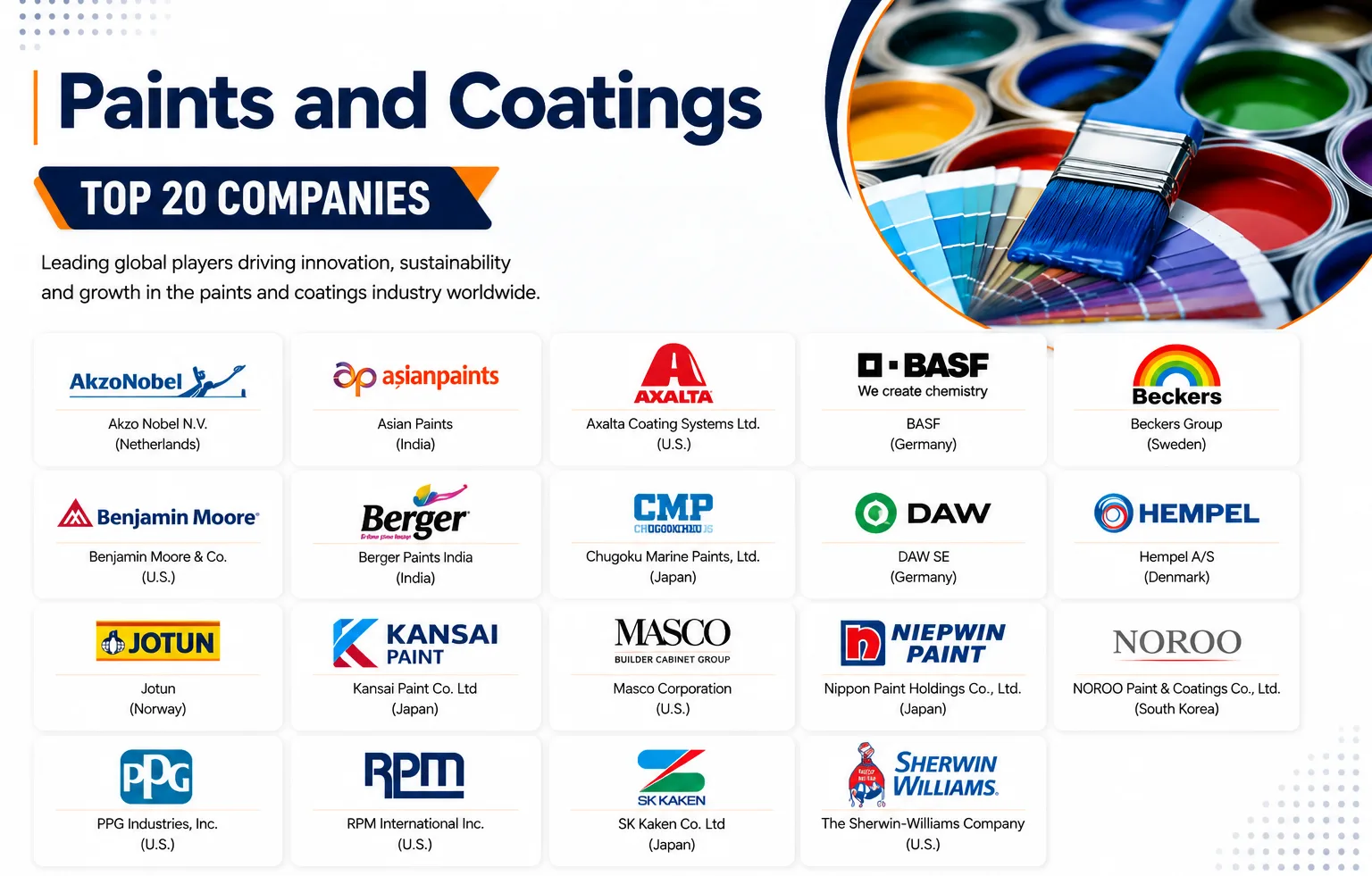
Leading Companies in the Global Paints and Coatings Market
- Akzo Nobel N.V.
- Asian Paints
- Axalta Coating Systems Ltd.
- BASF
- Beckers Group
- Benjamin Moore & Co.
- Berger Paints India
- Chugoku Marine Paints, Ltd.
- DAW SE
- Hempel A/S
- Jotun
- Kansai Paint Co. Ltd
- Masco Corporation
- Nippon Paint Holdings Co., Ltd.
- NOROO Paint & Coatings Co., Ltd.
- PPG Industries, Inc.
- RPM International Inc.
- SK Kaken Co. Ltd
- The Sherwin-Williams Company
1. The Sherwin-Williams Company (United States)
|
Category |
Details |
|---|---|
|
Industry Focus |
Architectural and Industrial Coatings, Retail Distribution |
|
Global Presence |
Operations across North America, South America, Europe, and Asia-Pacific |
|
Company Overview |
Sherwin-Williams operates one of the largest company-owned store networks in the industry, spanning decorative and protective coatings across residential, commercial, and industrial end markets. |
|
Market Position |
A top-ranked global player with deep distribution reach and strong brand equity in architectural coatings. |
|
Recent Developments |
Completed acquisition of BASF's Brazilian decorative paint business, expanding its store footprint and regional manufacturing capacity in South America. |
|
Strategic Advantages |
Vertically integrated manufacturing-to-retail model, extensive contractor relationships, and scale-driven purchasing power on raw materials. |
2. Nippon Paint Holdings Co., Ltd. (Japan)
|
Category |
Details |
|---|---|
|
Industry Focus |
Decorative, Automotive, and Marine Coatings |
|
Global Presence |
Strong footprint across Asia-Pacific, with expanding operations in the Americas and Europe |
|
Company Overview |
Nippon Paint holds a leading position across multiple Asian markets, supported by broad decorative and industrial coatings portfolios and regional manufacturing capacity. |
|
Market Position |
A dominant regional leader in Asia-Pacific, the fastest-growing market globally. |
|
Strategic Advantages |
Deep penetration in high-growth APAC economies and a diversified product mix spanning decorative, automotive, and protective segments. |
3. PPG Industries, Inc. (United States)
|
Category |
Details |
|---|---|
|
Industry Focus |
Industrial, Automotive, and Protective Coatings |
|
Global Presence |
Global manufacturing and distribution network across all major regions |
|
Company Overview |
PPG supplies coatings across automotive OEM, aerospace, protective, and architectural segments, while continuing to reshape its portfolio through targeted divestitures. |
|
Market Position |
A leading global coatings supplier with strong positioning in industrial and OEM channels. |
|
Recent Developments |
Divested its U.S. and Canada architectural coatings division, including company-owned stores, to sharpen focus on industrial and performance coatings. |
|
Strategic Advantages |
Broad technology portfolio across resin chemistries and strong OEM relationships in automotive and aerospace. |
4. BASF (Germany)
|
Category |
Details |
|---|---|
|
Industry Focus |
Resin Systems, Automotive Coatings, Specialty Chemicals |
|
Global Presence |
Operations across Europe, the Americas, and Asia-Pacific |
|
Company Overview |
BASF supplies resin technologies and coatings solutions across automotive, industrial, and decorative applications, underpinning many downstream formulators. |
|
Market Position |
A major upstream and downstream player with deep chemical formulation expertise. |
|
Strategic Advantages |
Integrated chemicals platform, strong R&D in low-VOC and bio-based resin systems, and long-standing OEM partnerships. |
5. Akzo Nobel N.V. (Netherlands)
|
Category |
Details |
|---|---|
|
Industry Focus |
Decorative Paints, Performance and Marine Coatings |
|
Global Presence |
Global operations with particular strength in Europe, Asia-Pacific, and the Americas |
|
Company Overview |
Akzo Nobel maintains a broad decorative and performance coatings portfolio, with a strong emphasis on sustainability-linked product innovation. |
|
Market Position |
A leading global coatings producer with strong brand recognition in decorative and protective segments. |
|
Strategic Advantages |
Long-standing sustainability leadership, broad geographic diversification, and strength across both decorative and industrial coatings. |
Competitive Landscape
The paints and coatings market is moderately fragmented, with private-equity investors continuing to roll up regional platforms and pursue exits to strategics seeking last-mile distribution or niche technology. Market leadership is concentrated among a group of global majors operating integrated manufacturing, resin-supply, and retail-distribution networks.
Key Competitive Trends:
Mature Players (Sherwin-Williams, PPG, Akzo Nobel, BASF, Nippon Paint, Asian Paints): Pursuing bio-based resin systems, smart functional finishes, and AI-driven customer interfaces to support premium pricing, while streamlining portfolios toward higher-margin segments through targeted acquisitions and divestitures. Their scale brings strong distribution reach and raw-material purchasing power, but also exposes them to volatile feedstock costs and tightening chemical-control regulations.
Regional and Specialist Players (Jotun, Hempel, Berger Paints India, Kansai Paint, DAW SE, Chugoku Marine Paints): Focused on protective, marine, and regional decorative niches, often with deep local distribution and application expertise. These players offer faster, more customizable regional solutions but face weaker global scale and greater exposure to single-region demand cycles.
Regional Analysis
Asia-Pacific
Asia-Pacific contributed 46.21% of worldwide paints and coatings revenue in 2025 and is tracking a robust 4.91% CAGR to 2034, supported by ongoing megacity development, industrial reshoring, and sustained public infrastructure outlays. Elevated humidity, salt spray, and UV exposure in coastal megacities are also driving demand for elastomeric and polysiloxane protective topcoats.
North America
North America is buoyed by federally funded transport-infrastructure programs and an accelerating residential remodeling cycle supported by stable mortgage rates. Growing preference for ESG-aligned, certified low-emission interior paints is positioning water-borne suppliers for incremental share gains.
Europe
Europe is undergoing a measured recovery as major economies work through housing shortages and energy-retrofit pipelines tied to the EU's Green Deal. Tightening labeling requirements under updated CLP regulations are adding compliance costs across the supply chain.
South America
South America offers selective upside, headlined by Brazil, where recent M&A activity has enlarged store footprints and given contractors easier access to branded decorative formulations.
Middle East & Africa
The Middle East and Africa present early-stage growth potential, driven by mega-projects and resource-linked infrastructure investment, though political risk and financing constraints continue to limit volume relative to Asia-Pacific. Harsh desert and coastal climates support strong specification of high-performance polysiloxane and fluoropolymer topcoats.
Emerging Trends Shaping the Paints and Coatings Market
- Water-Borne Chemistry Migration Global VOC regulations and sustainability preferences are accelerating the shift from solvent-borne to water-borne acrylic and polyurethane dispersions across architectural and automotive applications.
- Digitized Color-Matching and Plant Operations Producers are deploying AI-driven color-matching, scheduling, and quality-control tools to offset labor shortages and shorten time-to-market.
- Bio-Based and Functional Coatings Innovation is increasingly centered on bio-based resin systems and smart, functional finishes such as anti-microbial, thermally conductive, and self-healing coatings.
- Powder and UV-Cure Technology Adoption Near-zero-VOC powder coatings and instant-hardness UV-cure systems are gaining ground in metal furniture, appliances, flooring, and packaging.
- Portfolio Consolidation Leading suppliers are actively acquiring and divesting business units to build leaner, higher-margin portfolios and unlock regional scale efficiencies.
Future Outlook (2026–2034)
The global paints and coatings market is positioned for steady, resilient growth through 2034, underpinned by durable demand from construction and industrial end markets.
Growth Projections: The market is expected to grow from USD 192.46 billion in 2026 to USD 255.8 billion by 2034, at a CAGR of 3.62%, with Asia-Pacific likely to remain both the largest and fastest-growing region.
Investment Opportunities: The most compelling opportunities lie in low-VOC and bio-based resin systems, digitized manufacturing and color-matching platforms, and infrastructure build-out across South America, the Middle East, and Africa.
Industry Transformation: As VOC regulations tighten globally, the industry is expected to see continued convergence between resin formulators, equipment makers, and regulators to solve the performance-versus-compliance trade-off in water-borne systems.
Regulatory Evolution: Chemical-control and labeling regulations are expected to keep shaping regional product strategies, particularly across the EU and China, reinforcing the importance of agile, compliance-ready product-development pipelines.
FAQ Section: Paints and Coatings Market
Q1: What is the current size of the global paints and coatings market?
The global paints and coatings market was valued at USD 185.74 billion in 2025 and is estimated at USD 192.46 billion for 2026.
Q2: Who are the leading companies in the paints and coatings market?
Key players include The Sherwin-Williams Company, Nippon Paint Holdings, PPG Industries, BASF, Akzo Nobel, Asian Paints, Axalta Coating Systems, Jotun, Hempel, and Berger Paints India.
Q3: Which region dominates the paints and coatings market?
Asia-Pacific dominated the market with a 46.21% share in 2025, driven by urbanization, infrastructure spending, and industrial output, and is also expected to be the fastest-growing region through 2034.
Q4: What is the projected CAGR of the paints and coatings market?
The market is forecast to grow at a CAGR of 3.62% from 2026 to 2034.
Q5: Which resin segment leads the market?
Acrylic resins led with a 35.78% revenue share in 2025 and are projected to grow at a 3.98% CAGR through 2034.
Q6: Which technology segment dominates the market?
Water-borne technology held the largest revenue share in 2025 at 50.62% and remains the fastest-growing technology segment at a 4.02% CAGR.
Q7: What are the main end-user industries for paints and coatings?
Key end-user industries include architectural, automotive, wood, protective coating, general industrial, transportation, and packaging.
Conclusion
The global paints and coatings market reflects a mature but resilient industry, growing from an estimated USD 192.46 billion in 2026 to a projected USD 255.8 billion by 2034 at a CAGR of 3.62%. The market's trajectory is shaped by sustained residential and infrastructure construction, an automotive production recovery, and the ongoing migration toward low-VOC, water-borne chemistries in response to tightening global regulation.
The companies profiled in this article from decorative leaders like Sherwin-Williams and Asian Paints, to integrated chemical suppliers like BASF and Akzo Nobel, to protective and marine specialists like Jotun and Hempel collectively illustrate an industry balancing steady demand growth against raw-material volatility, regulatory complexity, and the technical challenges of reformulating for a lower-VOC future.
For investors, manufacturers, and channel partners, understanding the interplay between construction and automotive demand cycles, regional regulatory trajectories, and the pace of water-borne technology adoption will be key to identifying where the greatest opportunity lies through 2034.