
Periodontal Scalers and Curettes Market Size, Share, Trends, Growth Analysis and Forecast 2025–2035
Author:
Intellectual Market Insights Research
Published Date:
23 Jun 2026
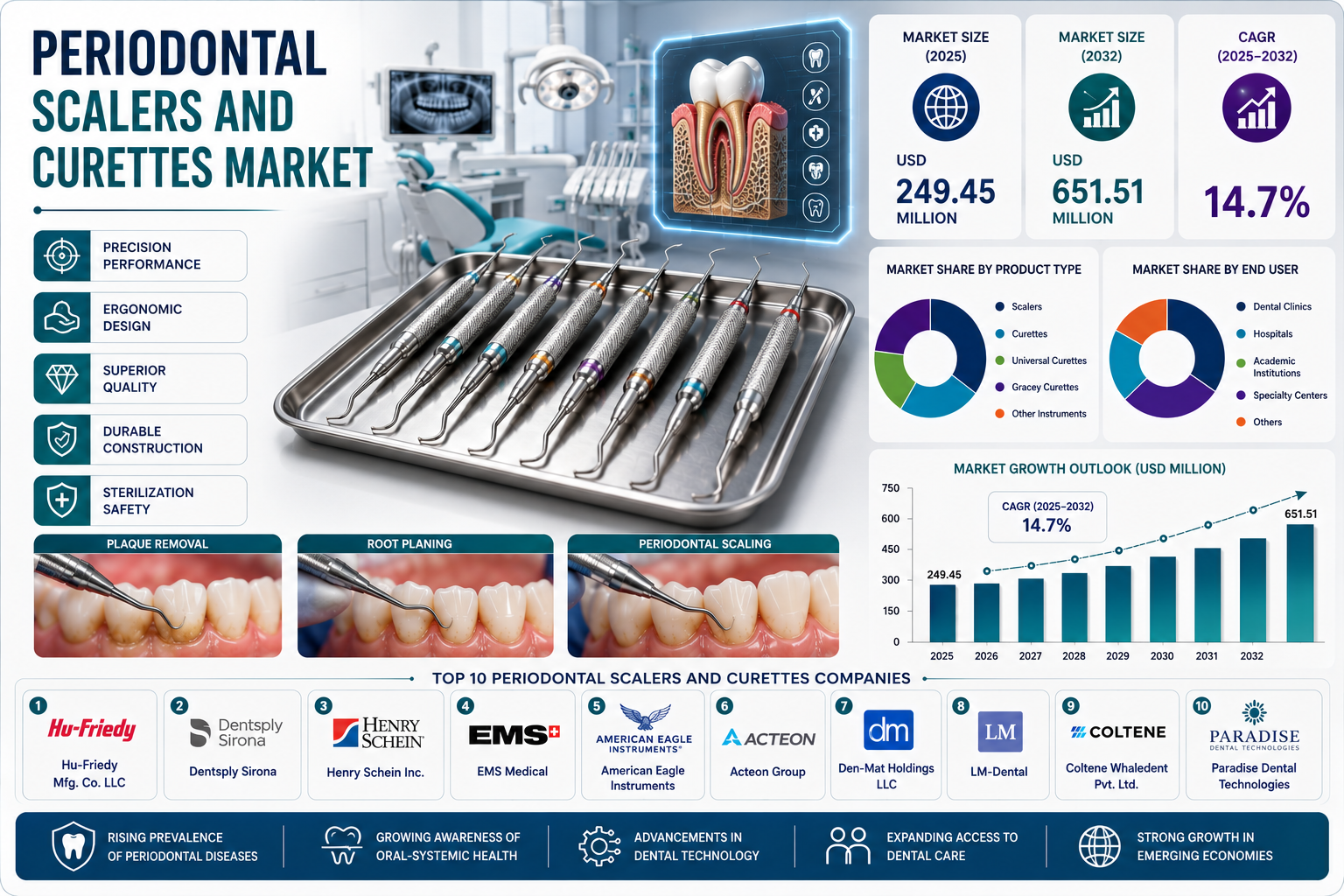
Top 10 Manufacturers in the Global Periodontal Scalers and Curettes Market Driving Industry Growth in 2025
The global dental care landscape is undergoing a significant transformation, with periodontal health increasingly recognized as a critical component of overall systemic wellbeing. At the center of modern preventive dentistry and periodontal therapy are periodontal scalers and curettes—precision instruments used for plaque removal, calculus debridement, root planing, and periodontal maintenance procedures. These instruments remain essential tools in dental clinics, hospitals, academic institutions, and specialty periodontal practices worldwide.
The global Periodontal Scalers and Curettes Market was valued at USD 249.45 million in 2025 and is projected to reach USD 651.51 million by 2032, expanding at a CAGR of 14.7% during the forecast period. Market growth is being fueled by rising periodontal disease prevalence, growing awareness of oral-systemic health connections, technological advancements in dental instruments, and expanding access to professional dental care across emerging economies.
So, what exactly does this market encompass? The periodontal scalers and curettes market includes handheld scalers, ultrasonic scalers, universal curettes, area-specific curettes such as Gracey curettes, implant maintenance instruments, and combination periodontal tools designed to improve clinical efficiency and treatment outcomes. These products are widely utilized across general dentistry, periodontics, oral surgery, and preventive dental care programs.
Several powerful forces are driving the market forward. Increasing global incidence of gum diseases, growing demand for preventive dental treatments, rapid expansion of dental clinic networks, ergonomic instrument innovations, and the adoption of advanced ultrasonic technologies are creating substantial opportunities for manufacturers worldwide.
Understanding the manufacturers leading this rapidly growing market is essential for investors, procurement managers, distributors, dental professionals, and industry stakeholders. This article highlights the top manufacturers shaping the global periodontal scalers and curettes market while examining competitive dynamics, regional trends, emerging technologies, and future growth opportunities.
Market Overview
|
Parameter |
Details |
|---|---|
|
Market Size (2025) |
USD 249.45 Million |
|
Projected Market Size (2032) |
USD 651.51 Million |
|
CAGR (2025–2032) |
14.7% |
|
Base Year |
2025 |
|
Forecast Period |
2025–2032 |
|
Leading Product Segment |
Ultrasonic Scalers |
|
Fastest-Growing Product Segment |
Combination Instruments |
|
Leading Application Segment |
General Dentistry |
|
Fastest-Growing Application |
Periodontal Treatments |
|
Dominant Region |
North America |
|
Fastest-Growing Region |
Asia-Pacific |
|
Key Growth Drivers |
Periodontal disease prevalence, preventive dentistry adoption, technology innovation |
|
Key Challenges |
High equipment costs, skilled professional shortages, infection control concerns |
|
Key Opportunities |
Emerging markets, ergonomic innovations, implant-specific instruments |
GROWTH DRIVERS
Why the Periodontal Scalers and Curettes Market is Growing
1. Rising Prevalence of Periodontal Diseases
Periodontal disease affects a significant proportion of the global adult population, with prevalence rising alongside aging demographics in North America and Europe. The resulting increase in scaling, root planing, and maintenance procedures directly drives volume demand for curettes and scalers. As awareness grows of untreated gum disease's links to cardiovascular disease and diabetes, treatment rates are increasing alongside instrument consumption.
2. Advancements in Dental Technology
Recent innovations including antimicrobial steel alloys, tip durability enhancements, guided sterilization processes, and ultrasonic frequency control have improved instrument effectiveness by over 64%, according to market data. These advances enable longer instrument lifespans, reduced infection risks, and better clinical outcomes supporting both premium pricing and higher replacement cycles.
3. Growing Awareness of Oral-Systemic Health
Increasing public and clinical awareness of the links between periodontal health and systemic conditions including heart disease, diabetes, and pregnancy outcomes is driving more patients to seek preventive and early-intervention care. Public health campaigns and professional education efforts are translating into higher cleaning visit frequency and greater demand for effective debridement instruments.
4. Ergonomic Co-Development and Precision Design
Close to 62% of new periodontal hand tools are now shaped through collaborations between product designers, periodontists, and hygiene trainers. These partnerships refine instrument angles, tip sharpness, and weight balance to deliver greater clinician comfort, better grip stability, and improved tactile sensitivity reducing occupational injury risk while improving clinical outcomes.
5. Expansion of Dental Care in Emerging Markets
Growing clinic networks, dental tourism, rising middle-class income, and government oral health investment across Asia-Pacific, Latin America, and the Middle East are opening substantial new demand channels for instrument manufacturers. Countries including China, India, Brazil, and Mexico represent high-growth frontiers where both basic and upgraded scaling instruments are experiencing rapid volume growth.
6. Preventive Dentistry and Recall Hygiene Programs
With approximately 68% of dental professionals recommending consistent use of periodontal scalers and curettes, the shift toward preventive dentistry and structured recall hygiene intervals is creating sustained, recurring instrument demand. Regular professional cleanings generate predictable, non-discretionary replacement and replenishment cycles for dental practices and institutional buyers alike.
Top 10 Manufacturers in the Global Periodontal Scalers and Curettes Market
- Hu-Friedy Mfg. Co. LLC
- Dentsply Sirona
- Henry Schein Inc.
- EMS Medical
- American Eagle Instruments
- Acteon Group
- Den-Mat Holdings LLC
- LM-Dental
- Coltene Whaledent Pvt. Ltd.
- Paradise Dental Technologies
1. Hu-Friedy Mfg. Co. LLC
Headquarters: Chicago, Illinois, USA | Founded: 1908 | Industry Focus: Dental Instruments, Infection Control | Global Presence: Products sold in over 100 countries
Company Overview
Hu-Friedy is widely recognized as the global leader in periodontal hand instruments. With more than a century of manufacturing expertise, the company has established itself as the benchmark for periodontal curettes and scalers.
Key Products and Services
The company offers Gracey Curettes, Universal Curettes, Sickle Scalers, Harmony Ergonomic Instruments, Instrument Cassettes, and Infection Prevention Solutions.
Market Position
Hu-Friedy commands a leading share of the global periodontal hand instrument market and maintains strong relationships with dental schools and professional organizations worldwide.
Recent Developments
The company continues expanding its ergonomic instrument portfolio and investing in infection prevention technologies.
Strategic Advantages
Strong brand recognition, extensive product portfolio, global distribution network, and deep clinical education partnerships.
2. Dentsply Sirona
Headquarters: Charlotte, North Carolina, USA | Founded: 1899 | Industry Focus: Dental Products and Technologies | Global Presence: Operations in more than 40 countries
Company Overview
Dentsply Sirona is the world's largest manufacturer of professional dental products and technologies, serving dentists, specialists, laboratories, and dental organizations globally.
Key Products and Services
Ultrasonic scaling systems, periodontal instruments, prophylaxis solutions, restorative products, and digital dentistry technologies.
Market Position
The company maintains a strong position in ultrasonic scaling systems and integrated dental treatment solutions.
Recent Developments
Continued investments in digital workflow integration and advanced ultrasonic technologies.
Strategic Advantages
Global manufacturing scale, broad product portfolio, strong DSO relationships, and integrated treatment ecosystems.
3. Henry Schein Inc.
Headquarters: Melville, New York, USA | Founded: 1932 | Industry Focus: Healthcare Distribution | Global Presence: Operations in more than 32 countries
Company Overview
Henry Schein is the world's largest provider of healthcare products and services to office-based practitioners.
Key Products and Services
Periodontal instruments, dental consumables, equipment solutions, practice management software, and healthcare services.
Market Position
The company possesses unparalleled distribution influence within the global dental industry.
Recent Developments
Expansion of digital procurement platforms and practice management solutions.
Strategic Advantages
Extensive distribution network, supply chain efficiency, technology integration, and strong customer relationships.
4. EMS Medical
Headquarters: Founded: Focus: Presence:
COMPANY OVERVIEW
KEY PRODUCTS AND SERVICES
MARKET POSITION
STRATEGIC ADVANTAGES
5. American Eagle Instruments
Headquarters: Founded: Focus: Presence:
COMPANY OVERVIEW
KEY PRODUCTS AND SERVICES
MARKET POSITION
STRATEGIC ADVANTAGES
Market Segmentation Analysis
By Product Type
- Handheld Scalers Foundational for tactile control in supragingival and subgingival procedures; advances in lightweight handles and single-use options sustain demand.
- Ultrasonic Scalers Drive productivity through cavitation and irrigation; dominant in high-throughput clinics with focus on patient comfort and aerosol control.
- Curettes Essential for root planing and fine finishing in periodontal pockets; Gracey and universal patterns serve diverse anatomical needs.
- Combination Instruments Gaining traction for reducing instrument changes and streamlining chairside workflow, especially in practices standardizing instrument kits.
By Material Type
- Stainless Steel Market dominant for proven durability, autoclave stability, and predictable sharpening geometry.
- Carbon Steel Valued for exceptional initial sharpness and cutting efficiency; preferred for high-edge acuity despite higher maintenance requirements.
- Plastic / Composite Targets implant surface compatibility; single-use options support cross-contamination prevention in strict infection control environments.
- Coated Steel Premium instruments with hard coatings to improve edge longevity, lower friction, and maintain sharpness across repeated sterilizations.
By Application
- General Dentistry Drives baseline volumes for prophylaxis, calculus removal, and routine maintenance; prioritizes versatility and cost-effectiveness.
- Periodontal Treatments Intensive scaling and root planing with specialized curettes and ultrasonic tips; fastest-growing application segment.
- Pediatric Dentistry Optimized for smaller dentition and patient comfort; lightweight handles and atraumatic tip designs enhance acceptance.
- Oral Surgery Pre-operative debridement and peri-implant hygiene requiring sterility assurance and implant surface compatibility.
By End User
- Dental Clinics Largest demand center; focus on reliable everyday instruments, ergonomics, and reprocessing efficiency.
- Hospitals Require central sterile service compatibility, stringent traceability, and robust construction for interdepartmental dental use.
- Academic Institutions Purchase diverse sets for skills training; vendor partnerships with faculty provide visibility among future practitioners.
- Research Laboratories Utilize specialized instruments for biofilm studies and material testing; precision and repeatability drive selection.
By Distribution Channel
- Online Retail Expands access to broad catalogs with transparent pricing and rapid fulfillment for high-volume replenishment.
- Direct Sales Offers demonstrations, trial programs, and hands-on training; anchors institutional contracts and ultrasonic system purchases.
- Distributors & Wholesalers Provides regional reach, inventory buffering, and multi-brand choice for clinics and hospitals.
- Dental Supply Stores Serves buyers preferring in-person evaluation of instrument balance and grip.
Competitive Landscape
The global periodontal scalers and curettes market demonstrates moderate concentration, with top companies holding over 50% of total market share. Mid-sized firms focus on niche strategies and specialized instruments to maintain competitiveness, while ongoing innovation and strategic collaboration support sustainable growth.
Product Specialization and Differentiation
Competitors differentiate across hand instruments (stainless steel, carbon steel, coated steel), ultrasonic systems (piezoelectric, magnetostrictive), and combination approaches. Within hand instruments, the depth and breadth of curette pattern offerings serves as a key differentiator for specialist buyers.
Distribution Channel Influence
Periodontal instruments are sold primarily through dental distributors and field sales forces. Companies with the broadest distributor relationships particularly Hu-Friedy and Henry Schein command significant advantages in channel access. Around 35% of players implement multi-channel strategies combining direct dental supply sales and e-commerce platforms.
Innovation-Led Competition
Over 45% of companies are actively investing in ergonomic and precision instrument innovation. Collaborative research and strategic partnerships improve performance and usability. The Hu-Friedy Harmony launch using 2.8 million ergonomic data points illustrates how evidence-based product development is becoming a primary competitive arena.
Acquisitive Consolidation
The market is experiencing consolidation as larger dental product groups seek to broaden instrument portfolios. Over 40% of leading players are engaging in mergers and alliances to enhance product innovation and expand market footprint.
Regional Analysis
North America
North America holds the dominant revenue position, accounting for over 50% of global market share. High adoption of advanced dental instruments, strong infection control standards, a well-established dental hygienist workforce, and widespread recall hygiene programs underpin sustained demand. DSO consolidation is driving formulary standardization and group purchasing scale.
Europe
Europe balances public and private procurement, with emphasis on ergonomics, sustainability, and documented sterilization compliance. Established training pathways in periodontology sustain demand for diverse curette sets. Germany, France, and the UK represent the largest national markets within the region.
Asia-Pacific
Asia-Pacific represents the fastest-growing regional market, benefiting from expanding clinic networks, rising oral health awareness, and dental tourism growth across Japan, China, South Korea, and India. Markets are adopting a mix of cost-effective handheld tools and upgraded ultrasonic platforms as procedure volumes increase.
Middle East & Africa
Rising investment in hospital dental units and private clinics is driving instrument procurement. Growth is linked to expanding preventive care programs and modernization of sterile services infrastructure across GCC countries and South Africa.
Latin America
Demand is led by urban centers in Brazil and Mexico, where clinics adopt ultrasonic systems alongside stainless-steel sets for routine prophylaxis. Channel performance depends on pricing flexibility, inventory continuity, and technical training capacity.
Drivers, Restraints & Opportunities
Key Drivers
- Increasing prevalence of periodontal diseases globally
- Advancements in dental technology and ergonomics
- Growing awareness of oral-systemic health links
- Expanding dental care access in emerging markets
- Rising preventive dentistry and recall care adoption
- DSO consolidation driving standardized procurement
Key Restraints
- High cost of advanced ultrasonic systems
- Shortage of skilled dental professionals in emerging markets
- Cross-contamination risks with reusable instruments
- Regulatory complexity across diverse national markets
- Environmental sustainability concerns with single-use disposables
- Pricing pressure from low-cost regional manufacturers
Key Opportunities
- Expansion of dental care in emerging economies
- Technological innovations and product diversification
- Increasing adoption of preventive dental care globally
- Smart and protocol-integrated instrument systems
- Eco-friendly and biodegradable disposable instrument development
- Implant-specific and minimally invasive instrument lines
Emerging Trends in the Periodontal Scalers and Curettes Market
1. Protocol-Driven Clinical Systems
EMS Guided Biofilm Therapy represents the leading example of manufacturers moving beyond instrument sales to offering complete clinical protocols combining detection, air polishing, and ultrasonic scaling in an evidence-based workflow. This approach creates strong clinical lock-in and commands premium pricing versus commoditized single-instrument purchasing.
2. Antimicrobial and Advanced Material Coatings
Antimicrobial steel alloys, hard coatings for edge longevity, and biocompatible surface treatments are increasingly standard in premium periodontal instruments. These technologies extend instrument lifespan, reduce infection risks, and support better care continuity driving upgrade cycles among practices managing high patient volumes.
3. Single-Use and Eco-Friendly Instrument Expansion
Growing infection control requirements and environmental awareness are driving parallel growth in single-use disposable instruments and eco-friendly reusable alternatives. Manufacturers are developing biodegradable composite instruments and sustainable packaging to address the dual pressures of safety compliance and environmental responsibility.
4. Ergonomic Data-Driven Design
The Hu-Friedy Harmony launch grounded in 2.8 million ergonomic data points from Registered Dental Hygienists illustrates a broader trend toward evidence-based instrument design. Collaborations between manufacturers, periodontists, and ergonomics researchers are reshaping handle geometry, tip angles, and weight balance to reduce occupational injury while improving clinical precision.
5. Implant-Specific and Minimally Invasive Instruments
The rapid expansion of dental implant placements worldwide is generating sustained demand for implant-compatible scalers and curettes including plastic/composite and coated steel instruments that clean peri-implant surfaces without damage. This represents a fast-growing niche within the broader periodontal instrument market.
6. Digital Integration and Smart Instrument Development
Early-stage development of connected ultrasonic scalers with real-time feedback on tip pressure, frequency, and irrigation parameters is emerging as a future product differentiation axis. These systems could improve treatment consistency and enable outcome tracking for value-based dental care programs.
Future Outlook (2026–2032)
The global periodontal scalers and curettes market's trajectory toward USD 651.51 million by 2032 reflects a high-growth story driven by convergence of rising disease burden, expanding access, and accelerating clinical innovation. The 14.7% CAGR through 2032 is among the strongest in the dental instruments sector, supported by durable structural drivers preventive care adoption, aging populations, emerging market expansion, and ongoing ergonomic and material innovation that are unlikely to experience significant cyclical reversal.
Key investment themes include continued premiumization toward coated, ergonomic, and protocol-integrated instruments; growth in implant-specific product lines as global implant adoption expands; the emergence of evidence-based clinical protocol systems that bundle instruments with training and outcomes frameworks; and continued regional expansion as dental care access improves across Asia-Pacific, Latin America, and the Middle East.
For investors and industry participants, the periodontal scalers and curettes market offers exposure to recurring, non-discretionary replacement demand driven by professional cleaning visit frequency and infection control compliance combined with a strong growth tailwind from preventive dentistry adoption and emerging market dental access expansion.
Frequently Asked Questions
1. What is the current size of the global periodontal scalers and curettes market?
The global periodontal scalers and curettes market was valued at USD 249.45 million in 2025 and is projected to reach USD 651.51 million by 2032, growing at a CAGR of 14.7% over the forecast period, according to ReAnIn market research data.
2. Who are the top manufacturers in the periodontal scalers and curettes market?
Leading manufacturers include Hu-Friedy Mfg. Co. LLC, Dentsply Sirona, Henry Schein Inc., EMS Medical, American Eagle Instruments, Acteon Group, Den-Mat Holdings LLC, LM-Dental, Coltene Whaledent, and Paradise Dental Technologies.
3. Which region dominates the periodontal scalers and curettes market?
North America holds the largest revenue share, accounting for over 50% of global market share. Asia-Pacific is the fastest-growing region, driven by expanding clinic networks, rising oral health awareness, and dental tourism growth.
4. What are the primary types of periodontal scalers and curettes?
Key product types include handheld scalers (sickle, hoe, file), ultrasonic scalers (piezoelectric and magnetostrictive), area-specific curettes (Gracey series), universal curettes (Columbia, Barnhart), and combination instruments.
5. What materials are periodontal instruments made from?
Periodontal instruments are manufactured from stainless steel (dominant for durability and autoclave compatibility), carbon steel (for high-acuity edge performance), plastic/composite materials (for implant surface compatibility), and coated steel (for extended edge longevity).
6. What is driving growth in the periodontal scalers and curettes market?
Key drivers include rising global prevalence of periodontal disease, growing awareness of oral-systemic health connections, advancements in dental technology and ergonomics, expansion of preventive dental care programs, and increasing dental access in emerging markets.
7. What challenges does the market face?
Key challenges include the high cost of advanced ultrasonic systems limiting adoption in cost-sensitive markets, shortages of skilled dental professionals in emerging economies, cross-contamination risks associated with reusable instruments, and environmental concerns regarding growth in single-use instrument usage.
8. What is Guided Biofilm Therapy and why is it significant?
Guided Biofilm Therapy (GBT), developed by EMS Medical, is an evidence-based clinical protocol combining biofilm detection, controlled air polishing, and piezoelectric ultrasonic scaling in an integrated patient care pathway. It represents the leading example of manufacturers moving beyond instrument sales to offering complete clinical workflows.
9. What investment opportunities exist in this market?
Opportunities include ergonomic and data-driven hand instrument innovation, implant-specific scaler and curette product lines, protocol-integrated clinical systems, eco-friendly and single-use instrument development for infection control compliance, and geographic expansion into underserved dental care markets.
10. Why are ultrasonic scalers growing faster than traditional hand instruments in some segments?
Ultrasonic scalers drive productivity through cavitation and irrigation, reduce operator fatigue, and improve patient comfort making them particularly attractive in high-throughput dental clinics and DSO settings. Advances in frequency control, tip variety, and protocol-driven adoption frameworks like GBT are accelerating their adoption.
Conclusion
The global periodontal scalers and curettes market represents one of the most compelling growth stories in the dental medical device sector high-growth, innovation-driven, and underpinned by some of the most durable structural drivers in healthcare: rising disease burden, preventive care adoption, aging demographics, and expanding access to professional dental services worldwide. With a projected market size of USD 651.51 million by 2032 and a CAGR of 14.7% (per ReAnIn), the sector offers exceptional growth exposure alongside the recurring, non-discretionary revenue characteristics of professional dental consumables and instruments.
The top manufacturers led by Hu-Friedy, Dentsply Sirona, EMS Medical, and American Eagle Instruments are competing not merely on instrument dimensions and material specifications, but on ergonomic evidence, clinical protocol integration, practitioner education partnerships, and the ability to deliver specialized solutions for the evolving demands of DSO-scale procurement, evidence-based hygiene protocols, and implant-compatible care. Manufacturers that successfully combine broad distribution reach, compelling clinical differentiation, and innovation investment aligned with the preventive dentistry megatrend will be best positioned to capture the market's significant long-term expansion through 2032 and beyond.