
Quantum Computing in 2026: Why the Hype Is Finally Turning Into Real Industry
Author:
Intellectual Market Insights Research
Published Date:
11 Jul 2026
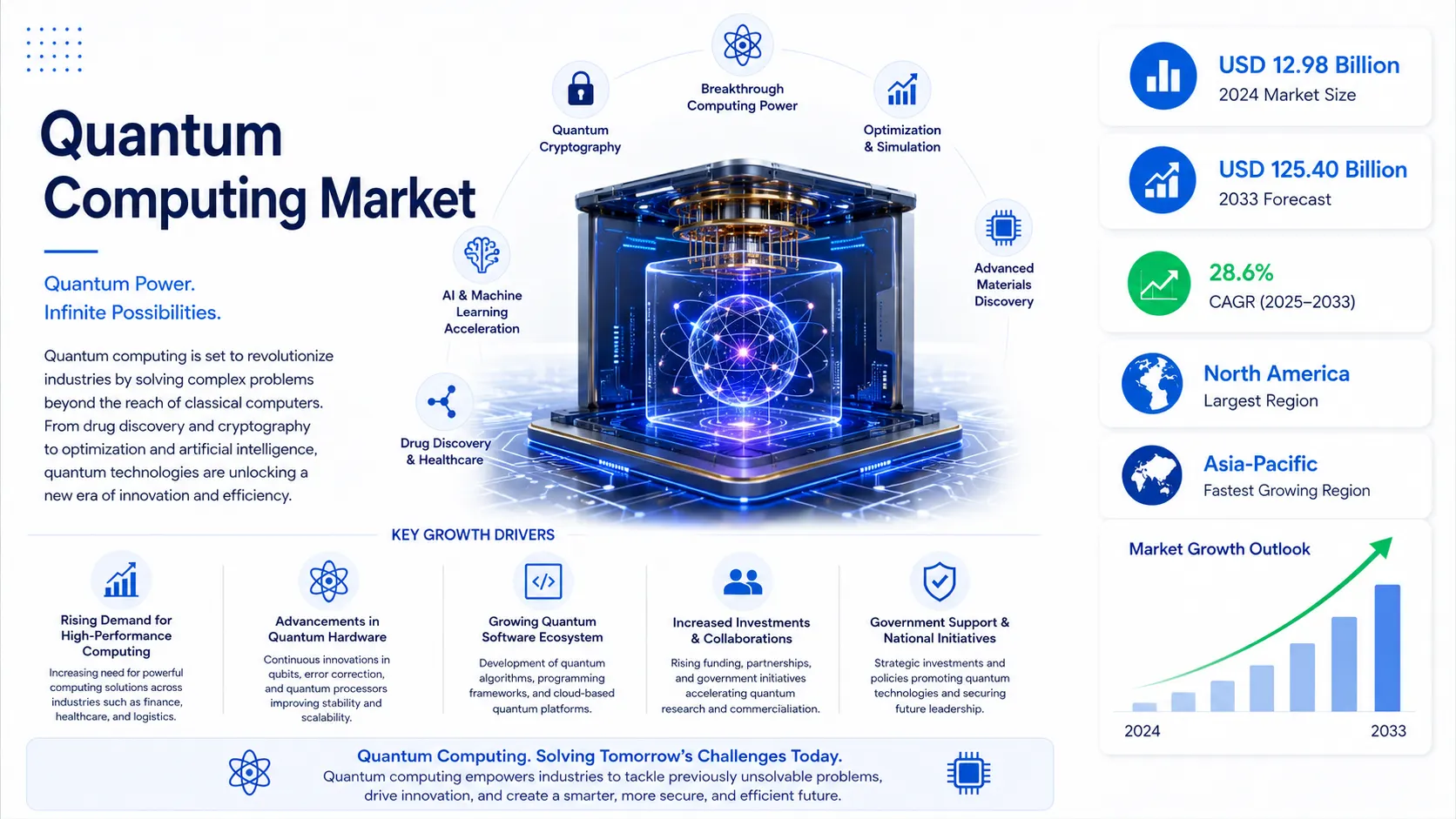
Quantum Computing in 2026: Why the Hype Is Finally Turning Into Real Industry
A few years ago, "quantum computing" was mostly a term you'd hear at a physics conference or in a Silicon Valley pitch deck promising something twenty years away. That's no longer the case. Walk into any serious conversation about industrial policy, semiconductor strategy, or enterprise R&D budgets in 2026, and quantum computing comes up — not as science fiction, but as a line item.
What changed? Mostly, the gap between "interesting research" and "usable technology" got a lot smaller. Governments are treating it as strategic infrastructure. Banks, drugmakers, and logistics companies are running actual pilots instead of just funding university labs. And the money has followed — billion-dollar raises, SPAC mergers, even direct government equity stakes in hardware companies. This piece breaks down what quantum computing actually is, why it matters right now, who's building it, and where the market is realistically headed.
So What Is Quantum Computing, Really?
Every computer you've ever used — your phone, your laptop, the servers running this website — stores information as bits. A bit is either a 0 or a 1, no in-between. That simplicity is exactly why classical computers are so reliable and so fast at the things we use them for daily.
Quantum computers throw that rulebook out. Instead of bits, they use qubits, built from physical systems that actually behave according to quantum mechanics — things like superconducting circuits, trapped ions, individual photons, or neutral atoms cooled to near absolute zero. Because these systems follow quantum rules instead of classical ones, they can do things a normal bit simply can't.
Classical vs. Quantum: It's Not Just "Faster"
Here's a common misconception worth clearing up: quantum computers aren't just souped-up classical computers. They're not going to replace your laptop for browsing the web or writing emails, and for most everyday computing, classical machines will keep winning for a long time.
Where quantum computing pulls ahead is in a specific category of hard problems — large-scale optimization, simulating molecules for drug discovery, certain cryptographic calculations, and pattern recognition at a scale that would choke a classical supercomputer. Classical computing power scales roughly in a straight line as you add more transistors. Quantum computing, for the right kind of problem, can scale exponentially. That distinction is the entire reason this technology is worth paying attention to.
Superposition and Entanglement — The Two Ideas Behind Everything
If you only remember two terms from this article, make them these two, because they're the actual engine behind quantum computing's advantage.
Superposition means a qubit isn't locked into being a 0 or a 1 — it can exist as a blend of both at once. String enough qubits together in superposition, and the system can represent an enormous number of possible states simultaneously, instead of checking them one at a time.
Entanglement is stranger still. Two or more qubits can become linked so tightly that the state of one instantly reflects the state of the other, no matter how far apart they physically are. There's no classical equivalent to this. It's also what allows quantum processors to coordinate information across many qubits at once, which is central to the speedups seen in quantum algorithms for search, factoring, and simulation.
Quantum Supremacy vs. Quantum Advantage (People Mix These Up Constantly)
You'll see both terms thrown around in coverage of this industry, often incorrectly used as synonyms.
Quantum supremacy is a narrower, more academic milestone — a quantum computer completing a specific calculation that a classical supercomputer couldn't finish in any reasonable amount of time. This was first claimed back in 2019 and has been revisited repeatedly since with more powerful hardware.
Quantum advantage is the bar that actually matters commercially: a quantum computer solving a real, economically useful problem faster, cheaper, or more accurately than the best classical alternative available. Several major hardware companies, including IBM, have set public targets for verified quantum advantage by the end of 2026, and independent benchmarking groups have sprung up specifically to check whether these claims hold up.
Where the Industry Actually Stands Right Now
There's no single winning approach to building a qubit yet, and that's one of the more interesting things about this industry — it's still wide open.
- Superconducting qubits (IBM, Google, Rigetti) currently lead on raw qubit counts and benefit from being closer to existing chip-manufacturing know-how.
- Trapped-ion systems (Quantinuum, IonQ) tend to have higher fidelity and better qubit-to-qubit connectivity, though gate speeds are slower.
- Neutral-atom architectures (QuEra, Atom Computing, Pasqal, Infleqtion) are scaling raw atom counts faster than almost anyone else.
- Photonic computing (PsiQuantum, Xanadu) is betting on standard semiconductor manufacturing to eventually reach fault-tolerant scale.
- Quantum annealing (D-Wave) skips universal computing altogether and focuses purely on optimization problems.
- Silicon-spin qubits (Diraq, Quantum Motion) are behind on qubit count today but have a strong long-term manufacturing story since they're compatible with existing chip fabs.
Meanwhile, cloud providers have made quantum hardware available on-demand through Quantum-as-a-Service, which has quietly done more to democratize access than almost anything else in the past few years — enterprises no longer need to own hardware to experiment with it.
The Money Is Real, and It's Not Small
If you want proof this isn't just hype, look at where capital has actually gone in 2025 and 2026:
- PsiQuantum closed roughly a $1 billion Series E round led by BlackRock at a reported $7 billion valuation — the largest private raise in quantum computing history at the time.
- Quantinuum raised close to $800 million and has since moved toward a Nasdaq listing.
- D-Wave pulled in a $400 million capital raise.
- The U.S. Department of Commerce announced roughly $2 billion in CHIPS and Science Act funding across nine companies in exchange for non-controlling government equity stakes — a genuinely unusual move that signals how seriously Washington is treating this as strategic infrastructure, not just research.
- IQM announced a roughly $1.8 billion SPAC merger, positioning it to become the first publicly listed European quantum hardware company.
- Xanadu completed a roughly $3.1 billion SPAC merger, listing on both NASDAQ and the TSX.
None of that happens around a technology that's purely theoretical.
How Big Is the Quantum Computing Market, Actually?
This is where you'll notice something odd if you read multiple industry reports: the numbers don't agree with each other, sometimes by a wide margin. Depending on scope and methodology, 2025–2026 baseline market estimates range roughly from $1.5 billion to $5.5 billion globally. Longer-term forecasts for the early-to-mid 2030s swing anywhere from about $16 billion to $58 billion.
That's not sloppy research — it's a reflection of how genuinely early this market still is, and how differently firms define what counts as "quantum computing" (some include only hardware, others fold in services, software, and adjacent quantum technologies). What almost every research firm agrees on, regardless of methodology, is the direction: strong double-digit to high-double-digit compound annual growth through the early 2030s, an expanding set of real use cases, and a widening gap between well-funded leaders and everyone else.
Who's Actually Using This Stuff
The most consistent finding across market research is that banking, financial services, and insurance (BFSI) is either the leading or fastest-growing end-user segment, typically representing somewhere between 21% and 26% of 2025–2026 revenue depending on the source. That tracks — portfolio optimization, derivatives pricing, credit risk modeling, and fraud detection are exactly the kind of large-scale optimization problems quantum computing is theoretically well-suited for.
Healthcare and pharmaceuticals is right behind it, driven by quantum simulation's natural fit for modeling molecules — genuinely useful for drug discovery and protein folding in ways classical simulation struggles with. Government and defense remain foundational, functioning as both major funders and early adopters, with use cases spanning secure communications, sensing, and mission-planning optimization.
A Quick Look at Who's Building It
IBM remains the most visible name in the space, with decades of computing history behind it and arguably the largest quantum ecosystem through IBM Quantum Network. Its Qiskit software toolkit and System Two hardware line anchor a strategy built around fault tolerance as the long-term goal.
Google Quantum AI made headlines with its 2019 supremacy demonstration using the Sycamore processor and continues pushing on logical qubits and error correction — its research output remains some of the most cited in the field.
Microsoft has taken a deliberately diversified route, combining Azure Quantum's multi-vendor cloud access with its own long-shot bet on topological qubits, which it claims could offer more inherent stability than other approaches.
Intel is playing a longer game, betting that its decades of semiconductor manufacturing expertise will eventually make silicon spin qubits the most scalable, most manufacturable option — even though it's behind on raw qubit count today.
D-Wave, meanwhile, has quietly built one of the largest actual commercial customer bases in the industry by staying focused on quantum annealing and optimization rather than chasing universal gate-based computing.
Regionally, Who's Leading?
North America holds the largest share of the global market by a wide margin — reported figures range from roughly 31% up to 61% depending on the research firm, with most placing it above 40%. That's driven by the National Quantum Initiative Act, deep venture capital availability, and the fact that nearly every major diversified hardware developer (IBM, Google, Microsoft, Amazon) is headquartered there.
Asia-Pacific, though, is where the growth curve is steepest — projected CAGR around 25.6% by some estimates, fueled by China's inclusion of quantum technology as a top priority in its current Five-Year Plan, Japan installing its first domestically built quantum computer in 2025, and India moving fast with a dedicated quantum computing hub in Andhra Pradesh and an IBM deployment planned for early 2026.
Europe leans heavily on the EU's Quantum Flagship Program, a roughly €1 billion, decade-long coordinated research push, with Germany and Finland (home to IQM) as standout national markets.
The Honest Caveat: This Is Still Early
It's worth being straight about this: verified, repeatable quantum advantage on economically meaningful problems is still the exception, not the rule. Most enterprise engagement today is pilot-stage. The industry is still operating in what's commonly called the NISQ era — Noisy Intermediate-Scale Quantum — where qubits are real but imperfect, and error rates remain a genuine engineering obstacle rather than a solved problem.
That said, the progress on error correction has been faster than expected. Below-threshold error correction — where adding more physical qubits actually reduces logical error rates instead of increasing them — was considered a distant goal just a few years ago and is now demonstrated reality in leading labs. Gate fidelities in trapped-ion and neutral-atom systems now regularly exceed 99.9%, and superconducting qubit counts have crossed 100 in generally available systems.
What This Means If You're Making Decisions Today
For technology leaders, this isn't a "wait and see" technology anymore — building even basic quantum literacy now, through cloud pilots and internal talent development, is cheaper and lower-risk than trying to catch up later. For investors, it's a long-horizon, high-conviction opportunity, but one that demands real discipline in separating technical progress from commercial proof — the two don't always move together. For governments, quantum computing has become inseparable from semiconductor policy and national security strategy, which is exactly why direct equity stakes and multi-billion-dollar national programs have become normal rather than exceptional.
The next few years will likely settle which qubit modality, which companies, and which national ecosystems come out ahead. Nobody has that answer yet — and that's precisely what makes this a market worth watching closely rather than glancing at once a year.