
Radar Sensor Market Size, Share & Growth Forecast 2025–2034: Trends, Drivers, and Key Players
Author:
Intellectual Market Insights Research
Published Date:
07 Aug 2026
Introduction
Radar sensing has quietly become one of the most consequential technologies of the decade, powering everything from adaptive cruise control on a family sedan to missile-defense-grade phased array systems tracking threats across an ocean. By transmitting radio waves and analyzing their reflections, radar sensors deliver reliable object detection, distance measurement, and velocity tracking in conditions, fog, darkness, rain, dust, where cameras and optical sensors alone struggle, making radar a foundational technology for automotive safety, defense, aviation, and industrial automation.
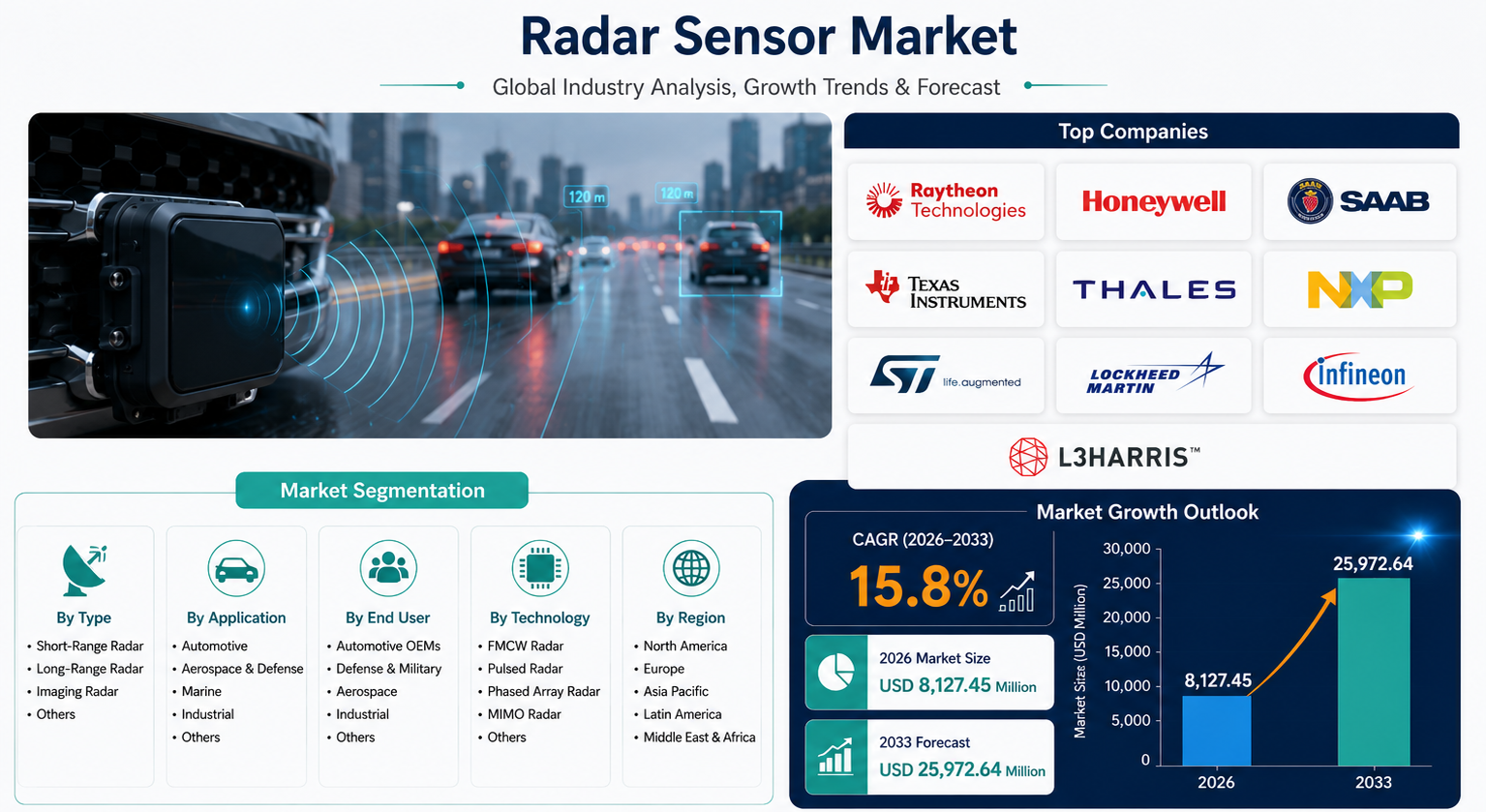
According to a new report from Intellectual Market Insights Research, the global radar sensor market was valued at approximately USD 24.35 billion in 2025 and is projected to reach USD 96.53 billion by 2034, growing at a compound annual growth rate (CAGR) of 16.4% between 2025 and 2034. That is nearly a fourfold increase in under a decade, reflecting how central radar sensing has become to advanced driver assistance systems (ADAS), autonomous driving, air and missile defense, air traffic control, and industrial and environmental monitoring.
In this article, we break down what's driving this growth, the challenges holding the market back, where the biggest opportunities lie, how the market is segmented, which regions are leading adoption, and who the major players are. Whether you're an investor, a systems engineer, a defense procurement professional, or simply curious about where radar sensing technology is headed, this guide will give you a clear, structured view of the radar sensor market landscape through 2034.
Market Overview
What Is a Radar Sensor?
A radar sensor works by emitting electromagnetic waves, typically in the radio or microwave frequency spectrum, and analyzing the signals reflected back from objects in its field of view. By measuring the time delay, frequency shift, and phase of the returning signal, radar sensors can calculate an object's distance, speed, and, with more advanced imaging radar, its shape and elevation.
Radar sensors broadly fall into two categories: imaging radar, which includes continuous wave (CW) radar (both unmodulated and frequency-modulated variants) and pulse radar systems capable of generating detailed, high-resolution representations of the surrounding environment, and non-imaging radar, such as speed gauges and radar altimeters, which are optimized for simpler, single-purpose measurement tasks. Unlike optical sensors, radar performance is largely unaffected by darkness, fog, rain, or dust, making it a critical complement, and in many cases a functional necessity, to camera- and LiDAR-based sensing systems.
Current Market Landscape
The radar sensor space today sits at the intersection of automotive safety, aerospace and defense, and industrial automation. It has expanded well beyond its historical military and aviation roots into mainstream passenger vehicles, weather monitoring stations, and factory automation systems. Semiconductor manufacturers have steadily shrunk radar components onto highly integrated chips, which has widened the addressable customer base from large defense primes and aircraft manufacturers to mass-market automotive OEMs and industrial equipment makers.
Industry Background
Radar technology dates back to the early 20th century and matured rapidly during and after World War II for military detection and air defense purposes. Long-range and pulse radar systems became the backbone of air traffic control and naval defense throughout the latter half of the century, pioneered by defense contractors and government research programs. Over the past two decades, the technology has benefited from the miniaturization of radio-frequency (RF) semiconductor components, falling chip costs, and growing regulatory mandates for automotive safety features, setting the stage for radar's expansion from a specialized defense and aviation tool into a mass-market automotive and industrial sensing technology.
Key Market Trends
- Rise of imaging and 4D radar in automotive applications: Newer automotive radar systems are moving beyond basic distance and speed detection toward high-resolution imaging radar capable of elevation-aware point clouds, improving object classification for advanced driver assistance and autonomous driving functions.
- Shift toward centralized radar architectures: Automakers and Tier-1 suppliers are increasingly moving from edge-processed radar sensors toward centralized architectures where raw sensor data is streamed to a central vehicle computer, reducing system cost while improving overall performance.
- Semiconductor miniaturization and one-chip radar solutions: Chipmakers are integrating RF transceivers and processing capability onto single system-on-chip (SoC) devices, lowering cost and power consumption and expanding radar's reach into mass-market and entry-level vehicle platforms.
- Modernization of defense radar fleets: Naval, air, and missile defense programs continue to invest heavily in next-generation phased array and gallium-nitride (GaN)-based radar systems to counter increasingly sophisticated aerial and missile threats.
- Expansion into industrial and environmental monitoring: Beyond automotive and defense, radar is gaining traction for industrial level sensing, weather monitoring, and remote sensing applications, broadening the technology's use cases well beyond its traditional core markets.
Market Growth Drivers
Rising Adoption of Advanced Driver Assistance Systems (ADAS): Regulatory safety mandates and growing consumer demand for features like adaptive cruise control, automatic emergency braking, and blind-spot detection continue to be the single largest driver of radar sensor volume growth, particularly in the automotive end-user segment.
Increasing Defense and Aerospace Modernization Spending: Elevated geopolitical tensions and sustained government investment in air and missile defense, from naval radar upgrades to next-generation fighter and surveillance systems, continue to support demand for high-performance radar platforms.
Growth in Autonomous and Semi-Autonomous Vehicles: As the automotive industry pushes toward higher levels of driving automation, radar's all-weather reliability makes it an essential sensing modality alongside cameras and LiDAR in sensor-fusion architectures.
Expanding Air Traffic and Space Navigation Requirements: Growing global air traffic volumes and expanding satellite and space navigation programs continue to drive demand for both ground-based and airborne radar systems.
Technological Advancements in RF Semiconductors: Continuous improvements in RFCMOS and GaN process technology are lowering per-unit costs, shrinking form factors, and improving performance, expanding the pool of automotive and industrial customers that can justify radar integration.
Market Challenges
High System and Integration Costs: Advanced imaging and 4D radar systems, along with their associated processing hardware, remain considerably more expensive than basic radar modules, which can be a barrier for cost-sensitive automotive and industrial applications.
Spectrum and Regulatory Complexity: Radar frequency allocation is tightly regulated and varies by region, and clearing region-specific certification and interference-mitigation requirements can slow product launches, particularly for automotive and consumer-facing devices.
Signal Interference in Dense Deployments: As the number of radar-equipped vehicles and devices grows, mutual interference between radar systems operating in similar frequency bands is an increasing technical challenge requiring sophisticated interference-mitigation techniques.
Long Defense Procurement Cycles: Government and military radar programs often involve lengthy procurement, testing, and qualification timelines, which can slow revenue recognition for suppliers despite strong underlying demand.
Supply Chain Sensitivities: As with much of the broader semiconductor sector, radar-grade RF components and specialized materials can be vulnerable to supply chain disruption, affecting production timelines for high-volume automotive and defense customers alike.
Market Opportunities
Untapped Emerging Markets: Expanding automotive production, growing defense budgets, and rising industrial automation investment in parts of Asia-Pacific, Latin America, and the Middle East are opening new territory for radar sensor adoption as local manufacturing and defense capacity expands.
Expansion Beyond Automotive and Defense: While automotive Autonomous Vehicle Market and aerospace/defense remain the largest end-user segments, growing use in industrial automation, environmental and weather monitoring, and remote sensing represents a significant white-space opportunity.
Centralized and Software-Defined Vehicle Architectures: As vehicle electronics shift toward centralized compute platforms, there is room for radar suppliers to capture greater value through integrated sensing-plus-processing solutions rather than standalone hardware.
4D and High-Resolution Imaging Radar: Continued advancement in elevation-aware, high-channel-count imaging radar offers a path toward radar systems that rival camera and LiDAR resolution while retaining radar's all-weather reliability, a significant growth opportunity for both automotive and defense applications.
Investment and M&A Activity: As the technology matures, there is ongoing opportunity for strategic investment and consolidation among RF semiconductor specialists, radar system integrators, and defense electronics companies serving the radar ecosystem.
Market Segmentation
By Type
- Imaging
- Continuous Wave (CW) Radar
- Unmodulated Continuous Wave Radar
- Frequency Modulated Continuous Wave Radar
- Pulse Radar
- Others
- Continuous Wave (CW) Radar
- Non-Imaging
- Speed Gauge
- Radar Altimeter
By Range
- Short Range
- Medium Range
- Long Range
By Application
- Air Traffic Control
- Remote Sensing
- Ground Traffic Control
- Space Navigation and Control
- Others
By End User
- Automotive
- Aerospace and Defense
- Environment and Weather Monitoring
- Industrial
- Others
Imaging radar, and frequency-modulated continuous wave (FMCW) radar in particular, represents the fastest-growing type segment given its central role in automotive ADAS and autonomous driving applications, where high-resolution point-cloud data is essential for accurate object detection and classification. On the end-user side, automotive is expected to be the largest volume driver given the sheer scale of vehicle production, while aerospace and defense continues to anchor the market's highest per-unit value given the complexity and cost of military-grade phased array and long-range surveillance systems.
Regional Analysis
North America: North America holds the largest revenue share of the global radar sensor market, underpinned by substantial defense spending, a dense concentration of aerospace and defense primes, and early automotive OEM adoption of ADAS-mandated radar systems. Strong government procurement programs and a high concentration of leading semiconductor and defense vendors also support regional demand.
Europe: Europe represents a mature, steadily growing market, supported by well-established automotive manufacturing, stringent vehicle safety regulations, and significant defense modernization programs across major economies such as Germany, France, and the U.K.
Asia-Pacific: Asia-Pacific is expected to be among the fastest-growing regions over the forecast period, driven by expanding automotive production, rising defense budgets, and the presence of key radar component manufacturers and automotive electronics hubs in countries like China, Japan, and South Korea.
Latin America: Latin America remains a smaller but developing market, with Brazil and Mexico leading regional demand as automotive manufacturing and infrastructure investment expand.
Middle East & Africa: The Middle East & Africa region is an emerging opportunity area, with growth concentrated in countries investing heavily in defense modernization and infrastructure, such as Saudi Arabia and the UAE, alongside gradual uptake in South Africa.
Competitive Landscape
The global radar sensor market features a mix of established defense and aerospace primes and specialized RF semiconductor manufacturers. Key players identified in the market include:
- Raytheon Technologies Corporation (RTX)
- Honeywell International Inc.
- Saab AB
- Texas Instruments Inc.
- Thales Group
- NXP Semiconductors N.V.
- STMicroelectronics N.V.
- Lockheed Martin Corporation
- Infineon Technologies AG
- L3Harris Technologies Inc.
Competition in this space centers on improving detection range and resolution, reducing system cost and power consumption, and building scalable, software-defined radar architectures. Diversified defense primes such as RTX and Lockheed Martin benefit from decades-long government relationships and large-scale program backlogs, while semiconductor specialists like NXP, Infineon, and Texas Instruments compete on RF chip integration, cost efficiency, and automotive design wins. As the market matures, continued consolidation, strategic partnerships between chipmakers and automotive Tier-1 suppliers, and new product launches targeting centralized and software-defined vehicle architectures are expected to shape the competitive landscape through 2034.
1. RTX Corporation (Raytheon)
|
Category |
Details |
|---|---|
|
Company Name |
RTX Corporation, operating through its Raytheon business |
|
Headquarters |
Arlington, Virginia, USA |
|
Industry Focus |
Aerospace, Defense Systems, and Radar Technology |
|
Global Presence |
Global aerospace and defense operations serving the U.S. military and allied governments, with 2025 sales of more than $88 billion |
|
Company Overview |
RTX's Raytheon business is a leading provider of defense radar solutions, best known for its AN/SPY-6 family of air and missile defense radars used across multiple U.S. Navy ship classes. Radar programs are designed and manufactured at Raytheon's dedicated Radar Development Facility in Andover, Massachusetts, which supports production of diverse radar types for U.S. and allied forces. |
|
Key Products & Services |
AN/SPY-6(V) family of gallium-nitride (GaN)-based air and missile defense radars, including variants for Flight IIA Arleigh Burke-class destroyers; broader air and missile defense, ground-based, and airborne radar systems; integrated defense electronics and sensing solutions. |
|
Market Position |
One of the dominant suppliers of naval and missile defense radar systems globally, with SPY-6 radars installed or under integration on more than a dozen U.S. Navy ships and expected deployment across more than 60 vessels over the next decade. |
|
Recent Developments |
Raytheon was awarded a $515 million U.S. Navy contract in June 2026 for continued SPY-6 integration and production support, building on a base contract from June 2025 valued up to $2.89 billion. In July 2026, Raytheon secured a further $1.8 billion contract extension for SPY-6 hardware production and sustainment, with options that could bring cumulative contract value to $3.3 billion, and has invested roughly $800 million to modernize radar production facilities with plans to double SPY-6 output by 2028. |
|
Strategic Advantages |
Deep, decades-long U.S. Navy and allied government relationships, vertically integrated GaN-based radar manufacturing capability, a substantial multi-billion-dollar program backlog, and dedicated radar production infrastructure supporting sustained volume growth. |
2. NXP Semiconductors N.V.
|
Category |
Details |
|---|---|
|
Company Name |
NXP Semiconductors N.V. |
|
Headquarters |
Eindhoven, The Netherlands |
|
Industry Focus |
Automotive, Industrial & IoT, Mobile, and Communications Infrastructure Semiconductors |
|
Global Presence |
Operations in more than 30 countries, with 2025 revenue of $12.27 billion |
|
Company Overview |
NXP is a leading supplier of automotive radar semiconductors, offering a scalable portfolio spanning highly integrated RFCMOS radar transceivers, dedicated radar processors, and single-chip radar system-on-chip (SoC) solutions used across corner, short-, medium-, and long-range automotive radar applications. |
|
Key Products & Services |
TEF8388 third-generation 8T8R RFCMOS radar transceiver supporting imaging radar with up to 576 antenna channels; S32R47 third-generation imaging radar processors built on 16 nm FinFET technology; SAF8444 automotive radar one-chip SoC built on 28 nm RFCMOS architecture for L2/L2+ ADAS; broader radar sensing portfolio scaling from 8T8R up to 32T32R configurations. |
|
Market Position |
A market share leader in automotive radar semiconductors, with a scalable product portfolio spanning entry-level economy vehicles through Level 2+ to Level 4 autonomous driving platforms, and design wins with major Tier-1 suppliers including DENSO. |
|
Recent Developments |
Unveiled the S32R47 imaging radar processor family in May 2025, delivering up to twice the processing power of the prior generation. Introduced the TEF8388 third-generation radar transceiver in early 2026, and launched the SAF8444 single-chip radar SoC in mid-2026, targeting broader adoption of L2/L2+ ADAS functionality in mainstream and entry-level vehicle platforms while reducing system cost and thermal complexity. |
|
Strategic Advantages |
Deep RFCMOS process expertise built over more than a decade of high-volume automotive radar production, a scalable one-chip-to-imaging-radar product architecture, strong Tier-1 and OEM design-win relationships, and functional-safety-qualified (ASIL) product lines. |
3. Infineon Technologies AG
|
Category |
Details |
|---|---|
|
Company Name |
Infineon Technologies AG |
|
Headquarters |
Munich, Germany |
|
Industry Focus |
Power Systems, IoT, and Automotive Semiconductors |
|
Global Presence |
Around 57,000 employees worldwide as of late 2025, with 2025 fiscal-year revenue of about €14.7 billion; listed on the Frankfurt Stock Exchange and the U.S. OTCQX market |
|
Company Overview |
Infineon is a global semiconductor leader whose RASIC (Radar System IC) product family has long been a core building block of automotive radar systems, including a well-established partnership with Robert Bosch on long-range radar sensors. The company continues to expand its 77/79 GHz radar transceiver portfolio for both edge- and centrally-processed automotive radar architectures. |
|
Key Products & Services |
RASIC CTRX8188F, an 8Tx8Rx radar transceiver built on second-generation CMOS technology supporting cascading configurations up to and beyond 32Tx32Rx channels; RASIC CTRX8181, a 28 nm CMOS 76–81 GHz radar MMIC; CARKIT radar development platform supporting both centralized and edge radar architectures. |
|
Market Position |
A leading supplier of RF radar transceivers for the automotive industry, positioned strongly in the shift toward centralized radar architectures that support 4D and high-resolution imaging radar for advanced ADAS and autonomous driving platforms. |
|
Recent Developments |
Began mass production of the RASIC CTRX8188F in June 2026, described as the automotive industry's first production-ready 8Tx8Rx imaging radar MMIC, engineered to support centralized radar architectures capable of detecting vulnerable road users and vehicles at distances of up to 400 meters. |
|
Strategic Advantages |
Long-standing RF semiconductor expertise, an established design-in relationship with major Tier-1 suppliers such as Bosch, a scalable radar transceiver architecture supporting both edge and centralized processing, and broad automotive semiconductor scale that supports cross-selling across power, sensing, and connectivity products. |
4. Texas Instruments Inc.
|
Category |
Details |
|---|---|
|
Company Name |
Texas Instruments Incorporated |
|
Headquarters |
Dallas, Texas, USA |
|
Industry Focus |
Analog and Embedded Processing Semiconductors |
|
Global Presence |
Global manufacturing and sales operations serving automotive, industrial, and personal electronics customers across dozens of countries |
|
Company Overview |
Texas Instruments is a major analog and embedded semiconductor supplier whose mmWave radar sensor portfolio spans automotive, industrial, and building automation applications. TI's single-chip FMCW radar sensors integrate RF, analog, and digital signal processing components, positioning the company as a supplier to both automotive Tier-1s and industrial equipment makers. |
|
Key Products & Services |
AWR and IWR series single-chip mmWave FMCW radar sensors for automotive and industrial applications; integrated RF front-ends, ADCs, and DSP/MCU processing cores on a single device; reference designs and software development tools supporting rapid radar system integration. |
|
Market Position |
A significant supplier of integrated radar sensor chips across both automotive and industrial end-user segments, differentiated by TI's broad analog semiconductor manufacturing scale and its historically strong presence in industrial sensing and automation markets. |
|
Recent Developments |
Continues to expand its single-chip mmWave radar sensor portfolio and reference design ecosystem to support growing industrial automation, robotics, and occupancy/presence-sensing applications alongside its established automotive radar business. |
|
Strategic Advantages |
Broad in-house analog and RF manufacturing capacity, a highly integrated single-chip radar architecture that reduces system bill-of-materials cost, and a diversified customer base spanning automotive, industrial, and building automation markets. |
5. Thales Group
|
Category |
Details |
|---|---|
|
Company Name |
Thales Group |
|
Headquarters |
Paris, France |
|
Industry Focus |
Aerospace, Defense, and Security Systems |
|
Global Presence |
Operations across dozens of countries, serving military, civil aviation, and government customers worldwide |
|
Company Overview |
Thales is a leading European defense and aerospace electronics company with a long-established radar systems portfolio spanning ground-based air surveillance, naval radar, airborne fire-control radar, and air traffic control systems. The company is a key supplier to European and allied defense ministries as well as civil aviation authorities. |
|
Key Products & Services |
Ground-based air surveillance and air defense radar systems; naval radar and combat management systems; airborne radar for fighter aircraft and maritime patrol platforms; air traffic control and space navigation radar and surveillance solutions. |
|
Market Position |
A dominant European supplier of military and civil radar systems, with deep integration into NATO and European defense procurement programs and a strong position in air traffic control and space navigation infrastructure. |
|
Recent Developments |
Continues to invest in next-generation active electronically scanned array (AESA) radar technology and expanded air and missile defense radar programs in response to sustained European defense modernization spending. |
|
Strategic Advantages |
Deep integration with European and NATO defense procurement, a diversified radar portfolio spanning air, naval, and space domains, and long-standing government relationships that support multi-year program visibility. |
Future Outlook
The radar sensor market is on a clear upward trajectory, with the forecasted CAGR of 16.4% through 2034 reflecting sustained demand across automotive ADAS, aerospace and defense modernization, air traffic control, and industrial sensing applications. Growth is expected to be increasingly driven by the automotive segment, as radar mandates expand globally and vehicle architectures shift toward centralized, software-defined sensing platforms.
Looking ahead, expect continued semiconductor miniaturization, deeper integration of radar with camera and LiDAR sensor-fusion systems, expanding imaging and 4D radar resolution, and sustained defense modernization investment as geopolitical tensions keep military radar programs well funded. Consolidation among RF semiconductor suppliers and closer partnerships between chipmakers, Tier-1 automotive suppliers, and defense integrators are also likely as the industry continues to scale through 2034.
Frequently Asked Questions (FAQ)
Q1: How big is the radar sensor market currently?
The global radar sensor market was valued at approximately USD 24.35 billion in 2025.
Q2: How fast is the radar sensor market expected to grow?
The market is projected to grow at a CAGR of 16.4% from 2025 to 2034, reaching an estimated USD 96.53 billion by 2034.
Q3: What is the difference between imaging and non-imaging radar?
Imaging radar, including continuous wave and pulse radar systems, generates detailed, high-resolution representations of the surrounding environment, while non-imaging radar, such as speed gauges and radar altimeters, is optimized for simpler, single-purpose measurements like speed or altitude.
Q4: What are the main applications of radar sensors?
Key applications include air traffic control, remote sensing, ground traffic control, and space navigation and control, alongside the broader automotive ADAS and defense use cases that drive the bulk of market volume.
Q5: Which region leads the radar sensor market?
North America currently holds the largest market share, supported by substantial defense spending and early automotive ADAS adoption, while Asia-Pacific is expected to see some of the fastest growth over the forecast period.
Q6: Who are the major companies in the radar sensor market?
Leading players include Raytheon Technologies (RTX), Honeywell International, Saab, Texas Instruments, Thales Group, NXP Semiconductors, STMicroelectronics, Lockheed Martin, Infineon Technologies, and L3Harris Technologies.
Q7: What are the biggest challenges facing the radar sensor market?
High system and integration costs, complex spectrum and regulatory requirements, growing signal interference in dense radar deployments, and long defense procurement cycles are among the primary challenges.
Q8: What end-user industries use radar sensors?
The main end-user segments are automotive, aerospace and defense, environment and weather monitoring, and industrial applications.
Q9: Is radar sensing mainly used in automotive or defense applications?
Radar sensing has deep roots in aerospace and defense but has become a mass-market technology through automotive ADAS adoption, which is expected to be the largest driver of unit volume growth going forward even as defense programs anchor much of the market's per-unit value.
Q10: What opportunities exist in the radar sensor market going forward?
Opportunities include expansion into industrial automation and environmental monitoring, advancement of 4D and high-resolution imaging radar, growth in centralized and software-defined vehicle radar architectures, and continued investment and consolidation among RF semiconductor and defense electronics suppliers.
Conclusion
Radar sensing has evolved from a specialized military and aviation technology into a foundational sensing modality across automotive, defense, industrial, and aerospace markets, and the numbers reflect that shift. With the market projected to grow from USD 24.35 billion in 2025 to USD 96.53 billion by 2034, the opportunity spans defense primes, RF semiconductor manufacturers, automotive Tier-1 suppliers, and industrial sensing companies alike. While system cost, spectrum regulation, and long defense procurement cycles remain real challenges, the underlying demand drivers, namely ADAS adoption, autonomous driving, and sustained defense modernization, show no signs of slowing. For stakeholders across the value chain, understanding regional dynamics, segmentation trends, and the competitive landscape will be key to capturing this growth.