
Top Players Dominating the Smart Pet Collar Market in 2025
Author:
Intellectual Market Insights Research
Published Date:
07 Aug 2026
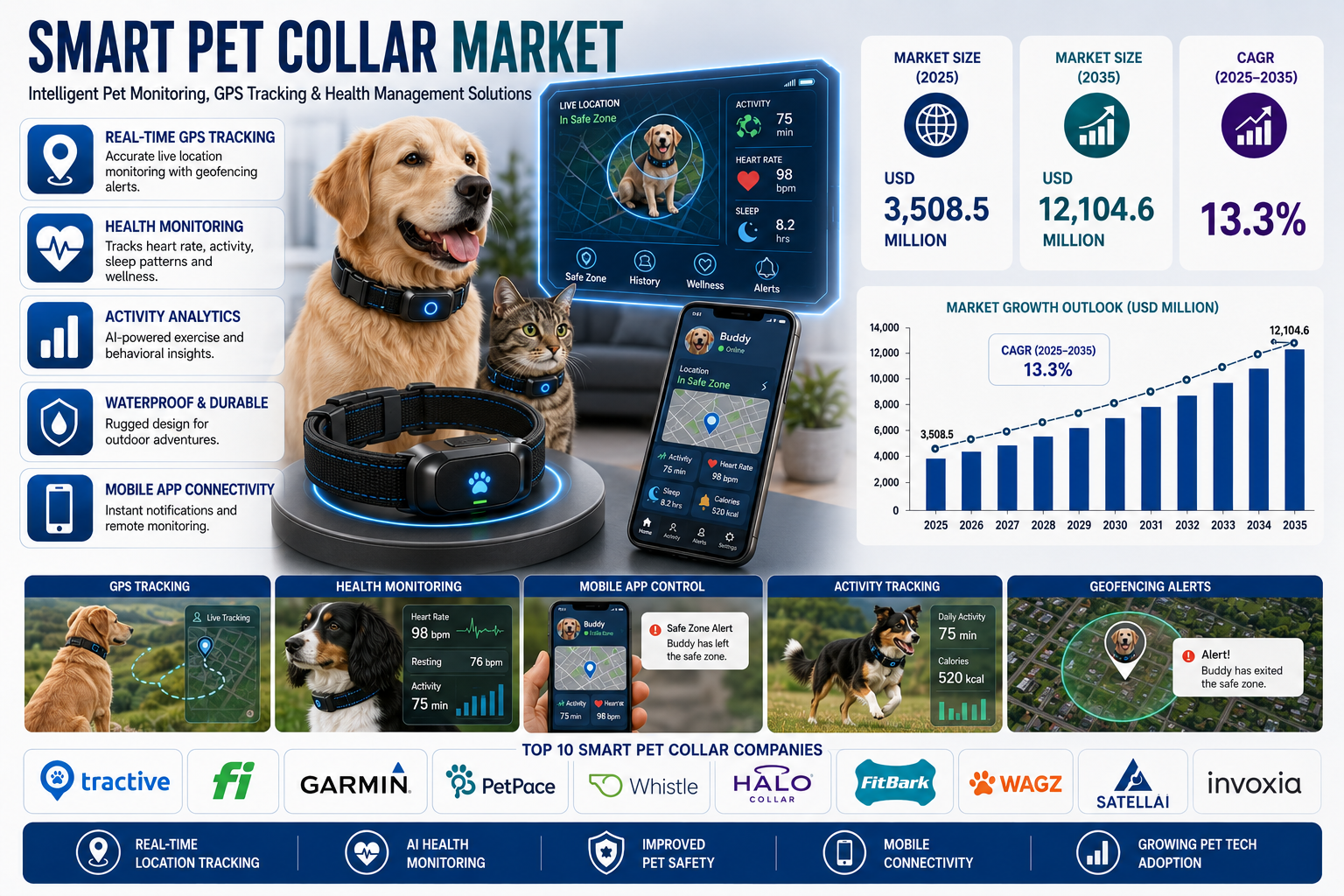
Smart Pet Collar Market Size, Share, Growth & Forecast 2025–2034: Trends, Drivers, and Key Players
The smart pet collar has moved from a novelty gadget for tech-forward pet owners into a mainstream category of the broader pet care economy. By combining GPS tracking, activity sensors, Bluetooth/Wi-Fi connectivity, and increasingly health-monitoring capabilities into a single wearable device, smart collars give owners real-time visibility into where their pet is, how active they've been, and, on newer platforms, early signals of potential health issues.
According to a new report from Intellectual Market Insights Research, the global smart pet collar market was valued at approximately USD 632.4 million in 2025 and is projected to reach USD 1,637 million by 2034, growing at a compound annual growth rate (CAGR) of 11.1% between 2025 and 2034. That is more than a 2.5x increase in under a decade, reflecting rising pet ownership, growing disposable incomes, and the broader trend of "pet humanization" that has pet owners treating their animals' safety and wellness with the same seriousness as their own.
In this article, we break down what's driving this growth, the challenges holding the market back, where the biggest opportunities lie, how the market is segmented, which regions are leading adoption, and who the major players are. Whether you're an investor, a retailer, a product manager, or simply curious about where pet technology is headed, this guide will give you a clear, structured view of the smart pet collar market landscape through 2034.
Market Overview
What Is a Smart Pet Collar?
A smart pet collar is a wearable device, typically attached to or built into a standard collar, that combines GPS or radio-based location tracking with onboard sensors and wireless connectivity to give owners real-time data about a pet's location, activity, and in some cases physiological status. Unlike passive ID tags, smart collars actively transmit data to a companion mobile app, allowing owners to set safe zones, receive escape alerts, track daily activity against breed-specific benchmarks, and, on premium devices, monitor resting heart rate, respiratory rate, or other early health indicators.
Most devices fall into two broad technology camps: GPS-based collars, which use satellite positioning plus cellular or Wi-Fi connectivity for continuous real-time tracking over long distances, and radio-based (RF) collars, which rely on shorter-range radio signals and are more common in hunting, containment, and remote-training use cases where cellular coverage may be unreliable.
Current Market Landscape
The smart pet collar space today sits at the intersection of consumer electronics, IoT connectivity, and veterinary wellness. It has expanded well beyond its original core use case, preventing a lost pet, into daily activity tracking, behavioral insight, and preventive health monitoring. Device makers have steadily improved battery life, waterproofing, and subscription-based cellular connectivity, which has widened the market from early-adopter hunters and hikers to mainstream urban and suburban pet owners.
Industry Background
Early pet tracking relied on passive RFID microchips and basic radio beacon collars used mainly by hunters and law enforcement K9 units. GPS-enabled consumer pet trackers began appearing in the early 2010s as GPS chipsets and cellular IoT connectivity became small and cheap enough to fit on a collar, with companies like Tractive and Whistle emerging as early consumer pioneers around 2012. Over the past decade, the technology has benefited from falling component costs, longer battery life, smaller form factors, and the addition of biometric sensors, setting the stage for the shift from pure tracking devices toward integrated health and wellness platforms.
Key Market Trends
- Convergence of tracking and health monitoring: Newer collars increasingly combine GPS location with heart rate, respiratory rate, and activity-pattern analysis, positioning the device as a preventive-health tool rather than just an anti-loss safeguard.
- Subscription-based business models: Most GPS-enabled collars now pair hardware sales with recurring cellular data subscriptions, giving vendors a stable, recurring revenue stream alongside one-time device sales.
- Consolidation among pet-tech brands: The market has seen notable M&A activity, including established players acquiring or absorbing smaller competitors to expand user bases and technology portfolios.
- Miniaturization and improved battery life: Manufacturers continue to shrink devices while extending battery life between charges, a critical factor for daily usability and a common purchase driver for owners of smaller pets.
- Rising use in multi-pet households: Platforms increasingly support multi-pet dashboards, letting owners track several animals from a single app, which is expanding average revenue per household.
Market Growth Drivers
Rising Pet Ownership and Pet Humanization: Growing numbers of households, particularly younger, urban pet owners, are treating pets as family members, driving demand for safety and wellness technology once reserved for humans.
Increasing Disposable Income: Higher discretionary spending on pets, especially in developed and increasingly in emerging economies, supports adoption of premium-priced smart collar devices and ongoing subscription services.
Growing Awareness of Pet Safety: Concerns about lost or stolen pets, especially in urban environments, continue to be a primary purchase trigger for GPS-based tracking collars.
Advances in Wearable Sensor Technology: Improvements in miniaturized biometric sensors, battery efficiency, and low-power wireless connectivity are making health-monitoring features more accurate, affordable, and accessible to mainstream buyers.
Expanding E-Commerce and Direct-to-Consumer Distribution: Online retail channels have made it easier for pet-tech brands to reach consumers directly, lowering distribution barriers and accelerating adoption outside traditional pet specialty retail.
Market Challenges
High Device and Subscription Costs: Premium smart collars combined with ongoing cellular data subscription fees can be a meaningful recurring expense, limiting adoption among price-sensitive pet owners.
Battery Life and Charging Constraints: Despite improvements, GPS-enabled collars still require frequent recharging compared to passive ID tags, which can be a friction point for owners of highly active or hard-to-handle pets.
Connectivity and Coverage Gaps: GPS and cellular-based tracking accuracy can degrade in rural areas, dense urban environments, or indoors, limiting reliability in some real-world conditions.
Data Privacy and Security Concerns: As collars collect and transmit location and health data, growing consumer awareness of data privacy raises questions about how vendors store, share, and secure that information.
Fragmented Competitive Landscape: A large number of small and mid-sized brands compete alongside established players, creating pricing pressure and making differentiation on features alone increasingly difficult.
Market Opportunities
Untapped Emerging Markets: Rising pet ownership and expanding disposable incomes across Asia-Pacific, Latin America, and parts of the Middle East represent significant white space for smart collar adoption as awareness grows.
Deeper Integration with Veterinary Care: Partnerships between pet-tech companies and veterinary networks or pet insurers could position smart collars as a standard tool for preventive care and early disease detection, similar to how wearables have integrated with human healthcare.
Expansion Into Cats and Smaller Animals: Most current smart collar innovation targets dogs; smaller, lighter form factors designed specifically for cats and other small pets remain a relatively underserved opportunity.
AI-Driven Behavioral Analytics: Applying machine learning to collar-generated activity and biometric data could unlock more sophisticated insights, such as early anxiety or illness detection, that go beyond basic step counts and location pings.
Bundled Insurance and Subscription Ecosystems: Bundling smart collar hardware and subscriptions with pet insurance products or veterinary telehealth services offers a path to higher customer lifetime value and stronger retention.
Market Segmentation
By Product Type
- GPS Based
- Radio Based
- Others
By Application
- Training
- Tracking
- Monitoring
By Component
- Displays
- GPS Chips
- Bluetooth Chips
- Sensors
By Sales Channel
- Online Sales Channel
- Offline Sales Channel
- Multi-Brand Stores
- Supermarkets/Hypermarkets
- Other Sales Channel
By Price
- Mass/Economic
- Premium
GPS-based collars represent the leading product type, reflecting strong consumer preference for real-time, long-range location tracking over shorter-range radio-based alternatives. Within components, GPS chips anchor the bill of materials and overall device cost, while sensors are an increasingly important growth area as health-monitoring features expand. On the channel side, online sales continue to gain share relative to traditional offline pet specialty retail, driven by direct-to-consumer brand strategies.
Regional Analysis
North America: North America holds the largest revenue share of the global smart pet collar market, supported by high pet ownership rates, strong smartphone penetration, and early, mature adoption of GPS pet-tracking subscriptions across the U.S. and Canada.
Europe: Europe represents a well-established and steadily growing market, led by countries such as Germany, the U.K., and France, with strong consumer awareness of pet wellness technology and a concentration of European pet-tech brands.
Asia-Pacific: Asia-Pacific is expected to register significant growth over the forecast period, driven by rising pet ownership, growing middle-class disposable income, and expanding e-commerce infrastructure in markets such as China, Japan, and South Korea.
Latin America: Latin America remains a smaller but developing market, with Brazil and Mexico leading regional demand as pet ownership rises and online retail access improves.
Middle East & Africa: The Middle East & Africa region is an emerging opportunity area, with growth concentrated in countries such as Saudi Arabia and the UAE, alongside gradual uptake in South Africa.
Competitive Landscape
The global smart pet collar market features a mix of GPS technology veterans and pet-tech specialists. Key players identified in the market include:
- Garmin
- Whistle
- FitBark
- Findster
- Link AKC
- KYON
- Tractive
- PetPace
- PETBLE
- Find My Pet
- DOTT, and others
Competition in this space centers on tracking accuracy, battery life, subscription pricing, and the breadth of health-monitoring features layered on top of core GPS functionality. Diversified GPS technology leaders such as Garmin benefit from decades of positioning expertise and strong brand trust in outdoor and hunting markets, while pet-tech specialists like Tractive and FitBark have built loyal consumer followings specifically around everyday pet safety and wellness. As the market matures, continued consolidation, subscription-model refinement, and deeper integration with veterinary and health-monitoring use cases are expected to shape the competitive landscape through 2034.
1. Garmin Ltd.
|
Category |
Details |
|---|---|
|
Company Name |
Garmin Ltd. |
|
Headquarters |
Olathe, Kansas, USA (executive offices in Schaffhausen, Switzerland) |
|
Founded |
1989 (by Gary Burrell and Min Kao) |
|
Industry Focus |
GPS Navigation, Wearables, Outdoor and Pet Technology |
|
Global Presence |
Operations and sales across dozens of countries, with a well-established global distribution network spanning outdoor, marine, aviation, and fitness retail channels |
|
Company Overview |
Garmin is a global leader in GPS technology with decades of engineering expertise developed across aviation, marine, automotive, and outdoor recreation markets. It entered the smart pet collar space by extending its GPS handheld ecosystem to hunting and working-dog applications, building the Alpha and Astro product lines into some of the most trusted GPS pet-tracking systems on the market. |
|
Key Products & Services |
Alpha 300 and Astro 430 handheld GPS tracker systems paired with compatible smart collars; the TT 25 and TT 15 dog devices combining training and tracking; the Garmin K5 sport dog collar; broader GPS navigation, wearable, and fitness device portfolio. |
|
Market Position |
One of the leading brands in the premium, performance-oriented segment of the smart pet collar market, particularly strong among hunters, field-trial competitors, and working-dog owners who prioritize rugged, long-range GPS reliability. |
|
Recent Developments |
Garmin has continued to expand its Alpha and TT collar series with updated GPS/GLONASS tracking, remote training integration, and multi-dog management features aimed at hunting and working-dog markets, reinforcing its position at the premium end of the category. |
|
Strategic Advantages |
Deep in-house GPS engineering expertise, an established global retail and distribution network, strong brand trust built across outdoor and navigation categories, and a loyal customer base among hunting and working-dog communities. |
2. Tractive GmbH
|
Category |
Details |
|---|---|
|
Company Name |
Tractive GmbH |
|
Headquarters |
Pasching, Austria |
|
Founded |
2012 (co-founded by Michael Hurnaus) |
|
Industry Focus |
GPS Pet Tracking and Pet Health Wearables |
|
Global Presence |
Serves over 1.4 million active users worldwide, with millions of devices sold across Europe and, following its 2025 acquisition of Whistle, an expanded footprint in the United States |
|
Company Overview |
Tractive has established itself as one of the world's leading providers of smart GPS and health trackers for pets, building its reputation in Europe before expanding globally. In July 2025, Tractive acquired Whistle, the connected pet wearable brand previously owned by Mars Petcare, adding Whistle's U.S. customer base and technology assets to its platform. |
|
Key Products & Services |
Tractive GPS Dog and Cat trackers; health-monitoring features including resting heart rate and respiratory rate tracking; the Tractive Base Station accessory for extended battery life; subscription-based location and wellness tracking plans. |
|
Market Position |
A leading global pet-tech brand recognized for GPS tracking and pet health insights, with platform rankings that include being named a top pick by Consumer Reports and The New York Times' Wirecutter, and strengthened U.S. market presence following the Whistle acquisition. |
|
Recent Developments |
Completed the acquisition of Whistle from Mars Petcare in July 2025, offering former Whistle customers free replacement trackers and transition support onto the Tractive platform ahead of Whistle's device shutdown at the end of August 2025. The deal reinforced Tractive's global leadership by combining two of the category's earliest pioneers, Tractive in Europe and Whistle in the U.S. |
|
Strategic Advantages |
Early-mover brand recognition in GPS pet tracking, a large and growing active user base, expanding health-monitoring feature set including biometric tracking, and a significantly strengthened U.S. footprint following the Whistle acquisition. |
3. FitBark, Inc.
|
Category |
Details |
|---|---|
|
Company Name |
FitBark, Inc. |
|
Headquarters |
Kansas City, Missouri, USA |
|
Founded |
2013 (by Davide Rossi, Sara Rossi, Michael Chiang, and Fabrizio Filippini; backed by Techstars and T-Mobile) |
|
Industry Focus |
Pet Wearables and Health Analytics |
|
Global Presence |
Products used by pet owners in 140+ countries, with a remote-friendly team spanning the United States, South America, Europe, and Asia |
|
Company Overview |
FitBark is a data-driven pet tech company focused on motivating dogs, cats, and their owners to stay active and healthy together. The company designs Bluetooth, Wi-Fi, and cellular-enabled wearables that track activity, sleep quality, calorie expenditure, mobility, and behavioral indicators such as anxious behavior. |
|
Key Products & Services |
FitBark GPS, a lightweight collar attachment providing real-time GPS tracking and health monitoring via 4G LTE-M cellular connectivity; FitBark 2, a Bluetooth-based activity and health monitor; companion mobile, web, and smartwatch apps; research-grade data platform. |
|
Market Position |
A recognized specialist brand in the health-and-wellness segment of the smart collar market, distinguished by deep integration with the veterinary and research community rather than competing primarily on GPS range or hardware ruggedness. |
|
Recent Developments |
FitBark has continued expanding its research partnerships, with its platform adopted by dozens of veterinary schools and research institutions to help validate new drugs, foods, procedures, and medical treatments using longitudinal pet activity and health data. |
|
Strategic Advantages |
Strong ties to veterinary and academic research communities lending scientific credibility, an in-house-developed technology stack spanning hardware and software, and a differentiated focus on health analytics alongside core tracking functionality. |
4. PetPace Ltd.
|
Category |
Details |
|---|---|
|
Company Name |
PetPace Ltd. |
|
Headquarters |
United States, with research and development operations in Israel |
|
Industry Focus |
AI-Powered Pet Health Monitoring and Vet-Grade Wearables |
|
Global Presence |
Devices and platform used by pet owners and veterinary partners across multiple regions, with a focus on clinical-grade monitoring use cases |
|
Company Overview |
PetPace positions itself squarely at the health-monitoring end of the smart collar market, developing AI-powered wearable technology designed to detect early symptoms and support ongoing disease management for sick, at-risk, or aging pets, rather than competing primarily on GPS tracking range. |
|
Key Products & Services |
PetPace Health 2.0 smart collar, offering continuous, real-time medical insight generation, early symptom detection, disease management support, and location tracking in a single vet-grade device. |
|
Market Position |
A specialized player focused on the fastest-growing application segment of the market, health and activity monitoring, positioning its technology as a preventive-care tool that can surface medical insights that might otherwise go unnoticed by owners. |
|
Recent Developments |
Launched its next-generation Health 2.0 smart dog collar, expanding its AI-powered capabilities for early symptom detection and continuous health monitoring aimed at giving pet owners and veterinarians actionable medical insights. |
|
Strategic Advantages |
Differentiated focus on clinical-grade, AI-driven health monitoring rather than tracking alone, positioning that aligns with the market's fastest-growing application segment, and credibility built through veterinary-oriented product design. |
5. Whistle (Now Part of Tractive)
|
Category |
Details |
|---|---|
|
Company Name |
Whistle Labs, Inc. (acquired by and integrated into Tractive) |
|
Headquarters |
San Francisco, California, USA (historical); operations now integrated into Tractive's Austria-based platform |
|
Founded |
2012 (by Ben Jacobs, Kevin Lloyd, and Steven Eidelman) |
|
Industry Focus |
GPS Pet Tracking and Activity Monitoring |
|
Global Presence |
Historically the leading U.S. GPS pet-tracking brand; as of 2025, its customer base has transitioned to Tractive's global platform |
|
Company Overview |
Whistle was one of the original pioneers of consumer GPS pet tracking in the United States, often described as the "Fitbit for dogs." Acquired by Mars Petcare in 2016 for approximately $117 million, Whistle operated as part of the Mars pet care portfolio until it was acquired by Tractive in July 2025. |
|
Key Products & Services |
Whistle Go Explore and Whistle Fit GPS and activity trackers (now discontinued); location tracking, activity monitoring, and health insight features that have since been folded into Tractive's product platform. |
|
Market Position |
Historically recognized as the original pioneer of pet tracking and activity monitoring in the U.S. market; following its acquisition, its technology and customer relationships now operate under the Tractive brand rather than as a standalone competitor. |
|
Recent Developments |
Tractive completed its acquisition of Whistle from Mars Petcare in July 2025. Whistle's own trackers were shut down at the end of August 2025, with affected customers offered free replacement Tractive devices and credit toward Tractive subscriptions. |
|
Strategic Advantages |
Deep brand recognition and an established U.S. customer base built over more than a decade, now folded into Tractive's broader global platform, giving the combined entity strengthened distribution and technology depth rather than competing independently. |
Future Outlook
The smart pet collar market is on a clear upward trajectory, with the forecasted CAGR of 11.1% through 2034 reflecting sustained demand across pet safety, activity tracking, and preventive health monitoring applications. Growth is expected to be increasingly driven by the convergence of GPS tracking with health analytics, as more devices move beyond simple location alerts toward comprehensive wellness platforms.
Looking ahead, expect continued miniaturization and battery-life improvements, deeper integration with veterinary and insurance ecosystems, expanding health-sensor capability, and growing adoption in emerging markets as pet ownership and disposable incomes rise. Consolidation among vendors, as seen with Tractive's acquisition of Whistle, and closer partnerships between hardware makers and veterinary or insurance providers are also likely as the industry matures.
Frequently Asked Questions (FAQ)
Q1: How big is the smart pet collar market currently?
The global smart pet collar market was valued at approximately USD 632.4 million in 2025.
Q2: How fast is the smart pet collar market expected to grow?
The market is projected to grow at a CAGR of 11.1% from 2025 to 2034, reaching an estimated USD 1,637 million by 2034.
Q3: What is the difference between GPS-based and radio-based smart collars?
GPS-based collars use satellite positioning combined with cellular or Wi-Fi connectivity for continuous, long-range real-time tracking, while radio-based collars rely on shorter-range radio signals and are more commonly used in hunting, containment, and remote-training applications.
Q4: What are the main applications of smart pet collars?
Key applications include tracking (location and anti-loss safety), training (remote tone, vibration, and stimulation features), and monitoring (activity and health data collection).
Q5: Which region leads the smart pet collar market?
North America currently holds the largest market share, supported by high pet ownership and mature adoption of GPS pet-tracking subscriptions, while Asia-Pacific is expected to see significant growth over the forecast period.
Q6: Who are the major companies in the smart pet collar market?
Leading players include Garmin, Whistle (now part of Tractive), FitBark, Findster, Link AKC, KYON, Tractive, PetPace, PETBLE, Find My Pet, and DOTT.
Q7: What are the biggest challenges facing the smart pet collar market?
High device and subscription costs, battery life and charging limitations, connectivity gaps in rural or dense urban areas, and data privacy concerns are among the primary challenges.
Q8: What components make up a smart pet collar?
Core components typically include GPS chips, Bluetooth chips, sensors for activity and biometric monitoring, and, on some devices, integrated displays.
Q9: Are smart pet collars mainly used for tracking or for health monitoring?
Smart collars started primarily as GPS tracking and anti-loss tools but are increasingly incorporating health and activity monitoring features, with health-focused monitoring emerging as the fastest-growing application segment.
Q10: What opportunities exist in the smart pet collar market going forward?
Opportunities include expansion into emerging markets, dedicated form factors for cats and smaller pets, AI-driven behavioral analytics, and bundled ecosystems combining smart collars with pet insurance or veterinary telehealth services.
Conclusion
The smart pet collar has evolved from a niche GPS gadget into a mainstream pillar of the connected pet care economy, and the numbers reflect that shift. With the market projected to grow from USD 632.4 million in 2025 to USD 1,637 million by 2034, the opportunity spans GPS technology veterans, pet-tech specialists, health-monitoring innovators, and retail and distribution partners alike. While device and subscription costs, battery constraints, and a fragmented competitive field remain real challenges, the underlying demand drivers, namely rising pet ownership, pet humanization, and growing interest in preventive pet health, show no signs of slowing. For stakeholders across the value chain, understanding regional dynamics, segmentation trends, and the competitive landscape will be key to capturing this growth.