
Top 10 Leading Companies in the Global Superalloys Market
Author:
Intellectual Market Insights Research
Published Date:
06 Aug 2026
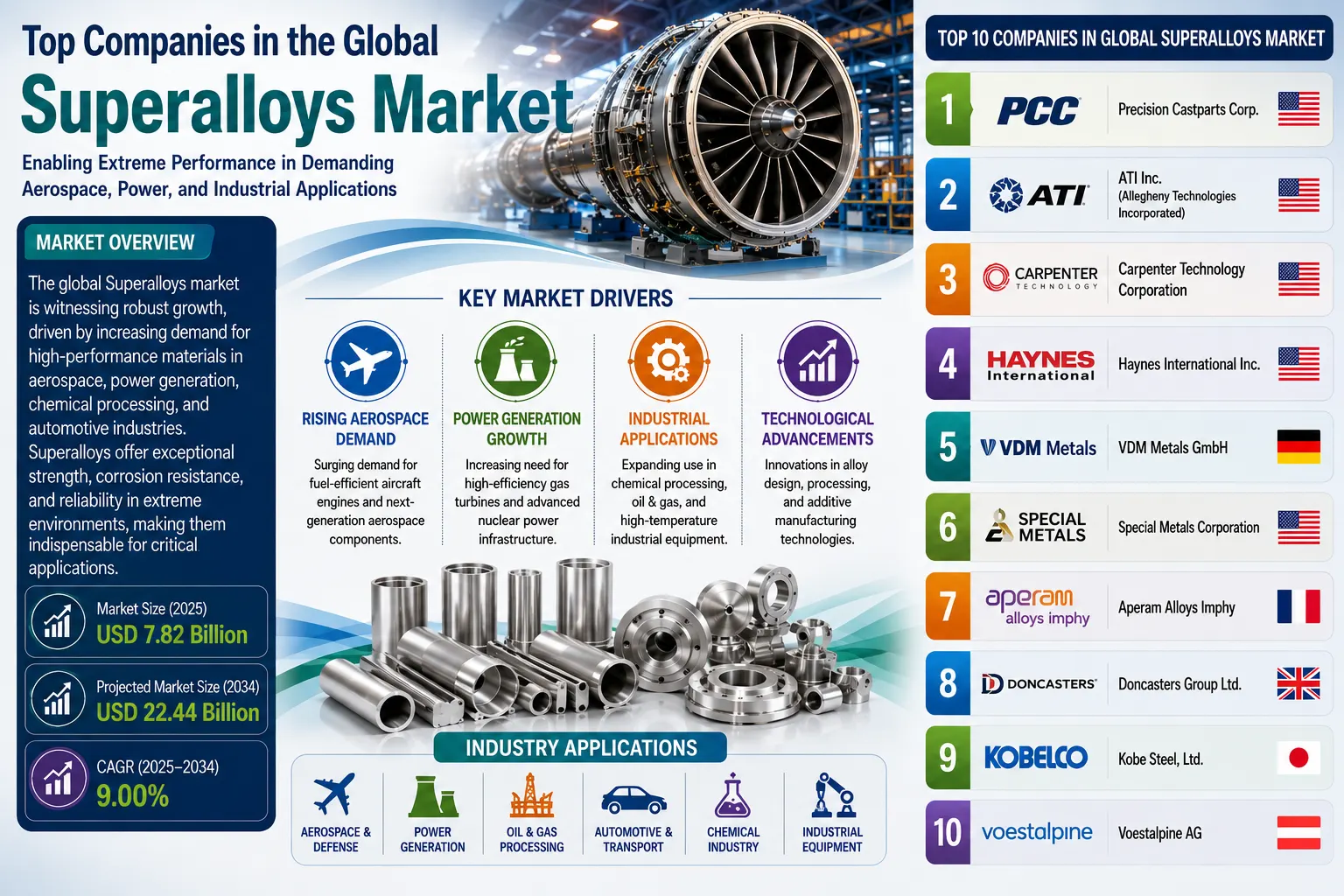
Top 10 Leading Companies in the Global Superalloys Market
The global Superalloys market has evolved from a specialized aerospace metallurgy niche into a foundational material category underpinning modern aviation, defense, power generation, and industrial engineering. As commercial aircraft fleets expand, defense modernization programs accelerate, and gas turbine operators push for higher operating temperatures and efficiency, superalloys have become an indispensable enabler of components that must withstand extreme heat, mechanical stress, and corrosive environments — from turbine blades and combustion chambers to nuclear reactor internals and high-performance automotive parts.
According to Intellectual Market Insights Research, the Superalloys market was valued at approximately USD 7.82 Billion in 2025 and is projected to grow at a CAGR of 9.00%, reaching USD 22.44 Billion by 2034. This strong, technology-driven growth trajectory is being propelled by rising commercial aircraft deliveries, expanding defense and space budgets, growing investment in power generation infrastructure, and the rapid maturation of additive manufacturing techniques for producing complex superalloy components.
North America continues to command the largest share of global demand, supported by the presence of major aerospace and defense manufacturers, advanced research and development infrastructure, and a mature industrial base. Meanwhile, Asia-Pacific is emerging as the fastest-growing region, driven by rapid industrialization, expanding domestic aerospace programs, and rising investment in power generation and automotive manufacturing across China, India, and Southeast Asia.
Market Overview
|
Parameter |
Details |
|---|---|
|
Market Size (2025) |
USD 7.82 Billion |
|
Projected Market Size (2034) |
USD 22.44 Billion |
|
CAGR (2025–2034) |
9.00% |
|
Leading Region (2025) |
North America |
|
Fast-Growing Region |
Asia-Pacific |
|
Leading Material Segment |
Nickel-Based Superalloys |
|
Leading Application Segment |
Turbine Engines |
|
Fastest-Growing Segments |
Cobalt-Based Superalloys (by material); Medical (by application) |
|
Key Growth Drivers |
Rising aerospace and aviation demand, growing power generation and energy investment, advances in additive manufacturing, focus on sustainable and recycled alloy production |
|
Key Challenges |
High production costs and volatile raw material prices, energy-intensive processing, lengthy aerospace and defense qualification cycles |
|
Major Players |
Precision Castparts Corp., ATI Inc., Carpenter Technology Corporation, Haynes International Inc., VDM Metals GmbH, Special Metals Corporation, Aperam Alloys Imphy, Doncasters Group Ltd., Kobe Steel Ltd., Voestalpine AG |
|
Forecast Period |
2025–2034 (Intellectual Market Insights Research) |
|
Study Period |
2019–2034 |
|
Report ID |
IMI-000586 |
Why the Superalloys Market Is Growing
1. Rising Demand from Aerospace and Aviation Industries
The single biggest structural driver of superalloy demand is the continued growth of commercial aviation and defense aerospace programs. Superalloys are essential to gas turbine engines, rocket propulsion systems, and structural aircraft components because of their exceptional mechanical strength, corrosion resistance, and high-temperature performance. Rising global air travel, increasing defense expenditure, and growing investment in space exploration and satellite deployment are all fueling sustained demand for these high-performance materials, while advances in additive manufacturing are enabling the production of increasingly complex, weight-optimized superalloy components.
2. Growing Demand from Power Generation and Energy Industries
The power generation and energy sector represents a major and expanding source of superalloy demand. These alloys are used in gas turbine engines, nuclear reactors, concentrated solar power systems, and geothermal plants, where components such as combustion chambers, heat exchangers, and turbine blades must withstand extreme heat, pressure, and corrosive operating conditions. As global energy consumption rises and utilities invest in modernizing aging infrastructure while transitioning toward cleaner and more efficient generation sources, superalloys are increasingly specified for their superior heat resistance, creep strength, and oxidation resistance relative to conventional materials.
3. Advancements in Additive Manufacturing Technologies
The rapid adoption of additive manufacturing, or 3D printing, is reshaping how complex superalloy components are designed and produced. Techniques such as direct metal laser sintering (DMLS), electron beam melting (EBM), and selective laser melting (SLM) allow for the precise, layer-by-layer construction of intricate geometries that are difficult or impossible to achieve through conventional casting or machining. These methods reduce material waste, shorten lead times, and enable lighter, mechanically optimized parts, while also supporting faster prototyping and spare-parts production — a combination that is accelerating innovation and customization across the superalloys market.
4. Focus on Sustainable and Eco-Friendly Alloy Solutions
Environmental and regulatory pressures are pushing manufacturers toward more sustainable superalloy production methods. Because superalloys rely on finite and often environmentally sensitive metals such as nickel, cobalt, and chromium, producers and researchers are increasingly investing in recycled-content alloys, closed-loop material recovery, and more efficient processing techniques. Efforts to reclaim and reuse precious alloying elements from end-of-life components and manufacturing scrap are becoming a meaningful differentiator, helping companies reduce environmental impact while easing exposure to raw-material price volatility.
5. Expansion of Automotive High-Performance Applications
The automotive industry is an increasingly important application area for superalloys, which are used to manufacture exhaust valves, turbochargers, and other engine components that must endure high temperatures while maintaining mechanical integrity. Rising regulatory pressure to reduce vehicle emissions and improve fuel efficiency is prompting greater adoption of superalloy components in both internal combustion and hybrid drivetrains, supporting incremental but steady demand growth outside the traditional aerospace and power generation base.
6. Defense Modernization and Space Program Investment
Rising global defense budgets and expanding national space programs are driving sustained procurement of superalloy components for next-generation military aircraft engines, missile systems, and launch vehicle propulsion. As defense OEMs push toward higher thrust-to-weight ratios and greater operational reliability under extreme conditions, superalloys remain a mission-critical material category where performance is prioritized over cost, supporting continued investment in advanced alloy development and qualification.
Top 10 Companies in the Global Superalloys Market
- Precision Castparts Corp. (U.S.)
- ATI Inc. (Allegheny Technologies Incorporated) (U.S.)
- Carpenter Technology Corporation (U.S.)
- Haynes International Inc. (U.S.)
- VDM Metals GmbH (Germany)
- Special Metals Corporation (U.S.)
- Aperam Alloys Imphy (France)
- Doncasters Group Ltd. (U.K.)
- Kobe Steel, Ltd. (Japan)
- Voestalpine AG (Austria)
Company Profiles
1. Precision Castparts Corp. (U.S.)
Headquarters: Portland, Oregon, USA Industry Focus: Investment-Cast Superalloy Components, Forgings & Fasteners for Aerospace and Industrial Gas Turbines Global Presence: Operations across North America, Europe, and Asia-Pacific; a Berkshire Hathaway subsidiary
Company Overview: Precision Castparts Corp. (PCC) is one of the world's largest manufacturers of complex metal components and products for the aerospace, power generation, and industrial markets, with deep vertical integration spanning investment casting, forging, and specialty alloy production through its Special Metals subsidiary. Its scale and vertical integration across the superalloy supply chain make it a central supplier to nearly every major aircraft engine and industrial turbine OEM.
Key Products and Services: PCC's portfolio includes investment-cast turbine airfoils and structural components, closed-die and seamless rolled-ring forgings for turbine engines, and nickel-based superalloy products manufactured through its Special Metals division.
Market Position: PCC holds a leading position in the global superalloys supply chain, particularly within investment casting and forged turbine components, supported by long-standing, deeply embedded relationships with major aircraft engine manufacturers.
Strategic Advantages: Extensive vertical integration from alloy melting through finished component manufacturing; deep-rooted OEM relationships across commercial and defense aerospace; substantial scale and capital backing; broad manufacturing footprint supporting global aerospace supply chains.
2. ATI Inc. (Allegheny Technologies Incorporated) (U.S.)
Headquarters: Pittsburgh, Pennsylvania, USA Industry Focus: Specialty Metals, including Nickel- and Cobalt-Based Superalloys, Titanium, and Advanced Alloys Global Presence: North America, Europe, and Asia, serving global aerospace and defense customers
Company Overview: ATI is a leading U.S. producer of technically demanding specialty materials, with a strong focus on high-performance nickel- and cobalt-based superalloys used in jet engines and airframe structures. The company has invested heavily in melting, forging, and powder metallurgy capacity to support the qualification-intensive requirements of aerospace and defense customers.
Key Products and Services: ATI's superalloy offerings include vacuum-melted nickel and cobalt alloys, powder metal products for additive manufacturing, and precision-forged components for jet engine rotating and structural parts.
Market Position: ATI holds a strong position among U.S. specialty alloy suppliers, particularly in next-generation jet engine programs where its advanced melting and powder metallurgy capabilities support tighter performance and quality specifications.
Strategic Advantages: Advanced vacuum melting and powder metallurgy capabilities; strong qualification status with major aerospace engine OEMs; ongoing capacity investment aligned with next-generation aircraft engine programs; diversified specialty metals portfolio beyond superalloys.
3. Carpenter Technology Corporation (U.S.)
Headquarters: Philadelphia, Pennsylvania, USA Industry Focus: Premium, Specialty Alloys including Nickel-, Cobalt-, and Iron-Based Superalloys Global Presence: North America, Europe, and Asia-Pacific through manufacturing and distribution operations
Company Overview: Carpenter Technology is a long-established U.S. producer of premium specialty alloys, with a superalloys business built on decades of metallurgical expertise serving aerospace, defense, medical, and energy customers. The company emphasizes tightly controlled melting and processing to meet the stringent certification requirements of critical applications.
Key Products and Services: Carpenter's superalloy range includes vacuum induction melted and vacuum arc remelted nickel- and cobalt-based alloys, powder products for additive manufacturing, and precision strip and bar products for turbine and medical applications.
Market Position: Carpenter holds a solid position across both traditional aerospace superalloys and the fast-growing medical application segment, benefiting from its broad melting and forming capabilities and its early investment in additive manufacturing powder production.
Strategic Advantages: Strong presence in both aerospace and medical-grade superalloy applications; advanced melting and remelting process control; early and sustained investment in additive manufacturing powders; diversified end-market exposure reducing cyclicality.
4. Haynes International Inc. (U.S.)
Headquarters: Kokomo, Indiana, USA Industry Focus: High-Performance Nickel- and Cobalt-Based Alloys for Aerospace, Chemical Processing, and Industrial Gas Turbines Global Presence: North America, Europe, and Asia through manufacturing and service centers
Company Overview: Haynes International is a specialist manufacturer of high-performance nickel- and cobalt-based alloys, with particular strength in corrosion-resistant and high-temperature alloy grades used across aerospace, chemical processing, and industrial gas turbine applications. The company's narrow but deep focus on specialty alloy metallurgy has made it a trusted supplier for demanding, application-specific requirements.
Key Products and Services: Haynes' product range includes sheet, plate, bar, and welding products in proprietary high-performance alloy grades engineered for extreme heat, corrosion, and oxidation resistance across aerospace and industrial applications.
Market Position: Haynes holds a strong niche position among specialty alloy producers, particularly within chemical processing and industrial gas turbine applications where corrosion resistance is as critical as high-temperature strength.
Strategic Advantages: Deep specialization in proprietary high-performance alloy chemistries; strong reputation in chemical processing and industrial gas turbine markets; long-standing customer qualification status; focused, application-engineered product development.
5. VDM Metals GmbH (Germany)
Headquarters: Werdohl, Germany Industry Focus: Nickel Alloys and Special Stainless Steels, including High-Temperature Superalloys Global Presence: Europe, with export operations across North America and Asia-Pacific
Company Overview: VDM Metals is a leading German manufacturer of nickel alloys and specialty stainless steels, with a superalloys business serving the aerospace, energy, and chemical processing sectors from a strong European industrial base. The company combines melting, hot and cold forming, and finishing capabilities to serve demanding technical specifications across multiple industries.
Key Products and Services: VDM Metals' portfolio includes high-temperature and high-corrosion-resistant nickel alloys in sheet, strip, wire, and bar form, along with specialty alloy solutions engineered for gas turbine, chemical processing, and energy applications.
Market Position: VDM Metals maintains a strong position within the European superalloys market, competing on metallurgical expertise and processing flexibility rather than sheer scale, with particular strength in energy and chemical processing applications.
Strategic Advantages: Strong European manufacturing base with integrated melting-to-finishing capabilities; deep expertise in high-corrosion, high-temperature nickel alloy chemistries; established relationships across energy and chemical processing end markets; flexible product forms supporting diverse customer specifications.
Competitive Landscape
The global Superalloys market in 2026 is moderately consolidated, shaped by a group of large, vertically integrated specialty metals producers alongside several regionally strong alloy specialists, rather than a large number of fragmented small manufacturers.
Market Structure
The competitive set includes large vertically integrated aerospace-metals suppliers (Precision Castparts Corp., ATI Inc.), diversified specialty alloy producers (Carpenter Technology, Haynes International), and regionally strong European and Asian specialists (VDM Metals, Aperam Alloys Imphy, Doncasters Group, Kobe Steel, Voestalpine). This structure allows a handful of large players to command significant aerospace-qualified volume, while several mid-sized specialists sustain strong positions in energy, chemical processing, and medical applications.
Aerospace Qualification as a Competitive Moat
Because superalloy components used in jet engines and defense applications must pass lengthy and rigorous OEM and regulatory qualification processes, long-standing certified-supplier status represents one of the most valuable competitive assets in the market. Producers with the deepest qualification history across major engine platforms, such as Precision Castparts Corp. and ATI, benefit from durable, difficult-to-displace positions in aerospace supply chains.
Additive Manufacturing Capability as a Differentiator
As aerospace OEMs increasingly qualify additive manufacturing feedstock suppliers to reduce machining waste and shorten component lead times, producers that have invested early in powder metallurgy and 3D-printing-compatible alloy grades, including Carpenter Technology and ATI, are gaining preference for next-generation engine and turbine component programs.
Vertical Integration and Raw Material Access
Given the high cost and volatility of key alloying metals such as nickel, cobalt, and chromium, the degree of vertical integration from melting through finished component manufacturing has become an important competitive factor, helping large integrated players such as Precision Castparts Corp. manage cost exposure more effectively than smaller, less-integrated competitors.
Regional Analysis
North America Leading Region (2025)
North America holds a leading share of the global superalloys market in 2025, supported by the presence of major aerospace and defense manufacturers, extensive automotive production, and advanced research and development infrastructure. The U.S. is the dominant national market, driven by strong demand from commercial aviation, defense, and power generation industries.
Europe Strong Aerospace and Industrial Base
Europe represents a mature and technically advanced superalloys market, led by Germany, France, and the U.K., home to several of the industry's leading alloy producers and major aerospace engine manufacturers. Strong domestic aviation, defense, and energy sectors continue to support consistent demand for high-performance alloy products.
Asia-Pacific Fastest-Growing Region
Asia-Pacific is the fastest-growing superalloys region, propelled by rapid industrialization and urbanization, expanding domestic aerospace and defense programs, and rising investment in power generation and automotive manufacturing in China, India, and Japan. The emergence of China and India as significant manufacturing hubs is drawing international superalloy producers to expand regional capacity.
Middle East and Africa Emerging Growth
The MEA region represents an emerging superalloys market, supported by growing investment in power generation infrastructure and gradually expanding aerospace maintenance and manufacturing activity in the Gulf states.
Latin America Developing Market
Latin America is a developing market for superalloys, with Brazil and Mexico leading regional demand as domestic aerospace, automotive, and energy sectors continue to mature.
Segmentation Analysis
By Material
Nickel-Based Superalloys hold the leading share of the material segment, owing to their exceptional combination of mechanical strength, corrosion resistance, and high-temperature performance, which makes them the material of choice for turbine blades, combustors, and other critical aerospace components. Cobalt-Based Superalloys represent the fastest-growing material category, favored for their outstanding wear and corrosion resistance in demanding gas turbine applications, particularly within the power generation sector. Iron-Based Superalloys continue to serve cost-sensitive applications where extreme performance requirements are less pronounced.
By Application
Turbine Engines represent the leading application segment, reflecting the central role of superalloys in aircraft and industrial gas turbine components that must withstand extreme heat and mechanical stress. Chemical Processing is a significant application area, leveraging superalloys' corrosion and oxidation resistance in demanding industrial environments. Medical applications represent the fastest-growing segment, driven by superalloys' biocompatibility, strength, and corrosion resistance, which make them well suited to orthopedic implants and surgical instruments.
By Product Form
Wrought Superalloys remain widely used across forged and rolled component applications, while Cast Superalloys continue to serve investment-cast turbine airfoils and structural components requiring complex net-shape geometries.
Key Industry Developments
2023 Joint Aerospace Engine Development Rolls-Royce and Safran announced a joint venture to develop innovative superalloy materials for use in next-generation, low-emission aviation engines, reflecting continued industry investment in advanced alloy chemistries to support fuel-efficiency and emissions goals.
2023 Closed-Loop Titanium Supply Chain Agreement Aperam Recycling and IperionX Limited announced an agreement, through Aperam's ELG Utica Alloys affiliate, to establish a low-carbon, closed-loop titanium supply chain, combining clean titanium scrap supply with low-carbon processing technology to support a more sustainable and fully circular alloy supply chain.
2024 Expansion of Additive Manufacturing Capacity Leading aerospace engine manufacturers expanded additive manufacturing facility capacity to support increased production of 3D-printed superalloy engine parts, reflecting the industry's continued shift toward AM-enabled turbine component manufacturing.
2025 Expansion of Vacuum Melting and Powder Atomization Investment Foundries and specialty alloy producers increased investment in vacuum induction melting and powder atomization systems to meet increasingly stringent aerospace material certification standards and support growing additive manufacturing feedstock demand.
Market Dynamics
Market Driver Aerospace, Defense, and Power Generation Demand
The combination of rising commercial aircraft deliveries, expanding defense modernization programs, and growing power generation infrastructure investment is the primary structural driver supporting sustained superalloy demand across mature and developing markets alike.
Market Restraint High Production Costs and Raw Material Volatility
The most significant restraint remains the high cost of key alloying metals such as nickel, cobalt, and chromium, combined with the energy- and technology-intensive processing methods, including vacuum induction melting and hot isostatic pressing, required to produce superalloys. This cost structure remains a meaningful barrier for smaller producers and cost-sensitive end users.
Market Opportunity Additive Manufacturing and Sustainable Alloy Development
The parallel growth of additive manufacturing adoption and increasing demand for recycled and sustainably sourced alloy content presents a significant long-term opportunity, as producers that invest early in AM-compatible powder metallurgy and closed-loop material recovery are well positioned to capture share in next-generation aerospace and energy programs.
Future Outlook 2025–2034
The global Superalloys market is on track for strong, technology-driven growth, expanding from USD 7.82 Billion in 2025 to USD 22.44 Billion by 2034, driven by the continued expansion of commercial and defense aerospace programs, power generation infrastructure investment, and the rapid maturation of additive manufacturing across the superalloys value chain.
Growth Projections
Nickel-based superalloys will continue to lead the material segment given their unmatched high-temperature performance, while cobalt-based superalloys gain share in power generation gas turbine applications. Turbine engines will remain the leading application, with medical applications representing the fastest-growing category as biocompatible superalloy use expands in orthopedic and surgical devices. Asia-Pacific is expected to post the fastest regional growth as aerospace, automotive, and power generation investment accelerates.
Investment Opportunities
The highest-value opportunities lie in additive-manufacturing-compatible powder alloy products; recycled and closed-loop sustainable alloy supply chains; advanced vacuum melting and powder atomization capacity; and expanded manufacturing and qualification infrastructure in Asia-Pacific, where aerospace and power generation programs are still scaling.
Industry Transformation
The superalloys industry is transitioning from a traditionally capacity- and qualification-driven category toward an increasingly technology-enabled segment of the broader advanced materials ecosystem, as additive manufacturing, sustainability pressures, and next-generation aerospace and energy programs reshape production methods and material chemistries across the coming decade.
FAQ Section
Q1: What is the current size of the global Superalloys market?
The global Superalloys market was valued at approximately USD 7.82 Billion in 2025 and is projected to grow at a CAGR of 9.00%, reaching USD 22.44 Billion by 2034, according to Intellectual Market Insights Research.
Q2: Which companies are the top leaders in the global Superalloys market?
The top Superalloys market companies include Precision Castparts Corp., ATI Inc., Carpenter Technology Corporation, Haynes International Inc., VDM Metals GmbH, Special Metals Corporation, Aperam Alloys Imphy, Doncasters Group Ltd., Kobe Steel Ltd., and Voestalpine AG.
Q3: Which region dominates the global Superalloys market?
North America holds a leading position in the Superalloys market, supported by the presence of major aerospace and defense manufacturers and advanced industrial infrastructure, while Europe remains a mature, technically advanced market home to several leading alloy producers.
Q4: What is the forecast CAGR for the Superalloys market?
The global Superalloys market is projected to grow at a CAGR of 9.00% during the forecast period from 2025 to 2034, according to Intellectual Market Insights Research (Report ID: IMI-000586).
Q5: What are the primary growth drivers of the Superalloys market?
Key growth drivers include rising demand from aerospace and aviation industries; growing demand from power generation and energy industries; advancements in additive manufacturing technologies; focus on sustainable and eco-friendly alloy solutions; expansion of automotive high-performance applications; and defense modernization and space program investment.
Q6: Which material segment holds the largest share in the Superalloys market?
Nickel-Based Superalloys hold the largest share due to their superior mechanical strength, corrosion resistance, and high-temperature performance, though Cobalt-Based Superalloys are the fastest-growing material category.
Q7: Which application segment leads the Superalloys market?
Turbine Engines lead the application segment, reflecting the central role of superalloys in aircraft and industrial gas turbine components, with Medical applications representing the fastest-growing category.
Q8: Which region is the fastest growing in the Superalloys market?
Asia-Pacific is the fastest-growing region, driven by rapid industrialization, expanding domestic aerospace and defense programs, and rising investment in power generation and automotive manufacturing in China, India, and Southeast Asia.
Q9: What is the major market trend in the Superalloys market?
The dominant trend is the growing adoption of additive manufacturing for producing complex, weight-optimized superalloy components, alongside rising investment in recycled and sustainably sourced alloy production.
Q10: What are the key challenges facing the Superalloys market?
Primary challenges include high production costs and volatile raw material prices for metals such as nickel, cobalt, and chromium, energy-intensive processing requirements, and lengthy aerospace and defense qualification procedures.
Conclusion
The global Superalloys market is on a strong, technology-driven growth path through 2034. What began as a specialized aerospace metallurgy category is becoming an increasingly essential material platform underpinning commercial aviation, defense modernization, power generation, and advanced manufacturing. With a projected market value of USD 22.44 Billion by 2034, the superalloys industry represents a durable, performance- and innovation-driven growth opportunity within the broader advanced materials landscape.
The top companies profiled in this analysis reflect the market's technically demanding, qualification-led competitive character, from vertically integrated aerospace-metals leaders like Precision Castparts Corp. and ATI Inc., to diversified specialty alloy producers such as Carpenter Technology and Haynes International, and strong European specialists like VDM Metals.
What unites these market leaders is a shared focus on metallurgical expertise, aerospace-grade qualification, and manufacturing precision, and increasingly, on additive manufacturing readiness and sustainable alloy production that will define competitiveness as aerospace, energy, and industrial sectors push materials performance further over the coming decade.