
Superhydrophobic Coatings Market Size, Share, Growth & Top 25 Companies (2026–2034)
Author:
Intellectual Market Insights Research
Published Date:
23 Jul 2026
Superhydrophobic Coatings Market
Superhydrophobic Coatings Market: Size, Share, Growth Trends & Top 25 Companies (2026–2034)
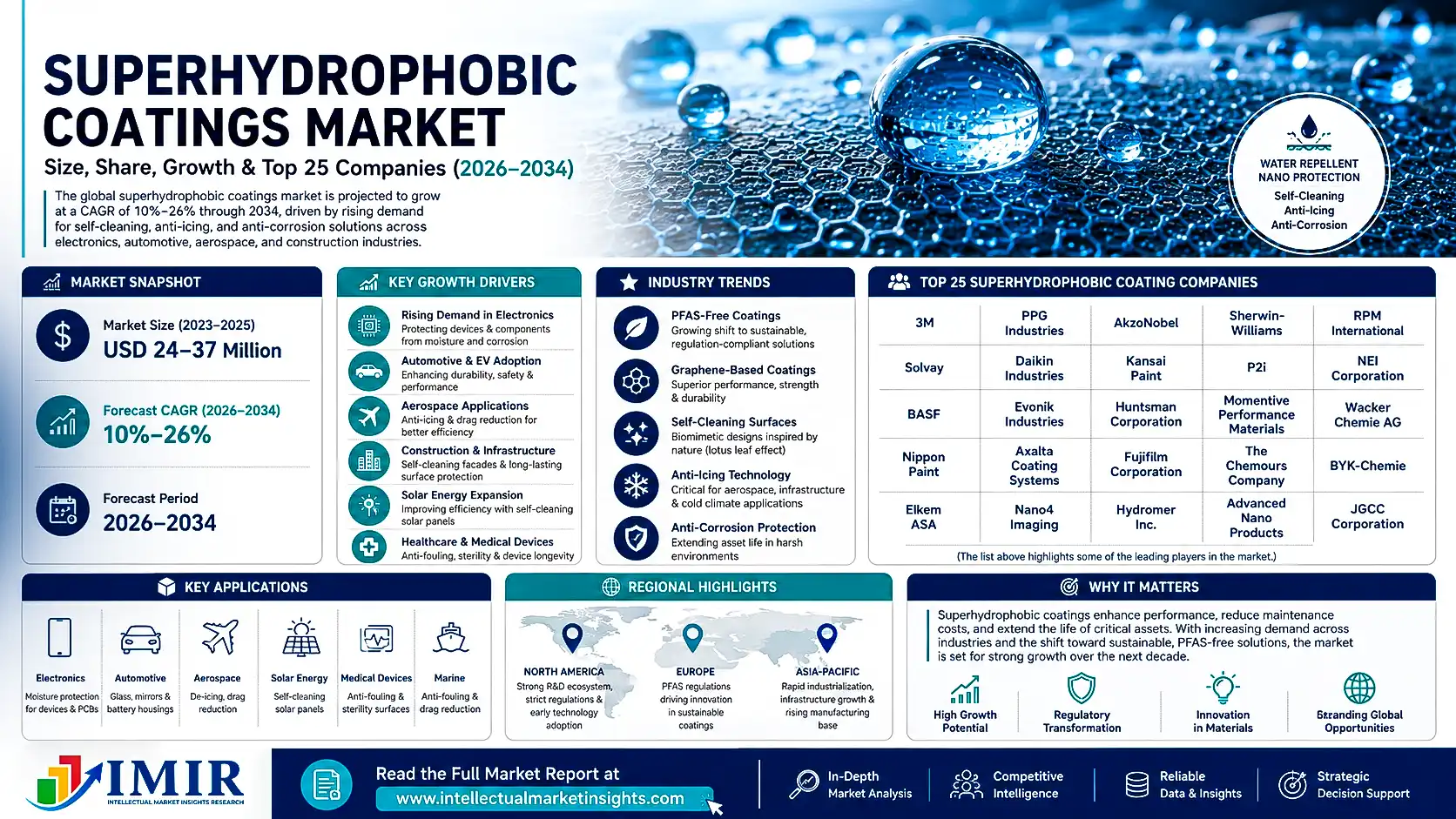
The global Superhydrophobic Coatings Market was valued in the range of roughly USD 24–37 million in 2023–2025, depending on the analyst firm and scope covered, and is projected to grow at a CAGR of approximately 10%–26% through 2031–2035 as electronics, automotive, aerospace, and construction industries adopt water-repellent nanocoatings for self-cleaning, anti-icing, and anti-corrosion applications.
Key Takeaway: Estimates vary widely across research firms because the category is still emerging and inconsistently scoped — some reports count only true superhydrophobic nano-coatings, while others fold in broader hydrophobic and oleophobic coating segments. Sahil and other readers evaluating this market should treat any single-source figure as directional, not definitive.
Expert Insight: The widest gap in analyst estimates is driven by PFAS regulation. Tightening restrictions in the EU and US are forcing a shift away from legacy fluoropolymer chemistries toward silica-, wax-, and graphene-based alternatives — a transition analysts are pricing very differently, which explains why growth forecasts range from roughly 10% to over 25% CAGR across sources.
What Are Superhydrophobic Coatings?
Superhydrophobic coatings are ultra-thin surface treatments — typically nanostructured silica, fluoropolymer, wax, or graphene-based formulations — engineered to make a surface extremely water-repellent, with a static water contact angle greater than 150° and a low roll-off (sliding) angle.
They work by combining surface roughness at the micro/nano scale with low surface-energy chemistry, mimicking natural structures like the lotus leaf, so water beads up and rolls off instead of wetting the surface.
Because they are biomimetically inspired by natural sources like the lotus leaf and desert beetle, superhydrophobic coatings can be applied to nearly any surface, regardless of its complex geometry or composition. This gives them a broader functional range than conventional hydrophobic coatings: beyond water repellency, well-formulated superhydrophobic surfaces also deliver self-cleaning, anti-icing, anti-corrosion, anti-fogging, and in some formulations, anti-microbial performance.
Where they're used:
- Consumer electronics and wearables (moisture protection for PCBs and connectors)
- Automotive glass, mirrors, and EV battery housings
- Aerospace components and de-icing surfaces
- Textiles and technical footwear
- Solar panels and building facades (self-cleaning)
- Medical devices (anti-fouling, sterility-adjacent surfaces)
- Marine hulls and offshore equipment (drag reduction, anti-fouling)
Market Size & Growth Forecast (2024–2034)
Most 2025–2026 analyst reports place the base-year market between USD 24 million and USD 65 million, with forecast-year values by 2031–2035 ranging from roughly USD 53 million to over USD 217 million, and CAGRs clustering between 10% and 26%.
The spread reflects differences in scope (pure superhydrophobic vs. broader hydrophobic/oleophobic coatings), base year, and regional coverage — not necessarily disagreement about underlying demand trends, which point consistently upward.
|
Sr No |
Base Year Value |
Forecast Value |
Forecast Year |
CAGR |
|---|---|---|---|---|
|
A |
~USD 24.3 million (2023) |
~USD 52.9 million |
2031 |
~10.1% |
|
B |
~USD 30 million (2024), USD 32.8 million (2025) |
~USD 171.7 million |
2034 |
~20.2% |
|
C |
~USD 37.5 billion* (2025) |
~USD 217 billion* |
2033 |
~25% |
|
D |
~USD 64.4 million (2026) |
— |
2034 |
~25.9% |
some third-party republished figures for Analyst Estimate C appear to use inconsistent units between millions and billions in source syndication; treat this row directionally only and verify against the original publisher before citing externally.
Regardless of which base figure is used, every source agrees on the same demand-side story: electronics miniaturization, EV adoption, and self-cleaning solar infrastructure are the three strongest volume drivers, while PFAS regulation is the biggest swing factor on the supply side.
Market Segmentation
By Product / Coating Type
- Anti-corrosion — protects metal substrates from moisture, salts, and chemical exposure
- Anti-icing — prevents ice adhesion on aerospace, wind turbine, and power-line surfaces
- Self-cleaning — enables dirt and contaminants to roll off with water rather than adhere
- Anti-wetting — the largest end-use category by product type, used heavily in marine hull coatings to reduce drag and lower fuel/shipping costs
By End-User Industry
- Textile and Footwear —projected to post the highest CAGR of the end-user segments as self-cleaning fabrics reduce water and energy use in cleaning
- Automotive — second-largest segment, concentrated in glass, mirrors, and exterior trim
- Building and Construction
- Aerospace
- Healthcare
- Optical
- Electrical and Electronics
By Raw Material / Chemistry
- Silica nanoparticle-based systems (currently the largest raw-material share)
- Fluoropolymer-based systems (facing PFAS-related headwinds)
- Wax and bio-based formulations
- Graphene and carbon-nanomaterial systems (fastest-growing chemistry category)
By Region
- North America —held the largest regional market share heading into the forecast period
- Asia-Pacific —leads on both current revenue and projected CAGR in several analyst reports, driven by industrialization in China, Japan, and South Korea
- Europe — second-largest region in most estimates, with construction and technical-textile demand concentrated in Germany
- Latin America, Middle East & Africa
Market Drivers
Growth is driven primarily by electronics waterproofing, EV expansion, self-cleaning solar demand, and healthcare's growing use of anti-fouling coated surfaces.
Rising Demand for Water-Resistant Electronics
Consumer electronics and wearable devices increasingly require internal and external moisture protection to safeguard components and data. Why it matters: device failures from moisture ingress are a leading cause of warranty claims, so OEMs are willing to pay a premium for nano-coating processes applied at the board or component level. Who benefits: specialty coating providers with dip- or vapor-deposition processes suited to small electronic parts. Future impact: as wearables and foldable devices proliferate, coating application will likely move further upstream into the component-manufacturing process itself.
Growth of the Electric Vehicle Sector
The global market for electric vehicles has expanded significantly in recent years, and superhydrophobic coatings are increasingly required for EV applications during the study period. Why it matters: EV battery housings and electronic modules are more moisture-sensitive than traditional combustion-engine components. Who benefits: coating suppliers with UL/IEC-certified formulations for battery-adjacent applications. Future impact: expect coating specs to become a standard line item in EV battery-pack sourcing requirements.
Self-Cleaning Solar and Building Infrastructure
Superhydrophobic coatings reduce dust and grime accumulation on solar panels, improving energy yield without manual cleaning. Why it matters: panel soiling can measurably cut energy output, so self-cleaning coatings have a direct ROI case. Who benefits: utility-scale solar operators in dusty, water-scarce regions. Future impact: this is likely to be one of the fastest-growing volume applications through 2030 given the scale of global solar buildout.
Healthcare and Anti-Microbial Applications
The healthcare industry is adopting anti-microbial superhydrophobic surfaces for their water resistance, impermeability, and biocompatibility. Why it matters: reducing surface-borne contamination risk has both clinical and liability value for device makers and hospitals. Who benefits: medical device manufacturers integrating coatings at the design stage. Future impact: regulatory clearance pathways (FDA/EU MDR) will likely become the key gating factor for adoption speed in this segment.
Government Water-Conservation and Self-Cleaning Mandates
Government regulations and international initiatives to conserve water are increasing demand for self-cleaning technology. Why it matters: self-cleaning surfaces reduce water used for maintenance cleaning at scale (buildings, transit infrastructure, solar farms). Who benefits: infrastructure and facilities-management sectors in water-stressed regions. Future impact: expect specification requirements in green-building certifications to increasingly reference self-cleaning coating performance.
Market Restraints & Challenges
High R&D and Raw Material Costs
Silicone resins and fluoropolymers are the two main raw materials used in this industry, distributed in binders such as urethane and fluoropolymer, along with silicon dioxide, cerium oxide, and titanium dioxide nanoparticles. Raw material production is a complex operation requiring advanced machinery and process technologies, which pushes up costs. Why it matters: this cost structure keeps superhydrophobic coatings a premium category relative to conventional water-resistant coatings, slowing mass-market adoption. Who is affected: smaller manufacturers face steeper margin pressure than diversified chemical majors that can absorb R&D costs across a broader portfolio.
Durability Under Mechanical Stress
Nanostructured surface texture is inherently delicate; abrasion, repeated handling, and hard use can degrade the micro/nano roughness that creates the superhydrophobic effect. Why it matters: this limits use in high-contact industrial and commercial settings where coatings must survive years of wear. Future impact: durability improvement is one of the most active R&D areas, particularly around graphene-reinforced and cross-linked polymer matrices.
PFAS Regulatory Pressure
Stricter PFAS regulations across the US and EU are pushing manufacturers to reformulate away from traditional fluoropolymer chemistries, which have historically delivered the best water- and oil-repellency performance. Why it matters: reformulation takes time and R&D spend, and PFAS-free alternatives don't always match legacy performance benchmarks yet. Who is affected: fluoropolymer-dependent suppliers face the most disruption, while silica- and wax-based specialists may gain relative competitive advantage.
Limited Commercialization at Scale
Despite strong interest, superhydrophobic coatings have not yet achieved the commercialization scale of conventional hydrophobic coatings, largely due to production complexity and upfront capital intensity.
Market Opportunities
- PFAS-free eco-coatings in Europe — first-movers with compliant, high-performance alternatives stand to capture share as incumbents scramble to reformulate.
- Healthcare expansion — anti-fouling and sterilization-adjacent coatings represent a largely untapped vertical relative to current electronics/automotive concentration.
- Transportation anti-icing/anti-fog — aviation, rail, and EV charging infrastructure all represent underpenetrated use cases.
- Smart coating integration — combining superhydrophobic surfaces with embedded sensors is an early-stage but high-value R&D direction, particularly for structural health monitoring.
- Graphene-based formulations — offer a path to combine durability improvements with PFAS-free chemistry, addressing two restraints simultaneously.
Industry Trends
Graphene-Based Coatings Accelerate Market Growth
The growing adoption of eco-friendly graphene-based superhydrophobic coatings is a key driver of market expansion. These coatings offer superior performance over traditional alternatives through higher contact angles and lower surface energy, enhancing water repellency and fouling resistance, while also providing greater durability against wear, harsh environments, and chemical exposure — lowering long-term maintenance and cleaning costs. Why it matters: graphene formulations directly address the durability restraint noted above. Who benefits: R&D-intensive players able to scale nanomaterial production cost-effectively. Future impact: expect graphene-based product lines to command premium pricing through the early 2030s before costs normalize.
Major Coatings Companies Entering the Category
Large, diversified coatings manufacturers are extending existing fluoropolymer and specialty-coating platforms into superhydrophobic applications rather than building standalone product lines from scratch — a sign the category is maturing from a nanotech-startup niche into a mainstream coatings segment. Why it matters: it brings manufacturing scale and distribution reach that specialist players typically lack. Who benefits: end customers gain access to more standardized, certified products; smaller specialists face intensifying competition.
Consolidation in the Broader Coatings Industry
AkzoNobel and Axalta announced an all-stock merger that would combine companies reporting about USD 16.2 billion in 2025 coatings sales, while Sherwin-Williams and Nippon Paint completed notable acquisitions in 2025. Why it matters: consolidation among the parent coatings majors can accelerate cross-pollination of superhydrophobic R&D into mainstream product catalogs. Future impact: smaller independent superhydrophobic specialists could become acquisition targets as majors look to buy rather than build nanocoating IP.
Shift Toward Eco-Friendly and Solvent-Free Formulations
The development of superhydrophobic coatings with minimal environmental impact is gaining attention as regulatory pressure to reduce hazardous chemicals and VOCs expands, with manufacturers investing in solvent-free, bio-based, and water-based formulations. Why it matters: this trend runs in parallel with PFAS restrictions and is reshaping formulation R&D priorities across the industry. Who benefits: green-building and sustainability-focused end markets.
Regulatory Environment
PFAS restrictions in the United States and European Union are the single most consequential regulatory factor shaping product formulation strategy in this market through the early 2030s.
Regulators in both regions are progressively restricting or phasing out long-chain and, in some EU proposals, broader classes of per- and polyfluoroalkyl substances due to environmental persistence and health concerns. Because fluoropolymers have historically been core to high-performance superhydrophobic formulations, manufacturers face a genuine trade-off between compliance timelines and product performance during the transition to silica-, wax-, and graphene-based alternatives. Companies that move early on PFAS-free reformulation are positioning themselves as preferred suppliers for EU-facing and sustainability-conscious customers; those that delay face rising compliance and reformulation risk. Beyond PFAS, water-conservation policy and green-building certification standards (in various markets) are increasingly referencing self-cleaning surface performance, indirectly supporting demand.
Need country-level or segment-level data on the Superhydrophobic Coatings Market? IMIR's full report covers 60+ countries, historical data from 2019, and continuous monitoring through 2026. Request a free sample or speak to an analyst to scope a custom regional or competitive deep-dive.
Supply Chain & Raw Materials
The supply chain centers on nanomaterial inputs (silica, fluoropolymers, cerium oxide, titanium dioxide, and increasingly graphene), specialty binder resins, and precision application/deposition equipment.
Upstream, coating formulators depend on nanoparticle and resin suppliers whose output requires advanced processing technology — a bottleneck that keeps raw material costs elevated relative to conventional coatings. Midstream, coating application typically requires specialized spray, dip, plasma, or vapor-deposition equipment depending on the substrate (textiles vs. electronics vs. metal vs. glass), meaning suppliers often need application expertise as much as chemistry expertise. Downstream, end-use industries with strict certification requirements (aerospace, medical devices, automotive OEM) impose qualification and testing timelines that can extend commercialization cycles even after a formulation is technically ready.
Competitive Landscape
The competitive landscape spans two distinct tiers: (1) large, diversified global coatings and chemicals majors extending existing platforms into superhydrophobic applications, and (2) specialized nanocoating companies built specifically around superhydrophobic/hydrophobic technology.
No single company currently dominates the superhydrophobic segment the way Sherwin-Williams or PPG dominate the broader paints and coatings industry —even the reported market leader held roughly 25% share in 2024, with the top five collectively holding about 45%— leaving meaningful room for specialist and regional players.
This fragmentation is itself informative for market entrants and B2B buyers: it signals the category is still technology-differentiated rather than scale-differentiated, meaning formulation IP and application expertise currently matter more than manufacturing scale — though that balance may shift as majors like 3M and Daikin commit more R&D budget to the space.
Top 25 Superhydrophobic Coating Companies
- 3M Company
- PPG Industries, Inc.
- AkzoNobel N.V.
- The Sherwin-Williams Company
- RPM International Inc. (Rust-Oleum / NeverWet)
- Solvay
- Daikin Industries, Ltd.
- Kansai Paint Co., Ltd.
- P2i Limited
- UltraTech International, Inc.
- NEI Corporation
- Cytonix LLC
- Aculon, Inc.
- Lotus Leaf Coatings, Inc.
- NTT Advanced Technology Corporation
- Hydrobead
- Pearl Nano LLC
- United Protective Technologies (United Protec)
- DryWired LLC
- Advanced Nanotech Lab
- Nasiol Nano Coating
- Nanex Co., Ltd.
- Artekya Technologies
- Beijing Nutrition Tech Co., Ltd.
- Excel Coatings
1. 3M Company
Headquarters: Saint Paul, Minnesota, USA | Founded: 1902 | Type: Public (NYSE: MMM)
Executive Summary: 3M is a diversified American industrial and technology conglomerate whose fluoropolymer and silica coating platforms give it a strong technical foundation in water-repellent surface treatments.
Company Overview: 3M is a key player in the superhydrophobic coatings market due to its diversified technology portfolio, offering solutions based on fluoropolymer and silica coating technologies that deliver water repellency, scratch resistance, and long-term durability. Its products span consumer electronics, automotive, and healthcare applications.
Product Portfolio & Core Technologies: Fluoropolymer- and silica-based repellent coatings; broader specialty materials and adhesives businesses that provide adjacent formulation expertise.
Recent Developments: In January 2026, 3M introduced next-generation fluoropolymer-based coatings for consumer electronics, improving waterproofing performance.
Innovation & ESG Strategy: 3M has publicly committed to reducing reliance on legacy PFAS chemistries across its broader portfolio, a strategic shift directly relevant to its superhydrophobic coatings line as PFAS regulation tightens.
Why This Company Leads: Scale, cross-industry distribution, and R&D depth let 3M move faster on PFAS-free reformulation than most specialist competitors — a decisive advantage given the regulatory environment described above.
2. PPG Industries, Inc.
Headquarters: Pittsburgh, Pennsylvania, USA | Founded: 1883 | Type: Public (NYSE: PPG)
Executive Summary: A global coatings leader extending its specialty and protective coatings expertise into water-repellent and self-cleaning surface treatments.
Company Overview: PPG is a global leader in industrial and specialty coatings, operating in over 70 countries, with a product range spanning automotive OEM coatings, protective coatings, and industrial finishes; the company reported net sales of USD 15.8 billion in 2024. PPG's 2025 coatings sales were estimated at roughly USD 15.9 billion, ranking second globally behind Sherwin-Williams.
Business Segments: Performance Coatings and Industrial Coatings, spanning automotive refinish, aerospace, protective and marine, and packaging coatings.
Innovation Strategy: PPG has pursued acquisitions to reportedly expand into AkzoNobel-scale consolidation discussions in the broader industry, signaling appetite for inorganic growth in specialty and protective coating technology.
Why This Company Leads: PPG's protective and marine coatings expertise — anti-corrosion, anti-fouling — overlaps directly with core superhydrophobic use cases, giving it existing customer relationships to cross-sell into.
3. AkzoNobel N.V.
Headquarters: Amsterdam, Netherlands | Founded: 1994 (merger lineage dating to 1792) | Type: Public (Euronext Amsterdam: AKZA)
Executive Summary: A major European coatings group with strong protective and marine coatings capability relevant to anti-corrosion and anti-fouling superhydrophobic applications.
Company Overview: AkzoNobel specializes in both industrial and decorative coatings, with a portfolio of protective and marine coatings distributed worldwide, and ranked third globally by coatings revenue in the low-USD-11-billion range for 2025 according to industry trade press. CEO Greg Poux-Guillaume has led recent strategic moves including a proposed transaction structure with Axalta.
Recent Developments: AkzoNobel and Axalta announced an all-stock merger combining companies reporting about USD 16.2 billion in 2025 coatings sales, which — if completed — would reshape the global coatings ranking.
Why This Company Leads: Deep marine and protective-coatings heritage translates directly into anti-corrosion and anti-fouling superhydrophobic product potential, particularly for shipping and offshore applications.
4. The Sherwin-Williams Company
Headquarters: Cleveland, Ohio, USA | Founded: 1866 | Type: Public (NYSE: SHW)
Executive Summary: The world's largest coatings company by revenue, with Performance Coatings Group operations relevant to protective, marine, and industrial superhydrophobic applications.
Company Overview: Founded in 1866 and headquartered in Cleveland, Ohio, Sherwin-Williams operates in more than 120 countries with revenue of approximately USD 23.6 billion in 2025 and roughly 64,249 employees. Heidi G. Petz serves as Chair, President and CEO. Sherwin-Williams remains the No. 1 ranked global coatings company with an estimated USD 19.8 billion in coatings-specific sales in 2026 industry rankings.
Business Segments: Paint Stores Group, Consumer Brands Group, and Performance Coatings Group.
Recent Developments: The Performance Coatings Group serves automotive, industrial, protective and marine, and OEM wood markets globally, competing directly with PPG, Axalta, and AkzoNobel, with adjusted EPS growing 9.5% to a record USD 11.33 in FY2024.
Why This Company Leads: Unmatched scale and distribution (thousands of company-operated stores) give Sherwin-Williams a route-to-market advantage that specialist superhydrophobic players cannot match.
5. RPM International Inc. (Rust-Oleum / NeverWet)
Headquarters: Medina, Ohio, USA | Founded: 1947 | Type: Public (NYSE: RPM)
Executive Summary: Parent company of Rust-Oleum, whose NeverWet brand is widely cited as a leading consumer- and industrial-facing superhydrophobic coating product line.
Company Overview: Rust-Oleum (NeverWet) is frequently cited as the leading player in the superhydrophobic coatings market, holding over 25% market share in 2024 among the top five players that collectively held 45% share. RPM International ranks fifth among global coatings companies by trade-press industry rankings.
Product Portfolio: NeverWet spray-on superhydrophobic treatments for consumer, automotive, and light industrial use, alongside RPM's broader protective coatings and specialty chemicals brands.
Why This Company Leads: NeverWet's brand recognition in the consumer/prosumer segment is unusual for this market — most competitors sell primarily B2B — giving RPM a distribution channel (retail) that specialist B2B players lack.
6. Solvay
Headquarters: Brussels, Belgium | Founded: 1863 | Type: Public (Euronext Brussels: SOLB)
Executive Summary: A specialty chemicals group whose fluoropolymer and specialty surfactant chemistries underpin water- and oil-repellent coating formulations used by downstream coating manufacturers.
Company Overview: Solvay is cited in coatings trade press as expanding beyond traditional spray-on coatings into niche high-performance applications, leveraging its fluorochemical and specialty polymer expertise.
Core Technologies: Specialty fluoropolymers and surfactants supplied as formulation inputs to downstream coating producers, rather than primarily end-user-facing branded coatings.
Note on data availability: Solvay does not break out superhydrophobic-specific revenue in public filings; the figures above reflect its broader specialty chemicals segment.
Why This Company Leads: As a materials supplier rather than end-brand, Solvay's influence runs through the formulations of many other companies profiled here — a structurally important but less visible position in the value chain.
7. Daikin Industries, Ltd.
Headquarters: Osaka, Japan | Founded: 1924 | Type: Public (TYO: 6367)
Executive Summary: Best known globally for air conditioning, Daikin is also a major fluorochemicals producer with advancing fluoropolymer-based water- and oil-repellent coating technology.
Company Overview: In January 2026, Daikin Industries advanced fluoropolymer-based coatings with superior water and oil repellency for industrial applications.
Core Technologies: Fluoropolymer chemistry drawing on Daikin's long-standing fluorochemicals business (also used in refrigerants and semiconductor materials).
Why This Company Leads: Daikin's fluorochemical manufacturing scale — built originally for refrigerants and semiconductor applications — gives it cost and supply-chain advantages in fluoropolymer-based repellent coatings even as the industry pivots toward PFAS-free alternatives for consumer-facing uses.
8. Kansai Paint Co., Ltd.
Headquarters: Osaka, Japan | Founded: 1918 | Type: Public (TYO: 4613)
Executive Summary: A major Asian coatings company extending automotive OEM coating expertise into self-cleaning surface technology.
Company Overview: cite index="9-1">In December 2025, Kansai Paint collaborated with automotive manufacturers to integrate self-cleaning coating technologies into next-generation vehicles. Kansai Paint ranks among the top ten global coatings companies by trade-press industry revenue rankings.
Business Segments: Automotive OEM and refinish coatings, industrial coatings, decorative paints — concentrated heavily in the Asia-Pacific region, the market's fastest-growing region by several analyst estimates.
Why This Company Leads: Direct automotive OEM partnerships give Kansai Paint a fast path from R&D to vehicle-line integration, ahead of companies that must sell through aftermarket or distributor channels.
9. P2i Limited
Headquarters: Abingdon, United Kingdom | Type: Private, specialist
Executive Summary: A US/UK-oriented specialist frequently cited as one of the top-five players in the global superhydrophobic coatings market.
Company Overview: P2i is a plasma-deposition nanocoating specialist whose core technology applies ultra-thin polymer coatings to electronics and consumer products for liquid protection, without materially changing the substrate's appearance or feel.
Core Technologies: Proprietary plasma-based vapor deposition process, differentiated from spray or dip application methods used by many competitors.
Note on data availability: As a privately held specialist, P2i does not publicly disclose revenue, market capitalization, or detailed leadership data; this profile relies on trade-press and market-report citations rather than company financial filings.
Why This Company Leads: Its plasma-deposition process is considered well suited to small, geometrically complex electronic components — a niche where spray/dip processes struggle — giving it a defensible technical position in the electronics vertical.
10. UltraTech International, Inc.
Headquarters: Jacksonville, Florida, USA | Type: Private
Executive Summary: Cited among the market's larger established players alongside Rust-Oleum.
Company Overview: UltraTech is positioned in industrial and environmental containment/coating products, with superhydrophobic formulations extending its broader spill-containment and protective-coating catalog.
Note on data availability: Detailed financials and executive leadership are not publicly disclosed for this privately held company.
Why This Company Leads: Its existing industrial distribution relationships (built on containment and safety products) provide a ready-made B2B channel for superhydrophobic protective coatings.
Company Comparison Tables
Headquarters & Company Type Comparison
|
Company |
Headquarters |
Type |
|---|---|---|
|
3M |
Saint Paul, USA |
Public |
|
PPG Industries |
Pittsburgh, USA |
Public |
|
AkzoNobel |
Amsterdam, Netherlands |
Public |
|
Sherwin-Williams |
Cleveland, USA |
Public |
|
RPM International (Rust-Oleum/NeverWet) |
Medina, USA |
Public |
|
Solvay |
Brussels, Belgium |
Public |
|
Daikin Industries |
Osaka, Japan |
Public |
|
Kansai Paint |
Osaka, Japan |
Public |
|
P2i Limited |
Abingdon, UK |
Private |
|
UltraTech International |
Jacksonville, USA |
Private |
|
NEI Corporation |
Somerset, USA |
Private |
|
Cytonix LLC |
Beltsville, USA |
Private |
|
Aculon, Inc. |
San Diego, USA |
Private |
|
Lotus Leaf Coatings |
US/Mexico (unverified) |
Private |
|
NTT Advanced Technology |
Kawasaki, Japan |
NTT subsidiary |
|
Hydrobead |
USA |
Private |
|
Pearl Nano LLC |
USA |
Private |
|
United Protective Technologies |
USA |
Private |
|
DryWired LLC |
Reno, USA |
Private |
|
Advanced Nanotech Lab |
India |
Private |
|
Nasiol Nano Coating |
Turkey |
Private |
|
Nanex Co. |
Japan |
Private |
|
Artekya Technologies |
Unverified |
Private |
|
Beijing Nutrition Tech |
Beijing, China |
Private |
|
Excel Coatings |
India |
Private |
Technology / Chemistry Focus Comparison
|
Company |
Primary Chemistry Focus |
|---|---|
|
3M, Daikin, Solvay |
Fluoropolymer-based |
|
P2i |
Plasma-deposition polymer |
|
Aculon |
Molecular-layer coatings |
|
NEI Corporation |
Nanoparticle dispersions |
|
Advanced Nanotech Lab, Nasiol |
Ceramic/hybrid nanocoatings |
|
RPM (NeverWet), Hydrobead, Pearl Nano |
Consumer/prosumer spray coatings |
|
AkzoNobel, PPG, Sherwin-Williams, Kansai Paint |
Broad industrial/protective/marine coatings platforms extended into the category |
Where a company's chemistry focus was not independently confirmed in public sources (Cytonix, Lotus Leaf Coatings, NTT-AT, United Protective Technologies, DryWired, Nanex, Artekya, Beijing Nutrition Tech, Excel Coatings, UltraTech International), it has been omitted from this comparison rather than assumed.
Revenue Comparison (Public Companies Only)
|
Company |
Reported Revenue |
Fiscal Year |
|---|---|---|
|
Sherwin-Williams |
~USD 23.6 billion (total company) |
2025 |
|
PPG Industries |
~USD 15.8 billion (total company) |
2024 |
|
AkzoNobel |
~USD 11 billion range (coatings, per trade press) |
2025 |
|
RPM International |
Not itemized above by coatings-only figure in sources reviewed |
— |
|
3M, Solvay, Daikin, Kansai Paint |
Total-company revenue not independently re-verified in this research pass |
— |
Note: these figures represent total company revenue, not superhydrophobic-coatings-specific revenue, which none of the public companies profiled break out separately. Private/specialist companies do not disclose revenue publicly and are excluded from this table entirely rather than estimated.
Regional Insights
North America: North America held the greatest market share heading into the projection period and is projected to grow at a CAGR of 26.6% in some analyst estimates, supported by the world's largest aerospace industry — the FAA estimates 8,270 commercial aircraft in the US fleet by 2037, up from 7,397 in 2018, alongside the country's leadership in photovoltaics and concentrated solar power.
Europe: Europe is the second-largest region, expected to reach approximately USD 27 million by 2030 at a CAGR of 23.4% in one estimate, with Germany's construction sector driving demand to extend the life of concrete structures and reduce maintenance costs on high-rise glass buildings, alongside a substantial technical textile industry shifting toward quality-focused, higher-value production.
Asia-Pacific: Asia-Pacific leads in both current revenue and projected CAGR in several analyst reports, fueled by rapid industrialization, expanding manufacturing, and significant infrastructure investment, particularly in China, Japan, and South Korea, with growing electronics and automotive industries combined with smart-city and sustainable-building initiatives amplifying construction-sector demand.
Latin America, Middle East & Africa: Currently the smallest regional segments across most analyst reports, though marine anti-fouling and offshore infrastructure applications represent a plausible growth path in Middle East markets given regional oil & gas and shipping activity.
Frequently Asked Questions
Q1. What is the current size of the global superhydrophobic coatings market? Estimates vary by analyst firm, but most place the market between roughly USD 24 million and USD 65 million as of 2023–2026, depending on scope and methodology.
Q2. What is the projected CAGR for the superhydrophobic coatings market? Forecast CAGRs range from approximately 10% to 26% depending on the source, with most recent (2025–2026) reports clustering closer to the 20–26% range.
Q3. Who are the leading companies in the superhydrophobic coatings market? Analyst reports frequently cite Rust-Oleum (NeverWet), P2i Ltd, UltraTech International, NEI Corporation, and Aculon as top-five players by market share, alongside major diversified coatings companies like 3M, PPG, AkzoNobel, Sherwin-Williams, and Daikin extending into the category.
Q4. What industries use superhydrophobic coatings the most? Electronics, automotive, and healthcare are the primary application industries cited across analyst reports, alongside aerospace, construction, textiles, and marine.
Q5. How do superhydrophobic coatings differ from regular waterproof coatings? Superhydrophobic coatings achieve a water contact angle above 150° combined with a low roll-off angle, using nanostructured surface texture plus low-energy chemistry — a materially stronger effect than standard water-resistant coatings, which typically only reduce water absorption rather than causing water to bead and roll off.
Q6. What raw materials are used in superhydrophobic coatings? Silicone resins and fluoropolymers are the two primary raw materials, distributed in binders such as urethane and fluoropolymer, alongside silicon dioxide, cerium oxide, and titanium dioxide nanoparticles.
Q7. Why is PFAS regulation important to this market? Because fluoropolymers have historically been core to high-performance formulations, tightening PFAS restrictions in the US and EU are forcing a shift toward silica-, wax-, and graphene-based alternatives, reshaping R&D priorities industry-wide.
Q8. Which region has the largest market share? North America held the largest market share heading into the projection period in several analyst reports, though Asia-Pacific leads on both revenue and projected CAGR in other reports— the answer depends somewhat on the specific analyst methodology.
Q9. What are graphene-based superhydrophobic coatings? Graphene-based superhydrophobic coatings use graphene's structure to achieve higher contact angles and lower surface energy than traditional coatings, improving water repellency, fouling resistance, and durability against wear and chemical exposure.
Q10. Are superhydrophobic coatings used in electric vehicles? Yes — EV battery housings and electronic modules are increasingly moisture-sensitive, and coating suppliers are developing formulations specifically for EV applications as adoption accelerates.
Q11. What is the difference between hydrophobic and superhydrophobic coatings? Hydrophobic coatings resist water to some degree (contact angle roughly 90°–150°), while superhydrophobic coatings exceed 150° contact angle with very low roll-off angle, producing a much stronger water-beading and self-cleaning effect.
Q12. Do superhydrophobic coatings have anti-microbial properties? Some formulations do — the healthcare sector is adopting anti-microbial superhydrophobic surfaces for their water resistance, impermeability, and biocompatibility, though anti-microbial performance depends on the specific formulation rather than being universal to all superhydrophobic coatings.
Q13. What limits wider commercial adoption of superhydrophobic coatings? High raw material and R&D costs, complex production processes, and durability limitations under abrasion and mechanical stress are the main restraining factors cited across analyst reports.
Q14. How are superhydrophobic coatings applied? Application methods vary by company and substrate — spray, dip, plasma vapor deposition, and molecular-layer deposition are all used, depending on the target surface (textile, electronics, metal, glass) and desired durability.
Q15. What is the anti-wetting segment, and why is it significant? Anti-wetting coatings are used heavily in marine applications, reducing water drag on ship hulls and lowering shipping costs, and represent the largest end-use category by product type in several analyst reports.
Q16. Which end-user segment is growing fastest? Textile and footwear is projected to grow at the highest CAGR among end-user segments in some analyst reports, driven by increasing focus on water- and stain-resistant materials.
Q17. Are large coatings companies or small specialists winning in this market? Neither dominates outright — the market remains fragmented, with the top five players collectively holding under half of total share in most estimates, meaning both large diversified players and focused specialists currently compete on relatively even footing.
Q18. What role does nanotechnology play in this market? Nanotechnology is foundational — nanoscale surface roughness combined with low-energy chemistry is what physically produces the superhydrophobic effect, and ongoing R&D in nanomaterials (especially graphene) is the main lever for improving durability and reducing reliance on PFAS chemistries.
Q19. Is the superhydrophobic coatings market expected to consolidate? Possibly — consolidation activity among parent coatings majors (such as the reported AkzoNobel-Axalta merger discussions) could extend to smaller superhydrophobic specialists as larger players look to acquire nanocoating IP rather than build it internally, though no major acquisition of a pure-play superhydrophobic specialist was confirmed in the sources reviewed for this report.
Q20. Where can I get a detailed data breakdown of this market by segment and region? IMIR's full Superhydrophobic Coatings Market report provides segment-level and country-level sizing, historical data back to 2019, and a full competitive profile section — see the report link at the top of this article for access options.
Key Takeaways
- The superhydrophobic coatings market is small in absolute terms today (tens of millions of dollars) but growing quickly, with most credible forecasts pointing to double-digit-to-mid-20s CAGR through the early 2030s.
- PFAS regulation is the single biggest structural factor reshaping competitive positioning — companies with credible PFAS-free roadmaps are best positioned for the next five years.
- The competitive landscape is genuinely fragmented between large diversified coatings majors and focused nanocoating specialists, unlike the broader coatings industry where a handful of giants dominate.
- Electronics, automotive/EV, and self-cleaning solar/construction represent the three strongest near-term demand drivers.
- Data quality on smaller specialist companies is limited in public sources — anyone publishing company-specific claims about the 17 specialist players profiled here should independently verify against each company's own site before publication.
Conclusion
The superhydrophobic coatings market is still small in absolute dollar terms, but it sits at the intersection of three durable trends — electronics miniaturization, EV growth, and tightening PFAS regulation — that make its trajectory more predictable than its current size suggests. No single company yet dominates the way majors dominate the broader coatings industry: large diversified players like 3M, PPG, AkzoNobel, Sherwin-Williams, and Daikin are extending existing fluoropolymer and protective-coatings platforms into the category, while a long tail of specialists (P2i, NEI Corporation, Aculon, Cytonix, and others) compete on formulation IP and application expertise rather than scale.
For buyers and investors, the near-term signal to watch is PFAS reformulation — companies with credible PFAS-free roadmaps are best positioned to win share as EU and US restrictions tighten. For content and competitive-intelligence purposes, the biggest caveat is data quality: because so many of the specialist players are privately held, any figure more precise than "tens of millions of dollars growing at a double-digit-to-mid-20s CAGR" should be treated as directional rather than exact, and company-level claims about the 17 smaller players in this report should be independently verified before publication.