
Swarm Drone Market 2026: Size, Share, Growth & Industry Forecast to 2030
Author:
Intellectual Market Insights Research
Published Date:
12 Jun 2026
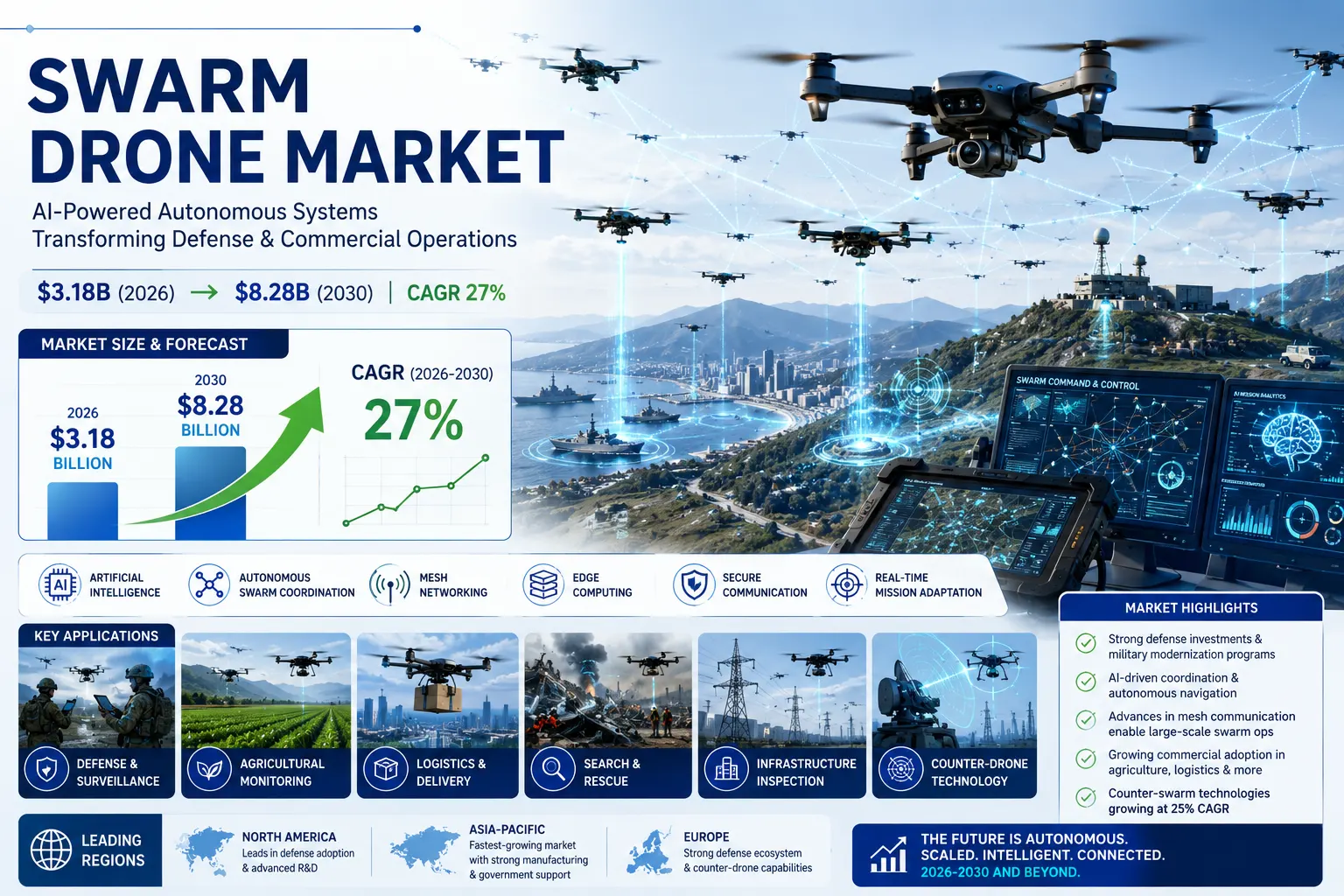
Swarm Drone Market: Complete Industry Analysis, Trends & Forecast (2026-2030)
Introduction
The swarm drone market has moved from experimental research labs into mainstream defense procurement and commercial pilot programs. What began as a niche application of robotics and AI is now one of the fastest-growing segments within the broader unmanned aerial systems industry.
Across the various swarm-related drone segments tracked by industry analysts, growth rates consistently sit in the 19% to 27% CAGR range through 2030 — figures that place this technology among the most dynamic corners of aerospace and defense. Whether the focus is military reconnaissance, counter-drone defense, agricultural monitoring, or last-mile delivery, coordinated multi-drone operations are reshaping how organizations think about aerial automation.
This article breaks down the swarm drone market’s current size, the forces driving its expansion, segment-by-segment analysis, regional dynamics, the competitive landscape, and what the next several years are likely to bring.
What is the Swarm Drone Market?
A “swarm” in this context refers to a group of drones operating as a coordinated unit rather than as individually piloted aircraft. Swarm drone technology relies on a combination of artificial intelligence, mesh networking, edge computing, and autonomous flight-control systems that allow dozens — or even hundreds — of drones to share data, divide tasks, and adapt to changing conditions in real time.
The market encompasses several interconnected categories: the drones themselves, the software and ground stations used to manage them, the communication networks that link them together, and the counter-drone systems designed to detect and neutralize hostile swarms. Together, these form an ecosystem that touches defense, commercial, and public-safety applications alike.
Key Takeaways
- The broader drone swarm systems market is valued at roughly $3.18 billion in 2026 and is projected to reach $8.28 billion by 2030, growing at around 27% CAGR.
- The swarm drone defense segment alone is valued at approximately $3.16 billion in 2026, expanding to roughly $7.69 billion by 2030 at a 25% CAGR.
- Counter-swarm drone technology is growing just as fast, from about $2.03 billion in 2026 to nearly $4.95 billion by 2030.
- Drone swarm management software and mesh-network communication are among the fastest-expanding sub-segments.
- North America currently leads in defense-driven swarm adoption, while Asia-Pacific has emerged as a dominant region in several related drone categories.
- Major players include Boeing, Lockheed Martin, Northrop Grumman, BAE Systems, Thales, Elbit Systems, Shield AI, Anduril Industries, AeroVironment, and Kratos Defense, among others.
- Key growth drivers include AI-driven coordination, military modernization programs, mesh communication advances, and expanding commercial use cases in agriculture and logistics.
Market Snapshot
|
Metric |
Value |
|---|---|
|
Market Size (2026) |
~$3.18 billion (drone swarm systems segment) |
|
Projected Market Size (2030) |
~$8.28 billion |
|
CAGR (2026-2030) |
~27% |
|
Forecast Period |
2026-2030 |
|
Leading Region (Defense Adoption) |
North America |
|
Fast-Growing Region |
Asia-Pacific |
|
Major Companies |
Boeing, Lockheed Martin, Northrop Grumman, BAE Systems, Thales, Shield AI, Anduril Industries, AeroVironment, Elbit Systems, Kratos Defense |
Note: The “swarm drone market” is tracked across several closely related segments — drone swarm systems, swarm drone defense, drone swarm management, mesh networks, ground control stations, and counter-swarm technology — each with slightly different valuations depending on scope. Figures above represent the broadest drone swarm systems classification.
Why Is the Swarm Drone Market Growing So Fast?
Technology Advancements
Improvements in onboard processing, battery efficßiency, and miniaturized sensors have made it economically viable to deploy large numbers of drones simultaneously. What once required expensive, custom-built platforms can now be achieved with increasingly standardized, mass-producible hardware.
AI Integration
Artificial intelligence is the backbone of modern swarm coordination. Machine learning models allow individual drones to make localized decisions — adjusting formation, reassigning tasks, or responding to threats — without constant human input, dramatically reducing operator workload.
Autonomous Navigation
Advances in GPS-denied navigation, simultaneous localization and mapping (SLAM), and onboard edge-computing flight controllers allow swarms to operate reliably in contested or complex environments where traditional navigation systems may fail.
Military Modernization
Defense budgets worldwide are shifting toward unmanned and autonomous systems. Initiatives such as the U.S. Department of Defense’s Replicator program — which prioritizes rapid, scalable production of autonomous systems — are accelerating procurement of swarm-capable platforms for reconnaissance and electronic warfare.
Commercial Applications
Beyond defense, industries such as agriculture, logistics, infrastructure inspection, and emergency response are testing swarm-based solutions for tasks like crop monitoring, last-mile delivery, and disaster assessment — opening an entirely new commercial growth avenue.
Latest Industry Trends
Artificial Intelligence Integration
AI-driven autonomous coordination is consistently cited as a top growth driver across drone swarm systems, management, and defense segments. Companies are investing heavily in machine-learning-based mission planning, predictive analytics, and adaptive formation control to make swarms more capable of independent decision-making.
Autonomous Swarm Coordination
Coordinated multi-drone operations — where individual units communicate and adjust behavior collectively — are moving from research demonstrations into operational deployments. This includes both fully autonomous swarms and human-supervised “swarm-of-swarms” configurations.
Edge Computing
Onboard edge-computing flight-control units are reducing dependence on centralized processing, enabling faster decision-making at the drone level. This is particularly important for swarms operating in environments with limited or contested connectivity.
Real-Time Surveillance
Surveillance and reconnaissance remain leading use cases, with swarms providing persistent area coverage that would be difficult or costly to achieve with single-drone operations.
Defense Investments
Rising cross-border security concerns, increased defense budget allocations, and growing numbers of unauthorized drone incidents are pushing governments to invest heavily in both offensive swarm capabilities and defensive countermeasures.
Counter-Drone Technologies
As swarm threats become more sophisticated, so does the counter-swarm segment. The counter-swarm drone technology market — valued at roughly $2.03 billion in 2026 — is growing at approximately 25% CAGR through 2030, driven by advances in radar detection, electronic jamming, directed-energy systems, and AI-enabled real-time threat tracking.
Market Drivers
Rising security threats and unauthorized drone incidents are pushing governments and critical infrastructure operators to invest in both swarm capabilities and counter-swarm defenses simultaneously.
Military modernization programs across major defense powers are prioritizing unmanned, autonomous, and networked systems — a category where swarm technology fits naturally.
Advances in mesh communication and connectivity are solving one of the historical bottlenecks of swarm operations: reliable drone-to-drone data sharing, especially in environments with limited infrastructure.
Falling costs of AI hardware and sensors mean that deploying dozens of coordinated drones is increasingly affordable for both defense and commercial buyers.
Expansion of commercial pilot programs in agriculture, logistics, and environmental monitoring are creating new revenue streams beyond traditional defense spending, broadening the addressable market considerably.
Market Restraints
Regulatory uncertainty remains one of the biggest hurdles, particularly for commercial applications. Beyond Visual Line of Sight (BVLOS) operations — essential for many swarm use cases — are still subject to evolving regulations in most jurisdictions.
High initial investment costs for swarm-capable hardware, software, and ground infrastructure can be prohibitive for smaller operators and emerging-market buyers.
Cybersecurity vulnerabilities are a growing concern, as swarms rely heavily on wireless communication links that could potentially be intercepted, jammed, or spoofed.
Technical complexity in achieving reliable autonomous coordination across large numbers of drones — particularly in GPS-denied or contested environments — continues to be a barrier to widespread commercial deployment.
Public perception and safety concerns around autonomous systems, particularly armed swarms, can slow adoption and complicate policy approval processes.
Market Opportunities
The shift toward swarm-as-a-service (SaaS) business models presents a significant opportunity, allowing organizations to access swarm capabilities without large capital expenditures on hardware and infrastructure.
Integration with digital-twin simulation for training and mission planning offers a lower-risk way for both defense and commercial users to test swarm operations before live deployment.
Expansion into infrastructure-limited environments — disaster zones, remote agricultural areas, and maritime operations — represents an underserved use case where self-healing mesh networks and decentralized communication provide clear advantages.
Growing demand for integrated counter-drone platforms that combine detection, tracking, and neutralization in a single system creates opportunities for both established defense contractors and newer entrants.
Cross-industry partnerships between drone manufacturers and AI software providers are reshaping the competitive landscape and opening doors for specialized software and analytics companies to capture value within the broader ecosystem.
Segment Analysis
By Platform
Unmanned Aerial Vehicles (UAVs) represent the dominant platform category within swarm robotics and drone swarm applications, commanding roughly 40% share in related swarm robotics markets. Rotary-blade drones are expected to see particularly strong growth due to their versatility in both military and commercial settings.
Growth factors: miniaturization, improved flight endurance, and modularity for different payload types. Outlook: Continued dominance of UAV platforms, with growing interest in hybrid fixed-wing/rotary designs for extended-range swarm missions.
By Component
Key components include flight-control hardware, communication and mesh-networking modules, ground control stations, sensors and payloads, and the software/AI layer that enables coordination.
Growth factors: edge-AI processors, secure communication terminals, and cloud-enabled control platforms. Outlook: Software and AI-driven coordination components are expected to grow fastest, as hardware increasingly commoditizes.
By Application
Major applications include surveillance and reconnaissance, electronic warfare, search and rescue, agricultural monitoring, logistics and delivery, and infrastructure inspection.
Growth factors: military demand for persistent ISR (intelligence, surveillance, reconnaissance), plus expanding commercial pilot programs. Outlook: Defense applications currently dominate, but commercial applications — particularly agriculture and logistics — are expected to be the fastest-growing over the forecast period.
By End User
End users span defense and security agencies, commercial enterprises (agriculture, logistics, energy), and government/public-safety organizations.
Growth factors: defense remains the largest spender, accounting for a majority share of demand in markets like North America, but public-safety and commercial adoption is accelerating. Outlook: Defense and security is projected to remain the leading end-user segment, with commercial enterprise adoption growing at a faster relative rate.
By Region
North America, Europe, and Asia-Pacific represent the three largest regional markets, with Asia-Pacific noted as a dominant region in several related swarm drone market reports, while North America leads in defense-driven swarm technology investment.
Regional Analysis
North America
North America’s leadership is closely tied to substantial defense sector investment and advanced R&D infrastructure. Military applications are estimated to drive the majority of regional demand, with a strong focus on coordinated surveillance and electronic warfare capabilities. Government initiatives like the Pentagon’s Replicator program are accelerating procurement of autonomous systems for reconnaissance missions. On the commercial side, logistics firms are testing last-mile delivery swarms, agricultural technology companies are developing crop-monitoring solutions, and evolving FAA BVLOS regulations are gradually enabling broader commercial swarm operations.
Europe
European defense contractors — including BAE Systems, Thales, Leonardo, Saab, and Hensoldt — are major participants in the global swarm drone supply chain, with strong involvement in both swarm platform development and counter-drone systems. Regional security concerns linked to geopolitical tensions are driving increased defense spending on autonomous and networked systems.
Asia-Pacific
Asia-Pacific has been identified as the largest regional market in some swarm drone market assessments, with significant participation from companies such as Aviation Industry Corporation of China and China Aerospace Science and Technology Corporation. The region benefits from rapid manufacturing scale-up capabilities and growing government interest in both defense and commercial drone applications.
Latin America
While currently a smaller market, Latin America presents emerging opportunities tied to agricultural monitoring, border security, and disaster response applications, particularly as swarm-as-a-service models lower the barrier to entry for smaller operators.
Middle East & Africa
The Middle East, in particular, has seen growing investment in drone and counter-drone technologies amid regional security dynamics, with companies like EDGE Group/ADASI playing an increasingly visible role in swarm-related defense procurement.
Competitive Landscape
The swarm drone market features a mix of established aerospace and defense giants alongside specialized autonomy-focused startups. Industry estimates suggest the top five drone swarm manufacturers control a substantial share of the global market, with strategic partnerships between traditional manufacturers and AI software providers increasingly shaping competitive dynamics.
Boeing
A longstanding aerospace and defense leader, Boeing continues to expand its unmanned systems portfolio with ongoing investment in autonomous swarm coordination technologies for military applications.
Lockheed Martin
Lockheed Martin is actively developing AI-powered swarm coordination systems aimed at improving redundancy and mission success rates in contested environments.
Northrop Grumman
Northrop Grumman advances swarm technologies with particular focus on electronic warfare, surveillance, and disaster-response applications.
BAE Systems, Thales, Leonardo, Saab, Hensoldt
These European defense majors maintain strong positions across both swarm platform development and the broader counter-drone ecosystem, leveraging decades of systems-integration expertise.
Elbit Systems & Israel Aerospace Industries (IAI)
Both companies are frequently cited among the leading players in swarm drone and counter-swarm technology, drawing on extensive experience in unmanned systems for defense markets.
Shield AI
A prominent autonomy-focused company developing AI-powered swarm coordination software designed to operate without reliance on GPS or communications links — an important capability for contested environments.
Anduril Industries
Anduril has rapidly expanded its presence in autonomous systems and swarm technology, with growing applications across both defense and adjacent commercial sectors.
AeroVironment & Kratos Defense
Both companies are recognized as significant niche players advancing swarm technologies, with strong portfolios in tactical UAVs and target/training systems respectively.
Emerging Players
Companies such as Skydio, Quantum Systems, Teal Drones, Red Cat Holdings, Draganfly, and Performance Drone Work represent the next wave of innovation, often focused on commercial applications, smaller-form-factor platforms, and software-driven differentiation.
Recent Industry Developments (Timeline)
2025-2026: Multiple market research firms publish updated forecasts reflecting accelerated growth across swarm drone segments, with the broader drone swarm systems category reaching approximately $3.18 billion.
Early-Mid 2026: Continued expansion of cloud-enabled swarm control platforms and integration of autonomous mission-planning tools with AI optimization capabilities across ground control station providers.
Ongoing: Defense contractors increasingly form partnerships with AI software providers, reflecting an industry-wide shift toward software-defined swarm capabilities rather than purely hardware-based differentiation.
Ongoing: Counter-swarm technology providers accelerate development of AI-enabled real-time tracking and neutralization systems in response to rising swarm-related security incidents globally.
Investment Analysis
Venture Capital: Autonomy-focused startups, particularly those developing AI coordination software and swarm-as-a-service platforms, continue to attract investor interest as the commercial use case for swarms matures.
Government Funding: Programs like the U.S. Replicator initiative represent significant direct government investment aimed at scaling autonomous system production, with similar modernization efforts underway in Europe and Asia-Pacific.
Defense Spending: Rising defense budgets globally, driven by geopolitical tensions and the proliferation of low-cost drone threats, are a primary funding source for both offensive swarm capability development and counter-swarm defense systems.
Mergers & Acquisitions: Strategic partnerships and acquisitions between established aerospace players and smaller autonomy/software specialists are increasingly common, as larger companies seek to integrate AI-driven coordination capabilities into existing platforms.
Future Outlook (2026-2030)
The trajectory for the swarm drone market points toward sustained double-digit growth across nearly every sub-segment. Defense will likely remain the largest revenue contributor through the forecast period, but the gap with commercial applications may begin to narrow as regulatory frameworks for BVLOS operations mature and swarm-as-a-service models reduce adoption barriers.
Expect continued convergence between swarm platforms and counter-swarm defense systems, as the same underlying AI and sensor technologies serve both offensive and defensive purposes. Edge computing and on-device AI will likely become standard rather than differentiating features, shifting competitive focus toward software ecosystems, mission-planning platforms, and integration services.
By 2030, the broader drone swarm systems market is projected to reach approximately $8.28 billion, with the swarm drone defense segment alone approaching $7.69 billion — together representing a substantially larger and more mature industry than exists today.
Frequently Asked Questions
1. What is the swarm drone market? It refers to the industry built around technologies that allow multiple drones to operate together in a coordinated, often AI-driven manner, spanning defense, commercial, and public-safety applications.
2. How big is the swarm drone market in 2026? The broader drone swarm systems segment is valued at approximately $3.18 billion in 2026, while the swarm drone defense segment is valued at around $3.16 billion.
3. What is the projected market size by 2030? The drone swarm systems market is projected to reach roughly $8.28 billion by 2030, with the defense segment reaching approximately $7.69 billion.
4. What is the CAGR of the swarm drone market? Growth rates vary by segment but generally range from about 19% to 27% CAGR through 2030, depending on the specific category.
5. Which region dominates the swarm drone market? North America leads in defense-driven swarm adoption, while Asia-Pacific is identified as the largest region in some broader swarm drone assessments.
6. What are the major applications of swarm drones? Key applications include surveillance and reconnaissance, electronic warfare, agricultural monitoring, logistics and delivery, search and rescue, and infrastructure inspection.
7. Who are the leading companies in the swarm drone market? Major players include Boeing, Lockheed Martin, Northrop Grumman, BAE Systems, Thales, Elbit Systems, Shield AI, Anduril Industries, AeroVironment, and Kratos Defense, among others.
8. What is driving growth in the swarm drone market? Key drivers include AI integration, military modernization programs, advances in mesh communication, falling sensor costs, and expanding commercial pilot programs.
9. What is the counter-swarm drone technology market? It’s a segment focused on detecting and neutralizing hostile drone swarms, valued at roughly $2.03 billion in 2026 and projected to reach about $4.95 billion by 2030.
10. What is swarm-as-a-service? It’s a business model where swarm drone capabilities are offered as a subscription or on-demand service, reducing the need for large upfront hardware investments.
11. How does AI improve drone swarm performance? AI enables individual drones to make localized decisions, coordinate formations, and adapt to changing conditions without constant human control, reducing operator workload and improving mission flexibility.
12. What role does edge computing play in drone swarms? Edge computing allows drones to process data and make decisions onboard, reducing reliance on centralized systems and improving performance in environments with limited connectivity.
13. What are the main restraints in the swarm drone market? Major restraints include regulatory uncertainty around BVLOS operations, high upfront costs, cybersecurity vulnerabilities, and the technical complexity of reliable autonomous coordination.
14. Are commercial applications growing in the swarm drone market? Yes — agriculture, logistics, and disaster response are among the fastest-growing commercial use cases, supported by evolving regulations and swarm-as-a-service models.
15. What is the Pentagon’s Replicator initiative? It’s a U.S. Department of Defense program aimed at rapidly scaling production of autonomous systems, including swarm-capable drones, for military applications.
Conclusion
The swarm drone market sits at the intersection of artificial intelligence, robotics, and modern defense strategy — and its growth trajectory through 2030 reflects just how central coordinated autonomous systems have become across both military and commercial sectors. With the broader drone swarm systems market on track to roughly double to $8.28 billion by 2030, and adjacent segments like counter-swarm technology and mesh networking growing nearly as fast, this is an industry still in its early stages relative to its long-term potential.
For organizations evaluating where to focus — whether in defense procurement, commercial drone operations, or technology investment — the message is consistent: AI-driven coordination, robust communication networks, and integrated counter-drone capabilities will define competitive advantage in the years ahead.