
Top 10 Leading Companies in the Global Tail Lift Market
Author:
Intellectual Market Insights Research
Published Date:
01 Aug 2026
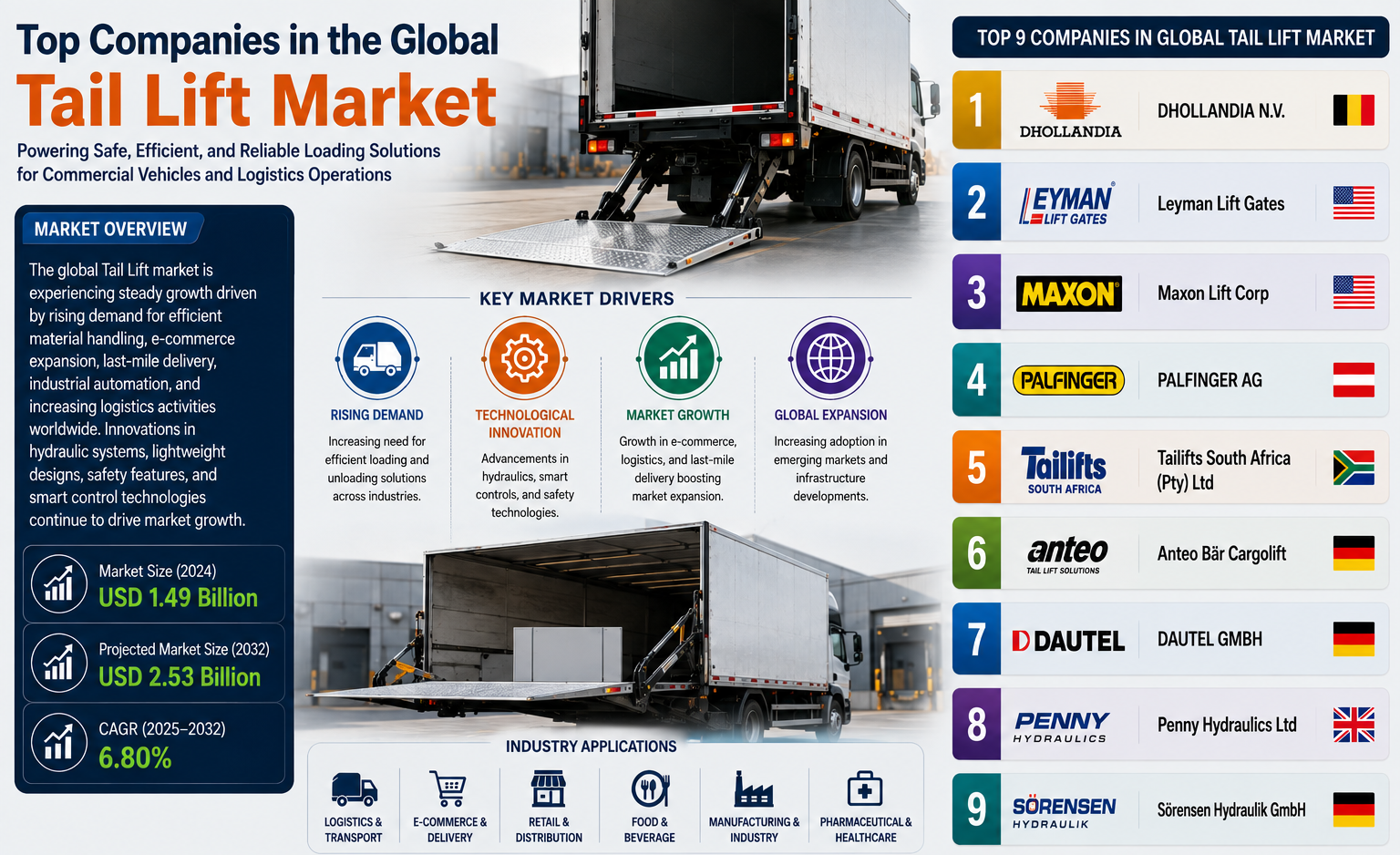
Top 10 Leading Companies in the Global Tail Lift Market
The global Tail Lift market has grown from a niche mechanical accessory category into an indispensable enabler of modern last-mile logistics, cargo handling, and commercial vehicle operations. As e-commerce volumes climb, urban delivery fleets expand, and workplace safety regulations tighten around manual material handling, tail lifts have become a near-standard fitment on light and heavy commercial vehicles across food distribution, waste management, emergency services, and rental fleets.
According to Intellectual Market Insights Research, the Tail Lift market was valued at approximately USD 2.85 Billion in 2025 and is projected to grow at a CAGR of 7.3%, reaching USD 5.39 Billion by 2034. This steady, structurally grounded growth trajectory is being driven by rising cross-border and intra-city freight movement, growth in cold-chain and food distribution, expanding waste management fleets, and continuous mechanical and hydraulic innovation among established European lift manufacturers.
North America and Europe together account for a substantial share of global demand in 2025, supported by dense logistics networks, strict occupational safety standards, and mature commercial vehicle fleets that increasingly specify tail lifts as standard equipment. Meanwhile, Asia-Pacific is emerging as a fast-growing region, propelled by rising freight volumes, expanding organized retail and food distribution networks, and the modernization of municipal and logistics vehicle fleets in China, India, and Southeast Asia.
Market Overview
|
Parameter |
Details |
|---|---|
|
Market Size (2025) |
USD 2.85 Billion |
|
Projected Market Size (2034) |
USD 5.39 Billion |
|
CAGR (2025–2034) |
7.3% |
|
Leading Region (2025) |
North America |
|
Fast-Growing Region |
Asia-Pacific |
|
Leading Type Segment |
Cantilever Lifts |
|
Leading Application Segment |
Transport & Logistics |
|
Fastest-Growing Application |
Waste Management |
|
Key Growth Drivers |
E-commerce and last-mile delivery growth, cold-chain expansion, workplace safety regulation, fleet modernization |
|
Key Challenges |
High upfront and maintenance cost, added vehicle weight and payload trade-offs, retrofit complexity |
|
Major Players |
DHOLLANDIA N.V., Leyman Lift Gates, Maxon Lift Corp, PALFINGER AG, Tailifts South Africa (Pty) Ltd, Anteo Bär Cargolift, DAUTEL GMBH, Penny Hydraulics Ltd, Sörensen Hydraulik GmbH, MBB Liftsystems GmbH |
|
Forecast Period |
2025–2034 (Intellectual Market Insights Research) |
|
Study Period |
2015–2034 |
|
Report ID |
IMI-000558 |
Why the Tail Lift Market Is Growing
1. Rapid Expansion of E-Commerce and Last-Mile Delivery
The single biggest structural driver of tail lift demand is the continued global expansion of e-commerce and the last-mile delivery networks that support it. Delivery fleets increasingly rely on tail lifts to safely and efficiently move heavy or bulky parcels, pallets, and appliances between the vehicle bed and ground level without depending on loading docks. As parcel volumes rise and delivery windows compress, fleet operators are specifying tail lifts on a growing share of new light and medium commercial vehicles to reduce loading time and manual handling risk.
2. Tightening Workplace and Occupational Safety Regulations
Regulatory bodies across Europe and North America are enforcing stricter manual handling and occupational safety standards that limit the weight employees can lift or lower by hand. Tail lifts directly address this compliance requirement by mechanizing the loading and unloading process, reducing musculoskeletal injury claims and insurance costs for fleet operators. This regulatory pressure is particularly strong in food distribution, waste management, and municipal services, where repetitive heavy lifting has historically been a major source of workplace injury.
3. Growth of Cold-Chain and Food Distribution Networks
The expansion of temperature-controlled food and beverage distribution is a significant demand driver, since cold-chain delivery vehicles routinely handle heavy, palletized loads that require mechanized lifting to preserve delivery speed and product integrity. Supermarket chains, foodservice distributors, and beverage companies increasingly equip their delivery fleets with column and cantilever tail lifts to accelerate multi-drop delivery routes while minimizing product damage from manual handling.
4. Fleet Modernization and Replacement Cycles
Aging commercial vehicle fleets across mature markets are being replaced with newer vehicles that come factory-fitted or retrofitted with lighter, more durable, and more energy-efficient tail lift systems. Advances in aluminum platform construction and electro-hydraulic drive systems are reducing the added weight and power draw of tail lifts, easing a historical trade-off between payload capacity and lifting convenience that had previously discouraged adoption on smaller vehicles.
5. Expansion of Waste Management and Municipal Services
Municipal waste collection, recycling, and local authority services represent a growing and increasingly mechanized application segment. Rising urban waste volumes and stricter labor-safety mandates are prompting municipalities and waste management contractors to expand their use of tail lifts and specialized lifting equipment on collection vehicles, supporting steady demand from public-sector and utility fleets.
6. Rise of Vehicle Leasing and Rental Fleets
The growth of commercial vehicle leasing and rental businesses is expanding the addressable market for tail lifts, as rental operators increasingly equip their fleets with lifting equipment to serve a broader range of business customers without requiring aftermarket retrofits. This trend is particularly pronounced in markets with high fleet-as-a-service adoption, where rental fleet standardization around tail-lift-equipped vehicles is becoming a competitive differentiator.
Top 10 Companies in the Global Tail Lift Market
- DHOLLANDIA N.V. (Belgium)
- PALFINGER AG (Austria)
- Maxon Lift Corp (U.S.)
- Sörensen Hydraulik GmbH (Germany)
- DAUTEL GMBH (Germany)
- Anteo Bär Cargolift (Italy / Germany)
- Penny Hydraulics Ltd (U.K.)
- Leyman Lift Gates (U.S.)
- Tailifts South Africa (Pty) Ltd (South Africa)
- MBB Liftsystems GmbH (Germany)
Company Profiles
1. DHOLLANDIA N.V. (Belgium)
Headquarters: Kortrijk, Belgium Industry Focus: Cantilever, Column & Slider Tail Lifts for Commercial Vehicles Global Presence: 100+ countries through a dealer and distributor network
Company Overview: DHOLLANDIA is one of the world's largest independent tail lift manufacturers, producing a full range of cantilever, column, slider, and tuck-away lift systems for vans, trucks, and trailers. Founded in Belgium, the company has built its reputation on engineering robustness and an extensive global service and spare-parts network, making it a preferred choice for fleet operators who prioritize uptime and long service life.
Key Products and Services: DHOLLANDIA's product range spans the DH-LM and DH-LSU cantilever lift series, DH-VT and DH-VTL column lift ranges for van applications, and slider tail-lift systems designed for retrofit onto a wide variety of chassis. The company also offers hydraulic power pack solutions, spare parts distribution, and vehicle-builder integration support.
Market Position: DHOLLANDIA holds a leading position in the European tail lift market and has expanded its footprint substantially into North America, the Middle East, and Asia-Pacific through OEM and body-builder partnerships. Its broad type coverage across cantilever, column, and slider categories gives it flexibility to serve nearly every commercial vehicle segment.
Strategic Advantages: Extensive independent distribution and service network; broad product range spanning nearly all lift types; strong OEM and vehicle-body-builder relationships; reputation for mechanical durability in demanding logistics and municipal applications.
2. PALFINGER AG (Austria)
Headquarters: Bergheim, Austria Industry Focus: Hydraulic Lifting and Handling Systems, including Tail Lifts Global Presence: 130+ countries
Company Overview: PALFINGER is a global leader in hydraulic lifting, loading, and handling equipment, with tail lifts forming part of a much broader portfolio that includes truck-mounted cranes, forestry and recycling cranes, and railway systems. This diversified engineering base gives PALFINGER significant scale, R&D capacity, and cross-segment hydraulic expertise that it applies to its tail lift and loading-system offerings, primarily through its MBB Liftsystems and Ratcliff brands.
Key Products and Services: PALFINGER's tail-lift-related portfolio includes column and cantilever lift systems, integrated loading solutions for refrigerated and dry-freight vehicles, and telematics-enabled service and maintenance monitoring for fleet customers.
Market Position: PALFINGER's scale, global brand recognition, and diversified hydraulic engineering base position it as one of the most financially resilient competitors in the tail lift space, able to invest in R&D and global service infrastructure that smaller specialist manufacturers cannot easily match.
Strategic Advantages: Large-scale global manufacturing and R&D capacity; cross-segment hydraulic engineering expertise; strong brand recognition among commercial fleet buyers; integrated telematics and service offerings supporting fleet uptime.
3. Maxon Lift Corp (U.S.)
Headquarters: La Mirada, California, USA Industry Focus: Liftgates for Commercial Trucks and Trailers Global Presence: North America, with export presence in Latin America and Asia-Pacific
Company Overview: Maxon Lift Corp is one of the longest-established liftgate manufacturers in North America, with decades of experience supplying cantilever and slider liftgates for delivery trucks, box trucks, and trailers. The company's deep relationships with North American truck body builders and fleet operators make it a central player in the region's tail lift ecosystem.
Key Products and Services: Maxon's product line includes the GPT and TE series cantilever liftgates, slider liftgates for high-cube trailers, and rail-style liftgates designed for heavy-duty freight and beverage distribution applications.
Market Position: Maxon holds a leading position in the North American liftgate market, particularly within food and beverage distribution and general freight applications, supported by an extensive dealer and service network across the United States and Canada.
Strategic Advantages: Deep-rooted relationships with North American truck body builders; strong brand recognition in the U.S. beverage and food distribution segment; established dealer and aftermarket service network; decades of application-specific engineering experience.
4. Sörensen Hydraulik GmbH (Germany)
Headquarters: Neumünster, Germany Industry Focus: Hydraulic Tail Lifts and Loading Systems Global Presence: Europe, with growing exports to the Middle East and Asia-Pacific
Company Overview: Sörensen Hydraulik is a specialist German manufacturer known for its engineering precision in column and cantilever tail lift systems for trucks and trailers, with particular strength in heavy-duty and specialized municipal and emergency-service vehicle applications.
Key Products and Services: The company's offering includes column lift systems for heavy trucks, cantilever platforms for general freight, and customized lifting solutions engineered for municipal, waste management, and emergency-service vehicle fleets.
Market Position: Sörensen holds a strong niche position in the German and broader European market, particularly among fleet operators requiring heavy-duty, application-specific lift engineering rather than standardized off-the-shelf systems.
Strategic Advantages: Strong engineering reputation in heavy-duty and specialized applications; deep penetration in the German municipal and utility vehicle segment; customization capability for demanding end-use applications.
5. DAUTEL GMBH (Germany)
Headquarters: Bad Friedrichshall, Germany Industry Focus: Column and Cantilever Tail Lift Systems Global Presence: Europe, Middle East, and select Asia-Pacific markets
Company Overview: DAUTEL is a long-established German manufacturer of column and cantilever tail lifts recognized for durable, application-tailored designs used across food distribution, general freight, and municipal service fleets. The company has built a strong reputation within the European vehicle body-building industry as a reliable OEM-integration partner.
Key Products and Services: DAUTEL's portfolio includes the DH-C column lift range, cantilever platform systems for medium and heavy trucks, and lift systems engineered specifically for refrigerated and food-distribution vehicle bodies.
Market Position: DAUTEL maintains a solid mid-tier position in the European tail lift market, competing on engineering quality and body-builder integration rather than scale, with particular strength in Germany, Austria, and neighboring markets.
Strategic Advantages: Strong reputation for build quality and reliability; well-established body-builder and OEM integration relationships; focused engineering expertise in column and cantilever systems for food and general freight applications.
Competitive Landscape
The global Tail Lift market in 2026 is moderately fragmented, dominated by a group of specialist European and North American manufacturers with deep hydraulic and mechanical engineering expertise, rather than by large diversified industrial conglomerates.
Market Structure
The competitive set includes broad-range independent lift manufacturers (DHOLLANDIA, PALFINGER/MBB), regionally dominant specialists (Maxon Lift in North America, Tailifts South Africa in Southern Africa), and heavy-duty and application-focused engineering firms (Sörensen Hydraulik, DAUTEL, Anteo Bär Cargolift). This structure has allowed multiple mid-sized players to sustain strong regional positions rather than converging around one or two global leaders.
Body-Builder and OEM Relationships as a Competitive Battleground
Because tail lifts are typically integrated during vehicle body-building rather than sold as standalone consumer products, long-standing relationships with commercial vehicle body builders and fleet OEMs represent one of the most important competitive assets in the market. Manufacturers with the deepest integration into body-builder supply chains, such as DHOLLANDIA and DAUTEL in Europe and Maxon in North America, benefit from strong repeat-specification advantages that are difficult for new entrants to displace.
Weight Reduction and Hydraulic Efficiency as Differentiators
As fleet operators increasingly weigh payload capacity against lifting convenience, manufacturers are competing intensely on reducing the added weight of lift systems through aluminum platform construction and more efficient electro-hydraulic drive systems, while maintaining lifting capacity and durability. Companies that achieve the best weight-to-capacity ratio are gaining preference among light commercial vehicle and van-based delivery fleets.
Service Network Breadth
Given that tail lift downtime directly disrupts delivery and logistics operations, the breadth and responsiveness of a manufacturer's spare-parts and service network has become a decisive competitive factor, particularly for large fleet customers negotiating multi-year supply agreements.
Regional Analysis
North America Leading Region (2025)
North America holds a leading share of the global tail lift market in 2025, supported by extensive last-mile delivery and food and beverage distribution networks, mature occupational safety regulation, and high fleet renewal rates. The U.S. is the dominant national market, with strong demand from parcel delivery, foodservice distribution, and municipal service fleets.
Europe Strong Regulatory-Driven Demand
Europe represents a mature and steadily growing tail lift market, led by Germany, the U.K., France, and the Benelux countries, home to several of the industry's leading manufacturers. Strict EU occupational safety and manual handling regulations, combined with dense urban delivery networks, continue to support consistent replacement and new-fitment demand.
Asia-Pacific Fastest-Growing Region
Asia-Pacific is the fastest-growing tail lift region, driven by rising freight and parcel volumes, the expansion of organized retail and cold-chain distribution, and modernization of municipal and logistics fleets in China, India, Japan, and South Korea. Rising labor costs in the region are also accelerating the shift from manual to mechanized loading.
Middle East and Africa Emerging Growth
The MEA region is an emerging tail lift market, with South Africa a notable hub supported by domestic manufacturer Tailifts South Africa, alongside growing demand from logistics and municipal fleets in the Gulf states as regional infrastructure and retail distribution networks expand.
Latin America Developing Market
Latin America is a developing market for tail lifts, with Brazil, Mexico, and Argentina leading adoption as e-commerce penetration rises and formalized logistics and food-distribution networks expand across the region.
Segmentation Analysis
By Type
Cantilever Lifts hold the leading share of the tail lift type segment, valued for their simple mechanical design, relatively lower cost, and suitability across a wide range of medium and heavy commercial vehicles. Column Lifts are widely used on heavier trucks requiring higher lifting capacities and are common in food distribution and general freight applications. Slider Tail-Lifts, which retract fully under the vehicle bed when not in use, are gaining preference on high-cube trailers where maximizing usable load space is critical. Tuck Away Lifts and standard Tail Lift configurations serve specialized retrofit and lighter-duty applications respectively.
By Application
Transport & Logistics represents the leading application segment, reflecting the central role of tail lifts in general freight and parcel delivery operations. Food distribution is a major application area, driven by cold-chain and multi-drop delivery requirements that demand fast, safe unloading. Waste Management and Local Authorities represent a fast-growing application segment as municipalities mechanize collection and service operations to meet safety mandates. Leasing and Rental Business fleets are increasingly specifying tail-lift-equipped vehicles to serve a broader commercial customer base, while Emergency Services use specialized lift configurations for equipment and stretcher loading in ambulance and rescue vehicle applications.
Key Industry Developments
2025 Expansion of Aluminum and Lightweight Platform Systems Leading manufacturers including DHOLLANDIA and DAUTEL have continued expanding their aluminum-platform product lines, reducing added vehicle weight while preserving lifting capacity, a development aimed at easing the payload trade-off that has historically limited tail lift adoption on smaller commercial vehicles.
2025–2026 Growth of Cold-Chain-Optimized Lift Systems Manufacturers serving the food and beverage distribution segment have introduced lift systems specifically engineered for refrigerated vehicle bodies, addressing the sector's need for fast, temperature-preserving multi-drop deliveries.
2025–2026 Expansion of Telematics-Enabled Service Monitoring Larger players, including PALFINGER through its MBB Liftsystems brand, are integrating telematics and remote diagnostics capabilities into lift systems, enabling predictive maintenance and reducing unplanned downtime for large fleet customers.
2026 Continued Regional Manufacturing Expansion Several established European and North American manufacturers have continued expanding regional manufacturing and service footprints in Asia-Pacific and the Middle East to serve rising demand from logistics and municipal fleets in those regions.
Market Dynamics
Market Driver E-Commerce, Cold-Chain, and Safety Regulation
The combination of rising e-commerce and last-mile delivery volumes, expanding cold-chain distribution, and tightening occupational safety regulation is the primary structural driver supporting sustained tail lift demand across mature and developing markets alike.
Market Restraint High Upfront Cost and Payload Trade-Offs
The most significant restraint remains the high upfront and maintenance cost of tail lift systems relative to smaller commercial vehicles, combined with the added weight that can reduce usable payload capacity. This trade-off remains a meaningful barrier for cost-sensitive fleet operators and owner-operators of light commercial vehicles.
Market Opportunity Fleet Electrification and Municipal Modernization
The parallel trends of commercial vehicle electrification and municipal fleet modernization present a significant long-term opportunity, as electric vehicle platforms and newly procured municipal fleets present a natural specification point for lightweight, energy-efficient tail lift systems designed from the outset for integration with electric drivetrains.
Future Outlook 2025–2034
The global Tail Lift market is on track for steady, structurally grounded growth, expanding from USD 2.85 Billion in 2025 to USD 5.39 Billion by 2034, driven by the continued expansion of last-mile logistics, cold-chain distribution, municipal fleet mechanization, and workplace safety regulation across both mature and developing regions.
Growth Projections
Cantilever lifts will continue to lead the type segment given their cost-effectiveness and broad vehicle compatibility, while slider systems gain share on high-cube trailer applications. Transport and logistics will remain the leading application, with waste management and municipal services representing the fastest-growing category as safety-driven mechanization continues. Asia-Pacific is expected to post the fastest regional growth as freight volumes and cold-chain infrastructure expand.
Investment Opportunities
The highest-value opportunities lie in lightweight aluminum and electro-hydraulic lift systems compatible with electric commercial vehicle platforms; telematics-enabled predictive maintenance offerings; cold-chain-optimized lift systems for food distribution; and expanded manufacturing and service infrastructure in Asia-Pacific and the Middle East, where fleet modernization is still in its early stages.
Industry Transformation
The tail lift industry is transitioning from a purely mechanical accessory category toward an increasingly connected, application-engineered component of the broader commercial vehicle and fleet management ecosystem, as electrification, telematics, and safety regulation reshape specification decisions across logistics, food distribution, and municipal fleets through the next decade.
FAQ Section
Q1: What is the current size of the global Tail Lift market?
The global Tail Lift market was valued at approximately USD 2.85 Billion in 2025 and is projected to grow at a CAGR of 7.3%, reaching USD 5.39 Billion by 2034, according to Intellectual Market Insights Research.
Q2: Which companies are the top leaders in the global Tail Lift market?
The top Tail Lift market companies include DHOLLANDIA N.V., PALFINGER AG, Maxon Lift Corp, Sörensen Hydraulik GmbH, DAUTEL GMBH, Anteo Bär Cargolift, Penny Hydraulics Ltd, Leyman Lift Gates, Tailifts South Africa (Pty) Ltd, and MBB Liftsystems GmbH.
Q3: Which region dominates the global Tail Lift market?
North America holds a leading position in the Tail Lift market in 2025, supported by extensive last-mile delivery and food distribution networks and mature occupational safety regulation, while Europe remains a mature, regulation-driven market home to several leading manufacturers.
Q4: What is the forecast CAGR for the Tail Lift market?
The global Tail Lift market is projected to grow at a CAGR of 7.3% during the forecast period from 2025 to 2034, according to Intellectual Market Insights Research (Report ID: IMI-000558).
Q5: What are the primary growth drivers of the Tail Lift market?
Key growth drivers include the expansion of e-commerce and last-mile delivery; tightening workplace and occupational safety regulation; growth in cold-chain and food distribution networks; commercial fleet modernization; expansion of waste management and municipal services; and growth of vehicle leasing and rental fleets.
Q6: Which type segment holds the largest share in the Tail Lift market?
Cantilever Lifts hold the largest share due to their cost-effective design and broad compatibility across medium and heavy commercial vehicles, though slider systems are gaining share on high-cube trailer applications.
Q7: Which application segment leads the Tail Lift market?
Transport & Logistics leads the application segment, reflecting the central role of tail lifts in general freight and parcel delivery, with Waste Management and Local Authorities representing the fastest-growing application category.
Q8: Which region is the fastest growing in the Tail Lift market?
Asia-Pacific is the fastest-growing region, driven by rising freight volumes, expanding cold-chain and organized retail distribution, and the modernization of municipal and logistics vehicle fleets in China, India, and Southeast Asia.
Q9: What is the major market trend in the Tail Lift market?
The dominant trend is the shift toward lightweight aluminum and electro-hydraulic lift systems designed to minimize added vehicle weight while supporting integration with electric commercial vehicle platforms, alongside growing adoption of telematics-enabled service monitoring.
Q10: What are the key challenges facing the Tail Lift market?
Primary challenges include the high upfront and maintenance cost of tail lift systems, the trade-off between added system weight and usable vehicle payload, and the complexity of retrofitting older vehicle fleets with modern lift systems.
Conclusion
The global Tail Lift market is on a steady, structurally supported growth path through 2034. What has long been a specialized mechanical accessory for logistics and commercial fleets is becoming an increasingly essential, and increasingly connected, component of last-mile delivery, cold-chain distribution, and municipal fleet operations. With a projected market value of USD 5.39 Billion by 2034, the tail lift industry represents a durable, safety- and efficiency-driven growth opportunity within the broader commercial vehicle equipment landscape.
The top companies profiled in this analysis reflect the market's specialist, engineering-led competitive character, from broad-range independents like DHOLLANDIA and diversified hydraulic leaders like PALFINGER, to regionally dominant specialists such as Maxon Lift Corp in North America and Tailifts South Africa in Southern Africa, and application-focused German engineering firms like Sörensen Hydraulik and DAUTEL.
What unites these market leaders is a shared focus on durability, body-builder integration, and service network strength, and increasingly, on lightweight and electrification-ready lift systems that will define competitiveness as commercial fleets modernize over the coming decade.