
Top 10 Companies in the Terminal Blocks Market Driving Industry Growth in 2026
Author:
Intellectual Market Insights Research
Published Date:
05 Aug 2026
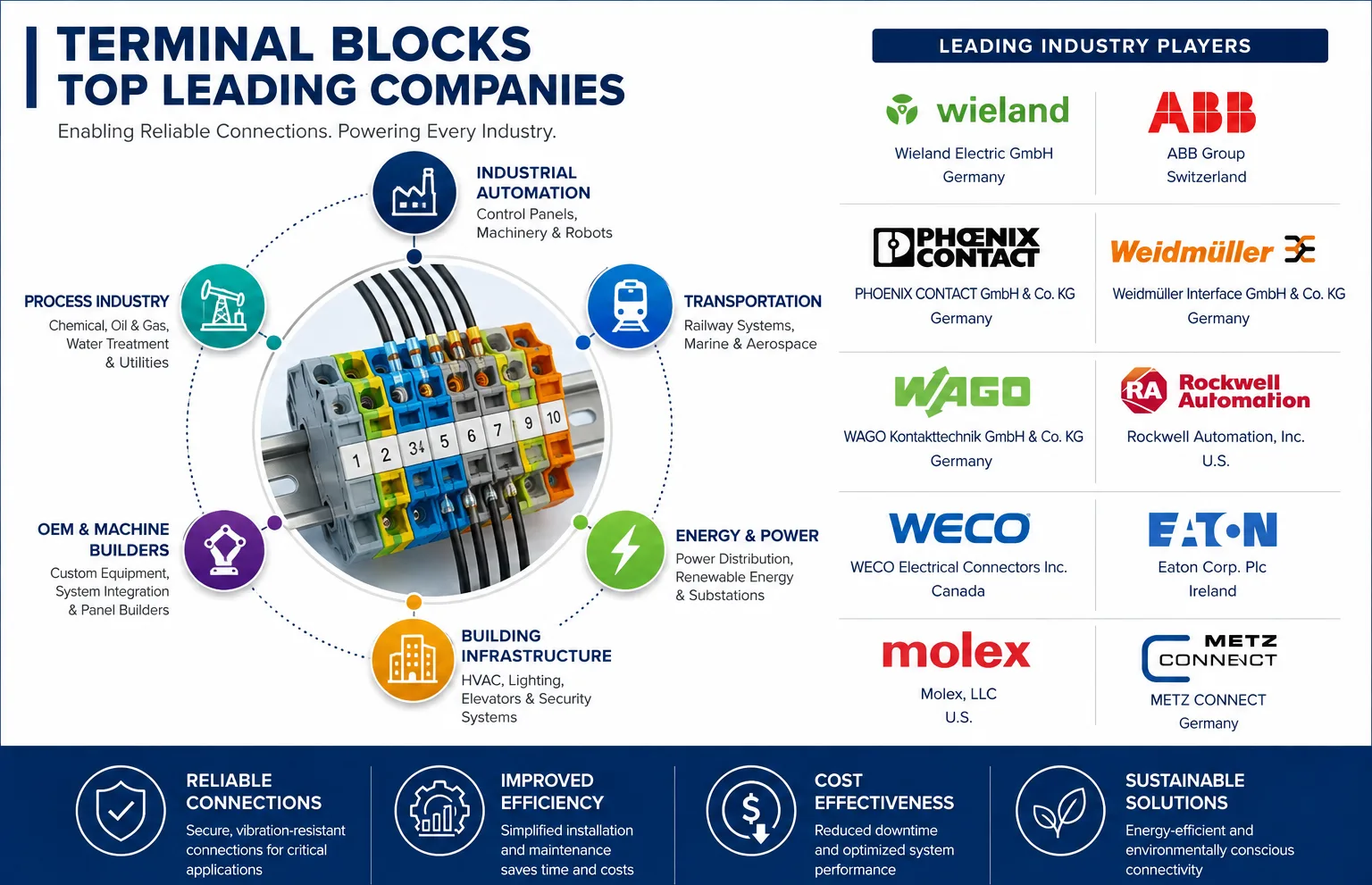
Top 10 Companies in the Terminal Blocks Market Driving Industry Growth in 2026
Terminal blocks are among the most fundamental yet indispensable components in electrical and electronic systems, forming the connection points that join, secure, and isolate wiring across industrial control panels, power distribution boards, transportation systems, telecom infrastructure, and building automation networks. Though simple in concept, terminal blocks are engineered to exacting standards for current rating, insulation, vibration resistance, and ease of maintenance making them a quietly essential enabler of industrial automation, renewable energy, and electrification trends worldwide.
Download brochure link: https://www.intellectualmarketinsights.com/report/terminal-blocks-market-size/imi-000562
The global Terminal Blocks market was valued at approximately USD 3.56 billion in 2025 and is projected to reach USD 5.07 billion by 2034, expanding at a compound annual growth rate (CAGR) of 4.01% over the forecast period, according to Intellectual Market Insights Research. This growth trajectory reflects rising investment in industrial automation, the expansion of renewable energy and EV infrastructure, and the steady modernization of power distribution and telecom networks across both developed and emerging economies.
Terminal blocks compete less on the base function reliably joining conductors and more on connection technology, mounting flexibility, current/voltage rating, and integration with modern panel-building workflows. Spring clamp and push-in connection technologies are steadily gaining ground over traditional screw-type designs, driven by demand for faster, tool-less panel assembly in factories and control-room retrofits.
Understanding which companies lead this foundational yet fast-evolving market is essential for panel builders, OEMs, distributors, and industry analysts. This article provides a research-based analysis of the top companies in the global terminal blocks market, their positioning, flagship products, and the regional and technological forces shaping the competitive landscape.
Market Overview
|
Parameter |
Details |
|---|---|
|
Market Size (2025) |
USD 3.56 Billion |
|
Projected Market Size (2034) |
USD 5.07 Billion |
|
CAGR (2025–2034) |
4.01% |
|
Base Year |
2025 |
|
Forecast Period |
2025–2034 |
|
Leading Consumption Region |
North America |
|
Fastest-Growing Region |
Asia-Pacific |
|
Key Growth Drivers |
Industrial automation investment, renewable energy and EV infrastructure buildout, telecom and data-center expansion, growing preference for push-in/spring clamp connections |
|
Key Challenges |
Commoditization and price pressure in standard segments, raw material (copper, thermoplastics) cost volatility, competition from low-cost regional manufacturers |
|
Key Opportunities |
Smart/IoT-enabled terminal blocks, modular panel-building systems, growth in EV charging and battery storage infrastructure |
Why the Terminal Blocks Market Is Growing
1. Expanding Industrial Automation and Panel Building
The continued rollout of automated production lines, robotics, and smart factories is driving sustained demand for reliable, standardized wiring connection points. Panel builders increasingly favor terminal block systems that reduce assembly time while meeting rising safety and traceability requirements.
2. Renewable Energy and EV Infrastructure Buildout
Solar farms, wind installations, battery energy storage systems, and EV charging networks all rely heavily on ruggedized terminal blocks capable of handling higher voltages and currents, positioning the market as a direct beneficiary of the global energy transition.
3. Shift Toward Push-in and Spring Clamp Connection Technologies
Panel builders are moving away from traditional screw-type terminals toward tool-less spring clamp and push-in designs that cut installation time and improve connection consistency, particularly in high-volume machine-building and control-panel applications.
4. Telecom and Data Center Expansion
The build-out of 5G infrastructure, fiber networks, and hyperscale data centers is generating steady demand for terminal blocks engineered for high-density, low-maintenance connectivity in telecom equipment racks and cabinets.
5. Growth in Transportation and Rail Electrification
Rail, mass transit, and increasingly electrified commercial vehicle platforms require vibration- and temperature-resistant terminal block designs, opening a differentiated, higher-margin segment for manufacturers with transportation-grade certifications.
6. Modernization of Aging Power Distribution Infrastructure
Utilities and industrial facilities across North America and Europe are replacing legacy wiring systems with modern, modular terminal block assemblies that improve maintenance efficiency and support digital monitoring integration.
Top 10 Companies in the Terminal Blocks Market
- Wieland Electric GmbH (Germany)
- ABB Group (Switzerland)
- PHOENIX CONTACT GmbH & Co. KG (Germany)
- Weidmüller Interface GmbH & Co. KG (Germany)
- WAGO Kontakttechnik GmbH & Co. KG (Germany)
- Rockwell Automation, Inc. (U.S.)
- WECO Electrical Connectors Inc. (Canada)
- Eaton Corp. Plc (Ireland)
- Molex, LLC (U.S.)
- METZ CONNECT (Germany)
1. Wieland Electric GmbH
|
Category |
Details |
|---|---|
|
Company Name |
Wieland Electric GmbH |
|
Headquarters |
Bamberg, Germany |
|
Founded |
1910 |
|
Employees |
3,000+ |
|
Revenue (2024) |
Approx. USD 700 Million |
|
Company Overview |
Wieland Electric is a long-established German manufacturer specializing in electrical connection technology, industrial switchgear, and safety automation, with terminal blocks forming a core part of its connectivity portfolio. |
|
Key Products |
GESIS modular connection systems, WKN/WK screw and spring-clamp terminal blocks, push-in rail-mount terminals. |
|
Market Position |
A recognized specialist in connection and safety technology with strong penetration across European industrial and building automation markets. |
|
Recent Developments |
Continued expansion of tool-less push-in terminal block lines aimed at faster panel assembly. |
|
Strategic Advantages |
Deep engineering heritage, strong OEM relationships, and a broad portfolio spanning connectors, relays, and safety systems alongside terminal blocks. |
2. ABB Group
|
Category |
Details |
|---|---|
|
Company Name |
ABB Group |
|
Headquarters |
Zurich, Switzerland |
|
Founded |
1988 (merger of ASEA and BBC) |
|
Employees |
100,000+ (group-wide) |
|
Revenue (2024) |
Approx. USD 32 Billion (group-wide) |
|
Company Overview |
ABB is a global technology leader in electrification and automation, offering terminal blocks as part of its broader low-voltage products and installation systems division serving industrial, utility, and commercial customers. |
|
Key Products |
Entrelec and ABB-branded feed-through, ground, and fuse terminal blocks; disconnect and knife-disconnect terminal ranges. |
|
Market Position |
A top-tier global player leveraging its scale, brand strength, and integrated automation and electrification portfolio. |
|
Recent Developments |
Continued investment in digital and IoT-enabled connectivity components to complement its smart panel and automation offerings. |
|
Strategic Advantages |
Global manufacturing and distribution footprint, strong brand equity, and cross-selling opportunities across ABB's electrification and automation businesses. |
3. PHOENIX CONTACT GmbH & Co. KG
|
Category |
Details |
|---|---|
|
Company Name |
PHOENIX CONTACT GmbH & Co. KG |
|
Headquarters |
Blomberg, Germany |
|
Founded |
1923 |
|
Employees |
22,000+ |
|
Revenue (2024) |
Approx. USD 3.5 Billion |
|
Company Overview |
Phoenix Contact is widely regarded as a pioneer and category leader in terminal block technology, having introduced early spring-clamp and modular DIN-rail terminal designs that remain industry benchmarks. |
|
Key Products |
CLIPLINE complete terminal block system, PT/ST spring-clamp terminals, push-in and screw-type DIN-rail terminal blocks. |
|
Market Position |
Consistently ranked among the top global terminal block suppliers, with particularly strong recognition for connection-technology innovation. |
|
Recent Developments |
Ongoing expansion of push-in and hybrid connection technology lines targeting faster panel-building workflows. |
|
Strategic Advantages |
Strong innovation pipeline, extensive DIN-rail ecosystem compatibility, and deep relationships with panel builders and machine OEMs worldwide. |
4. Weidmüller Interface GmbH & Co. KG
|
Category |
Details |
|---|---|
|
Company Name |
Weidmüller Interface GmbH & Co. KG |
|
Headquarters |
Detmold, Germany |
|
Founded |
1850 |
|
Employees |
5,000+ |
|
Revenue (2024) |
Approx. USD 1.2 Billion |
|
Company Overview |
Weidmüller is a leading provider of electrical connectivity and automation products, with terminal blocks representing one of its longest-standing and most recognized product lines. |
|
Key Products |
Klippon Connect terminal block series, push-in and spring-clamp rail terminals, thermocouple and sensor-specific terminal blocks. |
|
Market Position |
A well-established global player with strong presence across industrial automation, energy, and transportation end markets. |
|
Recent Developments |
Continued digitalization of connectivity products, including terminal blocks integrated with condition-monitoring capability. |
|
Strategic Advantages |
Long operating history, broad industry certifications, and strength in specialized segments such as rail and marine applications. |
5. WAGO Kontakttechnik GmbH & Co. KG
|
Category |
Details |
|---|---|
|
Company Name |
WAGO Kontakttechnik GmbH & Co. KG |
|
Headquarters |
Minden, Germany |
|
Founded |
1951 |
|
Employees |
9,000+ |
|
Revenue (2024) |
Approx. USD 1.4 Billion |
|
Company Overview |
WAGO is best known for pioneering spring-clamp (cage clamp) connection technology, which has become a widely adopted alternative to traditional screw-type terminal blocks across industrial and building installation markets. |
|
Key Products |
WAGO TOPJOB S rail-mount terminal blocks, 2- and 3-conductor push-wire connectors, PCB-mount spring-clamp terminals. |
|
Market Position |
A market leader in spring-clamp and push-in terminal block technology, with strong penetration in both industrial and electrical installation segments. |
|
Recent Developments |
Expansion of tool-less connection ranges aimed at reducing panel-building labor time. |
|
Strategic Advantages |
Strong patent and technology leadership in spring-clamp connectivity, broad global distribution, and high brand recognition among electricians and panel builders. |
Competitive Landscape
The global terminal blocks market is moderately consolidated, with German connectivity specialists Phoenix Contact, Weidmüller, and WAGO, alongside diversified electrification majors ABB and Eaton, commanding a significant combined share, while Wieland Electric, Rockwell Automation, WECO, Molex, and METZ CONNECT compete for the remaining volume.
Technology-Led Differentiation: Unlike many commodity electrical components, terminal block competition increasingly centers on connection technology spring clamp, push-in, and hybrid designs rather than price alone, allowing technology leaders to sustain premium positioning on advanced product lines.
DIN-Rail Ecosystem Lock-In: Leading manufacturers benefit from strong ecosystem effects, as panel builders standardize on a given brand's DIN-rail accessories, marking systems, and mounting components, reinforcing customer retention beyond the terminal block itself.
Regional and Application Specialists: Beyond the global majors, players such as WECO and METZ CONNECT maintain strong positions in specific regional or application niches through targeted certifications and localized support.
Diversification as Risk Management: Large diversified players including ABB, Eaton, Rockwell Automation, and Molex have embedded terminal blocks within broader automation, electrification, and interconnect portfolios, reducing reliance on the category alone and enabling cross-selling across industrial customers.
Regional Analysis
North America
North America remains the largest revenue-generating region, supported by strong industrial automation investment, ongoing power-grid modernization, and robust demand from the oil & gas and transportation sectors.
Europe
Germany, home to several of the market's leading manufacturers, along with the U.K., France, and Italy, continues to drive steady demand through advanced manufacturing, renewable energy installations, and strict industrial safety standards.
Asia-Pacific
APAC is expected to register the fastest growth, propelled by rapid industrialization, expanding electronics and EV manufacturing in China, and growing infrastructure and automation investment in India, Japan, and South Korea.
Latin America
Brazil and Mexico are seeing gradual growth in demand, tied to expanding manufacturing capacity and grid infrastructure investment across the region.
Middle East and Africa
Investment in power infrastructure, oil & gas facilities, and industrial diversification projects in Saudi Arabia and the UAE is generating incremental demand for ruggedized terminal block solutions.
Emerging Trends in the Terminal Blocks Market
1. Push-In and Tool-Less Connection Technology: Continued migration from screw-type to push-in and spring-clamp designs is reducing panel-assembly labor time and improving connection reliability.
2. Smart and IoT-Enabled Terminal Blocks: Manufacturers are piloting terminal blocks with integrated condition-monitoring and diagnostic capability to support predictive maintenance in industrial settings.
3. Growth in EV and Battery Storage Applications: Higher-current, higher-voltage terminal block variants are being developed specifically for EV charging infrastructure and battery energy storage systems.
4. Modular and Configurable Panel Systems: Demand is rising for modular terminal block platforms that allow panel builders to mix connection types, accessories, and marking systems within a single standardized rail ecosystem.
5. Sustainability-Focused Materials: Leading manufacturers are exploring halogen-free and recyclable thermoplastic housings to meet tightening environmental and building-material regulations.
Future Outlook (2025–2034)
The global terminal blocks market's trajectory toward USD 5.07 billion by 2034 reflects a durable combination of industrial automation investment, energy-transition infrastructure buildout, and steady modernization of power and telecom networks. The 4.01% CAGR forecast through 2034 assumes continued adoption of push-in and spring-clamp connection technologies, along with growing integration of smart, diagnostics-enabled terminal blocks in industrial settings.
Key investment themes include the scaling of tool-less connection technology, growth in EV charging and battery storage applications, and continued diversification by large electrification and automation conglomerates into terminal blocks as part of broader connectivity portfolios. Leading companies Phoenix Contact, WAGO, and Weidmüller are likely to retain technology leadership, while diversified majors ABB, Eaton, and Rockwell Automation continue to leverage scale and cross-portfolio distribution to compete for incremental share.
Frequently Asked Questions (FAQ)
1. What is the current size of the global terminal blocks market?
The global terminal blocks market was valued at approximately USD 3.56 billion in 2025 and is projected to reach USD 5.07 billion by 2034, growing at a CAGR of 4.01%.
2. Who are the top companies in the terminal blocks market?
Leading companies include Wieland Electric GmbH, ABB Group, PHOENIX CONTACT, Weidmüller Interface, WAGO Kontakttechnik, Rockwell Automation, WECO Electrical Connectors, Eaton Corp. Plc, Molex LLC, and METZ CONNECT.
3. Which region leads the terminal blocks market?
North America currently leads in revenue terms, while Asia-Pacific is expected to be the fastest-growing region through 2034, driven by rapid industrialization in China and India.
4. What is the forecast CAGR for the terminal blocks market?
The market is forecast to grow at a CAGR of 4.01% from 2025 to 2034.
5. What are the main growth drivers for this market?
Key drivers include expanding industrial automation, renewable energy and EV infrastructure buildout, telecom and data-center expansion, and the shift toward push-in and spring-clamp connection technologies.
6. What challenges does the terminal blocks industry face?
The industry faces commoditization and price pressure in standard product segments, raw material cost volatility, and competition from low-cost regional manufacturers.
7. Are smart, IoT-enabled terminal blocks gaining traction?
Yes. Growing demand for predictive maintenance and industrial digitalization is pushing manufacturers to develop terminal blocks with integrated monitoring and diagnostic capability.
Conclusion
The global terminal blocks market sits at the intersection of foundational industrial infrastructure and accelerating automation and electrification trends. With a projected size of USD 5.07 billion by 2034 at a 4.01% CAGR, the sector continues to offer steady, technology-driven growth even as competition intensifies around connection-technology innovation and panel-building efficiency.
Companies led by Phoenix Contact, WAGO, and Weidmüller are not just defending market share they are actively advancing connection technology and digital integration to differentiate beyond commodity pricing, while diversified majors ABB, Eaton, Rockwell Automation, and Molex leverage scale and cross-portfolio distribution. The manufacturers that successfully balance connection-technology leadership, ecosystem strength, and expanding application in energy-transition infrastructure will define market leadership through 2034 and beyond.