
Get the Complete Wearable Medical Devices Analysis: Global Trends, Companies, Opportunities
Author:
Intellectual Market Insights Research
Published Date:
24 Sep 2026
Executive Summary
Wearable medical devices are transforming how health information is collected, monitored and used. Unlike conventional medical equipment that is primarily used in hospitals or clinics, wearable technologies can continuously collect physiological data while patients carry out normal daily activities.
The market includes devices such as continuous glucose monitors, wearable ECG systems, connected blood-pressure monitoring devices, wearable defibrillators, therapeutic wearables, biosensors and other connected medical technologies.
Market forecasts vary considerably depending on the definition of "wearable medical devices." For example, Fortune Business Insights estimates the global market at $103.04 billion in 2025, projecting $505.28 billion by 2034, while Grand View Research projects $168.29 billion by 2030. These estimates should not be compared directly without examining each provider's market scope and methodology.
The broader opportunity is being shaped by continuous monitoring, remote patient monitoring, chronic disease management, miniaturized sensors, connectivity, artificial intelligence and increasing integration between wearable devices and healthcare systems.
What Are Wearable Medical Devices?
Wearable medical devices are electronic or sensor-enabled devices designed to be worn on or attached to the body to measure, monitor, diagnose, manage or support health-related conditions.
Examples include:
|
Device type |
Typical function |
Example application |
|
Continuous glucose monitors |
Glucose monitoring |
Diabetes management |
|
Wearable ECG monitors |
Cardiac monitoring |
Arrhythmia detection |
|
Pulse oximeters |
Oxygen saturation |
Respiratory monitoring |
|
Wearable blood-pressure devices |
Blood-pressure monitoring |
Hypertension management |
|
Wearable defibrillators |
Cardiac protection |
High-risk cardiac patients |
|
Biosensors |
Physiological measurement |
Clinical and research monitoring |
|
Therapeutic wearables |
Treatment/support |
Pain management and drug delivery |
The distinction between a consumer wearable and a medical device is important. A smartwatch feature that provides wellness information does not automatically have the same regulatory status or clinical purpose as a regulated medical device.
WHO describes medical devices broadly as products used for purposes including prevention, diagnosis, treatment, measurement or modification of health conditions.
Wearable Medical Devices Market Size and Forecast
There is no single universally accepted market figure because research firms define the category differently.
Fortune Business Insights currently estimates the global wearable medical devices market at $103.04 billion in 2025, with a forecast of $505.28 billion by 2034 and a reported CAGR of 20% for 2026–2034.
Grand View Research estimates the market will reach $168.29 billion by 2030, with a CAGR of 25.53% from 2025 to 2030.
An important research consideration is that these estimates should not be treated as contradictory evidence that one provider is necessarily wrong. Different studies may include different product categories, applications, distribution channels, geographic markets and definitions of medical versus consumer wearables.
How to interpret wearable medical device forecasts
Businesses evaluating the market should examine:
-
Base year
-
Forecast period
-
Product definition
-
Consumer versus clinical-grade inclusion
-
Geographic coverage
-
Revenue versus shipment methodology
-
Included applications
-
Data sources
-
Forecast assumptions
This methodological transparency is particularly important when market forecasts are used for investment, product strategy or competitive analysis.
Key Market Segments
The wearable medical devices industry can be analyzed across several dimensions.
By Product
Diagnostic and monitoring devices
These include:
-
Smart medical watches
-
ECG monitors
-
Continuous glucose monitors
-
Pulse oximeters
-
Wearable blood-pressure monitors
-
Smart clothing
-
Biosensors
Therapeutic devices
These include:
-
Wearable defibrillators
-
Drug-delivery systems
-
Pain-management devices
-
Hearing-related technologies
-
Other therapeutic wearables
By Application
Major applications include:
-
Remote patient monitoring
-
Home healthcare
-
Chronic disease management
-
Diabetes management
-
Cardiovascular monitoring
-
Sports and fitness
-
Preventive health
-
Clinical research
By Device Grade
A useful distinction is:
Consumer-grade: primarily designed around wellness, lifestyle and general health monitoring.
Clinical-grade: designed for medical purposes and subject to applicable regulatory and clinical requirements.
Key Drivers of the Wearable Medical Devices Market
1. Growth of Remote Patient Monitoring
Healthcare systems are increasingly interested in collecting patient information outside traditional clinical environments.
Wearable technologies can provide continuous or periodic measurements that may support remote monitoring workflows.
WHO's recent work on wearable technology highlights its potential role in population-level monitoring while also identifying challenges involving device selection, wear time, data processing, standardization and representativeness.
2. Chronic Disease Management
Diabetes, cardiovascular disease and other chronic conditions require ongoing monitoring.
Continuous glucose monitoring is a strong example of how wearable sensors can become part of a broader care ecosystem. Dexcom's G7, for example, is a wearable CGM system that provides real-time glucose readings and connects with digital health applications.
3. Sensor Miniaturization
Smaller sensors can make devices more practical for continuous use.
Advances in:
-
Biosensors
-
Wireless connectivity
-
Battery technology
-
Low-power computing
-
Flexible electronics
-
Data processing
are expanding the potential applications of wearable devices.
4. Increasing Health Awareness
Consumers increasingly use connected devices to understand health and fitness measurements.
However, the commercial opportunity is not limited to consumer wellness. The larger strategic opportunity is the integration of wearable data into clinical workflows, healthcare platforms and remote-care models.
Major Wearable Medical Device Trends
AI-Enabled Health Monitoring
Artificial intelligence is increasingly being incorporated into digital health systems for analysis, prediction and decision support.
The opportunity is not simply to collect more data. The greater value comes from converting continuous measurements into clinically useful information.
Continuous Monitoring
Wearable technologies are moving from occasional measurements toward continuous or near-continuous monitoring.
This can potentially provide information about trends that a single measurement may not capture.
Connected Care Ecosystems
Wearables increasingly connect with:
-
Smartphones
-
Cloud platforms
-
Digital health applications
-
Electronic health records
-
Remote monitoring platforms
-
Healthcare providers
This creates an ecosystem rather than an isolated device.
Personalized Healthcare
Wearable data can support more individualized monitoring and intervention strategies, although clinical usefulness depends on data quality, validation, workflow integration and appropriate interpretation.
WHO emphasizes the importance of evidence, interoperability and standards in scaling digital health technologies.
Technology Developments
The wearable medical device ecosystem combines multiple technologies.
Biosensors
Biosensors convert biological information into measurable signals.
Potential measurements include:
-
Glucose
-
Heart rate
-
ECG
-
Oxygen saturation
-
Temperature
-
Movement
-
Other physiological signals
Wireless Connectivity
Bluetooth, cellular connectivity and other communication technologies allow devices to transfer data to smartphones, cloud platforms or healthcare systems.
Edge and Cloud Computing
Some processing can occur directly on devices, while more complex analysis can be performed in connected computing environments.
Artificial Intelligence
AI can be used for pattern recognition, anomaly detection, risk stratification and decision-support applications.
The regulatory environment is therefore becoming increasingly important as medical devices incorporate software and AI-enabled functionality. FDA's current digital-health guidance portfolio includes guidance covering clinical decision-support software, cybersecurity and AI-enabled device software functions.
Leading Wearable Medical Device Companies
The competitive landscape includes companies operating across different wearable categories. Because companies have different product portfolios and market definitions, "key player" lists should not automatically be interpreted as market-share rankings.
Examples include:
|
Company |
Relevant wearable area |
|
Abbott |
Continuous glucose monitoring |
|
Dexcom |
Continuous glucose monitoring |
|
Medtronic |
Diabetes monitoring and connected systems |
|
iRhythm |
Wearable cardiac monitoring |
|
Apple |
Health-related wearable technologies |
|
Fitbit/Google |
Connected health and wearable technologies |
|
Philips |
Connected healthcare and monitoring |
|
Sonova |
Hearing-related wearable medical technologies |
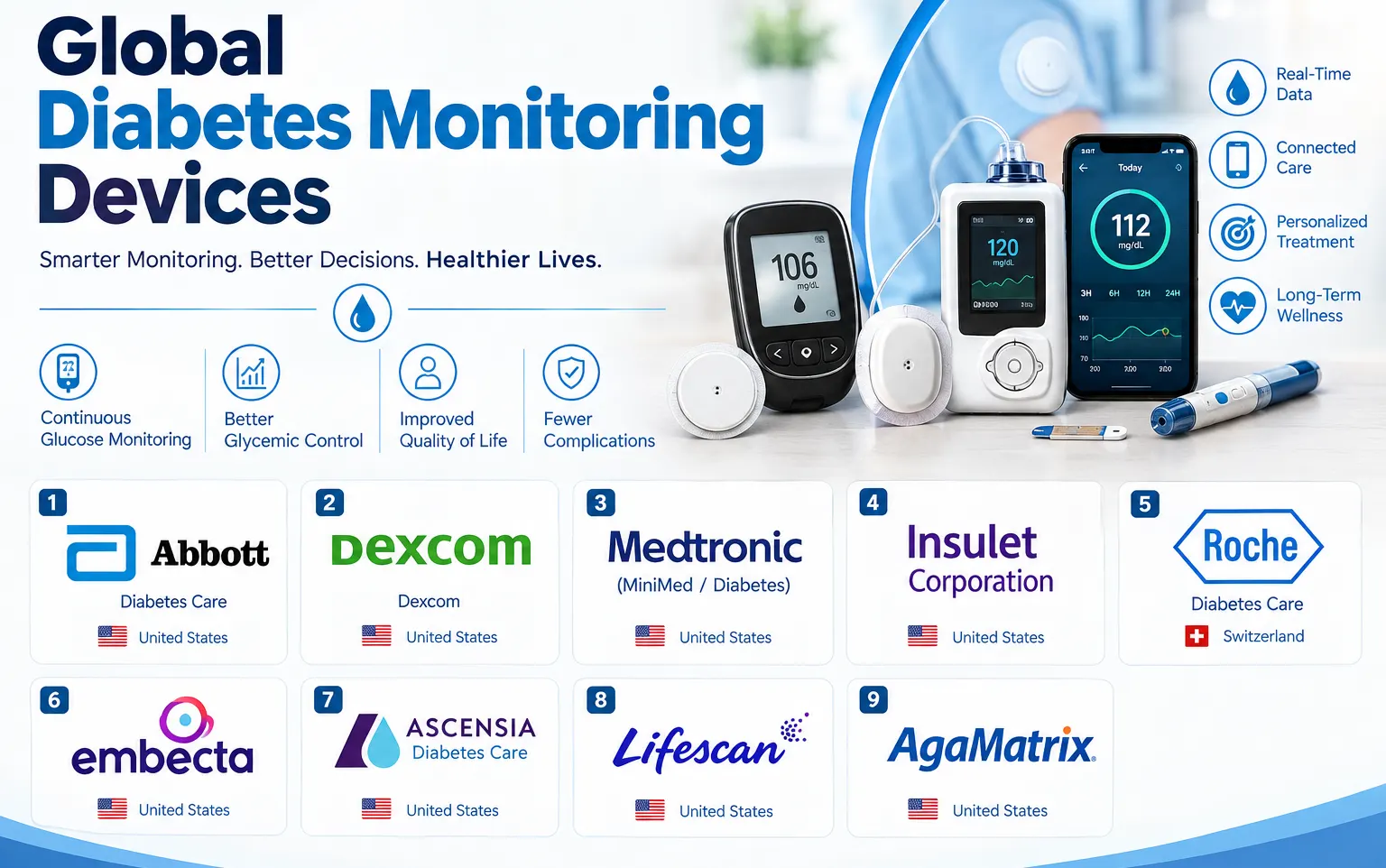
For example, Abbott's FreeStyle Libre portfolio includes continuous glucose monitoring technology, while Dexcom develops wearable CGM systems.
iRhythm's Zio AT is an example of a wearable cardiac-monitoring solution designed for continuous monitoring and remote transmission.
Regional Analysis
North America
North America remains a major market for wearable medical devices. Fortune Business Insights estimates that North America represented 45.70% of its defined global market in 2025.
Factors supporting the region include:
-
Healthcare technology adoption
-
Established healthcare infrastructure
-
Remote patient monitoring
-
Investment in digital health
-
Medical-device innovation
-
Regulatory pathways
Europe
Europe benefits from established healthcare systems, digital-health initiatives and growing interest in connected healthcare.
Key considerations include:
-
Medical-device regulation
-
Data protection
-
Interoperability
-
Healthcare reimbursement
-
Cross-border digital health
Asia-Pacific
Asia-Pacific represents an important growth opportunity because of its large population, expanding healthcare infrastructure, increasing technology adoption and growing demand for remote healthcare solutions.
Market opportunities may differ significantly between countries, making country-level analysis important.
Latin America, Middle East and Africa
These markets may offer opportunities in remote healthcare, chronic disease monitoring and connected health services, but adoption can be influenced by healthcare infrastructure, affordability, connectivity and regulatory requirements.
Challenges and Restraints
Wearable medical devices also face significant barriers.
Data Accuracy
Continuous monitoring does not automatically mean clinically accurate monitoring.
Device performance must be evaluated according to its intended purpose.
Privacy and Cybersecurity
Wearable devices can generate sensitive health information.
Security therefore becomes important across:
Device → Application → Cloud → Healthcare System
Regulatory Complexity
The regulatory requirements for a wearable depend on its intended use, claims, software functionality and jurisdiction.
Interoperability
A device may generate valuable information but still have limited clinical usefulness if that data cannot integrate effectively with healthcare workflows.
User Adherence
Wearable devices need sustained user engagement.
Comfort, battery life, sensor replacement, skin irritation, usability and cost can influence long-term adoption.
Opportunities for Businesses
The market creates opportunities beyond hardware manufacturing.
Potential opportunity areas include:
-
Biosensor development
-
Remote patient monitoring platforms
-
Medical-data analytics
-
AI-enabled monitoring
-
Digital therapeutics
-
Connected diabetes management
-
Cardiac monitoring
-
Healthcare interoperability
-
Device cybersecurity
-
Clinical research applications
The strongest business models may increasingly combine device + software + data + clinical workflow, rather than relying exclusively on hardware sales.
Regulatory and Industry Considerations
Companies developing wearable medical technologies must distinguish between wellness products and regulated medical devices.
In the United States, FDA maintains dedicated guidance covering digital-health technologies, including clinical decision-support software, cybersecurity and AI-enabled medical-device software.
Companies should therefore evaluate:
-
Intended use
-
Medical claims
-
Clinical evidence
-
Software functionality
-
Cybersecurity
-
Data privacy
-
Quality systems
-
Regulatory classification
-
Post-market monitoring
Regulatory requirements differ by country, so global commercialization requires jurisdiction-specific assessment.
Original IMIR Analysis
The next stage of wearable medical-device competition is unlikely to be determined only by who produces the smallest sensor.
Five signals deserve close monitoring.
1. From Device to Healthcare Platform
Competitive advantage may increasingly come from how effectively device data connects to applications, providers and healthcare workflows.
2. Clinical Validation Will Matter More
As more companies enter the market, differentiation based purely on "AI-powered" or "real-time" claims may become less meaningful.
Evidence supporting accuracy, usability and clinical value will become more important.
3. Data Interoperability Is a Strategic Issue
A wearable generating data is only one part of the healthcare value chain.
The ability to move, interpret and use that data across systems can determine its practical value.
4. Consumer and Medical Wearables Will Continue to Converge
The boundary between consumer health technology and medical technology is becoming more complex.
However, businesses should not assume that consumer adoption automatically translates into clinical adoption.
5. Market Forecasts Require Methodology-Level Analysis
The large differences between published market forecasts demonstrate why investors and business leaders should evaluate the underlying definition before using a forecast for strategic decisions.
Future Outlook
Wearable medical devices are moving toward increasingly connected, continuous and data-driven healthcare.
Future development is likely to focus on:
-
Smaller sensors
-
Longer wear duration
-
Better signal quality
-
More connected devices
-
AI-assisted analysis
-
Remote monitoring
-
Personalized healthcare
-
Greater interoperability
-
Improved cybersecurity
-
Clinical validation
The most important question for the industry is therefore shifting from "Can a device measure something?" to "Can that measurement produce reliable, actionable value within healthcare?"
Methodology
This article uses a secondary-research approach based on:
-
Publicly available market research
-
Government and regulatory sources
-
WHO publications
-
Company information
-
Industry sources
-
Publicly available technology information
Market estimates are reported with their respective source and forecast period. Estimates from different research providers are not combined into a single CAGR or market-size calculation.
Limitations
Market estimates can differ because research organizations use different:
-
Market definitions
-
Product inclusions
-
Geographic scopes
-
Revenue assumptions
-
Forecast models
-
Base years
Company inclusion should also not be interpreted as a definitive ranking of market share unless supported by comparable market-share data.
Last Updated: September 2026
Frequently Asked Questions
What are wearable medical devices?
Wearable medical devices are body-worn technologies that measure, monitor, diagnose, manage or support health-related conditions.
What are examples of wearable medical devices?
Examples include continuous glucose monitors, wearable ECG monitors, pulse oximeters, wearable blood-pressure devices, wearable defibrillators and other biosensor-based technologies.
What is driving the wearable medical devices market?
Major drivers include remote patient monitoring, chronic disease management, sensor miniaturization, connected healthcare, increasing health awareness and advances in digital health technologies.
Who are the key wearable medical device companies?
Companies active across relevant wearable medical-device categories include Abbott, Dexcom, Medtronic, iRhythm and other healthcare and technology companies. Their market positions differ by product category and geography.
What is the wearable medical devices market forecast?
Forecasts vary significantly depending on market definition. Fortune Business Insights projects the market to reach $505.28 billion by 2034, while Grand View Research projects $168.29 billion by 2030. These estimates use different scopes and should not be directly combined.
Are smartwatches medical devices?
Not necessarily. A smartwatch can include health or wellness features without being classified as a medical device. Regulatory status depends on intended use, claims, functionality and jurisdiction.
How is AI used in wearable medical devices?
AI can support analysis of sensor data, pattern recognition, anomaly detection, risk assessment and decision-support applications.
What are the major challenges for wearable medical devices?
Important challenges include accuracy, clinical validation, privacy, cybersecurity, interoperability, regulatory requirements, cost and long-term user adherence.
Which region has the largest wearable medical device market?
The answer depends on the market definition used. Fortune Business Insights identifies North America as its largest regional market in its current forecast. Other studies may produce different regional shares because of methodology differences.
Conclusion
Wearable medical devices are becoming an important component of connected healthcare. Their development is being supported by continuous monitoring, remote care, biosensors, AI, connectivity and increasing demand for personalized health management.
For businesses, however, market growth alone should not be the only consideration. Device accuracy, clinical evidence, interoperability, cybersecurity, regulatory requirements and healthcare workflow integration will influence which technologies achieve sustainable adoption.
The opportunity is therefore broader than wearable hardware. The next phase of the industry will increasingly involve devices, data, software, analytics and healthcare ecosystems working together.