
The Macitentan Market: Patent Expiry Dynamics and the Emerging Generic Competition Landscape
Author:
Intellectual Market Insights Research
Published Date:
19 May 2026
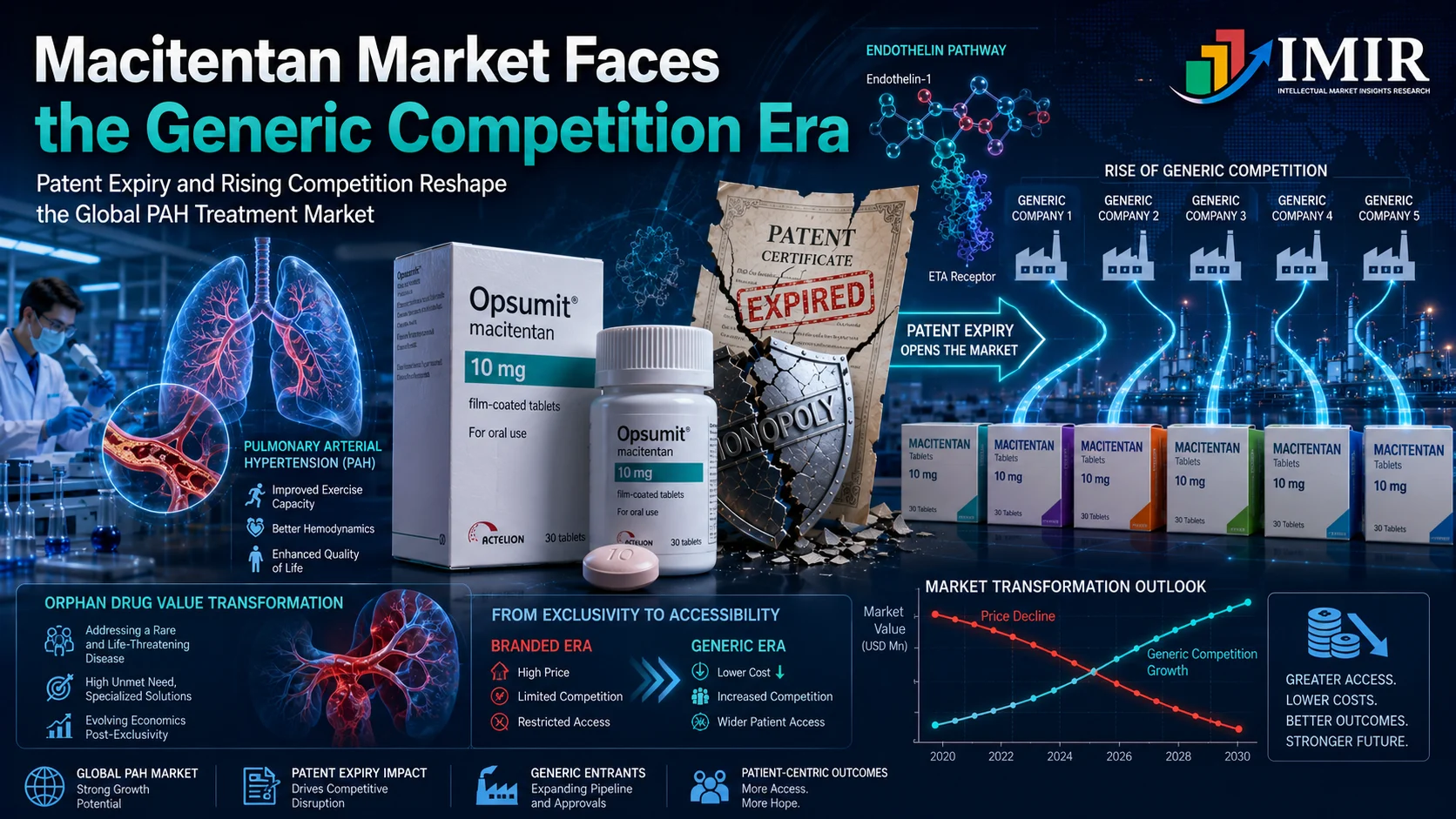
The Macitentan Market Faces Major Transformation Amid Patent Expiry and Generic Competition
The macitentan market across the world constitutes an important strategic area of growth within the realm of treatments for pulmonary arterial hypertension, currently undergoing an important transition about the expiry of patents for macitentan products and the imminent arrival of competitors in a very valuable orphan disease market. It is important to note that the product was initially developed by Actelion Pharmaceuticals, which was subsequently purchased by Johnson & Johnson at a record value of USD 30 billion in 2017.
Market Size and Commercial Performance
The macitentan product market has shown exemplary financial success following the product’s acquisition of FDA approval back in October 2013, with substantial financial gains being recorded, hence showing how essential the product is in the rare diseases pharmaceutical industry. Opsumit managed to achieve about USD 1.9-2.1 billion in net sales throughout 2023, hence making Opsumit one of the most financially successful drugs used for treating pulmonary arterial hypertension globally. The financial success recorded by the drug is an indication of how well the product is entrenched in some of the largest pharmaceutical markets across the world, such as the US market and Europe.
Factors behind macitentan's success can be understood via the unique attributes of pulmonary arterial hypertension itself, and the scarcity of treatment options for the condition. Approximately 15-50 individuals per million are said to suffer from the rare pulmonary arterial hypertension in developed countries, meaning there is a huge patient pool to treat despite the rare status of the condition. Due to being a life-threatening progressive illness, the need for lifelong treatment creates highly favorable patient retention trends that enable Opsumit to maintain its premium pricing strategy, with treatment costs commonly exceeding USD 100,000-140,000.
Competitive Landscape: Multi-Dimensional Therapeutic Competition
The competitive environment surrounding macitentan is multifaceted and involves various levels of therapeutic treatment, as seen in the complex approaches used to manage pulmonary arterial hypertension conditions. Among the endothelin receptor antagonists, macitentan competes against ambrisentan and the older bosentan; however, due to better clinical outcomes and safety, macitentan has taken most of its market share.
Competitive advantage gained by macitentan is through the clinical trials conducted on macitentan. The SERAPHIN study involved 742 patients and showed a 45% reduced morbidity and mortality risk in macitentan patients compared to the placebo. This positive dataset ensures macitentan enjoys preferred status in the treatment guidelines, thus creating competitive advantage for macitentan among pulmonary arterial hypertension specialists.
Competition for macitentan is broad and includes various levels of therapeutics and different types of drugs. The phosphodiesterase-5 inhibitors such as sildenafil and tadalafil pose great competition, especially in combination therapies. On the other hand, prostacyclin pathway agents, which include selexipag, epoprostenol, treprostinil, and iloprost are used in advanced stages of the condition but compete for early stages of the disease based on combination therapies' effectiveness.
The company has reacted to competitive threats by using advanced lifecycle management activities, especially the launch of Opsynvi, a fixed dose combination tablet formulation made up of macitentan and tadalafil. This thing was approved by the FDA in March 2024. The fixed-dose combination drug works like an integrated brand defense approach, meant to help preserve prescriber allegiance, since macitentan on its own is likely to run into generic competition later.
Novel treatment methods constitute further competition for the drug macitentan. For instance, new drugs that modify diseases include sotatercept, which is an activin signaling inhibitor. These drugs are anticipated to redefine the treatment approach for pulmonary arterial hypertension in the coming years and might disrupt macitentan’s dominance in the existing treatment algorithm.
Patent Expiry Timeline and Regulatory Complexities
The patent environment surrounding macitentan is entering a period where significant changes are about to take place, which are going to affect its market dynamics on a global level in pharmaceutical markets. Macitentan composition of matter patents and other key regulatory exclusivity periods covering the drug are set to expire based on the timeline which suggests the 2025–2028 years for major global markets, where European countries' patent protection is predicted to expire in 2025–2026 and U.S. patent protections would expire between 2026–2028, after taking into account the possible patent term extensions and court proceedings results.
One of the main difficulties involved in the macitentan generics process is related to the requirement of participating in a Risk Evaluation and Mitigation Strategy (REMS) program set by the FDA because of macitentan's teratogenic properties and the risk of birth defects. The generic manufacturer could participate in the current single-shared system REMS or create its own protocol of safety management, making the whole process more complicated.
Johnson & Johnson has adopted an integrated IP protection approach using formulation patents, process patents, and combination patents that can extend their exclusivity past the base compound expiration date. The newly approved Opsynvi fixed dose combination enjoys its own unique period of exclusivity, giving Johnson & Johnson a commercial advantage product intended to mitigate revenue loss from generics of macitentan alone.
Economic Impact of Generic Entry
The entrance of the generic version of macitentan in the marketplace will create major economic implications within the realm of therapies utilized to treat pulmonary arterial hypertension. Current Opsumit pricing is set at such levels that are reflective of orphan disease drug prices; such pricing levels can be very costly and have restricted the availability of treatment options for individuals who cannot afford treatment costs.
However, generic competition usually results in large reductions in the price of a drug, which is especially relevant for rare diseases. Industry standards show that generic entrants will lower the cost of a particular drug by 40-70 % initially and even more if there are several generic entrants on the market. These economic implications would greatly help many healthcare stakeholders while also providing greater access to the drug.
The availability of generic versions of macitentan is especially important due to the seriousness of PAH as well as the economic burden involved in using the drug brand name. Affordability could increase the use of the drug by economically disadvantaged patients, allowing more widespread use of combination therapies known to be more effective than other forms of medication due to their cost-effectiveness.
Payers like pharmacy benefit managers, commercial insurance companies, and government programs such as Medicare and Medicaid view the availability of generics for macitentan as a means of cutting costs in their specialty pharmacy budgets. Opsumit's success on the market makes it a priority candidate for being managed through formularies and promoted heavily once generics become available.
Upcoming Generic Manufacturers and Market Entry Strategies
Generic drug makers have recognized the potential of macitentan as a highly lucrative product to develop, with several abbreviated new drug applications being submitted or in the final stages of preparation in leading regulatory bodies around the world. The large sales of the branded version, the impending patent expiration date, and the unique niche of pulmonary arterial hypertension have brought in both big generic firms and rare disease producers.
Major pharmaceutical companies involved in developing macitentan generics include some of the giants in the pharmaceutical industry including Teva Pharmaceuticals, Sun Pharmaceutical Industries, Mylan (currently known as Viatris), Aurobindo Pharma, Dr. Reddy’s Laboratories, Cipla, Zydus Lifesciences, Alembic Pharmaceuticals, and Natco Pharma. These firms possess all the required capabilities for successful launch of generic formulations in specialized sectors.
The competitive forces between the generics will be greatly affected by patent challenge strategies first to file, manufacturing costs relative to competition, connections within the specialty pharmacy networks, and the capacity to manage the REMS program requirements. Companies that take early market share through patent settlement and payer contracting will dominate the market segment, which is both highly valued and specialized.
Indian companies, European companies, and other emerging market companies have been developing their products to not only penetrate the Western market, but the local markets as well as the increase in PAH diagnoses has gone along with the expansion of the healthcare infrastructure in rare diseases.
Market Outlook and Strategic Implications
The landscape for macitentan is at one of those rare transformational inflection points where existing commercial success must contend with the predictable reality of eventual loss of patent protection and ensuing generic competition. However, as evidenced by Johnson & Johnson’s lifecycle management efforts with Opsynvi and further clinical development, among other measures, the company has implemented complex branding protection techniques that will serve to dampen but not mitigate eventual sales decline in the face of generic competition.
For the wider world of PAH drug treatments, the introduction of generics for macitentan signifies a major step forward in providing increased access to care for patients who have been plagued by high costs previously. Not only will lower pricing through the competition offered by generics create better access to treatment, but it may also free up funding for novel therapeutics in late-stage clinical development.
The maturation process of the macitentan market provides an example of the complicated balance of pharmaceutical innovation incentives, intellectual property management practices, competitive market considerations, and patient access factors that characterize today’s rare disease pharmaceutical markets. With this transformation process continuing over the coming years, all participants in the marketplace, from innovators to prescribers to patients themselves, will find themselves operating in an entirely new commercial space in the service of meeting the important objective of improved patient care in pulmonary arterial hypertension.
This process will be beneficial for the international pulmonary arterial hypertension population by providing equal access to a well-established treatment option, but will force originator firms to innovate beyond these drugs in order to remain competitive.


