
The Pomalidomide Market: Patent Expiry Dynamics and the Generic Competition Revolution
Author:
Intellectual Market Insights Research
Published Date:
19 May 2026
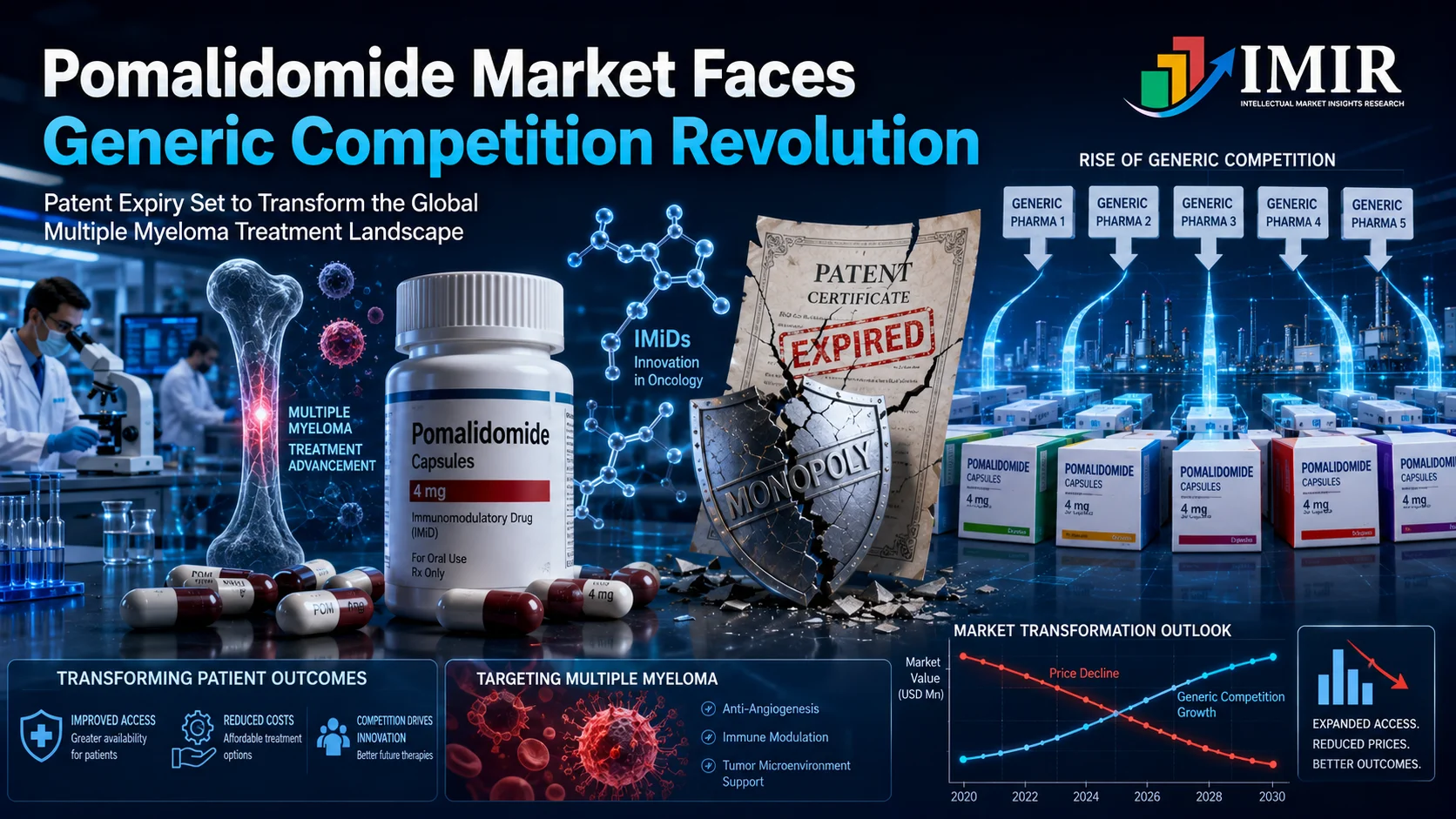
The Global Pomalidomide Market Enters a New Era Amid Patent Expiry and Generic Competition
Pomalidomide global market holds high importance in the overall market segment for the treatment of multiple myeloma due to undergoing a highly critical stage where patents have expired leading to intense competition among generics. Pomalidomide was originally invented by Celgene corporation and later acquired by Bristol-Myers Squibb in 2019. This medicine has proved to be a key solution in relapsed and refractory multiple myeloma cases and brings considerable profits to the company.
Market Size and Revenue Performance
The market for pomalidomide drug has shown impressive performance since the drug was approved for marketing in February 2013. For instance, Pomalyst and Imnovid products developed by Bristol-Myers Squibb made a revenue of approximately USD 3.4 billion on the international market during 2023, thus ensuring its status of a blockbuster product in the field of oncology treatment. The impressive revenues that were obtained can be attributed to the high popularity of the product in the major pharmaceutical markets, especially in the United States and several other European countries such as Germany, France, and the United Kingdom.
The potential of the market is expected to grow further due to the rising disease burden associated with multiple myeloma. Epidemiology reports state that there are about 176,000 annual diagnoses of multiple myeloma globally, which is expected to provide the pharmaceutical company with a stable customer base. Indeed, the drug represents a viable third-line treatment for people who have undergone at least two treatments using lenalidomide and proteasome inhibitors before.
Competitive Landscape: Navigating Complex Treatment Paradigms
Pomalidomide exists in a complex competitive landscape comprising many different aspects of pharmaceutical rivalry. In the IMiD class, pomalidomide is pitted against two predecessors, namely thalidomide and lenalidomide, with pomalidomide having a higher degree of efficacy in patients resistant to the latter. Pomalidomide has cleverly adopted itself to be used in combination therapy, with pomalidomide, bortezomib, and dexamethasone and the daratumumab, pomalidomide, and dexamethasone treatment showing impressive results for pomalidomide incorporation into existing therapy standards.
Pomalidomide’s competitive landscape is further complicated by the introduction of novel forms of therapy that pose serious competition to pomalidomide. These include various CAR-T cell therapies like idecabtagene vicleucel and ciltacabtagene autoleucel, which have become popular choices in heavily pretreated populations where pomalidomide-based therapy would previously have been the choice. Teclistamab and other anti-BCMA antibodies as well as proteasome inhibitors and various monoclonal antibodies are among such competitors.
Patent Expiry Timeline and Market Inflection Points
The patent landscape for pomalidomide is the most significant upcoming event affecting competition. Key patents and data exclusive for pomalidomide are ending soon in different countries in a manner that will change how this product can be accessed and priced.
For the EU market, patents for pomalidomide have either ended or will soon end, around 2024, allowing generic companies to submit applications to obtain approval through the European Medicines Agency. In the US market, which accounts for most of the revenue, patents and agreements on the timing of generics indicate that entry will start around 2026. However, the actual date will depend on individual litigation and licensing deals between manufacturers.
Although Bristol-Myers Squibb has used standard tactics such as seeking approvals for new indications and generating additional data for combination treatments, the small molecule nature of pomalidomide means that once patents expire, generics will replace it quickly and entirely, unlike the slow replacement pattern witnessed with biologics.
Economic Impact of Generic Entry
Generic competition in the market will cause massive changes in the marketplace, and it will be felt by all players involved. The first impact that will be experienced is price erosion, and according to the trends in the history of generics in oncology drugs, prices are expected to drop between 30-80 percent within a span of 2-3 years after the entrance of multi-sourced generic products. Considering the present pricing mechanism for pomalidomide, in which Pomalyst costs more than $20,000 per 28 days, this will be of much benefit to the stakeholders.
Volume growth will be an important second impact of the introduction of generics. Reduced costs of the products will make them available and accessible to many patients, especially in cost-conscious regions and populations that have been limited in their use of pomalidomide due to its relatively high prices.
Upcoming Generic Manufacturers and Market Entry Strategies
The presence of a robust pipeline of generic pharmaceutical companies has made it possible for the company to enter the pomalidomide market once the patents start expiring. The FDA has provided tentative or full approval to multiple generic versions of pomalidomide by several large manufacturers.
Prominent generic players gearing up to enter the market include well-known firms like Teva Pharmaceuticals, Dr. Reddy’s Laboratories, Aurobindo Pharma, Cipla, and Natco Pharma, which offer large-scale production capacity and an already existing oncology drug portfolio. Some of the other prominent participants expected to enter the market include Sun Pharmaceutical Industries, Mylan (which is now Viatris), and Hikma Pharmaceuticals, whose well-established commercial networks will help them penetrate the market.
Competition is likely to be stiff among these manufacturers; however, they may adopt varied strategies to differentiate themselves to gain a market share in this lucrative therapeutic segment.
Market Outlook and Strategic Implications
The process of the evolution of the pomalidomide market from exclusive to competitive is characteristic of the pharmaceutical industry as a whole and reflects the trends that define the development of oncology medicines on a global scale. Although the revenue losses associated with the appearance of generic products will be substantial for Bristol-Myers Squibb, the consequences will have a more complex nature.
Generic drugs will significantly increase the access to an already-proven treatment option for multiple myeloma, and thus, the cost savings due to the development of generic products can potentially be used by healthcare systems to fund advanced and expensive treatment options, such as chimeric antigen receptor T-cell therapy.
The growth process of the pomalidomide market is reflective of the normal product life cycle in the pharmaceutical industry, whereby the innovation period is replaced by the competitive stage, ensuring not only ongoing access to the treatment but also continued development of new treatment modalities. This scenario will be advantageous for worldwide multiple myeloma treatment, although the originator firms will face challenges to innovate further.


