
Top 10 Computed Tomography Companies focusing on AI Imaging and Advanced Diagnostic Technologies
Author:
Intellectual Market Insights Research
Published Date:
24 Jul 2026
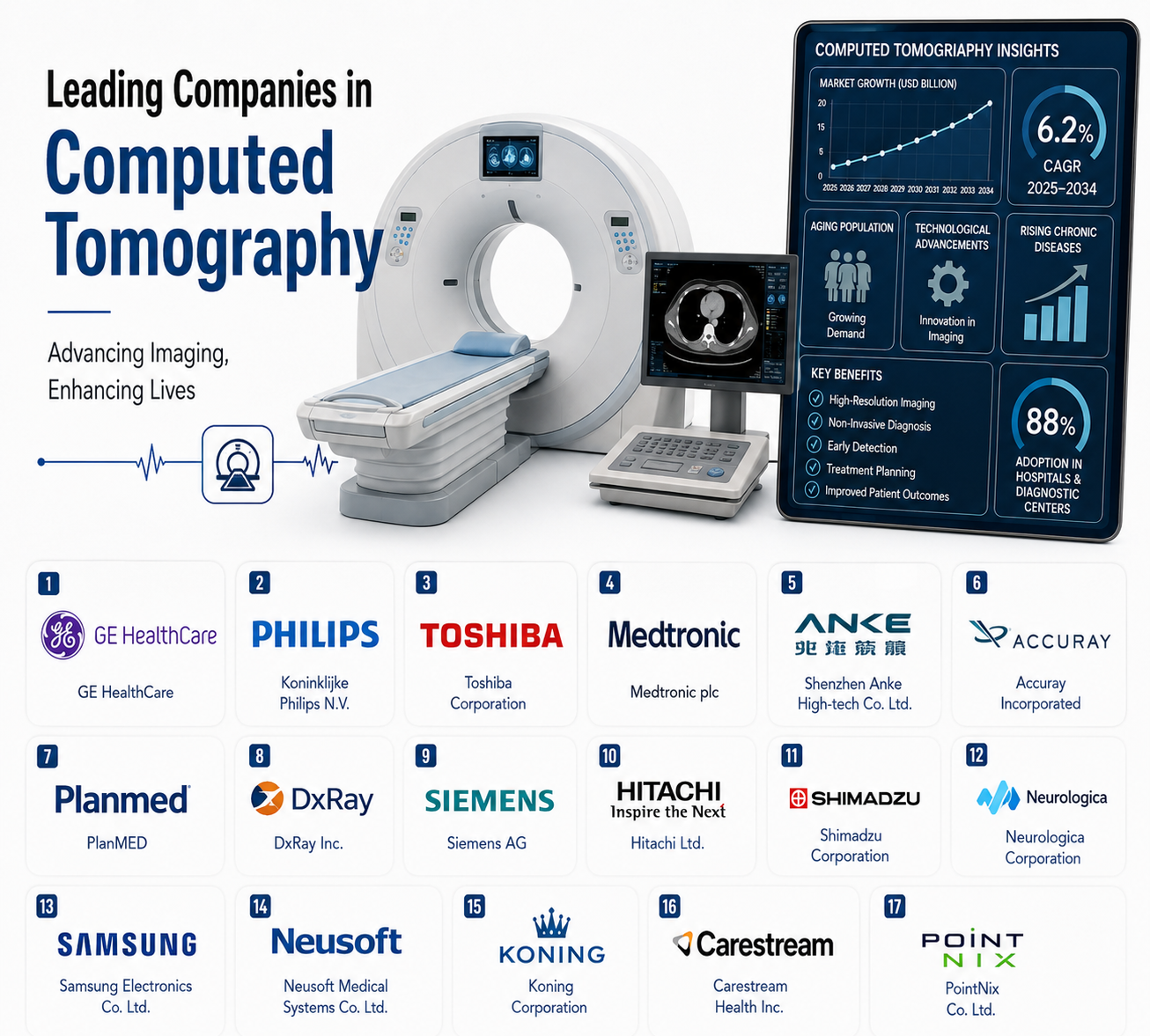
Advancing Diagnostic Imaging in Modern Healthcare
The global healthcare imaging landscape is undergoing a significant transformation as hospitals, diagnostic centers, and research institutions increasingly rely on Computed Tomography (CT) systems for faster, more accurate, and less invasive diagnosis. Rising incidences of chronic diseases, cancer, cardiovascular conditions, and trauma cases have accelerated demand for advanced imaging technologies capable of delivering high-resolution, three-dimensional views of the human body in a matter of seconds.
The global Computed Tomography market was valued at USD 5.2 Billion in 2025 and is projected to reach USD 8.0 Billion by 2034, growing at a CAGR of 4.8% from 2025 to 2034.
The integration of artificial intelligence, low-dose radiation technology, portable scanning systems, and cloud-based image management is reshaping how CT systems are designed, deployed, and used across clinical settings. From compact portable scanners suited for emergency and point-of-care diagnostics to high-slice stationary systems used in advanced oncology and cardiology imaging, manufacturers are racing to combine precision, speed, and patient safety.
This article highlights the Top 10 Leading Companies in the Global Computed Tomography Market 2026, profiling organizations that are driving innovation, expanding diagnostic imaging capabilities, and shaping the future of medical imaging technology.
What is Computed Tomography?
Computed Tomography (CT) is a diagnostic imaging technology that uses a combination of X-rays and computer processing to create detailed cross-sectional images of bones, blood vessels, and soft tissues inside the body. Unlike conventional X-rays, CT scans provide far more detailed information, enabling clinicians to detect tumors, internal bleeding, fractures, infections, and vascular conditions with greater precision.
CT systems are broadly categorized by product type into portable and stationary scanners, and by technology into low-slice, high-slice, and other configurations. These systems are widely used across diagnostic centers, hospitals, and specialty clinics for oncology screening, cardiac imaging, trauma assessment, and surgical planning.
As healthcare providers continue to prioritize early and accurate diagnosis, CT technology is becoming a cornerstone of modern radiology departments, supported by continuous advances in detector technology, image reconstruction algorithms, and radiation dose optimization.
Global Computed Tomography Market Overview
The global CT market has expanded steadily, driven by the rising burden of chronic and lifestyle-related diseases, growing geriatric populations, and increasing investment in hospital imaging infrastructure. Diagnostic centers and hospitals are upgrading legacy imaging equipment with advanced high-slice CT systems that offer faster scan times, improved image clarity, and reduced radiation exposure.
Manufacturers are also investing heavily in artificial intelligence-based image reconstruction, workflow automation, and cloud-connected diagnostic platforms that allow radiologists to share and analyze scans remotely. Strategic collaborations between medical device manufacturers, hospital networks, and software developers are accelerating the pace of innovation across the industry.
North America continues to hold a substantial share of the global CT market, supported by well-established healthcare infrastructure and high adoption of advanced diagnostic technologies. Europe follows with strong demand driven by aging populations and expanding public healthcare investment. Meanwhile, the Asia-Pacific region particularly Japan and China is expected to witness considerable growth due to the presence of leading CT manufacturers and expanding hospital networks.
Key Market Drivers
Several factors are contributing to the steady growth of the global Computed Tomography market:
Rising Prevalence of Chronic Diseases
Increasing incidence of cancer, cardiovascular disease, and neurological disorders is driving demand for advanced diagnostic imaging that enables early detection and treatment planning.
Technological Advancements in Imaging
Continuous innovation in detector technology, low-dose radiation systems, and high-slice scanning is improving image quality while reducing patient exposure to radiation.
Growing Adoption of Portable CT Systems
Portable and mobile CT scanners are gaining traction in emergency departments, intensive care units, and point-of-care settings where rapid diagnosis is critical.
Expansion of Healthcare Infrastructure
Ongoing investment in hospitals and diagnostic centers, particularly across emerging economies, is increasing the installed base of CT systems worldwide.
Integration of Artificial Intelligence
AI-powered image reconstruction and analysis tools are helping radiologists improve diagnostic accuracy, reduce scan times, and streamline reporting workflows.
Emerging Trends Shaping the Industry
The Computed Tomography industry continues to evolve with the introduction of new technologies and clinical applications. Some of the most notable trends include:
- AI-assisted image reconstruction and analysis
- Low-dose and ultra-low-dose radiation scanning protocols
- Portable and point-of-care CT systems
- High-slice CT for advanced cardiac and oncology imaging
- Cloud-based image storage and remote diagnostics
- Integration with picture archiving and communication systems (PACS)
- Photon-counting detector technology
- 3D and multi-planar reconstruction capabilities
- Workflow automation for radiology departments
- Expansion of CT-guided interventional procedures
These innovations are enabling faster, safer, and more accurate diagnostic imaging while supporting broader adoption across both developed and emerging healthcare markets.
Top 10 Leading Companies in the Global Computed Tomography Market 2026
- GE Healthcare
- Koninklijke Philips N.V.
- Siemens AG
- Toshiba Corporation
- Medtronic plc
- Hitachi Ltd.
- Shimadzu Corporation
- Samsung Electronics Co. Ltd.
- Neusoft Medical Systems Co. Ltd.
- Carestream Health Inc.
Company Profile
1. GE Healthcare
|
Category |
Details |
|---|---|
|
Company Name |
GE Healthcare |
|
Headquarters |
Chicago, Illinois, United States |
|
Industry Focus |
Medical Imaging, Diagnostics, Healthcare Technology |
|
Global Presence |
Operations across North America, Europe, Asia-Pacific, and Latin America |
|
Company Overview |
GE Healthcare is a leading global manufacturer of medical imaging equipment, including a broad portfolio of CT systems used in hospitals and diagnostic centers worldwide. The company combines advanced detector technology, AI-powered reconstruction software, and workflow automation tools to support faster and more accurate diagnostic imaging. |
|
Key Products & Services |
Stationary CT Scanners, Portable CT Systems, AI-Powered Image Reconstruction, Cardiac and Oncology Imaging Solutions, Cloud-Connected Radiology Platforms |
|
Market Position |
One of the largest global providers of diagnostic imaging systems, with a strong installed base across hospitals and diagnostic centers. |
|
Strategic Advantages |
Extensive global distribution network, strong R&D investment, broad imaging product portfolio, established hospital relationships, and continuous innovation in AI-enabled diagnostics. |
2. Koninklijke Philips N.V.
|
Category |
Details |
|---|---|
|
Company Name |
Koninklijke Philips N.V. |
|
Headquarters |
Amsterdam, Netherlands |
|
Industry Focus |
Health Technology, Diagnostic Imaging, Patient Monitoring |
|
Global Presence |
Operations across Europe, North America, Asia-Pacific, and the Middle East |
|
Company Overview |
Philips is a major health technology company offering a comprehensive range of CT imaging systems designed for precision diagnostics, low-dose scanning, and integrated workflow management. The company continues to invest in AI-driven imaging software and connected healthcare platforms. |
|
Key Products & Services |
High-Slice CT Systems, Low-Dose Imaging Technology, AI-Based Diagnostic Software, Integrated Radiology Workflow Solutions |
|
Market Position |
A key global player recognized for innovation in low-dose imaging and integrated diagnostic platforms. |
|
Strategic Advantages |
Strong brand reputation, broad healthcare technology portfolio, focus on patient safety through radiation dose reduction, and continuous software innovation. |
3. Siemens AG
|
Category |
Details |
|---|---|
|
Company Name |
Siemens AG (Siemens Healthineers) |
|
Headquarters |
Munich, Germany |
|
Industry Focus |
Medical Imaging, Diagnostics, Healthcare Equipment |
|
Global Presence |
Operations across Europe, North America, Asia-Pacific, and emerging markets |
|
Company Overview |
Siemens Healthineers is a leading manufacturer of advanced CT scanners, known for high-slice systems used in cardiology, oncology, and trauma imaging. The company emphasizes precision engineering, rapid scan speeds, and AI-enabled image processing. |
|
Key Products & Services |
High-Slice CT Scanners, Cardiac Imaging Systems, AI-Powered Reconstruction Tools, Photon-Counting Detector Technology |
|
Market Position |
Recognized as a technology leader in high-performance CT systems for complex diagnostic applications. |
|
Strategic Advantages |
Strong engineering capabilities, leadership in photon-counting detector innovation, established global hospital network, and continuous investment in next-generation imaging research. |
4. Toshiba Corporation
|
Category |
Details |
|---|---|
|
Company Name |
Toshiba Corporation |
|
Headquarters |
Tokyo, Japan |
|
Industry Focus |
Medical Imaging, Electronics, Diagnostic Equipment |
|
Global Presence |
Operations across Asia-Pacific, North America, and Europe |
|
Company Overview |
Toshiba has a long-standing presence in the medical imaging space, offering CT systems designed for diagnostic accuracy and operational efficiency. The company's imaging division has historically focused on detector innovation and image clarity for hospital and diagnostic center use. |
|
Key Products & Services |
Stationary CT Systems, Diagnostic Imaging Equipment, Detector Technology Solutions |
|
Market Position |
An established player with a strong presence in the Asia-Pacific diagnostic imaging market. |
|
Strategic Advantages |
Deep regional market knowledge, strong manufacturing capabilities, and long-standing relationships with hospital networks across Asia. |
5. Medtronic plc
|
Category |
Details |
|---|---|
|
Company Name |
Medtronic plc |
|
Headquarters |
Dublin, Ireland |
|
Industry Focus |
Medical Devices, Diagnostic and Interventional Imaging |
|
Global Presence |
Operations across North America, Europe, Asia-Pacific, and Latin America |
|
Company Overview |
Medtronic offers imaging and diagnostic solutions that support interventional and surgical applications, complementing its broader medical device portfolio. The company focuses on integrating imaging technology with minimally invasive procedures and surgical navigation. |
|
Key Products & Services |
Interventional Imaging Systems, Surgical Navigation Technology, Diagnostic Support Solutions |
|
Market Position |
A diversified medical device leader with a growing focus on imaging-enabled interventional care. |
|
Strategic Advantages |
Broad medical device portfolio, strong R&D capabilities, established relationships with surgical and diagnostic teams, and global distribution reach. |
Competitive Landscape
The global Computed Tomography market is highly competitive, with established medical device manufacturers, regional imaging specialists, and emerging technology firms competing to develop faster, safer, and more intelligent diagnostic systems. Market participants are increasingly investing in artificial intelligence, low-dose radiation technology, and cloud-connected radiology platforms to strengthen their competitive positioning.
Strategic partnerships between imaging manufacturers, hospital networks, and software developers are accelerating product innovation. Companies are also pursuing mergers, acquisitions, and regional expansion to broaden their product portfolios and reach new healthcare markets, particularly across Asia-Pacific and Latin America.
Market Segmentation
By Product Type
- Portable
- Stationary
By Technology Type
- Low Slice
- High Slice
- Others
By End User
- Diagnostic centers
- Hospitals
- Others
Regional Analysis
North America
North America holds a significant share of the global CT market, supported by advanced healthcare infrastructure, high adoption of diagnostic imaging technologies, and strong reimbursement frameworks.
Europe
Europe continues to see steady demand driven by an aging population, expanding public healthcare investment, and growing focus on early disease detection.
Asia-Pacific
Asia-Pacific is expected to witness significant growth, supported by the presence of leading CT manufacturers in economies such as Japan and China, along with expanding hospital infrastructure.
Latin America
Growing investment in healthcare infrastructure and rising awareness of early diagnostic screening are creating new opportunities across Latin America.
Middle East & Africa
The region is gradually expanding its diagnostic imaging capacity as healthcare infrastructure investment increases and access to advanced medical technologies improves.
Key Market Trends
- AI-powered image reconstruction and analysis
- Low-dose and ultra-low-dose scanning protocols
- Growth of portable and point-of-care CT systems
- Photon-counting detector technology
- Cloud-connected radiology and PACS integration
- Expansion of CT-guided interventional procedures
- Workflow automation in radiology departments
- Rising demand from diagnostic centers and outpatient facilities
Future Outlook
The global Computed Tomography market is expected to continue its steady expansion as artificial intelligence, low-dose imaging technology, and portable scanning systems reshape diagnostic radiology. Manufacturers that combine precision engineering with intelligent software platforms and efficient workflow integration are likely to strengthen their competitive positions.
Growing awareness of early disease detection, expanding hospital infrastructure across emerging markets, and continuous technological advancement are expected to support long-term industry growth through 2034 and beyond.
Frequently Asked Questions (FAQs)
1. What is Computed Tomography (CT)?
Computed Tomography is a diagnostic imaging technology that uses X-rays and computer processing to produce detailed cross-sectional images of the body's internal structures.
2. What is the size of the global CT market?
The global Computed Tomography market was valued at USD 5.2 Billion in 2025 and is projected to reach USD 8.0 Billion by 2034, growing at a CAGR of 4.8%.
3. Which companies are leading the global CT market?
Leading companies include GE Healthcare, Koninklijke Philips N.V., Siemens AG, Toshiba Corporation, Medtronic plc, Hitachi Ltd., Shimadzu Corporation, Samsung Electronics Co. Ltd., Neusoft Medical Systems Co. Ltd., and Carestream Health Inc.
4. What factors are driving market growth?
Rising prevalence of chronic diseases, technological advancements in imaging, growing adoption of portable CT systems, healthcare infrastructure expansion, and AI integration are major growth drivers.
5. Which region dominates the CT market?
North America currently holds a significant share of the market, while Asia-Pacific is expected to witness considerable growth, supported by key manufacturers based in Japan and China.
Conclusion
The global Computed Tomography market is advancing steadily, driven by continuous innovation in imaging technology, artificial intelligence, and low-dose radiation systems. The companies featured in this report are playing a critical role in improving diagnostic accuracy, expanding access to advanced imaging, and supporting better patient outcomes across hospitals and diagnostic centers worldwide.
As healthcare providers continue to prioritize early and accurate diagnosis, demand for faster, safer, and more intelligent CT systems will continue to grow. Organizations that invest in research and development, expand their imaging portfolios, and integrate AI-powered diagnostic tools will remain at the forefront of this evolving industry, creating significant opportunities for manufacturers, healthcare providers, and investors alike.


