
Top 10 Key Players in the Ultrasound Devices Market Industry Leaders Shaping the Future
Author:
Intellectual Market Insights Research
Published Date:
29 Aug 2026
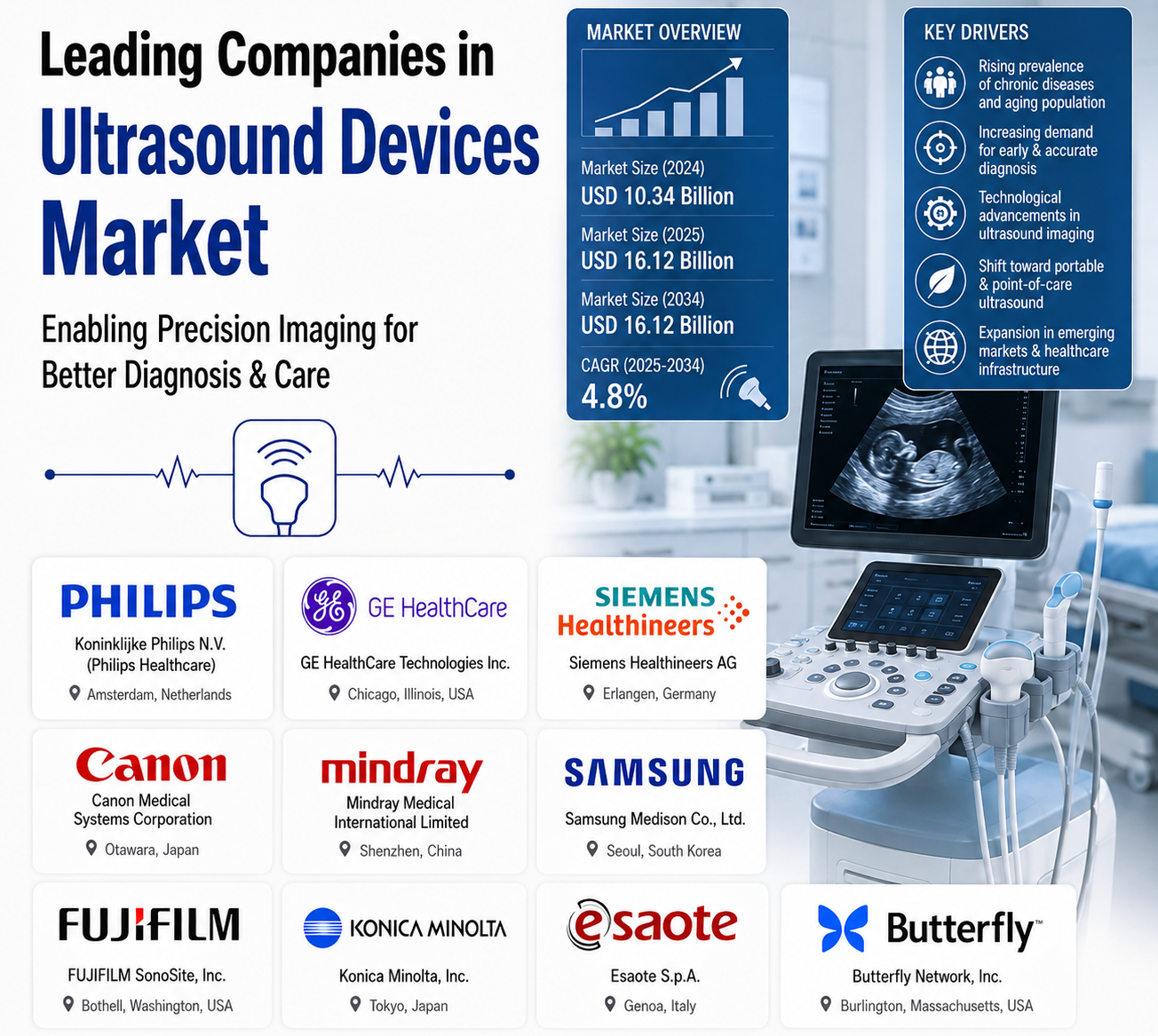
Top Companies in the World Offering Ultrasound Devices
Ultrasound imaging remains one of the most widely used diagnostic and therapeutic tools in modern medicine, using high-frequency sound waves to produce real-time images of internal organs, tissues, and blood flow without ionizing radiation. Faster and less expensive than CT or MRI, and safer for repeated use, ultrasound has become a first-line imaging modality across cardiology, obstetrics and gynecology, radiology, and emergency medicine, while newer therapeutic applications such as high-intensity focused ultrasound extend the technology into cancer treatment.
The global ultrasound devices market was valued at approximately USD 10.34 billion in 2025 and is projected to reach USD 16.12 billion by 2034, expanding at a compound annual growth rate (CAGR) of 4.8% over the forecast period. This growth reflects the rising global burden of chronic and lifestyle-related diseases, the accelerating shift toward handheld and point-of-care ultrasound devices, and the growing integration of artificial intelligence into image acquisition and interpretation.
The competitive landscape is led by a handful of large, diversified medical imaging conglomerates, Koninklijke Philips, GE HealthCare, Siemens Healthineers, and Canon Medical Systems, whose ultrasound businesses sit alongside broader diagnostic imaging and patient monitoring portfolios. Alongside these giants, Mindray has emerged as a fast-growing challenger from China, while specialists like Samsung Medison, FUJIFILM SonoSite, and Butterfly Network compete on handheld and point-of-care innovation.
Understanding which companies lead this large and technologically fast-moving market is essential for hospital procurement teams, clinicians, and healthcare industry analysts. This article provides a research-based analysis of the top companies in the global ultrasound devices market, their positioning, flagship offerings, and the regional and technological forces shaping the competitive landscape.
Market Overview
|
Parameter |
Details |
|---|---|
|
Market Size (2025) |
USD 10.34 Billion |
|
Projected Market Size (2034) |
USD 16.12 Billion |
|
CAGR (2025–2034) |
4.8% |
|
Base Year |
2024 |
|
Forecast Period |
2025–2034 |
|
Leading Region |
North America |
|
Fastest-Growing Region |
Asia-Pacific |
|
Key Growth Drivers |
Rising chronic disease burden, growing demand for point-of-care and handheld devices, AI-powered image analysis |
|
Key Challenges |
High cost of advanced (color Doppler, elastography, 3D/4D) systems; limited access in resource-constrained regions |
|
Key Opportunities |
AI-integrated diagnostics, wireless and app-based transducers, expansion of ultrasound in cardiology and oncology |
Why the Ultrasound Devices Market Is Growing
1. Advancements in Technology Leading to Enhanced Imaging Capabilities
Ongoing developments including high-frequency transducers, improved signal processing algorithms, and 3D/4D imaging are steadily improving image quality, clarity, and depth, enabling more detailed and accurate diagnostic information for clinicians.
2. Increasing Prevalence of Chronic Diseases Requiring Diagnostic Imaging
The rising global burden of cancer, cardiovascular disease, and musculoskeletal disorders is driving routine use of ultrasound for diagnosis, treatment planning, and monitoring, given its non-invasive, radiation-free, real-time imaging capability.
3. Growing Uptake of Handheld and Portable Ultrasound Equipment
Lightweight, point-of-care ultrasound devices are expanding the clinical settings in which ultrasound can be used, including ambulances, clinics, and emergency rooms, supporting the shift toward telemedicine and remote healthcare delivery.
4. Integration of Artificial Intelligence and Machine Learning
AI-driven ultrasound technology is improving diagnostic accuracy, automating measurements, and supporting individualized patient care, while machine learning models trained on large image datasets are enhancing prognosis and treatment-response prediction.
5. Expanding Healthcare Infrastructure in Emerging Markets
Growing healthcare spending, improved understanding of diagnostic techniques, and favorable reimbursement practices in developing economies are broadening the addressable patient population for ultrasound equipment.
6. Rising Radiology and M&A Activity
Increasing use of AI in radiology and growing merger and acquisition activity among major vendors to expand product offerings, such as GE HealthCare's acquisition of AI-diagnostics firm Caption Health, is propelling market expansion.
Top 10 Companies in the Ultrasound Devices Market
- Koninklijke Philips N.V. (Philips Healthcare)
- GE HealthCare Technologies Inc.
- Siemens Healthineers AG
- Canon Medical Systems Corporation
- Mindray Medical International Limited
- Samsung Medison Co., Ltd.
- FUJIFILM SonoSite, Inc.
- Konica Minolta, Inc.
- Esaote S.p.A.
- Butterfly Network, Inc.
1. Koninklijke Philips N.V.
|
Category |
Details |
|---|---|
|
Company Name |
Koninklijke Philips N.V. (Philips Healthcare) |
|
Headquarters |
Amsterdam, Netherlands |
|
Founded |
1891 (Philips); ultrasound business built substantially through its 1998 acquisition of ATL Ultrasound |
|
Employees |
Approx. 67,800 (2024) |
|
Revenue (FY2024) |
Approx. EUR 18.0 Billion (~USD 19.5 Billion); diagnosis and treatment segment, which includes ultrasound, generates nearly half of total revenue |
|
Company Overview |
Philips is a diversified global health technology company and a longstanding leader in diagnostic imaging, with ultrasound forming a core part of its diagnosis and treatment portfolio alongside CT, MRI, and image-guided therapy. |
|
Key Products |
EPIQ Elite and Affiniti premium cart-based ultrasound systems, Lumify app-based handheld ultrasound, and the compact 5000 Series small-format ultrasound platform. |
|
Market Position |
A top-tier global ultrasound vendor with particular strength in premium cart-based cardiology and radiology systems as well as growing point-of-care and handheld offerings. |
|
Recent Developments |
Announced the acquisition of SpectraWAVE for next-generation intravascular imaging (December 2025) and continues expanding AI-supported imaging tools such as SmartIQ across its cardiovascular platforms. |
|
Strategic Advantages |
Deep integration across imaging, diagnostics, and informatics, a large global installed base, and a broad ultrasound portfolio spanning premium hospital systems to handheld point-of-care devices. |
2. GE HealthCare Technologies Inc.
|
Category |
Details |
|---|---|
|
Company Name |
GE HealthCare Technologies Inc. |
|
Headquarters |
Chicago, Illinois, United States |
|
Founded |
1994 (as GE Medical Systems); spun off as an independent public company in January 2023 |
|
Employees |
Approx. 54,000 (2025) |
|
Revenue (FY2025) |
Approx. USD 20.6 Billion |
|
Company Overview |
GE HealthCare describes itself as a global leader in ultrasound, and its Advanced Visualization Solutions segment houses one of the industry's broadest ultrasound portfolios spanning cardiovascular, women's health, and general imaging. |
|
Key Products |
Voluson (obstetrics/gynecology), Vivid (cardiovascular), LOGIQ (general imaging), and Venue point-of-care ultrasound systems, several featuring Caption AI-guided scanning. |
|
Market Position |
A global leader in ultrasound, with particularly strong positions in obstetrics/gynecology and cardiovascular ultrasound through its long-established Voluson and Vivid product families. |
|
Recent Developments |
Unveiled the next generation of its Vivid cardiovascular ultrasound portfolio (August 2026) and partnered with Diagnoly to integrate AI solutions into fetal ultrasound workflows (February 2026). |
|
Strategic Advantages |
Broad, brand-recognized ultrasound product families, deep integration of AI-guided scanning (Caption AI), and a large global installed base supporting recurring service and software revenue. |
3. Siemens Healthineers AG
|
Category |
Details |
|---|---|
|
Company Name |
Siemens Healthineers AG |
|
Headquarters |
Erlangen, Germany |
|
Founded |
2017 (spun off from Siemens AG); ultrasound business rooted in its 2000 acquisition of Acuson Corporation |
|
Employees |
Approx. 72,000 (FY2024) |
|
Revenue (FY2024) |
Approx. EUR 22.4 Billion (~USD 24 Billion) |
|
Company Overview |
Siemens Healthineers is a leading global medical technology company whose Acuson ultrasound brand competes at the premium end of the market, complemented by newer AI-powered and affordable system lines. |
|
Key Products |
ACUSON Sequoia premium ultrasound platform with AI Abdomen automated organ measurement, and the ACUSON Maple, a lightweight, battery-powered system aimed at emerging markets and outpatient settings. |
|
Market Position |
A major global ultrasound vendor known for premium, AI-enabled cart-based systems, with expanding reach into affordable and portable segments through the ACUSON Maple line. |
|
Recent Developments |
Introduced AI Abdomen as part of the Acuson Sequoia 3.5 release and formed an AI-focused ultrasound collaboration with DeepHealth/RadNet to enable remote "SmartSonography" workflows (December 2024). |
|
Strategic Advantages |
Strong integration of AI into ultrasound workflow and image interpretation, a globally recognized Acuson premium brand, and dedicated US-based ultrasound manufacturing in Issaquah, Washington. |
4. Canon Medical Systems Corporation
|
Category |
Details |
|---|---|
|
Company Name |
Canon Medical Systems Corporation |
|
Headquarters |
Otawara, Tochigi, Japan (U.S. operations headquartered in Tustin, California) |
|
Founded |
2016, formed when Canon Inc. acquired Toshiba Medical Systems, whose diagnostic imaging heritage dates to the 1930s |
|
Employees |
Not publicly disclosed on a global basis; U.S. operations alone employ several thousand staff |
|
Revenue |
Approx. USD 3.9 Billion |
|
Company Overview |
Canon Medical Systems combines Canon's imaging and optics expertise with Toshiba Medical's decades of diagnostic imaging heritage, offering a full ultrasound lineup alongside CT, MRI, and X-ray systems. |
|
Key Products |
Aplio i-series diagnostic ultrasound platforms, including the Aplio i800 and i900, and the Aplio i800 EUS system for endoscopic ultrasound. |
|
Market Position |
A top-tier global ultrasound and diagnostic imaging vendor with particular strength in Japan and the broader Asia-Pacific region, and an expanding presence in endoscopic ultrasound. |
|
Recent Developments |
Announced a collaboration with Olympus in January 2024 to co-develop endoscopic ultrasound technology, with the Aplio i800 EUS system launching commercially in the U.S. in May 2026. |
|
Strategic Advantages |
Century-plus diagnostic imaging heritage inherited from Toshiba Medical, strong regional presence across Asia-Pacific, and a differentiated partnership-driven position in endoscopic ultrasound. |
5. Mindray Medical International Limited
|
Category |
Details |
|---|---|
|
Company Name |
Mindray Medical International Limited (Shenzhen Mindray Bio-Medical Electronics Co., Ltd.) |
|
Headquarters |
Shenzhen, Guangdong, China |
|
Founded |
1991 |
|
Employees |
Approx. 21,000 (2025) |
|
Revenue (FY2024) |
Approx. USD 5.1 Billion (RMB 36.7 Billion) |
|
Company Overview |
Mindray is a leading Chinese medical device company for which digital ultrasound is one of four core business lines, alongside patient monitoring, in-vitro diagnostics, and radiology imaging. |
|
Key Products |
TE Air wireless, two-in-one handheld ultrasound with multi-device connectivity, and the Resona and DC series of cart-based color Doppler ultrasound systems. |
|
Market Position |
The fastest-growing major ultrasound vendor globally, with a leading position in China and rapidly expanding share in cost-sensitive international markets across more than 190 countries. |
|
Recent Developments |
Launched the TE Air wireless handheld ultrasound device and partnered with Tencent to launch the "Qiyuan Critical Care Large Model," an AI model for critical care applications (December 2024). |
|
Strategic Advantages |
Cost-competitive, high-performance systems that lower the price barrier to advanced ultrasound, a dominant domestic China position, and rapidly growing international distribution. |
Competitive Landscape
The global ultrasound devices market is led by a handful of large, diversified medical imaging conglomerates, with a fast-growing Chinese challenger and several focused point-of-care specialists rounding out the top tier.
Diversified Imaging Giants: Philips, GE HealthCare, Siemens Healthineers, and Canon Medical Systems each operate ultrasound as one pillar of a much broader diagnostic imaging portfolio spanning CT, MRI, and X-ray, allowing them to bundle ultrasound with adjacent imaging modalities and enterprise informatics platforms.
The Mindray Challenge: Mindray has emerged as the fastest-growing major vendor, leveraging cost-competitive, high-performance systems to build a dominant position in China and expand rapidly across price-sensitive international markets, increasingly being named alongside Philips, GE HealthCare, and Konica Minolta as a top-tier global ultrasound player.
Point-of-Care Specialists: Companies like FUJIFILM SonoSite and Butterfly Network compete specifically in the handheld and point-of-care segment, differentiating through portability, ease of use, and app-based or wireless connectivity rather than the broad imaging-suite breadth of the larger conglomerates.
AI as the Emerging Differentiator: As core image quality converges across major vendors, competitive differentiation is increasingly shifting toward AI-powered features, automated measurement, guided scanning for non-expert users, and integration with broader oncology and cardiology informatics platforms.
Regional Analysis
North America
North America led the ultrasound devices industry with a market share of more than 29.75% in 2023, driven by the presence of numerous competitors, rising cancer incidence, expanding healthcare spending, and favorable reimbursement practices.
Europe
Europe represents a moderate-growth, mature market, supported by established healthcare systems, strong regulatory frameworks, and steady replacement demand for advanced diagnostic ultrasound equipment.
Asia-Pacific
Asia-Pacific is expected to grow at the fastest rate, with a CAGR of 4.90% between 2024 and 2030, driven by the growing need for better imaging devices, lower research costs, less stringent regulations, increased government R&D funding, and rapidly developing economies and healthcare systems in countries like China, Japan, and India.
Latin America
Latin America shows moderate growth, supported by gradually improving diagnostic imaging infrastructure and expanding access to ultrasound services in major urban healthcare centers.
Middle East & Africa
The Middle East & Africa region shows comparatively slower growth, constrained by limited healthcare resources in parts of the region, though select Gulf markets are investing in advanced diagnostic imaging infrastructure.
Emerging Trends in the Ultrasound Devices Market
1. Handheld and Portable Ultrasound Adoption: The shift toward lightweight, point-of-care devices is transforming patient care delivery, enabling bedside and remote ultrasound examinations in ambulances, clinics, and emergency rooms.
2. AI and Machine Learning Integration: AI-driven image analysis, automated measurement, and guided-scanning tools are improving diagnostic accuracy and enabling less-experienced users to perform reliable ultrasound examinations.
3. Wireless and App-Based Transducers: Development of wireless probes and smartphone- or tablet-connected ultrasound is expanding access to imaging in remote healthcare settings and telemedicine workflows.
4. Fusion Imaging and Multi-Modality Integration: Real-time ultrasound is increasingly being fused with CT and MRI data, supporting more precise, image-guided procedures across radiology and interventional specialties.
5. Expansion of 3D/4D and Elastography Applications: Growing use of 3D/4D volume imaging in obstetrics and gynecology, alongside elastography for liver and musculoskeletal assessment, is broadening the clinical applications of advanced ultrasound systems.
Future Outlook (2025–2034)
The global ultrasound devices market's trajectory toward USD 16.12 billion by 2034 reflects ultrasound's durable role as a fast, cost-effective, and radiation-free first-line imaging modality across an expanding range of clinical settings. The 4.8% CAGR forecast through 2034 assumes continued adoption of point-of-care and handheld devices, sustained integration of AI into imaging workflows, and steady healthcare infrastructure investment across emerging markets.
Key investment themes include deeper AI integration for automated measurement and guided scanning, continued growth of wireless and app-based handheld systems, and expansion of ultrasound applications in cardiology and oncology through elastography and fusion imaging. Leading diversified vendors including Philips, GE HealthCare, and Siemens Healthineers are likely to retain strong positions at the premium end of the market, while Mindray and point-of-care specialists continue to compete aggressively on cost, portability, and accessibility.
Frequently Asked Questions (FAQ)
1. What is the current size of the global ultrasound devices market?
The global ultrasound devices market was valued at approximately USD 10.34 billion in 2025 and is projected to reach USD 16.12 billion by 2034, growing at a CAGR of 4.8%.
2. Who are the top companies in the ultrasound devices market?
Leading companies include Koninklijke Philips N.V., GE HealthCare, Siemens Healthineers, Canon Medical Systems, Mindray Medical International, Samsung Medison, FUJIFILM SonoSite, Konica Minolta, Esaote, and Butterfly Network.
3. Which region dominates the ultrasound devices market?
North America dominates the market, holding more than 29.75% share in 2023 due to strong healthcare infrastructure and competitor presence, while Asia-Pacific is expected to be the fastest-growing region.
4. What is the forecast CAGR for the ultrasound devices market?
The market is forecast to grow at a CAGR of 4.8% from 2025 to 2034.
5. What are the main growth drivers for this market?
Key drivers include the rising global burden of chronic diseases requiring diagnostic imaging, growing adoption of handheld and point-of-care ultrasound devices, and increasing integration of AI into image acquisition and interpretation.
6. What challenges does the ultrasound devices industry face?
The industry's primary challenge is the high cost of advanced systems with capabilities like color Doppler, elastography, and 3D/4D imaging, which can limit adoption in resource-constrained healthcare settings.
7. What is the difference between diagnostic and therapeutic ultrasound devices?
Diagnostic ultrasound devices create real-time images of internal organs and tissues for imaging and monitoring purposes and hold the largest market share, while therapeutic ultrasound devices, including high-intensity focused ultrasound and extracorporeal shockwave lithotripsy, are used to actively treat conditions such as cancer and kidney stones.
Conclusion
The global ultrasound devices market sits at the intersection of steady clinical demand and rapid technological advancement. With a projected size of USD 16.12 billion by 2034 at a 4.8% CAGR, the sector offers durable, broad-based growth as handheld, AI-powered, and application-specific ultrasound systems become more capable and accessible.
Philips, GE HealthCare, and Siemens Healthineers continue to lead at the premium, technology-intensive end of the market, while Canon Medical Systems and fast-growing Mindray compete strongly on regional strength and cost-effective innovation. The companies that successfully combine AI-powered diagnostic capability with portable, accessible hardware will define market leadership through 2034 and beyond.