
Top 10 Leading Companies in the Global Anti-Tuberculosis Therapeutics Market
Author:
Intellectual Market Insights Research
Published Date:
01 Sep 2026
Introduction
Tuberculosis remains one of the world's oldest and most persistent infectious diseases, still infecting millions of people every year despite being both preventable and curable. Treating it typically requires a multi-drug regimen taken over months, and the emergence of drug-resistant strains has made the search for more effective, better-tolerated therapies an ongoing global health priority. Anti-tuberculosis therapeutics spanning first-line drugs like isoniazid and rifampin, second-line options for drug-resistant cases, and newer regimens developed specifically for multidrug-resistant TB sit at the center of this fight.
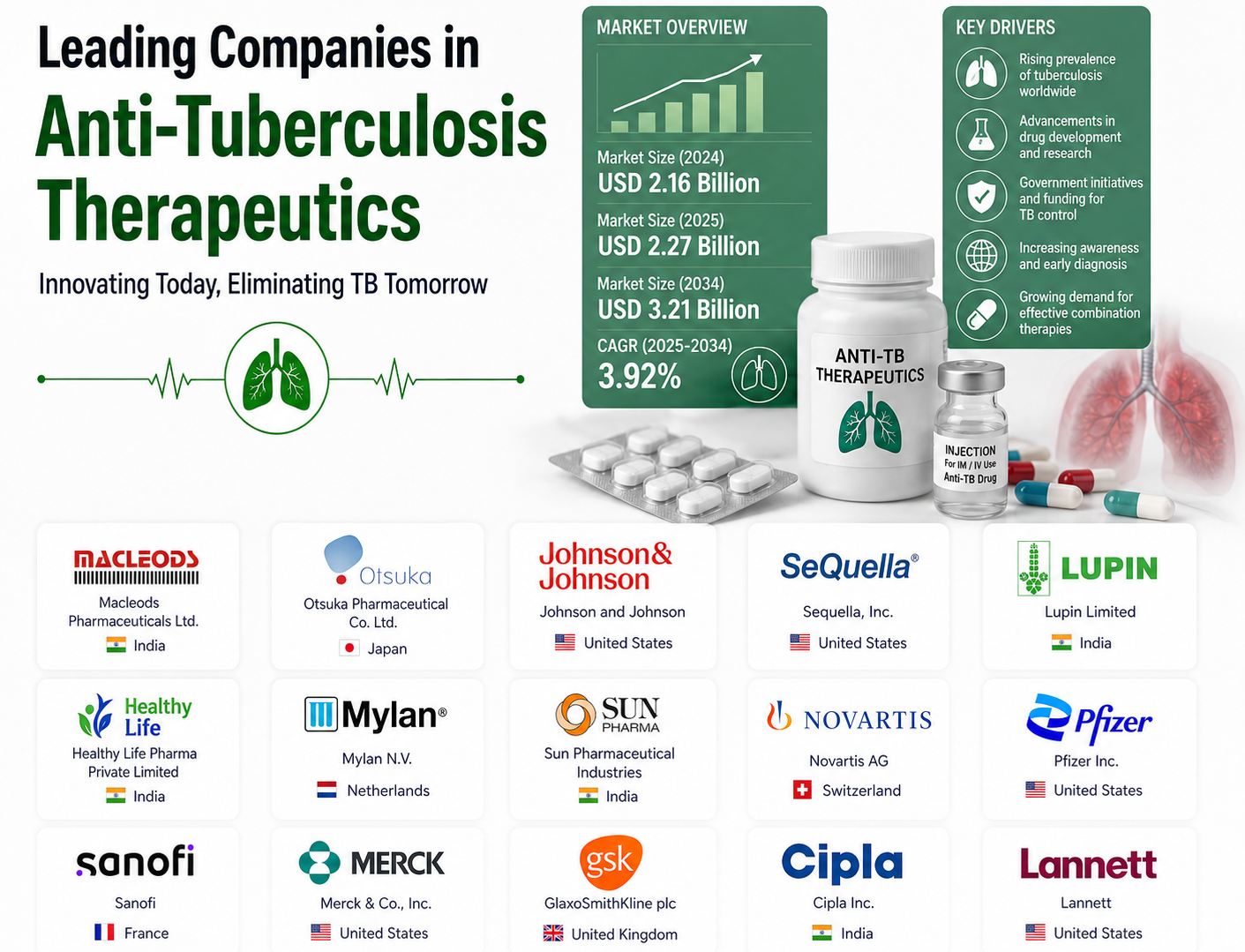
The global anti-tuberculosis therapeutics market was valued at approximately USD 1.71 billion in 2025 and is projected to reach USD 2.67 billion by 2034, expanding at a compound annual growth rate (CAGR) of 5.52% over the forecast period. Growth is being driven by the continued high prevalence of TB in developing nations, the rise of drug-resistant strains requiring more specialized treatment, and increased usage of combination therapy regimens, supported by sustained government and international funding for TB-eradication programs.
The competitive landscape is highly consolidated, dominated by a small number of large multinational pharmaceutical companies alongside specialized generic drug manufacturers based in India and Japan that produce much of the world's affordable TB medicine supply. Because TB drug development requires navigating long clinical trial timelines, complex regulatory pathways across high-burden countries, and partnerships with global health organizations, the market rewards companies that combine deep R&D capability with the manufacturing scale and distribution networks needed to reach patients in the highest-burden, often lowest-income regions.
Understanding which companies lead this public-health-critical market is essential for health systems, NGOs, and procurement bodies working to expand access to TB treatment. This article provides a research-based analysis of the top companies in the global anti-tuberculosis therapeutics market, their positioning, flagship offerings, and the regional and technological forces shaping the competitive landscape.
Market Overview
|
Parameter |
Details |
|---|---|
|
Market Size (2025) |
USD 1.71 Billion |
|
Projected Market Size (2034) |
USD 2.67 Billion |
|
CAGR (2025–2034) |
5.52% |
|
Base Year |
2023/2024 |
|
Historic Period |
2018–2023 |
|
Forecast Period |
2025–2034 |
|
Leading Region |
North America |
|
Fastest-Growing Region |
Asia-Pacific, led by India and China |
|
Key Growth Drivers |
High TB prevalence in developing nations, rise of drug-resistant TB strains, rising use of combination therapy |
|
Key Challenges |
Adverse side effects of anti-TB drugs, high cost of MDR and XDR TB drugs |
|
Key Opportunities |
Digital health tools for treatment adherence, growing demand for generic TB drugs, new regimens for drug-resistant TB |
Why the Anti-Tuberculosis Therapeutics Market Is Growing
1. High Prevalence of Tuberculosis in Developing Nations
TB remains highly prevalent worldwide, with the World Health Organization estimating around 10 million cases and 1.5 million deaths in 2020 alone, and this sustained disease burden continues to drive demand for anti-tuberculosis therapeutics, particularly across high-burden developing economies.
2. Rise of Drug-Resistant TB Strains
The emergence of multidrug-resistant (MDR) and extensively drug-resistant (XDR) TB strains is increasing demand for more potent, specialized second-line drugs and new combination regimens capable of overcoming resistance to standard first-line treatments.
3. Rising Use of Combination Therapy
Combination drug regimens that pair multiple TB medications are increasingly standard practice to suppress the risk of resistance developing to any single drug, driving demand across both first-line and second-line therapeutic categories.
4. Government and International Funding for TB Eradication
Sustained investment from governments and international organizations in TB-eradication programs, including expanded healthcare infrastructure and training, is improving accessibility of anti-tuberculosis therapeutics to populations in need.
5. Increasing Use of Digital Health Technologies
Mobile apps and telemedicine are increasingly being used to monitor patient adherence to TB medication regimens and provide remote consultations, improving treatment outcomes and expanding access in underserved areas.
6. Rising Demand for Generic TB Drugs
The high cost of branded drugs is driving growing demand for generic anti-tuberculosis medications, particularly in developing countries where TB is most prevalent, supporting the continued growth of the generics segment.
Top Companies in the Global Anti-Tuberculosis Therapeutics Market
- Johnson and Johnson
- Novartis AG
- Sanofi
- Pfizer Inc.
- Lupin Limited
- Otsuka Pharmaceutical Co. Ltd
- Macleods Pharmaceuticals Ltd
- Sun Pharmaceutical Industries
- Merck & Co., Inc.
- GlaxoSmithKline plc
- Cipla Inc.
1. Johnson and Johnson
|
Category |
Details |
|---|---|
|
Company Name |
Johnson & Johnson |
|
Headquarters |
New Brunswick, New Jersey, United States |
|
Founded |
1886 |
|
Employees |
Approx. 138,200 (group-wide) |
|
Revenue |
Approx. USD 94.19 Billion (group-wide, FY2025) |
|
Company Overview |
Johnson & Johnson is a global healthcare giant whose Innovative Medicine division includes bedaquiline, a key drug used in modern multidrug-resistant TB regimens, as part of a broader pharmaceutical portfolio spanning oncology, immunology, and neuroscience alongside its medical technology business. |
|
Key Products |
Bedaquiline (SIRTURO), a core component of shorter, more effective regimens for drug-resistant TB, alongside a broad portfolio of innovative medicines. |
|
Market Position |
One of the largest global pharmaceutical companies and a leading player in the TB space through its bedaquiline franchise, which has become central to WHO-recommended regimens for drug-resistant TB. |
|
Recent Developments |
Continued its long-standing corporate commitment against tuberculosis, including digital public health initiatives in India developed jointly with the Union Ministry of Health's Central TB Division and USAID. |
|
Strategic Advantages |
Deep R&D investment capacity, an extensive global regulatory and distribution footprint, and a multi-decade corporate commitment to TB elimination programs alongside public health partners. |
2. Lupin Limited
|
Category |
Details |
|---|---|
|
Company Name |
Lupin Limited |
|
Headquarters |
Mumbai, Maharashtra, India |
|
Founded |
1968 |
|
Employees |
Approx. 19,000–28,000 |
|
Revenue |
Approx. USD 2.6–3.1 Billion |
|
Company Overview |
Lupin is a leading Indian multinational pharmaceutical company with a long-standing presence in the anti-TB and cephalosporins segments, alongside cardiovascular, diabetology, and respiratory therapy areas, operating across India, the United States, and other regulated and emerging markets. |
|
Key Products |
Generic and branded anti-tuberculosis formulations, and pretomanid, licensed as part of the three-drug BPaL regimen for drug-resistant TB. |
|
Market Position |
A top generics manufacturer with commercialization rights to pretomanid across approximately 140 countries and territories, including many of the world's highest TB-burden nations. |
|
Recent Developments |
Commercializes pretomanid under a non-exclusive license granted by the non-profit TB Alliance, expanding access to the BPaL regimen across high-burden countries. |
|
Strategic Advantages |
Deep manufacturing scale across India, the US, Mexico, and Brazil, an established generics distribution network in high-TB-burden markets, and a dedicated non-profit partnership supporting affordable regimen access. |
3. Otsuka Pharmaceutical Co. Ltd
|
Category |
Details |
|---|---|
|
Company Name |
Otsuka Pharmaceutical Co., Ltd. (subsidiary of Otsuka Holdings Co., Ltd.) |
|
Headquarters |
Tokyo, Japan |
|
Founded |
1964 (Otsuka Pharmaceutical); Otsuka Holdings founded 2008 |
|
Employees |
Approx. 35,000 (Otsuka Holdings group-wide) |
|
Revenue |
Approx. ¥1.74 Trillion (Otsuka Pharmaceutical); Otsuka Holdings group revenue in the multi-billion-dollar range |
|
Company Overview |
Otsuka is a Japanese pharmaceutical company that has remained committed to TB drug research since the 1970s, when many other developers abandoned the field, ultimately developing delamanid, one of the newest anti-TB drugs approved globally in over 40 years. |
|
Key Products |
Delamanid (DELTYBA), used in WHO-recommended oral regimens for multidrug- and rifampicin-resistant TB, and quabodepistat, a late-stage TB treatment candidate in Phase III trials. |
|
Market Position |
A pioneering player in drug-resistant TB treatment, with delamanid available in more than 120 countries and a comprehensive access and stewardship plan supporting its pipeline candidate quabodepistat. |
|
Recent Developments |
Contributed delamanid tablets to the Stop TB Partnership's Global Drug Facility Strategic Rotating Stockpile to expand access in low- and middle-income countries, and advanced quabodepistat through Phase III combination trials. |
|
Strategic Advantages |
Multi-decade specialized R&D commitment to TB despite it being a historically under-invested therapeutic area, established partnerships with global health stockpile programs, and a differentiated pipeline targeting pediatric and drug-resistant TB populations. |
4. Novartis AG
|
Category |
Details |
|---|---|
|
Company Name |
Novartis AG |
|
Headquarters |
Basel, Switzerland |
|
Founded |
1996 |
|
Employees |
Approx. 75,000–76,000 |
|
Revenue |
Approx. USD 54–57 Billion |
|
Company Overview |
Novartis is a major global pharmaceutical corporation with a long history in infectious disease research, including anti-tuberculosis drug development and its historical role in TB treatment innovation, alongside core focus areas in oncology, immunology, and neuroscience. |
|
Key Products |
Historical and ongoing contributions to TB drug formulations and combination therapies as part of its broader established medicines and innovative medicines portfolio. |
|
Market Position |
One of the world's largest pharmaceutical companies by revenue, leveraging its global scale and R&D infrastructure to support infectious disease programs including TB. |
|
Recent Developments |
Continued to prioritize innovative medicine development across therapeutic areas, with ongoing investment in global health partnerships supporting access to essential medicines in high-burden regions. |
|
Strategic Advantages |
Extensive global R&D infrastructure, a large-scale international manufacturing and distribution network, and long-standing engagement with global health access initiatives. |
5. Macleods Pharmaceuticals Ltd
|
Category |
Details |
|---|---|
|
Company Name |
Macleods Pharmaceuticals Ltd |
|
Headquarters |
Mumbai, Maharashtra, India |
|
Founded |
1989 |
|
Employees |
Approx. 14,000–24,000 |
|
Revenue |
Approx. ?9,672 Crore / USD 1.1–1.2 Billion (FY2025) |
|
Company Overview |
Macleods Pharmaceuticals is a vertically integrated Indian pharmaceutical company engaged in developing, manufacturing, and marketing formulations across several major therapeutic areas, including anti-infectives, with a significant presence in the anti-TB generics segment. |
|
Key Products |
Generic anti-tuberculosis formulations across solid oral, injectable, and other dosage forms, alongside a broader anti-infective and cardiovascular portfolio. |
|
Market Position |
Recognized as one of the largest market-share holders in the global anti-tuberculosis therapeutics market, reflecting its scale as a vertically integrated generics manufacturer serving high-TB-burden markets. |
|
Recent Developments |
Continued expanding its global formulation manufacturing and distribution capacity, reporting steady revenue growth in its most recent fiscal year. |
|
Strategic Advantages |
Vertically integrated manufacturing that supports cost-competitive generic production, a broad multi-dosage-form product portfolio, and an established presence in high-TB-burden export markets. |
Competitive Landscape
The global anti-tuberculosis therapeutics market is highly consolidated, with a small number of large multinational pharmaceutical companies such as Johnson & Johnson, Novartis, Sanofi, and Pfizer holding a significant share alongside specialized generics manufacturers such as Lupin, Macleods Pharmaceuticals, and Sun Pharmaceutical Industries that produce much of the world's affordable TB drug supply.
R&D Investment as a Barrier to Entry: Developing new anti-TB drugs requires navigating long clinical trial timelines and complex regulatory pathways, favoring large multinational companies like Johnson & Johnson and Otsuka with the R&D infrastructure to sustain multi-decade drug development programs.
Generics Manufacturing Scale: Indian generics manufacturers such as Lupin and Macleods Pharmaceuticals compete on vertically integrated, cost-efficient production scale, positioning them as critical suppliers of affordable TB medication to high-burden, price-sensitive markets.
Global Health Partnerships as a Differentiator: Companies that maintain strong relationships with organizations like the TB Alliance and the Stop TB Partnership's Global Drug Facility, such as Lupin and Otsuka, gain differentiated access to supply agreements that expand their reach into the highest-burden countries.
Innovation in Drug-Resistant TB Treatment: As drug-resistant TB strains become more prevalent, companies with differentiated pipelines targeting MDR and XDR TB, such as Johnson & Johnson's bedaquiline and Otsuka's delamanid and quabodepistat, hold a structural advantage in capturing the fastest-growing segment of the market.
Regional Analysis
North America
North America is expected to grow steadily due to the region's strong healthcare infrastructure, presence of major pharmaceutical companies, and increasing prevalence of TB, with the United States dominating regional demand.
Europe
Europe's market is expected to grow at a moderate pace, driven by well-established healthcare systems and high drug reimbursement levels in Western European countries, even as the region's overall TB incidence declines.
Asia-Pacific
Asia-Pacific is expected to grow rapidly, driven by the high burden of TB in India and China, which together account for a significant share of the global TB burden, alongside increasing availability of generic TB drugs and government and NGO efforts to improve diagnosis and treatment.
Latin America
Latin America's market is expected to grow at a moderate pace, dominated by Brazil and Mexico, which have well-established healthcare systems alongside declining TB incidence and increasing availability of generic TB drugs.
Middle East and Africa
The Middle East and Africa market is expected to grow at a moderate pace, dominated by South Africa, which has the highest TB incidence in the region, supported by increasing availability of generic drugs and ongoing government and NGO efforts.
Emerging Trends in the Anti-Tuberculosis Therapeutics Market
1. Digital Health Integration in TB Treatment: Mobile apps and telemedicine platforms are increasingly used to monitor patient medication adherence and provide remote consultations, improving treatment completion rates in both developed and developing markets.
2. Growth of Generic Drug Adoption: Rising demand for generic anti-tuberculosis drugs, particularly in developing countries, is driving continued growth in the generics segment as patients and health systems seek more affordable treatment options.
3. New Regimens for Drug-Resistant TB: Newer combination regimens like BPaL (bedaquiline, pretomanid, linezolid) are transforming treatment for multidrug-resistant TB, offering shorter, more effective courses compared to older, more prolonged treatment protocols.
4. Expanded Access Partnerships: Pharmaceutical companies are increasingly partnering with global health organizations like the TB Alliance and Global Drug Facility to expand access to newer TB drugs in low- and middle-income countries through stockpiling and licensing agreements.
5. Pediatric and Underserved Population Focus: Companies are increasingly developing formulations and conducting trials specifically targeting historically overlooked populations, including children, adolescents, and pregnant and breastfeeding women with drug-resistant TB.
Future Outlook (2025–2034)
The global anti-tuberculosis therapeutics market's trajectory toward USD 2.67 billion by 2034 reflects the persistent global burden of TB, particularly in developing nations, even as new drug-resistant strains continue to complicate treatment. The 5.52% CAGR forecast through 2034 assumes continued government and international funding for TB-eradication programs, ongoing growth in generic drug adoption, and continued innovation in combination regimens for drug-resistant TB.
Key investment themes include continued development of shorter, more effective regimens for MDR and XDR TB, expansion of digital health tools supporting treatment adherence, and deepening partnerships between pharmaceutical companies and global health organizations to expand access in the highest-burden regions. Leading companies including Johnson & Johnson, Lupin, Otsuka Pharmaceutical, and Novartis are likely to retain strong market positions by combining R&D innovation with the manufacturing scale and global health partnerships needed to reach patients in high-burden, often resource-constrained markets.
Frequently Asked Questions (FAQ)
1. What is the current size of the global anti-tuberculosis therapeutics market?
The global anti-tuberculosis therapeutics market was valued at approximately USD 1.71 billion in 2025 and is projected to reach USD 2.67 billion by 2034, growing at a CAGR of 5.52%.
2. Who are the top companies in the anti-tuberculosis therapeutics market?
Leading companies include Johnson and Johnson, Novartis, Sanofi, Pfizer, Lupin Limited, Otsuka Pharmaceutical, Macleods Pharmaceuticals, Sun Pharmaceutical Industries, Merck & Co., GlaxoSmithKline, and Cipla.
3. Which region dominates the anti-tuberculosis therapeutics market?
North America currently leads the market, while Asia-Pacific is expected to grow the fastest, driven by the high TB burden in India and China.
4. What is the forecast CAGR for the anti-tuberculosis therapeutics market?
The market is forecast to grow at a CAGR of 5.52% from 2025 to 2034.
5. What are the main growth drivers for this market?
Key drivers include the high prevalence of TB in developing nations, the rise of drug-resistant TB strains, and increasing use of combination therapy regimens.
6. What challenges does the anti-tuberculosis therapeutics industry face?
The industry's primary challenges are the adverse side effects associated with anti-TB drugs, which can reduce patient compliance, and the high cost of drugs used to treat multidrug-resistant and extensively drug-resistant TB strains.
7. Which segment drives the most anti-tuberculosis therapeutics demand?
First-line drugs remain the most commonly used treatment category for drug-susceptible TB, while second-line drugs are a smaller but faster-growing segment given the rising prevalence of drug-resistant TB strains.
Conclusion
The global anti-tuberculosis therapeutics market sits at the intersection of persistent global health need and continued pharmaceutical innovation against one of humanity's oldest infectious diseases. With a projected size of USD 2.67 billion by 2034 at a 5.52% CAGR, the sector offers steady growth potential for companies that can combine sustained R&D investment with the manufacturing scale and global health partnerships needed to reach high-burden, often resource-constrained markets.
Large multinational innovators like Johnson & Johnson and Otsuka Pharmaceutical have driven breakthrough treatments for drug-resistant TB, while generics manufacturers like Lupin and Macleods Pharmaceuticals ensure these and standard therapies remain affordable and accessible at scale. The companies that successfully balance continued innovation in drug-resistant TB regimens with expanded access partnerships and digital adherence tools will define market leadership through 2034 and beyond.