
Top 10 Leading Companies in the Global Microgreens Market
Author:
Intellectual Market Insights Research
Published Date:
22 Jun 2026
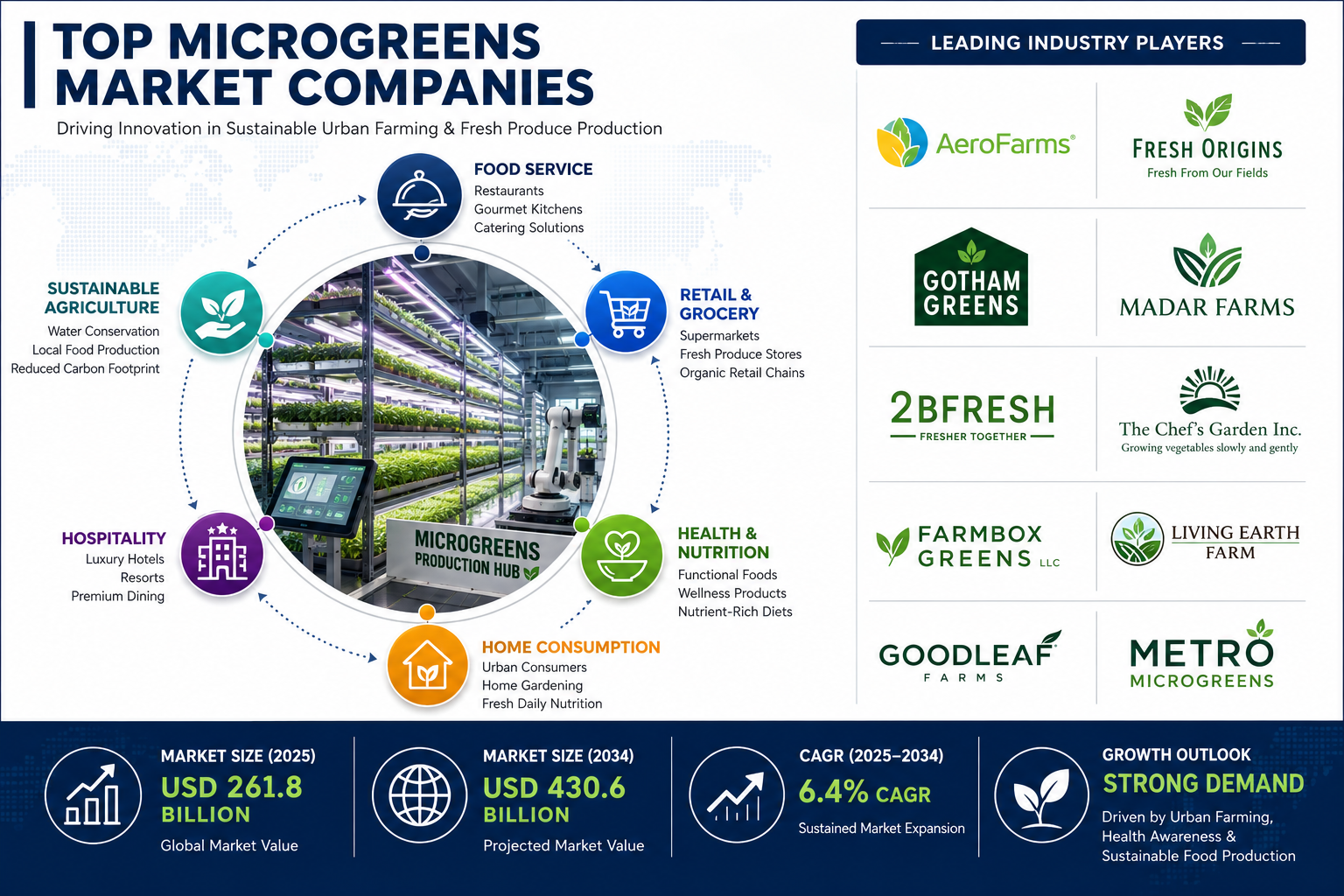
Top 10 Leading Companies in the Global Microgreens Market Driving Industry Growth in 2025
Food is the foundation of human health and the business of delivering it in its most nutritious, fresh, and sustainably produced form has become one of the world's most exciting and rapidly evolving industries. The Global Microgreens Market sits at the intersection of urban agriculture, nutritional science, culinary innovation, and food technology, making it a uniquely dynamic and increasingly competitive sector.
According to the latest market intelligence from Intellectual Market Insights Research (IMIR), the Global Microgreens Market was valued at approximately USD 261.8 Billion in 2025 and is projected to reach USD 430.6 Billion by 2034, advancing at a robust compound annual growth rate (CAGR) of 6.4% throughout the forecast period of 2025–2034. This sustained expansion over nearly a decade speaks not just to growing consumer appetite for fresh, nutrient-dense greens but to a profound transformation in how microgreens are cultivated, distributed, and consumed across global markets.
At its core, the microgreens market encompasses the full value chain of production, distribution, and sale of microgreens young, edible greens harvested from the seeds of vegetables, herbs, and flowers. These miniature plants are typically harvested within 7 to 21 days of germination, at the cotyledon stage, when their concentration of vitamins, antioxidants, and phytonutrients is at its peak. Key growing methods include indoor vertical farming, greenhouse cultivation, hydroponic systems, and conventional soil-based farming each playing a critical role in delivering fresh, high-quality microgreens to food manufacturers, restaurants, retailers, and health-conscious consumers across the world.
The industry's growth is being driven by multiple powerful and converging forces. First, a worldwide shift in consumer preference toward clean-label, plant-based, and nutrient-dense foods has positioned microgreens as one of the fastest-growing fresh produce categories globally. Second, escalating concerns about food safety, chemical residues in conventional produce, and the nutritional shortcomings of processed foods are pushing consumers in both developed and emerging economies to seek minimally processed, freshly grown food sources. Third, rapid urbanization particularly across Asia Pacific, North America, and Europe is generating vast new consumer bases with the purchasing power and health awareness to support premium microgreens products.
Perhaps most importantly, the technological backbone of microgreens production is evolving at an unprecedented pace. From AI-enabled smart indoor farming systems to energy-efficient LED grow lighting and soilless hydroponic cultivation platforms, companies that invest in next-generation growing technology are gaining decisive competitive advantages in this increasingly crowded market. Investment activity remains strong, with agri-tech startups, established food companies, and institutional investors alike allocating significant capital to R&D, vertical farm expansion, and sustainable packaging innovation.
The industry also faces serious headwinds: a persistent shortage of skilled agricultural labour, high upfront costs of indoor vertical farming infrastructure, limited crop variety diversity, and logistical challenges in maintaining freshness across extended supply chains. Nevertheless, the long-term trajectory of the market remains firmly positive, underpinned by demographic realities, expanding retail and online distribution channels, and the irreplaceable role of fresh, nutrient-dense microgreens in a world increasingly prioritizing preventive health and wellness.
Market Overview
|
Parameter |
Details |
|---|---|
|
Market Size (2025) |
USD 261.8 Billion |
|
Market Size (2034) |
USD 430.6 Billion |
|
CAGR (2025–2034) |
6.4% |
|
Forecast Period |
2025–2034 |
|
Base Year |
2024 |
|
Historical Data |
2019–2023 |
|
By Type |
Vegetable-based Microgreens, Herb-based Microgreens, Flower-based Microgreens, Others |
|
By Farming Method |
Indoor Farming, Greenhouse Farming, Conventional Farming |
|
By Distribution Channel |
Retail Stores, Online Stores, Foodservice Sector |
|
By End-Use |
Food & Beverage Industry, Nutraceuticals, Cosmetics |
|
Key Regions |
North America, Europe, Asia-Pacific, Latin America, MEA |
|
Dominant Region |
North America |
|
Fastest Growing Region |
Asia-Pacific |
Key Market Drivers:
- Surging global consumer demand for nutrient-dense, clean-label superfoods
- Rising health consciousness and preventive wellness lifestyle adoption worldwide
- Rapid expansion of indoor vertical farming and controlled environment agriculture (CEA)
- Growing adoption of microgreens in premium foodservice, fine dining, and restaurant chains
- Technological advancements in hydroponics, aeroponics, and LED-based grow systems
Key Market Opportunities:
- Expansion of online microgreens retail and direct-to-consumer subscription models
- Premiumization of microgreens products including functional, organic, and exotic varieties
- Sustainable packaging innovation for fresh produce (biodegradable trays, compostable films)
- Untapped market potential across South Asia, Southeast Asia, and Sub-Saharan Africa
- Integration of microgreens into nutraceuticals, cosmetics, and pharmaceutical formulations
Key Market Challenges:
- High upfront capital costs of indoor vertical farming infrastructure
- Shortage of skilled agricultural and agri-tech labor globally
- Limited variety diversity and consumer awareness in emerging markets
- Logistical challenges in maintaining freshness and cold-chain integrity across distribution networks
Why the Global Microgreens Market Is Growing
The trajectory of the microgreens market is no accident it is the result of powerful structural shifts reshaping how the world's population thinks about food, health, and sustainable agriculture.
1. Explosive Health and Wellness Consumption Growth
Consumer demand for functional, nutrient-dense foods has reached an inflection point. Microgreens contain up to 40 times more vitamins, antioxidants, and phytonutrients than their mature counterparts, making them one of the most nutrient-concentrated foods available. Growing awareness of their health benefits including cardiovascular protection, immunity support, and cancer-risk reduction is driving strong adoption across health-conscious demographics in North America, Europe, and Asia Pacific. As consumers increasingly substitute fresh, functional foods for processed alternatives, microgreens are emerging as a staple of the modern wellness diet.
2. The Rise of Indoor and Vertical Farming
Indoor vertical farming has fundamentally transformed the economics and geography of microgreens production. By cultivating crops in climate-controlled, AI-monitored environments using hydroponic, aeroponic, and geoponic systems, producers can deliver year-round output regardless of season, geography, or weather conditions. Technologies such as LED grow lighting, automated irrigation systems, and IoT-enabled environmental sensors have dramatically reduced production costs while improving yield consistency and nutritional quality. This technological revolution is enabling microgreens production to scale from artisan grow operations to industrial-scale urban farms capable of supplying major retail chains and food manufacturers.
3. Urbanization and Proximity to Consumer Markets
Rapid urbanization across Asia Pacific, Latin America, and Africa is creating millions of new consumers each year with growing disposable incomes and increasing health awareness. In major cities such as Tokyo, Shanghai, Mumbai, São Paulo, and Nairobi, the demand for fresh, locally grown produce is surging and microgreens, with their rapid grow cycle of 7 to 21 days and suitability for urban farming environments, are ideally positioned to meet this demand. The ability to produce microgreens in rooftop farms, repurposed warehouses, and urban vertical facilities directly adjacent to consumer markets also dramatically reduces supply chain carbon footprints and cold-chain logistical complexity.
4. Culinary Innovation and Foodservice Adoption
The global foodservice industry has been instrumental in elevating microgreens from a niche health food to a mainstream culinary ingredient. Michelin-starred chefs, upscale restaurant chains, hotel groups, and catering companies worldwide are incorporating microgreens as flavour-enhancing garnishes, salad ingredients, and nutritional additions to menus. In the United States alone, the adoption of microgreens in foodservice has surged dramatically, with organic vegetable growers tapping into this emerging and relatively low-competition market. As foodservice operators expand their use of microgreens, demand for consistent, high-volume, premium-quality supply is creating significant commercial opportunities for scaled producers.
5. Online Retail and Direct-to-Consumer Expansion
The rapid growth of e-commerce and online grocery platforms has opened a powerful new distribution channel for microgreens producers. Direct-to-consumer subscription models, online farmers' markets, and specialty food e-commerce platforms are enabling smaller microgreens growers to reach health-conscious consumers far beyond their local geographies. This democratization of access is accelerating market penetration across both urban and suburban demographics, while also enabling producers to capture higher margins by bypassing traditional retail intermediaries.
6. Sustainability and ESG Alignment
Microgreens production aligns strongly with ESG investment priorities. Indoor vertical farming uses up to 95% less water than conventional field farming, requires no pesticides or herbicides, generates minimal agricultural runoff, and can be powered by renewable energy. These environmental credentials are attracting significant venture capital, private equity, and institutional investment into the sector. Companies that can demonstrate measurable sustainability outcomes through certifications, lifecycle assessments, and transparent supply chain reporting are gaining preferential access to capital, retail partnerships, and premium consumer segments.
Top 10 Companies in the Global Microgreens Market
- AeroFarms
- Fresh Origins
- Gotham Greens
- Madar Farms
- 2BFresh
- The Chef's Garden Inc.
- Farmbox Greens LLC
- Living Earth Farm
- Good Leaf Farms
- Metro Microgreens
1. AeroFarms
Headquarters: Newark, New Jersey, USA
Founded: 2004
Employees: Approx. 200 (2025)
Revenue: ~USD 30 Million (2025)
Regional Analysis: Strong presence in North America, with pilot projects expanding into Europe and the Middle East.
Overview: AeroFarms is a global pioneer in indoor vertical farming and one of the most recognized names in commercial microgreens production. Leveraging its proprietary aeroponic growing technology, AeroFarms cultivates a wide variety of microgreens including arugula, kale, and radish without soil and with up to 95% less water than conventional field farming. The company's state-of-the-art indoor farms use AI-driven LED lighting, real-time data analytics, and precision climate-controlled environments to deliver year-round, consistent, high-yield output.
AeroFarms supplies premium microgreens to leading restaurants, grocery chains, and foodservice operators across the United States. Its deep commitment to sustainability, food safety, and technological innovation has established it as a benchmark player in the commercial microgreens space, and its aeroponic platform is widely regarded as the most advanced in the industry.
2. Fresh Origins
Headquarters: San Marcos, California, USA
Founded: 1995
Employees: Approx. 150 (2025)
Revenue: ~USD 20 Million (2025)
Regional Analysis: Dominant in North America, particularly within the premium foodservice and fine dining segment.
Overview: Fresh Origins is widely credited as the original pioneer of microgreens for the culinary market in the United States, having introduced chefs to these miniature greens more than three decades ago. The company grows over 500 varieties of microgreens, edible flowers, and specialty crops from its Southern California farms, supplying some of the world's most prestigious restaurants, luxury hotels, and catering operations.
Fresh Origins operates using sustainable greenhouse and outdoor growing methods, prioritizing flavour integrity, visual presentation, and culinary versatility. Its range spans petite greens, herb-based microgreens, flower-based microgreens, and an extraordinary array of specialty crops. Decades of chef partnerships and culinary innovation continue to drive strong, loyal demand across the premium foodservice sector.
3. Gotham Greens
Headquarters: New York, New York, USA
Founded: 2009
Employees: Approx. 500 (2025)
Revenue: ~USD 100 Million (2025)
Regional Analysis: Strong presence across North America, with urban greenhouse farms operating in New York, Chicago, Denver, Providence, and other major U.S. cities.
Overview: Gotham Greens is a leading urban agriculture company specializing in greenhouse-grown microgreens, salad greens, and fresh herbs. The company operates technologically advanced rooftop and ground-level urban greenhouse facilities, delivering locally grown, pesticide-free produce directly to retail stores, foodservice distributors, and restaurants across the country.
Gotham Greens' microgreens lineup spans basil, arugula, butterhead blends, and specialty varieties, all grown using minimal water and zero agricultural chemicals. Its urban farm model dramatically reduces transportation distances, ensuring unmatched freshness, reduced supply chain emissions, and a compelling local sourcing narrative that resonates strongly with today's sustainability-focused retailers and consumers.
4. Madar Farms
Headquarters:
Founded:
Employees:
Revenue:
Regional Analysis:
Overview:
5. 2BFresh
Headquarters:
Founded:
Employees:
Revenue:
Regional Analysis:
Overview:
6. The Chef's Garden Inc.
Headquarters:
Founded:
Employees:
Revenue:
Regional Analysis:
Overview:
Competitive Landscape
The global microgreens market is characterized by moderate market concentration at the premium brand and commercial producer level, but significant fragmentation at the regional grower, agri-tech supplier, and indoor farming technology level.
Among commercial microgreens producers and brands, a small group of established players AeroFarms, Fresh Origins, Gotham Greens, The Chef's Garden, and Good Leaf Farms collectively command a dominant share of premium revenue in North America and Europe. However, the market is far from a pure oligopoly; regional urban farms, artisan microgreens growers, community-supported agriculture operations, and fast-growing agri-tech startups are consistently challenging established incumbents across geographies and distribution channels.
At the indoor farming technology and agri-tech supplier level, the competitive landscape is shaped by specialist companies providing hydroponic systems, aeroponic platforms, LED grow lighting, IoT-enabled crop monitoring software, and controlled environment agriculture (CEA) solutions. These companies compete on energy efficiency, yield optimization, ease of operation, and integration with digital farm management platforms and are increasingly differentiating through AI-powered predictive analytics, automated harvesting systems, and proprietary seed-to-shelf traceability solutions.
Key Competitive Trends:
Mergers and Acquisitions: The microgreens and broader indoor farming sector has seen growing consolidation activity as investors seek scale, technology access, and geographic diversification. Notable activity includes venture capital-backed acquisitions of regional urban farms by larger agri-tech platforms, and strategic investments by major food and beverage conglomerates seeking to vertically integrate premium fresh produce supply chains. M&A activity is expected to intensify through 2034 as the market matures and larger players seek to consolidate fragmented regional production networks.
Partnerships and Collaborations: Strategic partnerships between microgreens producers and foodservice operators, retail chains, meal kit delivery services, and nutraceutical companies are accelerating market penetration and supply chain integration. Technology collaborations between indoor farming operators and LED manufacturers, hydroponic system developers, and AI software companies are enabling producers to reduce costs, improve yields, and scale operations more efficiently. FMCG companies are increasingly partnering with microgreens producers to develop branded functional food and beverage products incorporating microgreens extracts and ingredients.
Innovation Strategies: Leading players are investing in AI-enabled crop monitoring, next-generation aeroponic and aquaponic growing systems, sustainable biodegradable packaging, proprietary seed development, and functional microgreens product formulations as core innovation priorities. Companies that successfully combine agronomic expertise with digital technology and sustainability credentials are establishing durable competitive advantages in this rapidly evolving market.
Regional Competitive Landscape
North America dominates the global microgreens market, accounting for the largest revenue share in 2025. The United States leads driven by rapid adoption of indoor vertical farming technology, high health consciousness among consumers, and strong demand from the premium foodservice and fine dining sector. The organic and clean-label food movement in the U.S. and Canada continues to generate robust, sustained demand for commercially produced microgreens across retail, foodservice, and direct-to-consumer channels.
Europe holds a substantial market share driven by growing health-conscious populations, extensive protected cultivation infrastructure, and a well-established food safety and organic certification ecosystem. Countries including Germany, France, the UK, the Netherlands, and the Nordic nations are emerging as key innovation hubs for microgreens cultivation technology and premium product development.
Asia-Pacific is the fastest-growing regional market, propelled by rapidly rising health awareness, increasing disposable incomes, and surging demand for functional and organic food products across China, Japan, India, South Korea, and ASEAN nations. China and Japan lead production and consumption within the region, leveraging technological innovation and established horticulture expertise. India represents one of the most significant untapped growth opportunities globally, as growing urban middle-class populations increasingly seek premium, fresh, and nutritious food options.
Middle East and Africa is an emerging growth region, driven by food security imperatives, smart city investments, and the adoption of controlled-environment agriculture technologies in water-scarce geographies. The UAE and Saudi Arabia are leading regional adoption through sovereign-funded agricultural diversification programs.
Latin America represents a nascent but growing opportunity, with Brazil and Mexico emerging as early adopters among foodservice operators and health-focused urban consumers.
Emerging Trends Shaping the Global Microgreens Market
1. Smart and Connected Indoor Farming Technology
The integration of IoT sensors, AI-powered crop monitoring platforms, and cloud-connected farm management systems is fundamentally transforming microgreens production economics. Leading producers are deploying real-time environmental monitoring systems that track temperature, humidity, CO? levels, light intensity, and nutrient solution composition with precision enabling predictive intervention, waste reduction, and yield optimization at scale. Digital twin technology is emerging as a particularly powerful tool, enabling producers to simulate and optimize growing conditions before implementing changes in live production environments. Expect continued investment in smart farming infrastructure as the cost of sensors, connectivity, and AI processing continues to fall.
2. Sustainable and Biodegradable Packaging
Consumer and regulatory pressure on single-use plastic packaging is accelerating innovation in sustainable fresh produce packaging across the microgreens sector. Leading producers are transitioning to compostable trays made from plant-based PHA and PLA bioplastics, exploring mushroom-based and cellulose-fibre packaging formats, and investing in recyclable modified atmosphere packaging (MAP) technologies that extend shelf life without synthetic materials. Light-weighting of conventional plastic clamshell packaging remains a near-term engineering priority, while fully plastic-free packaging solutions are an emerging medium-term goal for sustainability-leading brands.
3. Functional and Nutraceutical Integration
The functional food and nutraceutical segment is emerging as one of the most exciting growth frontiers for microgreens producers. Scientific research consistently demonstrates that microgreens contain extraordinary concentrations of vitamins C, E, and K, beta-carotene, lutein, and sulforaphane compounds with well-documented cardiovascular, anti-inflammatory, and cancer-preventive properties. This evidence base is driving demand for microgreens extracts, powders, and concentrates as active ingredients in dietary supplements, functional beverages, protein bars, and cosmetic formulations. This trend is creating significant new revenue streams for producers capable of supplying food-grade microgreens ingredients at commercial scale, requiring specialized processing, drying, and extraction technologies.
4. Vertical Farming Expansion and Cost Reduction
As LED lighting efficiency improves, aeroponic system costs decline, and automation technology matures, the economics of indoor vertical microgreens farming are becoming increasingly compelling for producers across a wider range of geographies and scales. Modular vertical farming systems deployable in shipping containers, repurposed warehouses, rooftop spaces, and purpose-built urban agricultural facilities are enabling producers to establish localized production close to consumer markets with dramatically lower capital and operational costs than first-generation vertical farms required. This technological democratization is expanding the competitive landscape significantly, enabling new entrants across emerging markets in Asia Pacific, Latin America, and Africa.
5. PFAS and Food Safety Monitoring
Growing regulatory and consumer scrutiny of chemical contamination in fresh produce including pesticide residues, heavy metals, and emerging contaminants is driving investment in enhanced analytical testing and food safety certification across the microgreens sector. Producers operating indoor hydroponic and aeroponic systems are well-positioned to demonstrate superior food safety credentials relative to conventionally farmed produce, given their chemical-free, controlled growing environments. However, ensuring the safety of water inputs, growing media, and seed treatments remains an important quality assurance priority and investment in robust food safety testing protocols is increasingly a prerequisite for access to premium retail and foodservice partnerships.
6. Premiumization and Specialty Variety Development
Consumer willingness to pay a premium for microgreens with verifiable organic certification, documented nutritional profiles, heirloom seed provenance, and artisan growing credentials is supporting the growth of premium microgreens brands globally. This premiumization trend is encouraging investment in proprietary seed development, specialty variety cultivation including rare herbs, edible flowers, and exotic vegetable microgreens and premium packaging formats that communicate quality, provenance, and nutritional value. Direct-to-consumer subscription models offering curated weekly microgreens assortments are a particularly effective channel for premium brand building and high-margin revenue generation.
Future Outlook (2025–2034)
The Global Microgreens Market is poised for sustained and structurally driven growth through 2034. Several macro trends will define the competitive landscape over the coming decade:
Technology-Driven Cost Reduction: Continued advances in LED efficiency, aeroponic system design, AI-enabled crop monitoring, and automated harvesting technologies will progressively reduce the cost of indoor microgreens production, enabling smaller producers to achieve commercial viability and larger players to expand margins.
Retail and E-Commerce Expansion: The proliferation of online grocery platforms, meal kit delivery services, and direct-to-consumer subscription models will dramatically expand the accessible market for microgreens producers, particularly in geographies currently underserved by specialty fresh produce retail.
Nutraceutical and Functional Food Integration: As scientific evidence for the health benefits of microgreens continues to accumulate, their integration into nutraceuticals, dietary supplements, functional beverages, and cosmetics formulations will open significant new revenue streams beyond the fresh produce category.
Sustainability as Competitive Advantage: ESG alignment will increasingly become a prerequisite for accessing institutional retail partnerships, venture capital funding, and premium consumer segments. Producers capable of demonstrating measurable sustainability outcomes water efficiency, zero chemical inputs, renewable energy use, and minimal packaging waste will command superior market positioning and pricing power.
Geographic Expansion into Emerging Markets: South Asia, Southeast Asia, Sub-Saharan Africa, and Latin America represent the next great frontier for microgreens market development, driven by urbanization, income growth, and rising health awareness. Early movers establishing production, distribution, and brand presence in these geographies will be positioned for outsized long-term returns.
FAQ Section: Global Microgreens Market
Q1: What is the current size of the Global Microgreens Market?
The Global Microgreens Market was valued at approximately USD 261.8 Billion in 2025 and is projected to reach USD 430.6 Billion by 2034, growing at a CAGR of 6.4% over the forecast period from 2025 to 2034, according to Intellectual Market Insights Research (IMIR).
Q2: Who are the leading companies in the Global Microgreens Market?
The leading companies include AeroFarms (aeroponic indoor farming), Fresh Origins (culinary specialty microgreens), Gotham Greens (urban greenhouse farming), Madar Farms (Middle East vertical farming), 2BFresh (Israeli agri-tech), The Chef's Garden Inc. (premium specialty produce), Farmbox Greens LLC (Pacific Northwest sustainable growing), Living Earth Farm (certified organic microgreens), Good Leaf Farms (Canada's largest indoor vertical farm), and Metro Microgreens (community-scale artisan production).
Q3: Which region dominates the Global Microgreens Market?
North America currently dominates the Global Microgreens Market, driven by rapid adoption of indoor vertical farming technology, strong consumer health consciousness, high per capita spending on premium fresh produce, and robust demand from the fine dining and premium foodservice sector. The United States leads within the region, supported by a well-developed organic food retail ecosystem and a highly innovative agri-tech investment community. Asia-Pacific is expected to be the fastest-growing region through 2034.
Q4: What are the primary growth drivers of the Global Microgreens Market?
Key drivers include surging global consumer demand for nutrient-dense and clean-label superfoods, the rapid expansion of indoor vertical farming and controlled environment agriculture, growing adoption of microgreens in premium foodservice and restaurant chains, rising health consciousness and preventive wellness lifestyle trends globally, technological advancements in hydroponics and aeroponics, and the explosive growth of online retail and direct-to-consumer distribution channels.
Q5: What is the projected CAGR of the Global Microgreens Market?
The Global Microgreens Market is forecast to grow at a CAGR of 6.4% from 2025 to 2034, according to Intellectual Market Insights Research.
Q6: What farming methods are used in microgreens production?
The primary farming methods include indoor vertical farming using hydroponic, aeroponic, and geoponic systems; greenhouse farming offering semi-controlled outdoor environments; and conventional soil-based farming used by smaller-scale and artisan producers. Indoor farming dominates commercial production due to its ability to deliver year-round, consistent, high-yield output in any geographic location regardless of seasonal conditions.
Q7: What are the main product types in the microgreens market?
The primary product categories are vegetable-based microgreens (arugula, kale, broccoli, radish dominant segment), herb-based microgreens (basil, cilantro, parsley, dill), flower-based microgreens (nasturtium, sunflower, marigold), and other specialty varieties including amaranth, wheatgrass, and mustard greens. Each category serves distinct consumer preferences and culinary applications across foodservice, retail, and nutraceutical end-use segments.
Q8: What is the biggest challenge facing the Global Microgreens Market?
Q9: What opportunities exist in the Global Microgreens Market?
Q10: Which country has the largest microgreens production capacity?
Q11: What is the difference between indoor farming and greenhouse farming for microgreens?
Q12: How are AI and digital technologies being used in microgreens farming?
Q13: What are the key segments of the Global Microgreens Market?
Q14: How does the premiumization trend impact the Global Microgreens Market?
Q15: What is the future outlook for the Global Microgreens Market through 2034?
Conclusion
The Global Microgreens Market stands as one of the most dynamic, nutritionally significant, and rapidly evolving sectors within the broader fresh produce, urban agriculture, and functional food landscape. Growing from approximately USD 261.8 Billion in 2025 to a projected USD 430.6 Billion by 2034 at a CAGR of 6.4%, the market's sustained trajectory reflects the convergence of irreversible health and wellness megatrends, accelerating indoor farming technology innovation, and the critical role of fresh, nutrient-dense microgreens in addressing the world's growing appetite for clean, functional, and sustainably produced food.
The companies profiled in this article spanning pioneering indoor vertical farming operators like AeroFarms and Gotham Greens; premium culinary specialists including Fresh Origins and The Chef's Garden; regional agri-tech innovators such as Madar Farms and 2BFresh; and community-scale artisan producers like Farmbox Greens, Living Earth Farm, Good Leaf Farms, and Metro Microgreens collectively represent the full ecosystem of innovation, investment, and competitive intensity shaping this market in 2025 and beyond.
For investors, procurement professionals, foodservice operators, retail buyers, and strategic decision-makers, understanding the dynamics of this market from the promise of AI-driven vertical farming cost reduction and nutraceutical market integration, to the challenges of skilled labor shortages and cold-chain logistics is essential for identifying where opportunity lies and where risk must be managed. The global microgreens industry is not merely a fresh produce business: it is a technology-driven, innovation-intensive, and increasingly sustainability-defined sector whose evolution will shape how millions of people around the world access the most nutrient-dense, freshest, and most sustainably grown food available for decades to come.


