
Top 10 Leading Companies in the Global Moringa Ingredients Market
Author:
Intellectual Market Insights Research
Published Date:
07 Jul 2026
Market Overview
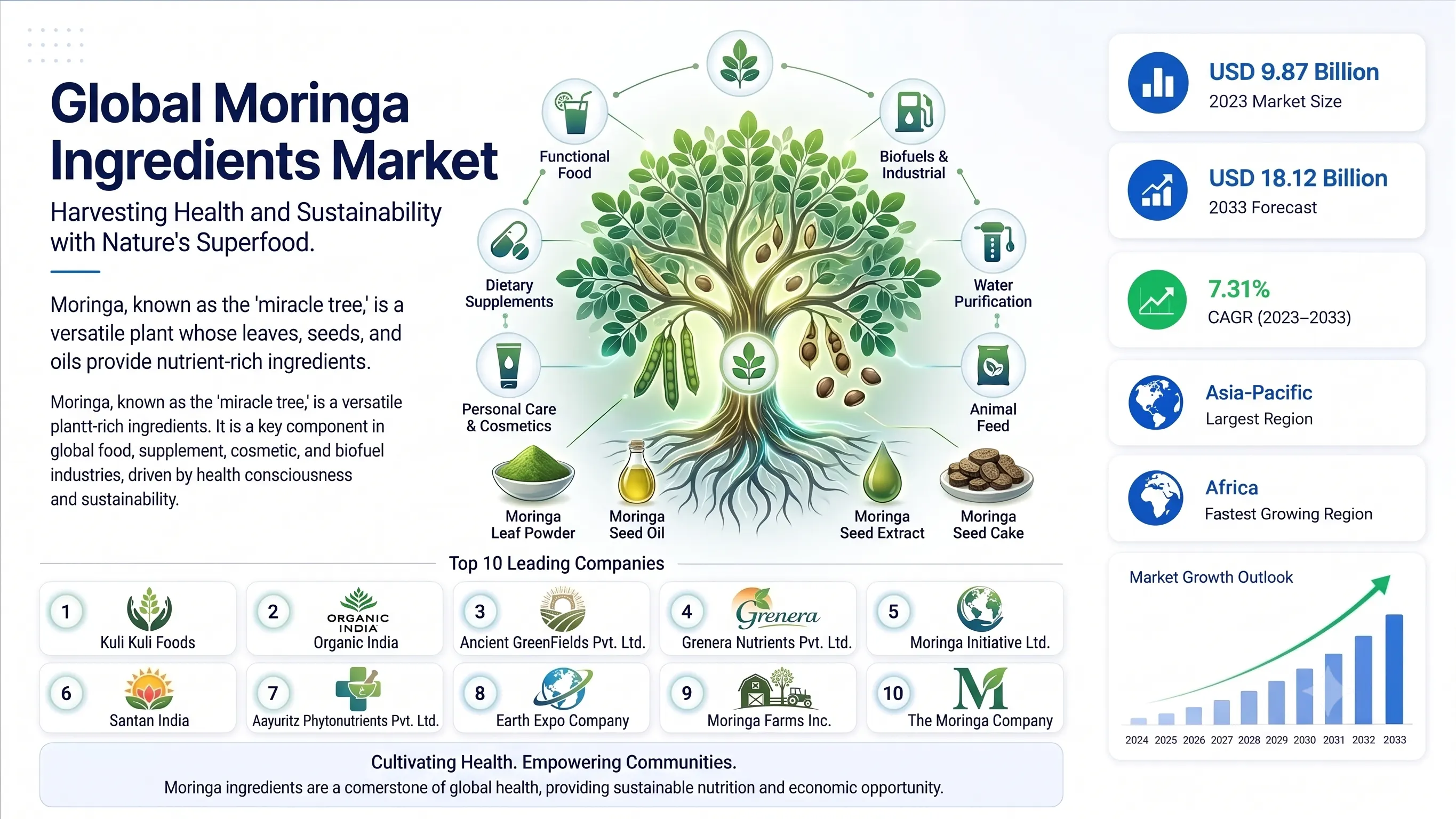
Moringa oleifera — the "drumstick tree" — has moved from a traditional South Asian and African staple into a mainstream global ingredient over the past decade. Its leaves, seeds, pods, and oil are now processed into powders, capsules, teas, and cold-pressed oils used across dietary supplements, functional foods and beverages, and cosmetics. Growth is being pulled forward by three durable trends: rising consumer preference for clean-label, plant-based nutrition; expanding use of moringa oil in skincare and hair care; and government-backed cultivation programs in producing regions like India, which sees moringa (drumstick) as a high-potential export crop.
Independent market-research estimates vary depending on scope and methodology, but they consistently point to high single-digit to low double-digit compound annual growth through the early-to-mid 2030s, with the addressable market's value cited anywhere from roughly $8 billion to $25 billion depending on which product and application segments are included and the forecast horizon used. What all of these estimates agree on is the direction: moringa is graduating from a niche wellness ingredient to a scalable, B2B-traded commodity feeding the dietary supplements, herbal supplements, and broader plant-based protein supply chains.
The market remains structurally fragmented. Unlike categories dominated by two or three multinational giants, moringa ingredients are supplied by a mix of India-based agri-processors with vertically integrated farm-to-powder operations, mission-driven North American consumer brands sourcing from African smallholder cooperatives, and a long tail of regional players. That fragmentation is itself a growth driver — it keeps entry barriers relatively low for purpose-driven brands while pushing established players to differentiate on traceability, certification, and supply-chain storytelling.
For a full data breakdown — including historical sizing, segment-level forecasts, and country-level detail — see the complete Moringa Ingredients Market report.
Growth Drivers
Health and wellness demand. Moringa's nutrient density — high vitamin A, iron, calcium, and antioxidant content relative to common greens — continues to drive adoption in the supplement and functional-food aisles, adjacent to the broader wellness supplements and omega-3 supplements categories.
Clean-label and organic positioning. Retailers and consumers increasingly favor single-ingredient, recognizable superfoods over synthetic additives, a dynamic also fueling adjacent categories like plant-based beverages and herbal supplements.
Government and export-led cultivation programs. India's push to expand drumstick cultivation and value-added processing for export is expanding raw-material supply, complementing broader agriculture sector investment in smallholder crop value chains.
Expanding cosmetics and personal-care use. Moringa seed oil's stability and fatty-acid profile (comparable to olive oil) is driving uptake in moisturizers, hair treatments, and massage oils.
E-commerce and DTC distribution. Digital channels have lowered the barrier for smaller and mission-driven brands to reach global consumers directly, accelerating brand discovery well beyond traditional retail footprints.
Investment in processing technology. Techniques such as cold-press extraction, freeze-drying, and PCR-based authentication (to guard against adulteration) are improving both product quality and buyer confidence in export-grade material.
Market Challenges
Thin scientific consensus. While moringa has centuries of traditional use, the clinical evidence base for many marketed health claims is still developing, which can limit uptake among more conservative buyers and regulators.
Agricultural and quality variability. Yield and nutrient content are sensitive to soil, climate, and harvesting practices, making consistent quality control harder for smaller producers.
Certification and export costs. Organic certification and food-safety compliance (needed to sell into North America, Europe, and Japan) is capital-intensive for smallholder-linked supply chains, a challenge shared with other emerging superfood categories tracked in the specialty ingredients market.
Fragmented competition and pricing pressure. With no dominant global leader, price competition among mid-size processors can compress margins, particularly for undifferentiated bulk leaf powder.
Processing infrastructure gaps. Techniques like aqueous enzymatic oil extraction require tight control of pH, enzyme activity, and temperature — technical capability many smaller producers still lack.
Top 10 Leading Companies in the Global Moringa Ingredients Market
Ranking is based on a composite view of product breadth, geographic reach, brand recognition, supply-chain integration, and how consistently each company appears across independent industry analyses (Mordor Intelligence, Grand View-style research houses, SkyQuest, Zion Market Research, Straits Research, and Intellectual Market Insights' own coverage).
- Kuli Kuli Foods
- Organic India
- Ancient GreenFields Pvt. Ltd.
- Grenera Nutrients Pvt. Ltd.
- Moringa Initiative Ltd.
- Santan India
- Aayuritz Phytonutrients Pvt. Ltd.
- Earth Expo Company
- Moringa Farms Inc.
- The Moringa Company
1. Kuli Kuli Foods
Headquarters: Oakland, California, USA
Founded: 2011
Kuli Kuli Foods is one of the world's most recognized moringa-focused companies, pioneering the commercialization of moringa as a mainstream superfood ingredient. The company sources premium-quality moringa from smallholder farmers across Africa and Asia while promoting sustainable agriculture and fair-trade practices.
Its extensive product portfolio includes moringa powder, nutritional supplements, energy bars, wellness shots, teas, and functional food ingredients. Kuli Kuli has played a major role in increasing consumer awareness of moringa's nutritional benefits, making it one of the most influential brands in the global moringa ingredients market.
Why Kuli Kuli Foods Leads the Market
- Global pioneer in moringa-based consumer products.
- Strong sustainable sourcing network.
- Fair-trade partnerships with thousands of farmers.
- Extensive retail distribution across North America.
- Innovative functional food product portfolio.
Company Snapshot
|
Attribute |
Details |
|---|---|
|
Company |
Kuli Kuli Foods |
|
Founded |
2011 |
|
Headquarters |
Oakland, California, USA |
|
Industry |
Functional Foods & Plant-Based Nutrition |
|
Core Products |
Moringa Powder, Energy Bars, Supplements, Tea |
|
Key Markets |
North America, Europe |
|
Competitive Advantage |
Vertically integrated sustainable moringa supply chain |
|
Growth Drivers |
Plant-based nutrition, superfoods, clean-label products |
|
Why It Stands Out |
One of the world's best-known moringa brands |
2. Organic India
Headquarters: Lucknow, Uttar Pradesh, India
Founded: 1997
Organic India is a global leader in organic herbal ingredients and Ayurvedic wellness products. The company produces certified organic moringa leaf powder, capsules, herbal teas, and nutritional supplements while emphasizing regenerative agriculture and sustainable farming practices.
Its international presence and strong reputation for organic certification have made it a trusted supplier in the moringa ingredients market.
Why Organic India Leads
- Certified organic production.
- Strong Ayurvedic heritage.
- Global distribution network.
- Sustainable farming initiatives.
- Premium-quality herbal ingredients.
Company Snapshot
|
Attribute |
Details |
|---|---|
|
Company |
Organic India |
|
Founded |
1997 |
|
Headquarters |
Lucknow, India |
|
Industry |
Herbal & Organic Nutrition |
|
Core Products |
Organic Moringa Powder, Tea, Capsules |
|
Key Markets |
India, North America, Europe |
|
Competitive Advantage |
Certified organic Ayurvedic ingredients |
|
Growth Drivers |
Organic foods, herbal supplements |
|
Why It Stands Out |
Trusted global organic wellness brand |
3. Ancient GreenFields Pvt. Ltd.
Headquarters: Chennai, Tamil Nadu, India
Founded: 2009
Ancient GreenFields specializes in premium moringa cultivation, processing, and export. The company supplies organic moringa powder, leaf extract, seeds, and ingredients to food, nutraceutical, cosmetic, and pharmaceutical manufacturers worldwide.
Why Ancient GreenFields Leads
- Large-scale moringa cultivation.
- Organic-certified manufacturing.
- Strong export capabilities.
- Advanced processing facilities.
- Wide ingredient portfolio.
4. Grenera Nutrients Pvt. Ltd.
Headquarters: Tamil Nadu, India
Founded: 2010
Grenera Nutrients is among the leading manufacturers of organic moringa ingredients, supplying powders, leaf extracts, seed oils, capsules, and customized botanical ingredients for global food and nutraceutical companies.
Why Grenera Leads
- GMP-certified production.
- Strong export presence.
- Wide botanical ingredient portfolio.
- High-quality processing standards.
- Customized ingredient solutions.
5. Moringa Initiative Ltd.
Headquarters: Accra, Ghana
Founded: 2014
Moringa Initiative focuses on sustainable moringa cultivation across Africa while supplying premium moringa ingredients to food manufacturers, cosmetic companies, and nutritional supplement brands worldwide.
Why Moringa Initiative Leads
- Sustainable African sourcing.
- Farmer empowerment programs.
- High-quality moringa ingredients.
- Export-focused operations.
- Strong ESG initiatives.
6. Santan India
Headquarters: Chennai, Tamil Nadu, India
Founded: 2004
Santan India manufactures organic moringa leaf powder, moringa seed oil, herbal extracts, and botanical ingredients for nutraceutical, cosmetic, and pharmaceutical industries.
7. Aayuritz Phytonutrients Pvt. Ltd.
Headquarters: Hyderabad, Telangana, India
Founded: 2012
Aayuritz Phytonutrients develops premium herbal extracts, including standardized moringa ingredients for dietary supplements, pharmaceuticals, and functional food applications.
8. Earth Expo Company
Headquarters: Bangkok, Thailand
Founded: 2004
Earth Expo Company supplies organic moringa powder, dried moringa leaves, seed oil, and customized botanical ingredients to international food and wellness brands.
9. Moringa Farms Inc.
Headquarters: Los Angeles, California, USA
Founded: 2010
Moringa Farms focuses on producing high-quality moringa powders, capsules, seed oils, and wellness ingredients while promoting sustainable farming and clean-label nutrition.
10. The Moringa Company
Headquarters: Rotterdam, Netherlands
Founded: 2015
The Moringa Company supplies premium moringa ingredients sourced from sustainable farms for use in dietary supplements, functional beverages, cosmetics, and health foods. The company emphasizes ethical sourcing, quality assurance, and environmentally responsible production.
Segment Analysis
By Product Type: Leaf powder remains the largest single segment, reflecting its versatility across supplements, functional foods, and feed additives, and its relatively simple, scalable processing. Moringa seed oil is gaining share fastest, driven by cosmetics and personal-care formulators seeking a stable, skin-friendly carrier oil. Tea, capsules, and pods round out the remaining volume, each tied closely to specific end-use channels — tea and capsules mostly in retail wellness, pods in traditional food use in South Asia and parts of Africa.
By Application: Dietary supplements and nutraceuticals represent the single largest application, benefiting from crossover demand with the broader dietary supplements market. Food and beverage use is expanding as brands fortify smoothies, bars, and functional drinks with moringa powder. Cosmetics and personal care is the fastest-growing application given moringa oil's functional properties. Pharmaceutical and animal-feed applications remain smaller but are growing steadily, supported by ongoing interest in moringa's anti-inflammatory and antimicrobial properties.
By Sourcing Geography: India and parts of Africa (notably Ghana, Nigeria, Kenya, and Malawi) dominate raw-material cultivation, while North America and Europe remain the largest consuming and value-added-processing markets for finished branded products.
Regional Analysis
North America: The largest consuming market, driven by dietary-supplement demand, strong retail and e-commerce distribution, and consumer appetite for "superfood" branding. The U.S. is also home to several of the category's most visible consumer brands.
Europe: Growth here is shaped by strict organic and clean-label regulatory standards, alongside rising adoption of plant-based ingredients in cosmetics and wellness formulations across Germany, France, the U.K., and Italy.
Asia-Pacific: The center of gravity for cultivation. India and the Philippines are leading producers, and rising domestic health awareness plus traditional herbal-medicine use is also expanding regional consumption — not just export volume.
Latin America, Middle East & Africa: Emerging but structurally important, given Africa's role as both a cultivation base (Ghana, Nigeria, Kenya, Malawi, Uganda) and a growing consumer market as local brands scale distribution.
Frequently Asked Questions
1. How big is the global moringa ingredients market? Estimates vary by research house and scope, generally ranging from roughly $8–10 billion currently to $15–25 billion by the early-to-mid 2030s, at compound annual growth rates commonly cited between about 8% and 12.5%.
2. Who are the top companies in the moringa ingredients market? Leading names cited consistently across independent industry analyses include Kuli Kuli, Organic India, Grenera Nutrients, Ancient Greenfields, Earth Expo Company, Herbs & Crops Overseas, Saipro Biotech, Genius Nature Herbs, MoringaConnect, and True Moringa.
3. What are moringa ingredients used for? Primarily dietary supplements, functional foods and beverages, and cosmetics/personal care, with smaller but growing use in pharmaceuticals and animal feed.
4. Which region produces the most moringa? Asia-Pacific, led by India and the Philippines, is the largest cultivation base, while several African countries — Ghana, Nigeria, Kenya, and Malawi — are also significant producing regions.
5. Which region consumes the most moringa ingredients? North America is generally cited as the largest consuming market, driven by dietary-supplement demand and strong retail/e-commerce distribution, with Europe close behind.
6. What product form of moringa has the largest market share? Leaf powder is typically cited as the largest segment by product type, due to its processing scalability and versatility across supplements and functional foods.
7. Is the moringa ingredients market fragmented or consolidated? It's a fragmented market. No single company holds dominant global share; competition is spread across India-based agri-processors, African smallholder-linked cooperatives, and North American consumer brands.
8. What is driving growth in moringa oil demand specifically? Cosmetics and personal-care formulators are adopting moringa oil for its stability and skin-conditioning properties, comparable to olive oil but marketed with a "natural superfood" positioning.
9. What are the biggest challenges facing moringa ingredient suppliers? Limited large-scale clinical validation of some health claims, quality variability tied to agricultural conditions, and the cost of organic/export certification for smallholder-linked supply chains.
10. Are moringa ingredients regulated differently across regions? Yes — supplement and food-ingredient regulations vary meaningfully between the U.S., EU, and Asia-Pacific markets, and companies exporting internationally generally need to meet the strictest applicable standard across their target markets.
Conclusion
The global moringa ingredients market sits at an interesting inflection point: mature enough to have established leaders, cultivation regions, and processing infrastructure, but still fragmented enough that no single company has locked up global share. That combination is likely to persist through the next several years. Growth will keep being pulled by clean-label and plant-based nutrition demand, expanding cosmetics use for moringa oil, and continued government-backed cultivation investment in producing regions — while facing real headwinds from certification costs, agricultural quality variability, and a still-developing clinical evidence base for some of its marketed health claims.
The competitive field over the next decade is likely to keep separating into two broad strategies. One is scale and vertical integration — companies like Grenera Nutrients and Ancient Greenfields, and other India-based processors building consistent, export-grade bulk supply for nutraceutical and functional-food manufacturers. The other is brand and mission — companies like Kuli Kuli, MoringaConnect, and True Moringa, competing on traceability, farmer-partnership narratives, and category specialization (energy bars, skincare oil, and beyond) rather than on commodity pricing alone. Companies that can credibly do both — reliable, certified supply and a compelling sustainability story — are best positioned to consolidate share as retailers and manufacturers consolidate their supplier lists.
Innovation will increasingly determine who moves up the value chain. Processing techniques like cold-press extraction, freeze-drying, and PCR-based authentication aren't just quality tools; they're becoming baseline expectations for buyers who need documented traceability to support organic and clean-label claims downstream. Similarly, precision-agriculture tools are starting to reach moringa cultivation regions, which should gradually reduce the yield and quality variability that has historically constrained smaller producers' ability to scale into export markets.
Geographically, expect Asia-Pacific to remain the cultivation center of gravity while North America and Europe continue to lead consumption, with Africa's dual role — as both a growing cultivation base and an emerging consumer market — becoming more strategically important as brands like MoringaConnect and Moringa Life build out regional distribution. Investors and manufacturers evaluating this space should watch supply-chain traceability capability, certification breadth, and product-format diversification (beyond raw leaf powder into oils, extracts, and novel delivery formats like gummies) as the clearest signals of which companies are positioned to lead the market's next growth phase.
For a complete data-backed breakdown of market sizing, segmentation, and country-level forecasts, access the full Moringa Ingredients Market report from Intellectual Market Insights Research.


