
Top 10 Leading Companies in the Global RFID Market A Comprehensive Overview
Author:
Intellectual Market Insights Research
Published Date:
01 Sep 2026
Introduction
Every time a retailer counts an entire stockroom of inventory in seconds, a hospital tracks a piece of equipment across a sprawling campus, or a logistics hub verifies a shipment without unpacking a single box, radio frequency identification (RFID) is doing the work behind the scenes. RFID uses electromagnetic fields to wirelessly identify and track tagged objects without requiring line-of-sight scanning, giving businesses real-time visibility into inventory, assets, and operations that traditional barcode systems simply cannot match.
The global RFID market was valued at approximately USD 17.56 billion in 2025 and is projected to reach USD 46.28 billion by 2034, expanding at a compound annual growth rate (CAGR) of 11.79% over the forecast period. This rapid growth reflects rising demand for real-time tracking, automation, and improved data accuracy across retail, manufacturing, healthcare, transportation, and logistics, along with continued advancements in passive RFID tags and cloud-based analytics platforms.
The competitive landscape spans large diversified technology and industrial conglomerates, specialist RFID chip and reader manufacturers, and materials science companies that produce RFID inlays and tags at scale. Because RFID performance depends on precise semiconductor design, antenna engineering, and integration with enterprise software systems, the market rewards companies that combine deep hardware expertise with the software and analytics capabilities needed to turn raw tag reads into actionable business intelligence.
Understanding which companies lead this fast-growing but technically layered market is essential for retailers, manufacturers, and logistics providers investing in automated tracking infrastructure. This article provides a research-based analysis of the top companies in the global RFID market, their positioning, flagship offerings, and the regional and technological forces shaping the competitive landscape.
Market Overview
|
Parameter |
Details |
|---|---|
|
Market Size (2025) |
USD 17.56 Billion |
|
Projected Market Size (2034) |
USD 46.28 Billion |
|
CAGR (2025–2034) |
11.79% |
|
Base Year |
2024 |
|
Historic Period |
2019–2023 |
|
Forecast Period |
2025–2034 |
|
Leading Region |
North America |
|
Fastest-Growing Region |
Asia-Pacific, led by China and India |
|
Key Growth Drivers |
Real-time tracking and automation demand, improved data accuracy over barcodes, growing IoT integration |
|
Key Challenges |
Lack of standardization across vendor systems, limited read range of passive RFID tags |
|
Key Opportunities |
Growing IoT integration, expansion into emerging markets, advanced analytics and predictive maintenance applications |
Why the RFID Market Is Growing
1. Rising Demand for Real-Time Tracking and Automation
Businesses across retail, manufacturing, healthcare, and logistics are increasingly relying on RFID to gain real-time visibility into inventory, assets, and operations, moving beyond periodic manual checks toward continuous, automated tracking.
2. Improved Data Accuracy Over Barcode Systems
RFID tags can be read automatically at a distance without line-of-sight restrictions, eliminating many of the human errors associated with manual barcode scanning and giving businesses more reliable data for timely, informed decision-making.
3. Advancements in Passive RFID Tags
Continued innovation in lower-cost passive RFID tags, which operate without an internal power source, has made large-scale deployments more economically viable across high-volume retail and industrial applications.
4. Growing Integration with IoT and Cloud Analytics
The integration of RFID systems with IoT networks and cloud-based analytics platforms is enhancing the technology's capabilities, enabling predictive maintenance, smarter inventory management, and improved asset utilization.
5. Expansion in Healthcare Applications
Hospitals and health facilities are increasingly using RFID to track medical equipment, patients, and pharmaceuticals, improving both operational efficiency and patient safety in increasingly complex care environments.
6. Growth in Emerging Markets
Rising competition, high consumer expectations, and the need for operational efficiency in retail, logistics, and manufacturing are driving RFID adoption across developing economies seeking better asset tracking and inventory management capabilities.
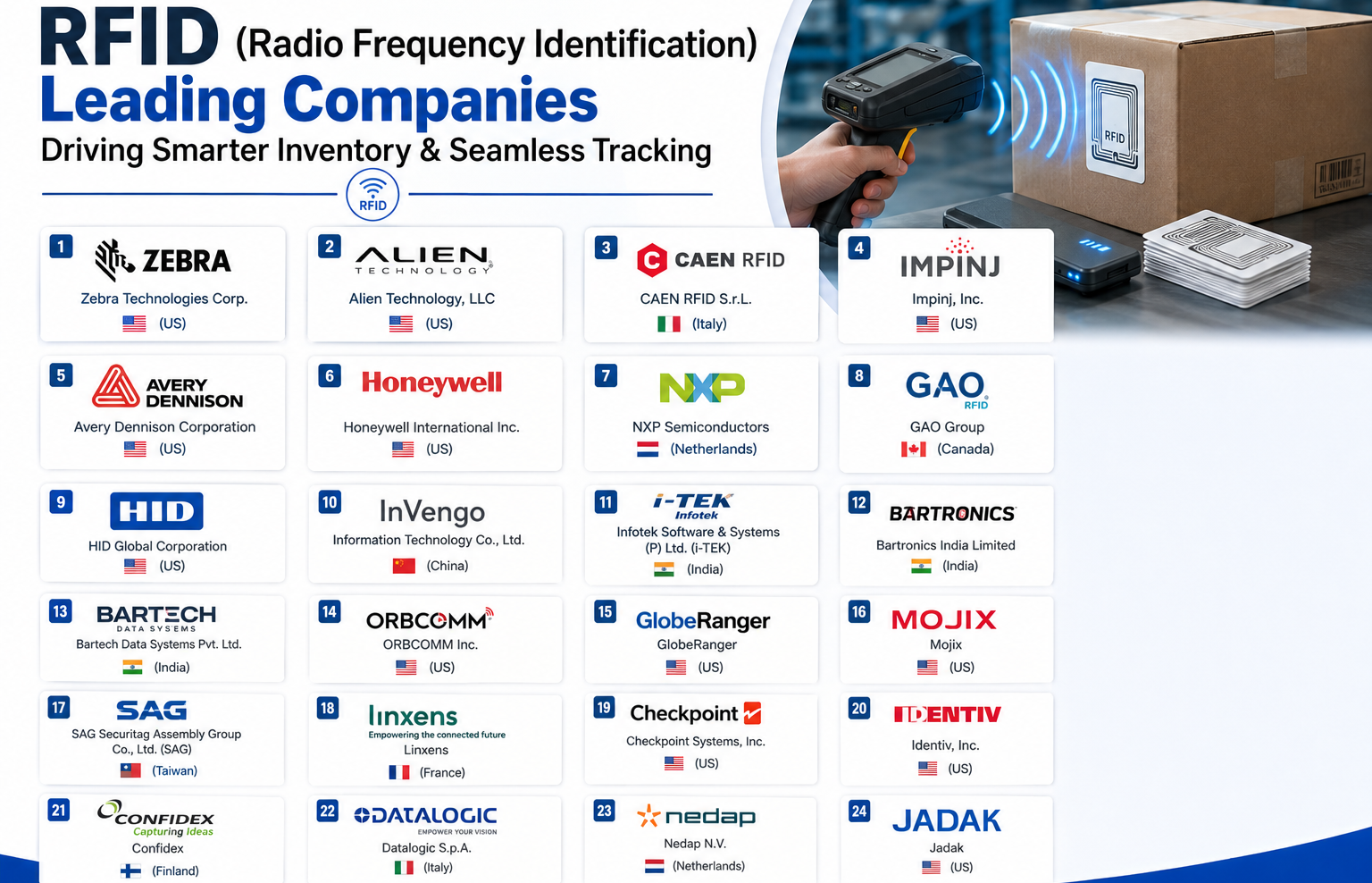
Top Companies in the Global RFID Market
- Zebra Technologies Corp.
- Alien Technology, LLC
- Impinj, Inc.
- Avery Dennison Corporation
- Honeywell International Inc.
- NXP Semiconductors
- HID Global Corporation
- Invengo Information Technology Co., Ltd.
- Checkpoint Systems, Inc.
- Identiv, Inc.
1. Zebra Technologies Corp.
|
Category |
Details |
|---|---|
|
Company Name |
Zebra Technologies Corporation |
|
Headquarters |
Lincolnshire, Illinois, United States |
|
Founded |
1969 |
|
Employees |
Approx. 10,700 |
|
Revenue |
Approx. USD 5.4–5.85 Billion |
|
Company Overview |
Zebra Technologies is a leading provider of automatic identification and data capture technology, offering a portfolio spanning RFID printers and encoders, barcode printers, rugged mobile computers, scanners, and enterprise software used across retail, healthcare, manufacturing, and transportation and logistics. |
|
Key Products |
RFID printers and encoders, real-time locating systems, UWB tracking solutions, rugged mobile computers and tablets, and machine vision and data capture software. |
|
Market Position |
A market leader in automatic identification and data capture, holding nearly 8,000 patents and patent applications, with an ecosystem of roughly 10,000 partners serving customers including more than 80% of the Fortune 500. |
|
Recent Developments |
Continued expanding its RFID and machine vision portfolio, including hands-free RFID wearables and AI-optimized mobile computers, alongside record quarterly results driven by strong demand for automation solutions. |
|
Strategic Advantages |
Deep patent portfolio and decades of scanning and track-and-trace expertise, a large global partner ecosystem, and a broad hardware-to-software platform spanning RFID, machine vision, and mobile computing. |
2. Impinj, Inc.
|
Category |
Details |
|---|---|
|
Company Name |
Impinj, Inc. |
|
Headquarters |
Seattle, Washington, United States |
|
Founded |
2000 |
|
Employees |
Approx. 450–460 |
|
Revenue |
Approx. USD 361 Million |
|
Company Overview |
Impinj is a specialist RAIN RFID technology provider that wirelessly connects everyday items — from apparel to automobile parts to shipments — to the internet, providing endpoint and reader ICs, gateways, and software that power item-level intelligence across supply chains. |
|
Key Products |
RAIN RFID endpoint ICs (tag chips), reader ICs, RFID readers, gateways, and the Impinj platform for enterprise-ready item intelligence and data processing. |
|
Market Position |
A leading pure-play RAIN RFID chip supplier, positioning its platform as a foundational data layer that supports AI and automation applications across retail, aviation, healthcare, and logistics. |
|
Recent Developments |
Continued advancing its Gen2X endpoint IC technology and platform enhancements, while highlighting how reliable, item-level RFID data is increasingly viewed as critical training input for AI-driven supply chain applications. |
|
Strategic Advantages |
Singular focus on RAIN RFID chip design and platform software, deep semiconductor engineering expertise dating to its Caltech research origins, and strong positioning at the intersection of RFID and AI-driven analytics. |
3. Avery Dennison Corporation
|
Category |
Details |
|---|---|
|
Company Name |
Avery Dennison Corporation (Intelligent Labels / Smartrac RFID division) |
|
Headquarters |
Glendale/Mentor, United States |
|
Founded |
1935 (Avery Dennison); RFID inlay business built through the 2020 Smartrac acquisition |
|
Employees |
Approx. 35,000+ (group-wide) |
|
Revenue |
Approx. USD 8.86 Billion (group-wide, FY2025) |
|
Company Overview |
Avery Dennison is a global materials science and digital identification solutions company whose Intelligent Labels platform, built around its acquisition of Smartrac's RFID transponder business, produces RFID inlays and tags for retail, logistics, food and grocery, pharmaceuticals, and automotive customers. |
|
Key Products |
RFID inlays and tags including AD IdentiFresh solutions aimed at reducing food waste through improved inventory visibility, alongside broader labeling and functional materials. |
|
Market Position |
One of the largest global suppliers of RFID inlays and intelligent labels, with high-value categories including RFID-enabled products now representing approximately 45% of total company revenue. |
|
Recent Developments |
Expanded its retail RFID partnerships, including a collaboration with Walmart to enhance product freshness and operational efficiency using RFID technology. |
|
Strategic Advantages |
Global materials science manufacturing scale, an extensive multi-industry customer base, and continued strategic investment in high-value, RFID-enabled product categories. |
4. Honeywell International Inc.
|
Category |
Details |
|---|---|
|
Company Name |
Honeywell International Inc. |
|
Headquarters |
Charlotte, North Carolina, United States |
|
Founded |
1906 |
|
Employees |
Approx. 101,000 (group-wide) |
|
Revenue |
Approx. USD 37.4 Billion (group-wide, FY2025) |
|
Company Overview |
Honeywell is a diversified global technology and manufacturing conglomerate whose safety and productivity solutions business supplies RFID-enabled scanning, tracking, and automatic identification technology alongside a much broader portfolio spanning aerospace, building automation, and industrial automation. |
|
Key Products |
RFID-enabled scanners and mobile computing devices, access control solutions incorporating RFID technology, and enterprise automatic identification and data capture systems. |
|
Market Position |
A major diversified supplier bringing RFID and automatic identification technology to industrial, retail, and access-control customers as part of its broader industrial automation and productivity solutions portfolio. |
|
Recent Developments |
Partnered with Olea Kiosk to deploy RFID technology in access control applications aimed at improving user check-in and authentication processes. |
|
Strategic Advantages |
Broad diversification across aerospace, automation, and safety technology that supports sustained R&D investment, deep enterprise customer relationships, and a long history of industrial technology innovation. |
5. NXP Semiconductors
|
Category |
Details |
|---|---|
|
Company Name |
NXP Semiconductors N.V. |
|
Headquarters |
Eindhoven, Netherlands |
|
Founded |
2006 (spun off from Philips) |
|
Employees |
Approx. 32,000+ |
|
Revenue |
Approx. USD 12.3 Billion |
|
Company Overview |
NXP Semiconductors is a global semiconductor company with over 70 years of combined innovation history, supplying secure connectivity and RFID/NFC chip solutions used in access control, payments, automotive, and industrial and IoT applications. |
|
Key Products |
RFID and NFC integrated circuits, secure identification chips, embedded processing and mixed-signal semiconductors used across automotive, industrial, and communications infrastructure end markets. |
|
Market Position |
A leading global supplier of secure connectivity semiconductors, with RFID and NFC chip technology forming a key part of its broader embedded processing and secure identification portfolio. |
|
Recent Developments |
Continued to focus its portfolio on automotive, industrial & IoT, mobile, and communications infrastructure markets, reporting revenue of USD 12.27 billion in 2025 across operations in more than 30 countries. |
|
Strategic Advantages |
Deep semiconductor design and manufacturing expertise built over decades, strong relationships with leading global electronics and automotive customers, and broad application reach across secure identification and embedded processing. |
Competitive Landscape
The global RFID market is moderately fragmented, spanning large diversified technology and industrial conglomerates such as Honeywell and NXP Semiconductors, pure-play RFID chip specialists such as Impinj, hardware and automatic identification leaders such as Zebra Technologies, and materials science companies such as Avery Dennison that manufacture RFID inlays and tags at scale.
Semiconductor Design as a Barrier to Entry: RFID chip performance depends on precise analog and RF semiconductor design, favoring established players like Impinj and NXP Semiconductors with deep chip engineering expertise built over decades.
Hardware-Software Integration: Companies like Zebra Technologies compete by bundling RFID hardware with broader enterprise software and analytics platforms, turning raw tag data into actionable business intelligence for retail and logistics customers.
Scale Manufacturing of Tags and Inlays: Materials science companies like Avery Dennison compete on manufacturing scale and cost efficiency in producing the physical RFID inlays and tags that get attached to billions of items annually.
Diversified Conglomerates as Enablers: Companies like Honeywell bring RFID technology to market as part of much broader industrial automation and safety portfolios, leveraging existing enterprise relationships to expand RFID adoption across access control and asset tracking use cases.
Regional Analysis
North America
North America is the largest RFID market, driven by an advanced technological ecosystem, high adoption across retail, logistics, and healthcare, and strict inventory and safety compliance requirements that favor automated tracking solutions.
Europe
Europe's RFID growth is compelled by strict regulatory requirements, particularly in healthcare and automotive sectors, with Germany and the UK leading adoption for asset tracking, quality control, and supply chain management, alongside strong emphasis on data privacy and security.
Asia-Pacific
Asia-Pacific is considered the growth engine for RFID, driven by fast-paced industrialization and rising demand for efficient inventory and asset management solutions, with China and India seeing accelerated adoption across retail, logistics, and manufacturing, further pushed by regional e-commerce growth.
Latin America and MEA
RFID adoption is growing in Latin America and the Middle East and Africa as awareness of the technology's benefits in retail and logistics increases, though adoption rates remain lower than in North America and Europe, with growing focus on operational efficiency driving investment.
Emerging Trends in the RFID Market
1. IoT and Cloud Analytics Integration: RFID systems are increasingly integrated with IoT networks and cloud-based analytics platforms, enabling predictive maintenance, smarter inventory management, and improved asset utilization across supply chains.
2. Growth in Passive RFID Adoption: Continued cost reductions in passive RFID tags are enabling large-scale deployments across retail and industrial applications where power-source-free tags offer a more economical tracking solution.
3. Expansion into Healthcare Asset Tracking: RFID adoption is accelerating in hospitals and health facilities for tracking medical equipment, patients, and pharmaceuticals, improving both operational efficiency and patient safety.
4. AI-Enabled Item-Level Intelligence: RFID data is increasingly viewed as a critical input for AI-driven supply chain applications, with reliable item-level tracking supporting recall management, waste reduction, and brand protection use cases.
5. Access Control and Authentication Applications: RFID technology is expanding into access control and authentication use cases, including kiosk check-in systems, as organizations look for faster, more secure identity verification methods.
Future Outlook (2025–2034)
The global RFID market's trajectory toward USD 46.28 billion by 2034 reflects the technology's expanding role as a foundational data layer across retail, healthcare, manufacturing, and logistics operations. The 11.79% CAGR forecast through 2034 assumes continued growth in real-time tracking and automation demand, ongoing cost reductions in passive RFID tags, and deepening integration between RFID systems and IoT and AI-driven analytics platforms.
Key investment themes include continued expansion of RFID-enabled retail inventory management, growth in healthcare and access control applications, and the increasing role of RFID data in supporting AI-driven supply chain decision-making. Leading companies including Zebra Technologies, Impinj, Avery Dennison, and NXP Semiconductors are likely to retain strong market positions by combining deep hardware and semiconductor expertise with expanding software and analytics capabilities, while specialist and regional players continue to compete for share as RFID adoption accelerates across emerging markets.
Frequently Asked Questions (FAQ)
1. What is the current size of the global RFID market?
The global RFID market was valued at approximately USD 17.56 billion in 2025 and is projected to reach USD 46.28 billion by 2034, growing at a CAGR of 11.79%.
2. Who are the top companies in the RFID market?
Leading companies include Zebra Technologies, Alien Technology, Impinj, Avery Dennison, Honeywell International, NXP Semiconductors, HID Global, Invengo Information Technology, Checkpoint Systems, and Identiv.
3. Which region dominates the RFID market?
North America currently leads the market, while Asia-Pacific is considered the growth engine, driven by rapid industrialization and rising RFID adoption in economies such as China and India.
4. What is the forecast CAGR for the RFID market?
The market is forecast to grow at a CAGR of 11.79% from 2025 to 2034.
5. What are the main growth drivers for this market?
Key drivers include rising demand for real-time tracking and automation, improved data accuracy compared to barcode systems, and growing integration between RFID and IoT platforms.
6. What challenges does the RFID industry face?
The industry's primary challenges are the lack of universal standardization across vendor systems, which creates interoperability issues, and the limited read range of passive RFID tags in applications requiring extended tracking distances.
7. Which application segment drives the most RFID demand?
Retail is a major driver of RFID demand through inventory management and anti-theft applications, while logistics and supply chain, healthcare, and manufacturing are also significant and growing contributors to overall market demand.
Conclusion
The global RFID market sits at the intersection of automation, real-time data, and the growing need for accurate, wireless visibility into inventory and assets. With a projected size of USD 46.28 billion by 2034 at a 11.79% CAGR, the sector offers strong growth potential for companies that can combine deep semiconductor and hardware engineering with the software and analytics capabilities needed to turn tag reads into business intelligence.
Specialists like Impinj compete on deep RAIN RFID chip design expertise, while diversified players such as Zebra Technologies, Honeywell, and NXP Semiconductors bundle RFID technology within broader hardware, industrial automation, and semiconductor portfolios, and materials science leaders like Avery Dennison supply the inlays and tags that make large-scale deployment economically viable. The companies that successfully extend RFID into IoT integration, AI-driven analytics, and emerging market expansion will define market leadership through 2034 and beyond.