
Top 10 Leading Companies in the Global Semiconductor Chips Market
Author:
Intellectual Market Insights Research
Published Date:
20 Jun 2026
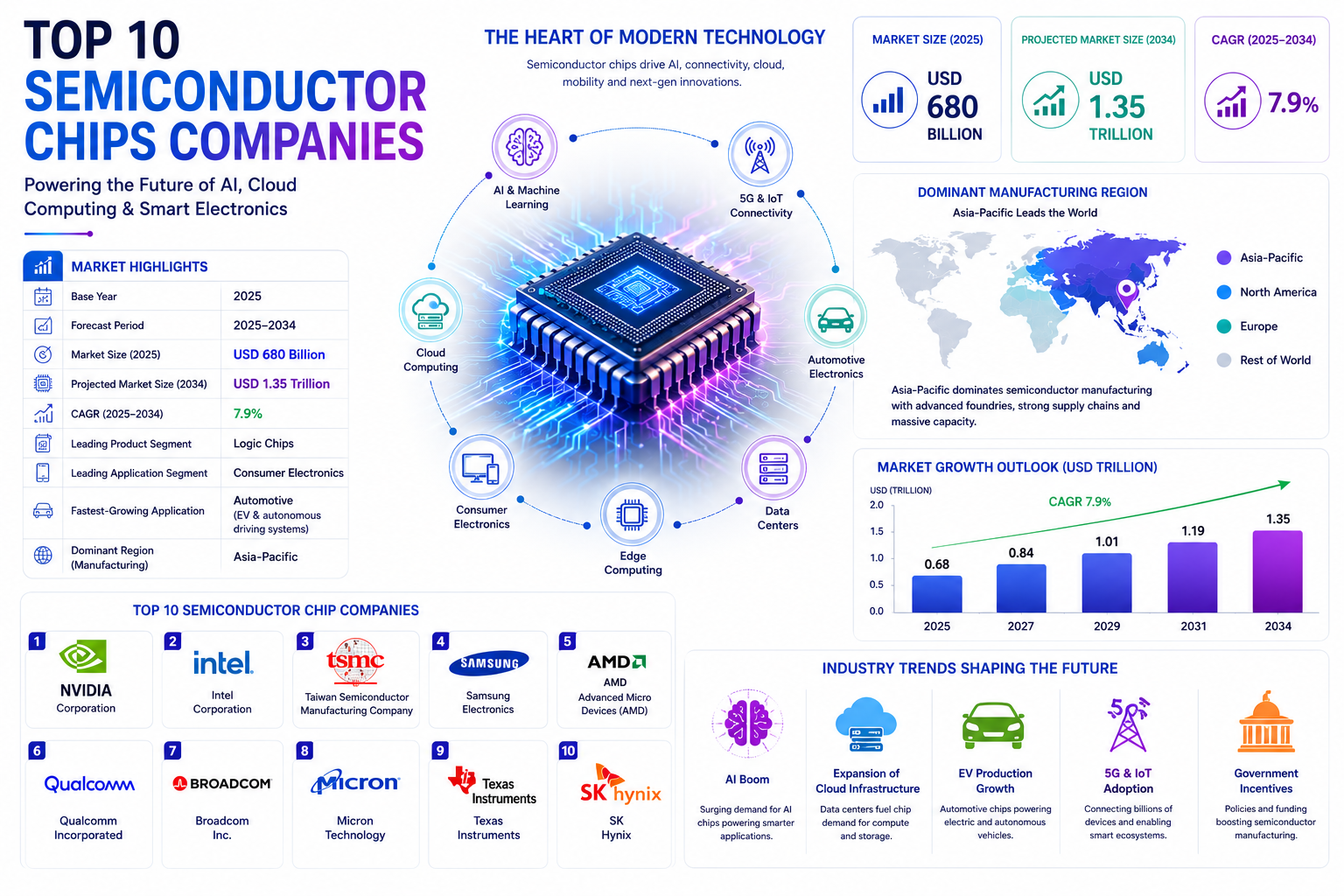
Top 10 Companies in the Global Semiconductor Chips Market Driving Industry Growth in 2026
The global technology landscape is undergoing a profound transformation, and at the heart of this evolution sits the single most foundational component of the digital age the semiconductor chip. From the smartphones in our pockets to the hyperscale data centers training the world's largest AI models, semiconductor chips have become the silent infrastructure underpinning virtually every facet of modern life.
The global semiconductor chips market was valued at approximately USD 680 billion in 2025 and is on a remarkable growth trajectory, expected to reach USD 1.35 trillion by 2034, expanding at a robust compound annual growth rate (CAGR) of 7.9% over the forecast period. These numbers tell a compelling story semiconductors are no longer simply a consumer electronics commodity they are a strategic asset shaping national security policy, economic competitiveness, and the pace of technological innovation worldwide.
So what exactly drives a semiconductor chip's value? At its core, a semiconductor chip is a piece of engineered silicon containing billions of microscopic transistors that process, store, and transmit digital information. Chips range from simple analog components that manage power in household appliances to advanced logic processors with billions of transistors fabricated at sub-5-nanometer scale, powering artificial intelligence, autonomous vehicles, and cloud supercomputing.
Several powerful forces are propelling this market forward in 2026 and beyond. First, the explosive growth of artificial intelligence and generative AI is creating a computing supercycle that demands specialized processors GPUs, AI accelerators, and high-bandwidth memory at a pace the industry has never seen. Hyperscale cloud providers are investing tens of billions of dollars annually in AI infrastructure, almost all of which depends on advanced semiconductor supply.
Second, the global shift toward electrification and autonomy in the automotive sector is dramatically increasing semiconductor content per vehicle.Electric vehicles require several times more chips than traditional internal combustion vehicles, covering everything from battery management to advanced driver-assistance systems (ADAS).
Third, the expansion of 5G networks, the Internet of Things, and edge computing is multiplying the number of connected devices requiring embedded processors, sensors, and connectivity chips creating a long tail of steady demand beyond the AI and data center boom.
Finally, geopolitical competition over semiconductor self-sufficiency is reshaping the industry's geography. Governments across the United States, European Union, Japan, India, and South Korea are deploying billions of dollars in subsidies and incentives to localize advanced chip manufacturing, reduce reliance on concentrated supply chains, and secure technological sovereignty.
Understanding which companies lead this dynamic, rapidly expanding market is critical for investors, OEM procurement teams, policymakers, and industry analysts.This article provides an overview of the top companies in the global semiconductor chips market, covering their strategies, market positions, key products, and competitive advantages, alongside a regional and competitive landscape review.
Market Overview
|
Parameter |
Details |
|---|---|
|
Market Size (2025) |
USD 680 Billion |
|
Projected Market Size (2034) |
USD 1.35 Trillion |
|
CAGR (2025–2034) |
7.9% |
|
Base Year |
2025 |
|
Forecast Period |
2025–2034 |
|
Leading Product Segment |
Logic Chips |
|
Leading Application Segment |
Consumer Electronics |
|
Fastest-Growing Application |
Automotive (EV & autonomous driving systems) |
|
Dominant Region (Manufacturing) |
Asia-Pacific |
|
Key Growth Drivers |
AI adoption, cloud computing expansion, EV production, 5G/IoT deployment, government manufacturing incentives |
|
Key Challenges |
Capital-intensive manufacturing, complex global supply chains, geopolitical tensions |
|
Key Opportunities |
AI accelerators, chiplet architectures, advanced packaging, quantum and edge computing |
Why the Semiconductor Chips Market is Growing
1. The Artificial Intelligence Computing Boom
Artificial intelligence has emerged as the single largest catalyst for advanced semiconductor demand. Training and running large language models and generative AI systems requires massive parallel processing power, driving unprecedented demand for GPUs, custom AI accelerators, and high-bandwidth memory (HBM). Hyperscale cloud providers and AI labs are competing fiercely for limited advanced-node fabrication capacity, pushing lead times and pricing for top-tier AI chips to historic highs.
2. Cloud Infrastructure and Data Center Expansion
The continued migration of enterprise workloads to the cloud, combined with AI-driven data center build-outs, is fueling sustained demand for server processors, memory, networking chips, and storage semiconductors. Hyperscalers are constructing data centers at a pace and capital intensity rarely seen in any industry, with semiconductor content representing a substantial share of total infrastructure spend.
3. Electric Vehicle and Automotive Semiconductor Content Growth
Electric vehicles require significantly more semiconductor content than traditional internal combustion vehicles — spanning battery management systems, power electronics, infotainment, connectivity, and advanced driver-assistance systems. As EV adoption accelerates globally and autonomous driving technology matures, automotive semiconductor demand is expected to remain one of the fastest-growing segments of the broader chip market.
4. 5G, IoT, and Connected Device Proliferation
The ongoing rollout of 5G networks and the expanding footprint of Internet of Things devices — from industrial sensors to smart home products — are creating sustained, broad-based demand for connectivity chips, microcontrollers, and sensors. This long tail of embedded and connectivity semiconductor demand provides a stable counterbalance to the more cyclical AI and consumer electronics segments.
5. Government-Backed Semiconductor Sovereignty Initiatives
Governments worldwide are deploying significant subsidies and incentive programs — such as the U.S. CHIPS Act, the European Chips Act, and similar initiatives in Japan, India, and South Korea — to localize advanced semiconductor manufacturing capacity. This wave of public investment is reshaping the industry's geography and accelerating capacity expansion well beyond what private capital alone would support.
6. Advanced Packaging and Chiplet Architecture Innovation
As traditional transistor scaling becomes more difficult and expensive, the industry is increasingly turning to chiplet architectures and advanced packaging technologies (such as 2.5D/3D integration) to continue improving performance and efficiency. This shift is opening new competitive fronts beyond pure fabrication, rewarding companies with strong packaging and integration capabilities.
Top 10 Companies in the Global Semiconductor Chips Market
- NVIDIA Corporation
- Intel Corporation
- Taiwan Semiconductor Manufacturing Company (TSMC)
- Samsung Electronics
- Advanced Micro Devices (AMD)
- Qualcomm Incorporated
- Broadcom Inc.
- Micron Technology
- Texas Instruments
- SK Hynix
1. NVIDIA Corporation
Headquarters: Santa Clara, California, USA | Founded: 1993 | Industry Focus: GPUs, AI Computing, Data Center Infrastructure | Global Presence: Design and R&D operations across North America, Asia, and Europe
Company Overview: NVIDIA has transformed from a graphics processing pioneer into one of the world's most influential AI infrastructure providers. Its advanced GPUs and full-stack computing platforms power machine learning, generative AI, cloud computing, autonomous vehicles, robotics, and scientific research applications around the world.
Key Products and Services: NVIDIA's portfolio spans GeForce gaming GPUs, data center AI accelerators (including its latest-generation Blackwell architecture chips), DGX AI systems, the CUDA software development platform, networking solutions, and the DRIVE platform for autonomous vehicles.
Market Position: NVIDIA is widely regarded as the dominant supplier of AI training and inference hardware, commanding the largest share of the data center GPU market and benefiting from one of the strongest software ecosystem moats in the semiconductor industry.
Recent Developments: Continued expansion of its AI accelerator portfolio, new data center processor generations, deepened strategic partnerships across the AI ecosystem, and growing investment in generative AI infrastructure for enterprise and sovereign AI customers.
Strategic Advantages: A powerful software ecosystem built around CUDA, industry-leading AI hardware performance, strong developer adoption, and a full-stack approach spanning chips, systems, and software.
2. Intel Corporation
Headquarters: Santa Clara, California, USA | Founded: 1968 | Industry Focus: CPUs, Data Center Processors, Foundry Services | Global Presence: Fabrication and design facilities across the U.S., Ireland, Israel, and Asia
Company Overview: Intel Corporation is one of the world's most established semiconductor companies and a pioneer in microprocessor innovation. The company has played a critical role in shaping the global computing industry through its extensive portfolio of CPUs, data center processors, networking solutions, AI accelerators, and semiconductor manufacturing technologies, serving consumer electronics, enterprise computing, telecommunications, automotive, healthcare, and industrial automation markets.
Key Products and Services: Intel's portfolio includes Core and Xeon processors, AI accelerators (including its Gaudi line), networking and connectivity silicon, and contract manufacturing services through Intel Foundry.
Market Position: A long-established computing leader navigating a competitive transition, Intel retains a vast installed base, deep manufacturing expertise, and an expanding foundry services business.
Recent Developments: Expanded investment in advanced fabrication facilities, accelerated development of AI-focused processors, growth of Intel Foundry Services, new partnerships across cloud and data center markets, and expanded advanced packaging and chiplet initiatives.
Strategic Advantages: Decades of semiconductor expertise, extensive manufacturing capabilities, a strong intellectual property portfolio, and an integrated design-and-manufacturing model that provides greater control over the supply chain.
3. Taiwan Semiconductor Manufacturing Company (TSMC)
Headquarters: Hsinchu, Taiwan | Founded: 1987 | Industry Focus: Semiconductor Foundry and Contract Manufacturing | Global Presence: Fabrication facilities in Taiwan, with expanding capacity in the U.S., Japan, and Germany
Company Overview: TSMC is the world's largest dedicated semiconductor foundry and serves as the manufacturing backbone for many of the industry's leading technology companies. The company specializes in advanced semiconductor fabrication, producing chips for smartphones, AI systems, data centers, automotive electronics, and high-performance computing.
Key Products and Services: TSMC offers leading-edge process nodes (including advanced 3-nanometer and emerging 2-nanometer technologies) and advanced packaging services such as CoWoS, used extensively for AI accelerator production.
Market Position: TSMC's leadership in advanced process nodes has positioned it at the forefront of semiconductor innovation, manufacturing chips for Apple, NVIDIA, AMD, Qualcomm, and most other major fabless chip designers.
Recent Developments: Expanded global manufacturing capacity, increased investment in next-generation process technologies, strengthened advanced packaging capabilities, and new fabrication facilities across multiple regions to support AI and high-performance computing customers.
Strategic Advantages: Unmatched leadership in advanced manufacturing processes, large-scale production capabilities, and deep, long-standing customer relationships across the global semiconductor design ecosystem.
4. Samsung Electronics
Headquarters: Suwon, South Korea | Founded: 1969 | Industry Focus: Memory Chips, Logic Semiconductors, Foundry Services | Global Presence: Manufacturing operations in South Korea, the U.S., Vietnam, and China
Company Overview: Samsung Electronics is one of the world's largest semiconductor manufacturers, with extensive operations spanning memory chips, logic semiconductors, foundry services, and advanced packaging technologies, supplying smartphones, consumer electronics, AI infrastructure, automotive systems, and data centers.
Key Products and Services: Samsung's semiconductor portfolio includes DRAM and NAND flash memory, Exynos logic processors, and foundry manufacturing services for external customers.
Market Position: Samsung is a leading global memory chip supplier and maintains a growing foundry business competing for advanced logic manufacturing contracts.
Recent Developments: Expanded advanced fabrication facilities, increased investment in AI-focused chip technologies, strengthened foundry operations, and advanced development of next-generation memory solutions including high-bandwidth memory.
Strategic Advantages: Vertical integration, large-scale manufacturing capabilities, strong R&D investment, and global leadership in memory semiconductor production.
5. Advanced Micro Devices (AMD)
Headquarters: Santa Clara, California, USA | Founded: 1969 | Industry Focus: CPUs, GPUs, Adaptive and Embedded Computing | Global Presence: Global operations with a fabless manufacturing model
Company Overview: AMD has emerged as a leading semiconductor innovator through its high-performance CPUs, GPUs, adaptive computing solutions, and AI-focused technologies, serving gaming, data center, cloud computing, enterprise, and embedded system markets worldwide.
Key Products and Services: AMD's portfolio includes Ryzen and EPYC processors, Radeon and Instinct GPUs and AI accelerators, and adaptive computing solutions gained through its acquisition of Xilinx.
Market Position: AMD has gained market share across multiple semiconductor segments and is positioning itself as a leading challenger in AI and high-performance computing.
Recent Developments: Expanded AI processor and accelerator portfolio, increased data center product investment, advanced development of next-generation CPU architectures, and strengthened partnerships with major cloud providers.
Strategic Advantages: Innovative chiplet-based architectures, strong performance-per-watt efficiency, and a growing presence in enterprise and cloud computing markets.
6. Qualcomm Incorporated
Headquarters: San Diego, California, USA | Founded: 1985 | Industry Focus: Wireless Communications and Mobile Semiconductors | Global Presence: Operations across more than 25 countries
Company Overview: Qualcomm is a global leader in wireless communications and mobile semiconductor technologies. The company's chipsets power billions of smartphones, IoT devices, automotive platforms, and connected systems worldwide, with expanding presence in automotive, industrial IoT, extended reality, and AI-driven applications.
Key Products and Services: Qualcomm's Snapdragon platforms power premium and mid-tier mobile devices, alongside modem-RF systems, automotive digital chassis solutions, and edge AI computing platforms.
Market Position: Qualcomm holds a dominant position in premium mobile chipsets and wireless connectivity intellectual property licensing.
Recent Developments: Expanded AI-enabled mobile processor offerings, increased automotive semiconductor investment, strengthened IoT platform development, and advanced next-generation wireless communication technologies.
Strategic Advantages: Industry-leading wireless technology expertise, a strong intellectual property and licensing portfolio, and extensive global market presence.
7. Broadcom Inc.
Headquarters: Palo Alto, California, USA | Founded: 1991 (in its earlier form, with the current entity shaped through a 2016 merger) | Industry Focus: Networking Semiconductors, Connectivity, Infrastructure Technology | Global Presence: Global operations supporting data center, telecom, and enterprise markets
Company Overview: Broadcom is a major provider of semiconductor solutions for networking, broadband, wireless communications, enterprise storage, and industrial applications, playing a critical role in supporting global connectivity infrastructure and cloud computing environments.
Key Products and Services: Broadcom's portfolio includes networking switch and router silicon, broadband and wireless connectivity chips, and custom AI accelerator (ASIC) design services for hyperscale customers.
Market Position: Broadcom is a key supplier to hyperscale data center operators and networking equipment manufacturers, with a diversified portfolio spanning multiple high-growth markets.
Recent Developments: Expanded networking and data center semiconductor offerings, increased AI infrastructure investment, advanced connectivity solutions development, and strengthened enterprise technology partnerships.
Strategic Advantages: Strong relationships with enterprise and hyperscale customers, a diversified product portfolio, and leadership in networking technologies.
8. Micron Technology
Headquarters: Boise, Idaho, USA | Founded: 1978 | Industry Focus: Memory and Storage Semiconductors | Global Presence: Manufacturing operations in the U.S., Taiwan, Japan, and Singapore
Company Overview: Micron Technology is one of the world's leading memory semiconductor manufacturers, specializing in DRAM, NAND flash memory, and storage solutions essential for AI systems, cloud computing, consumer electronics, automotive platforms, and enterprise data centers.
Key Products and Services: Micron's portfolio includes DRAM, NAND flash, and high-bandwidth memory (HBM) products increasingly central to AI server architectures.
Market Position: Micron is one of only three major global suppliers of advanced memory technology, alongside Samsung and SK Hynix.
Recent Developments: Expanded high-bandwidth memory production capabilities, increased investment in AI memory solutions, advanced next-generation DRAM technologies, and expanded U.S. manufacturing capacity.
Strategic Advantages: Advanced memory technology expertise, strong manufacturing capabilities, and growing participation in AI infrastructure markets.
9. Texas Instruments
Headquarters: Dallas, Texas, USA | Founded: 1930 | Industry Focus: Analog and Embedded Semiconductors | Global Presence: Manufacturing across the U.S., with international design and sales operations
Company Overview: Texas Instruments is a global leader in analog semiconductors and embedded processing technologies, serving automotive, industrial automation, healthcare, communications, and consumer electronics markets through a broad portfolio of analog and embedded solutions.
Key Products and Services: TI's products span power management integrated circuits, analog signal-chain components, and embedded microcontrollers used widely in power management, sensing, and industrial control applications.
Market Position: Texas Instruments is the largest analog semiconductor manufacturer globally, benefiting from a highly diversified customer base across industrial and automotive end markets.
Recent Developments: Expanded analog semiconductor manufacturing capacity, increased investment in industrial automation solutions, strengthened its automotive semiconductor portfolio, and advanced power management technologies.
Strategic Advantages: A highly diversified customer base, extensive analog design expertise, and strong operational efficiency that reduces cyclicality relative to logic-chip peers.
10. SK Hynix
Headquarters: Icheon, South Korea | Founded: 1983 (renamed SK Hynix in 2012) | Industry Focus: Memory Semiconductors | Global Presence: Manufacturing operations in South Korea, the U.S., and China
Company Overview: SK Hynix is one of the world's largest memory semiconductor manufacturers and a major supplier of DRAM, NAND flash, and advanced memory products, serving data centers, AI infrastructure providers, mobile device manufacturers, and enterprise customers globally.
Key Products and Services: SK Hynix's portfolio centers on DRAM, NAND flash, and high-bandwidth memory — the company has become a leading supplier of HBM used in leading AI accelerator platforms.
Market Position: As AI applications require increasingly powerful memory systems, SK Hynix has emerged as a critical player within the global semiconductor ecosystem and a leading HBM supplier.
Recent Developments: Expanded high-bandwidth memory production, increased AI memory technology investment, advanced next-generation DRAM development, and expanded manufacturing capabilities to support AI infrastructure providers.
Strategic Advantages: Strong memory technology expertise, large-scale manufacturing operations, and leadership in AI-focused memory solutions.
Competitive Landscape
The global semiconductor chips market exhibits a complex, multi-tiered competitive structure. A small number of companies — TSMC, Samsung, and Intel — dominate advanced manufacturing capacity, while design-focused (fabless) leaders such as NVIDIA, AMD, and Qualcomm compete on architecture and software ecosystems without owning fabrication facilities themselves. Memory remains its own concentrated sub-market, led by Samsung, SK Hynix, and Micron.
The competitive landscape is shaped by several key dynamics:
Manufacturing Concentration: Advanced-node fabrication is concentrated among a handful of foundries capable of the capital expenditure required to build leading-edge fabs, creating significant barriers to entry and geopolitical sensitivity around supply chain concentration in East Asia.
The Fabless-Foundry Model: Many of the industry's most prominent brands — NVIDIA, AMD, Qualcomm, Broadcom — design chips but outsource manufacturing to foundries like TSMC and Samsung, creating deep interdependence between chip designers and contract manufacturers.
AI as the New Battleground: With AI accelerator demand vastly outpacing supply, companies across the value chain — from GPU designers to memory suppliers to foundries — are racing to expand capacity and capture share of this high-margin segment.
Vertical and Strategic Integration: Leading players are increasingly integrating across the value chain — from chip design through advanced packaging — to secure supply and differentiate on system-level performance rather than individual components.
Geopolitical Realignment: Export controls, tariffs, and national subsidy programs are actively reshaping where companies choose to locate manufacturing capacity, with significant new investment flowing into the U.S., Japan, and parts of Europe.
Regional Analysis
North America
North America remains a global innovation center for semiconductor design, AI computing, and advanced research, anchored by companies such as NVIDIA, Intel, AMD, Qualcomm, Broadcom, Micron, and Texas Instruments. Significant government investment through programs like the CHIPS Act, combined with strong venture capital activity and deep talent pools, continues to support both design leadership and a growing push toward domestic manufacturing capacity.
Europe
Europe benefits from strong automotive manufacturing, industrial automation expertise, and a growing semiconductor investment push under the European Chips Act, alongside established equipment and specialty chip manufacturers supporting the global supply chain.
Asia-Pacific
Asia-Pacific dominates the global semiconductor chips market in terms of manufacturing volume, due to the presence of major foundries and advanced manufacturing infrastructure across Taiwan, South Korea, Japan, and China. The region hosts the world's most advanced fabrication facilities, led by TSMC, Samsung, and SK Hynix, alongside a vast base of electronics assembly and component supply.
Latin America
Latin America represents a smaller but growing market, supported by expanding electronics assembly operations and broader digitalization efforts, though it remains a minor contributor to global chip manufacturing.
Middle East & Africa
Smart city initiatives, telecommunications infrastructure investment, and digital transformation programs are creating early-stage growth opportunities for semiconductor demand across the region, particularly in connectivity and industrial applications.
Emerging Trends in the Semiconductor Chips Market
1. Artificial Intelligence Semiconductor Boom: AI applications are creating unprecedented demand for GPUs, AI accelerators, and high-performance processors, reshaping capital allocation across the entire industry.
2. Advanced Node Development: Manufacturers continue investing heavily in 3-nanometer, 2-nanometer, and next-generation fabrication technologies to sustain performance and efficiency gains.
3. Chiplet Architecture Adoption: Chiplets are enabling greater design flexibility, improved manufacturing yields, and lower development costs compared to traditional monolithic chip designs.
4. Automotive Semiconductor Expansion: Electric vehicles, autonomous driving systems, and vehicle connectivity continue to increase semiconductor content per vehicle.
5. Edge AI Computing: Organizations increasingly require processors capable of handling AI workloads closer to data sources, reducing latency and bandwidth costs.
6. Semiconductor Sovereignty Initiatives: Governments are investing heavily in domestic semiconductor manufacturing capacity to reduce reliance on concentrated global supply chains.
Future Outlook (2026–2034)
The global semiconductor chips market's trajectory toward USD 1.35 trillion by 2034 is supported by a convergence of powerful, durable macro trends. The 7.9% CAGR forecast through 2034 reflects the sustained strength of AI-driven computing demand, the electrification of the automotive sector, the continued buildout of cloud and data center infrastructure, and growing government support for domestic manufacturing capacity.
Key investment themes include the scaling of advanced packaging and chiplet manufacturing, continued expansion of high-bandwidth memory production for AI workloads, geographic diversification of advanced fabrication capacity, and the commercialization of next-generation computing paradigms such as edge AI and early-stage quantum computing chips.
For investors, the semiconductor chips market offers exposure to the secular growth of global digital transformation, with significant upside concentrated in companies positioned at the center of the AI infrastructure buildout. Leading companies — NVIDIA, TSMC, and Samsung — are likely to continue capturing outsized value, while diversified players across memory, analog, and networking semiconductors offer more defensive, broad-based exposure to the industry's long-term growth.
Frequently Asked Questions (FAQ)
1. What is the current size of the global semiconductor chips market? The global semiconductor chips market was valued at approximately USD 680 billion in 2025. It is projected to grow at a CAGR of 7.9%, reaching USD 1.35 trillion by 2034.
2. Who are the top companies in the global semiconductor chips market? The leading companies include NVIDIA, Intel, TSMC, Samsung Electronics, AMD, Qualcomm, Broadcom, Micron Technology, Texas Instruments, and SK Hynix.
3. Which region dominates the semiconductor chips market? Asia-Pacific dominates the global semiconductor chips market in terms of manufacturing, driven primarily by Taiwan, South Korea, Japan, and China. North America leads in chip design and AI innovation.
4. What is the forecast CAGR for the semiconductor chips market? The global semiconductor chips market is forecast to grow at a CAGR of 7.9% from 2025 to 2034.
5. What are the primary applications of semiconductor chips? Semiconductor chips are used across consumer electronics (largest segment), automotive, telecommunications, data centers, healthcare, and industrial automation applications.
6. What is the leading product segment in the semiconductor chips market? Logic chips represent the largest product segment, given their widespread use across computing and communication devices.
7. Which application segment is growing the fastest? Automotive semiconductors represent one of the fastest-growing application segments, driven by electric vehicle adoption and autonomous driving technology.
8. What are the main growth drivers for the semiconductor chips market? Key drivers include AI adoption, cloud computing investment, electric vehicle production, 5G and IoT deployment, and government incentives supporting domestic semiconductor manufacturing.
9. What challenges does the semiconductor chips market face? Key challenges include capital-intensive manufacturing requirements, complex global supply chains, geopolitical tensions, and rapid technological change.
10. How is AI impacting the semiconductor industry? AI is creating exceptionally strong demand for specialized processors, GPUs, AI accelerators, and high-bandwidth memory, reshaping investment priorities across the entire industry.
11. Why are advanced process nodes important? Smaller process nodes improve performance, energy efficiency, and transistor density, enabling more powerful and efficient chips.
12. What investment opportunities exist in the semiconductor chips market? AI accelerators, automotive semiconductors, advanced foundries, memory technologies, and advanced packaging solutions offer significant opportunities for investors.
Conclusion
The global semiconductor chips market stands at an inflection point, transitioning from a cyclical, consumer-electronics-driven industry to a strategically vital sector shaped by artificial intelligence, electrification, and national technology policy. With a projected market size of USD 1.35 trillion by 2034 at a CAGR of 7.9%, the sector offers compelling growth opportunities for manufacturers, investors, and technology industry participants.
The top companies in the semiconductor chips market — led by NVIDIA, TSMC, Intel, Samsung, and AMD — are not merely competing on processing power and price. They are competing on architecture innovation, manufacturing leadership, software ecosystems, and supply chain resilience. The companies that successfully navigate the shift toward AI-centric computing while capturing automotive electrification demand and benefiting from government-backed manufacturing investment will define the industry's leadership landscape through 2034 and beyond.