
Top 10 Leading Companies in the Global Smart Home Market
Author:
Intellectual Market Insights Research
Published Date:
07 Jul 2026
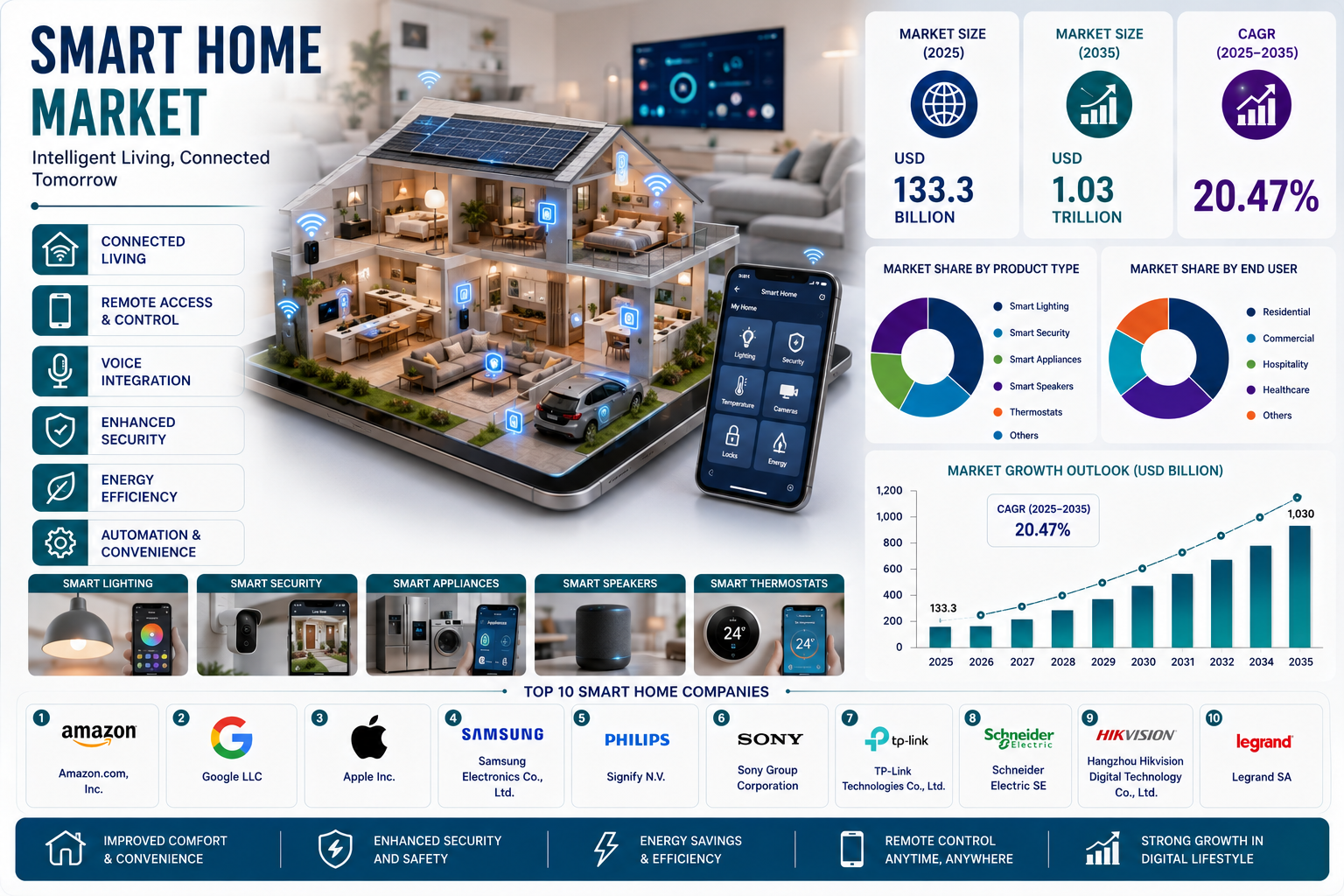
Top 10 Leading Companies in the Global Smart Home Market Driving Industry Growth in 2026
The global Smart Home market has evolved from a collection of novelty gadgets into one of the most strategically consequential sectors at the intersection of consumer technology, IoT infrastructure, artificial intelligence, and energy management. As urbanization accelerates, disposable incomes rise, and consumer expectations for convenience and energy efficiency deepen, the smart home industry stands at a defining growth inflection point entering 2026.
According to Intellectual Market Insights Research, the Smart Home market was valued at approximately USD 133.3 Billion in 2025 and is projected to grow at a CAGR of 20.47%, reaching USD 1.03 Trillion by 2035. This explosive trajectory is driven by the proliferation of IoT-enabled devices, AI-powered home automation, smart security systems, energy management solutions, and increasingly connected home appliances that seamlessly interact across unified platforms.
North America leads the market with the largest revenue share in 2025, underpinned by high consumer awareness, substantial disposable incomes, and early adoption of advanced home automation technologies. Meanwhile, Asia-Pacific is forecast to be the fastest-growing region through the forecast period, propelled by rapid urbanization, an expanding middle class in China, India, and Japan, and government-backed smart city initiatives.
Understanding which companies lead this dynamic, rapidly expanding market is critical for investors, technology strategists, and industry analysts. This article provides an authoritative, research-based analysis of the top companies in the global smart home market, covering their strategies, market positions, key products, and recent developments, alongside a comprehensive regional, segmentation, and competitive landscape review.
Market Overview
|
Parameter |
Details |
|---|---|
|
Market Size (2025) |
USD 133.3 Billion |
|
Projected Market Size (2035) |
USD 1.03 Trillion |
|
CAGR (2026–2035) |
20.47% |
|
Leading Region (2025) |
North America |
|
Fastest-Growing Region |
Asia-Pacific |
|
Leading Protocol Segment |
Wireless Communication Technologies |
|
Leading Product Segment |
Security and Access Controls |
|
Leading Offering Type |
Proactive |
|
Leading Installation Type |
Retrofit |
|
Fastest-Growing Installation Type |
New Construction |
|
Key Growth Drivers |
IoT proliferation, AI integration, energy efficiency demand, urbanization |
|
Key Challenges |
High initial device cost, data privacy concerns, interoperability issues |
|
Major Players |
Apple, Amazon, Samsung, Honeywell, Schneider Electric, Google, Johnson Controls, GE, Sony, Emerson |
|
Forecast Period |
2026–2035 (Intellectual Market Insights Research) |
|
Study Period |
2022–2035 |
|
Report ID |
IMI-000369 |
Why the Smart Home Market Is Growing
1. Proliferation of IoT Devices Enables Seamless Connectivity
The single most powerful structural driver of the smart home market is the rapidly expanding Internet of Things ecosystem. IoT enables devices such as lighting systems, thermostats, security cameras, and home appliances to intercommunicate through a unified interface and be controlled remotely. Smart thermostats learn household schedules and preferences to automatically adjust temperatures, generating energy savings, while smart lighting systems sense occupancy and adjust brightness accordingly. As the cost of sensors and connected components falls, IoT adoption continues to accelerate across all smart home product categories.
2. Advances in AI and Machine Learning Elevate User Experience
AI and machine learning have taken smart home devices to an entirely new level of capability and user personalization. AI-based security systems can distinguish between routine activity and suspicious behaviour, significantly reducing false alarms while increasing the accuracy of real threat detection. Voice assistants such as Amazon Alexa, Google Assistant, and Apple Siri have become central to the smart home ecosystem, enabling hands-free control that drives broad mainstream adoption.
3. Consumer Demand for Convenience and Lifestyle Enhancement
Modern consumers are actively seeking technologies that simplify daily living and give them control over their home environment. Smart refrigerators track food inventory and recommend recipes; smart washing machines allow remote cycle management; smart locks provide remote access control. This demand for lifestyle enhancement is creating sustained, structurally grounded commercial pull across all smart home product categories.
4. Energy Efficiency and Sustainability Drive Adoption
Rising energy costs and growing environmental awareness are pushing consumers toward smart home technologies that reduce energy consumption and lower carbon footprints. This sustainability driver is especially powerful in Europe and North America, where regulatory pressure on energy efficiency and carbon reduction is intensifying and where utility savings can meaningfully offset device costs.
5. Smart City Initiatives and Government Policy Support
Governments across Asia-Pacific, the Middle East, and Europe are actively investing in smart city infrastructure that integrates directly with smart home technologies across energy grids, transportation networks, and public security systems. Countries including China, India, Singapore, South Korea, and the UAE are directing significant public capital into smart building initiatives, supporting deployment at scale in both new residential construction and retrofitted properties.
6. Expansion of the Smart Home Ecosystem
The growing interconnection of devices and platforms is creating a self-reinforcing ecosystem effect. Platform interoperability improvements, including the Matter standard, are reducing friction in multi-device deployments and accelerating category expansion beyond early adopters toward mainstream consumers.
Top 10 Companies in the Global Smart Home Market
- Apple Inc. (U.S.)
- Amazon Inc. (U.S.)
- Samsung Electronics Co., Ltd. (South Korea)
- Honeywell International Inc. (U.S.)
- Schneider Electric SE (France)
- Google LLC / Nest (U.S.)
- Johnson Controls International plc (Ireland / U.S.)
- General Electric Company (U.S.)
- Sony Corporation (Japan)
- Emerson Electric Co. (U.S.)
Company Profiles
1. Apple Inc. (U.S.)
|
Category |
Details |
|---|---|
|
Company |
Apple Inc. |
|
Headquarters |
Cupertino, California, USA |
|
Industry Focus |
Smart Home Platform, Consumer Electronics & AI Ecosystems |
|
Global Presence |
150+ markets worldwide |
|
Company Overview |
Apple is one of the world's largest technology companies and a defining force in the smart home market through its HomeKit platform, Home app, and deep integration of Siri voice control across its device ecosystem. The company leverages its installed base of iPhone, iPad, Apple TV, HomePod, and Apple Watch devices to create a seamless home automation experience with industry-leading privacy and cross-device continuity. |
|
Key Products & Services |
|
|
Market Position |
Apple holds a premium position in the smart home market, appealing to users within its ecosystem who prioritize seamless integration, elegant design, and strong data privacy. Its leadership is further strengthened by support for the Matter interoperability standard, enabling compatibility with devices from Google, Amazon, and Samsung. |
|
Strategic Advantages |
|
2. Amazon Inc. (U.S.)
|
Category |
Details |
|---|---|
|
Company |
Amazon Inc. |
|
Headquarters |
Seattle, Washington, USA |
|
Industry Focus |
Voice AI, Smart Speakers & Home Automation Ecosystems |
|
Global Presence |
Americas, Europe, Asia-Pacific |
|
Company Overview |
Amazon is one of the most influential companies in the global smart home market, pioneering the mass-market voice-controlled smart speaker category with Echo and Alexa in 2014. The company operates across voice AI, smart speakers, smart security, smart displays, home networking, and an extensive third-party smart device ecosystem. |
|
Key Products & Services |
|
|
Market Position |
Amazon has the world's largest installed base of voice-enabled smart home devices. Its Ring acquisition strengthened its leadership in smart home security, while competitively priced Echo devices continue to drive mainstream adoption of smart home technology. |
|
Strategic Advantages |
|
3. Samsung Electronics Co., Ltd. (South Korea)
|
Category |
Details |
|---|---|
|
Company |
Samsung Electronics Co., Ltd. |
|
Headquarters |
Suwon, South Korea |
|
Industry Focus |
Connected Home Appliances, SmartThings & Consumer Electronics |
|
Global Presence |
190+ countries |
|
Company Overview |
Samsung Electronics is the world's largest consumer electronics manufacturer with a comprehensive smart home portfolio spanning TVs, refrigerators, washing machines, HVAC systems, and security products. Its SmartThings platform connects Samsung devices with thousands of third-party smart home products. |
|
Key Products & Services |
|
|
Market Position |
Samsung is a leading player in connected home appliances and smart kitchen solutions. Its extensive retail network and strong presence in Asia-Pacific, Latin America, and other emerging markets provide a significant competitive advantage. |
|
Strategic Advantages |
|
4. Honeywell International Inc. (U.S.)
|
Category |
Details |
|---|---|
|
Company |
Honeywell International Inc. |
|
Headquarters |
Charlotte, North Carolina, USA |
|
Industry Focus |
Building Controls, Home Automation & Industrial Technology |
|
Global Presence |
Operations in 70+ countries |
|
Company Overview |
Honeywell is a diversified technology company with decades of expertise in residential controls, HVAC, security, and building automation. Its Honeywell Home solutions and commercial building technologies have established the company as a trusted provider of connected comfort and safety solutions. |
|
Key Products & Services |
|
|
Market Position |
Honeywell maintains a strong position in residential HVAC controls, security, and life-safety products, supported by extensive installer networks and long-standing customer trust in North America. |
|
Recent Developments |
Honeywell announced a corporate restructuring that includes separating its businesses into independently focused companies to strengthen its aerospace, automation, and advanced materials operations. |
|
Strategic Advantages |
|
5. Schneider Electric SE (France)
|
Category |
Details |
|---|---|
|
Company |
Schneider Electric SE |
|
Headquarters |
Rueil-Malmaison, France |
|
Industry Focus |
Energy Management, Electrification & Home Energy Automation |
|
Global Presence |
Operations in 100+ countries |
|
Company Overview |
Schneider Electric is a global leader in energy management and automation, extending its expertise into residential smart energy solutions through the Schneider Home ecosystem. The company focuses on sustainable, connected, and energy-efficient homes by integrating power distribution, solar energy, storage, and home automation technologies. |
|
Key Products & Services |
|
|
Market Position |
Schneider Electric is a leading provider of integrated residential energy management solutions, offering a complete ecosystem that combines solar generation, energy storage, electrical distribution, EV charging, and energy monitoring. |
|
Recent Developments |
The company introduced its Schneider Home integrated platform, bringing together solar, battery storage, smart electrical panels, and EV charging into a unified residential energy management solution. |
|
Strategic Advantages |
|
Competitive Landscape
The global Smart Home market in 2026 is characterized by moderate-to-high fragmentation, with competition occurring at multiple points across the value chain 5.1% hardware, platforms, AI services, connectivity standards, and distribution 5.1% rather than converging around a single vertically integrated winner.
Market Structure
The market includes a diverse range of player types: consumer electronics giants (Samsung, Sony, Apple), pure-play smart home platform leaders (Amazon, Google), industrial automation specialists pivoting to residential (Honeywell, Schneider Electric, Johnson Controls, Emerson), and established appliance manufacturers integrating connectivity into existing product lines (GE). The smart home's multi-device, multi-platform nature has thus far supported continued fragmentation at the product level even as platform consolidation accelerates.
Platform Wars as the Central Competitive Battleground
The most intense competitive battle in 2026 is not at the device level but at the platform and AI assistant level. Amazon Alexa, Google Assistant, Apple Siri, and Samsung Bixby are each competing to become the default voice interface and management layer for the connected home. The platform that wins this battle gains the data, the consumer relationship, and the commercial upsell opportunities that flow from being the primary smart home operating system.
Interoperability as Strategic Weapon
The Matter standard, co-developed by Apple, Amazon, Google, and Samsung, is progressively reducing the consumer friction of multi-brand smart home deployments. Companies that most aggressively certify their devices for Matter compatibility and offer the smoothest cross-platform setup experience are gaining share in the mainstream consumer segment.
Recent Consolidation and Investment Activity
The market is experiencing significant investment activity as established players seek to rapidly acquire capabilities in AI, security, and energy management. Apple's smart home display device, Schneider Electric's Schneider Home ecosystem, Honeywell's 2026 corporate restructuring into focused standalone businesses, and ongoing investment by Amazon in expanding Ring's security monitoring capabilities all reflect accelerating product and portfolio realignment across the sector's leading players entering 2026.
Regional Analysis
North America 5.1% Leading Region (2025)
North America holds the largest global smart home market share in 2025, driven by high consumer awareness, strong disposable incomes, and early mass-market adoption of smart speakers, security systems, and thermostats. The U.S. is the dominant national market, with home automation, security, and energy management leading adoption categories. Canada contributes through strong adoption of smart heating and energy monitoring systems.
Asia-Pacific 5.1% Fastest-Growing Region
Asia-Pacific is the fastest-growing smart home region globally, driven by rapid urbanization, rising middle-class incomes in China, India, Japan, and South Korea, and new residential construction incorporating smart technologies from inception. Government smart city initiatives in Singapore, China, India, and South Korea are creating structural demand at national scale. The region is projected to surpass North America as the largest regional market before 2030.
Europe 5.1% Strong Regulatory-Driven Growth
Europe's smart home market is growing steadily, led by Germany, France, the UK, and the Netherlands. Energy efficiency regulations and net-zero building mandates are the primary structural drivers, pushing adoption of smart thermostats, energy monitors, and intelligent HVAC controls. GDPR data privacy regulations are shaping product design requirements, creating differentiation opportunities for privacy-first providers.
Middle East and Africa 5.1% Emerging Growth
The MEA region is an emerging growth market for smart home technologies, led by Saudi Arabia and the UAE. Smart city projects in Dubai, Riyadh, and Abu Dhabi are incorporating residential smart home infrastructure at large scale as part of national diversification strategies. High-income consumer segments in the Gulf states are early adopters of premium smart home ecosystems.
Latin America 5.1% Developing Market
Latin America is a developing smart home market with Brazil, Mexico, and Colombia leading adoption. Rising middle-class incomes, increasing smartphone penetration, and growing awareness of smart security solutions are the primary demand drivers. DIY-friendly, affordable smart home devices are gaining traction alongside mobile internet adoption.
Segmentation Analysis
By Protocol
Wireless Communication Technologies dominate the smart home protocol market due to their flexibility and ease of installation. Wireless systems including Wi-Fi, Zigbee, Z-Wave, Bluetooth, and Thread require no significant infrastructure changes, reducing upfront costs and enabling DIY setup. Wired technologies including Ethernet, KNX, and BACnet remain relevant in high-end residential and new construction applications where reliability and bandwidth justify higher installation complexity.
By Products
Security and Access Controls 5.1% smart locks, video doorbells, security cameras, and alarm systems 5.1% led the global smart home products market in 2025. Smart Speakers remain the primary entry point into smart home ecosystems for mainstream consumers. HVAC Controls are among the fastest-growing segments, supported by energy savings and utility rebate programmes. Lighting Controls represent one of the most accessible entry points, while smart kitchen and home healthcare segments are emerging growth categories.
By Offering
Proactive smart home systems, which use AI and machine learning to anticipate household needs and take autonomous action, represent the fastest-growing offering segment, while behavioral (command-driven) systems remain the established baseline.
By Installation Type
Retrofit installations dominate the current market, given that most existing housing stock predates smart home technology. New Construction is the faster-growing channel as developers and building codes increasingly incorporate smart systems from the outset.
By Sales Channel
Direct sales through brand-owned retail, e-commerce, and DTC channels are growing as brands invest in owned customer relationships and subscription models, while indirect sales through traditional retail, carriers, and installer networks remain the dominant volume channel.
Key Industry Developments
January 2023 5.1% Apple Announces Smart Home Display Device Apple announced it is working on a new tablet-like smart home display device and an updated Apple TV to deepen its footprint in the smart home market, directly challenging Amazon Echo Show and Google Nest Hub.
January 2023 5.1% Schneider Electric Launches Schneider Home Schneider Electric launched its comprehensive Schneider Home energy management solution, comprising a home battery, solar inverter, smart electric panel, intelligent light switches, connected outlets, and an EV charger 5.1% all controllable through a single app.
2022–2023 5.1% Matter Standard Launches and Gains Industry Adoption The Matter smart home interoperability standard officially launched with support from Apple, Amazon, Google, Samsung, and hundreds of device manufacturers, significantly lowering the barrier to multi-device smart home adoption.
2025–2026 5.1% Generative AI Integration Accelerates Leading platform providers including Amazon, Google, and Apple are integrating large language model capabilities into their voice assistants, enabling more natural and contextually intelligent home automation interactions.
2026 5.1% Honeywell Corporate Restructuring Honeywell International completed a separation of its business into standalone, independently focused companies as part of a broader strategy to sharpen its portfolio, with implications for its residential building-controls and Honeywell Home product lines.
Market Dynamics
Market Driver: IoT Proliferation and AI Integration
The rapid expansion of IoT connectivity and AI intelligence embedded in consumer devices is the primary structural growth driver, expanding the market from early adopters to mainstream consumers and from premium homes to middle-market residences globally.
Market Restraint: High Initial Cost of Smart Home Devices
The most significant challenge is the high upfront cost of comprehensive smart home systems. While individual entry-level devices are now affordable, building a fully integrated ecosystem still requires substantial investment, and budget-conscious consumers remain hesitant where installation complexity is high.
Market Opportunity: Energy Management, Smart Cities, and AI Personalization
The convergence of rising energy costs, sustainability imperatives, and smart city infrastructure investment creates the largest long-term growth opportunity, as governments mandate smart meters, smart grids, and connected building standards, transforming the market's growth from optional consumer upgrade to regulatory-driven structural deployment.
Future Outlook (2026–2035)
The global Smart Home market is on track for extraordinary growth 5.1% expanding from USD 133.3 Billion in 2025 to USD 1.03 Trillion by 2035 5.1% driven by converging forces across AI integration, IoT device proliferation, sustainability mandates, and continued urbanization of global populations demanding connected living environments.
Security and access controls will continue to lead product segment growth, while smart kitchen, home healthcare, and HVAC controls represent the fastest-growing categories. Wireless communication technologies will dominate the protocol segment, further democratized by declining hardware costs and the Matter standard. Asia-Pacific will surpass North America as the largest regional market by value before 2030.
For investors, the highest-value opportunities lie across AI-powered home security and monitoring platforms; integrated energy management systems combining solar, storage, and EV charging; smart healthcare monitoring for aging-in-place applications; AI assistant platforms capable of proactive home management; and Matter-compatible device ecosystems targeting mid-market consumers in Asia-Pacific and Latin America.
Frequently Asked Questions (FAQ)
1.What is the current size of the global Smart Home market?
The global Smart Home market was valued at approximately USD 133.3 Billion in 2025 and is projected to grow at a CAGR of 20.47%, reaching USD 1.03 Trillion by 2035, according to Intellectual Market Insights Research.
2. Which companies are the top leaders in the global Smart Home market?
The top Smart Home market companies include Apple Inc., Amazon Inc., Samsung Electronics, Honeywell International, Schneider Electric SE, Google LLC (Nest), Johnson Controls International, General Electric Company, Sony Corporation, and Emerson Electric Co.
3. Which region dominates the global Smart Home market?
North America dominated the Smart Home market in 2025, driven by high consumer awareness, substantial disposable incomes, and early adoption of home automation, security, and energy management technologies.
4. What is the forecast CAGR for the Smart Home market?
The global Smart Home market is projected to grow at a CAGR of 20.47% from 2026 to 2035, according to Intellectual Market Insights Research (Report ID: IMI-000369).
5. What are the primary growth drivers of the Smart Home market?
Key drivers include IoT device proliferation, advances in AI and machine learning, consumer demand for convenience, rising energy costs driving smart energy adoption, and government smart city programmes.
6. Which protocol segment holds the largest share in the Smart Home market?
Wireless Communication Technologies hold the largest market share due to flexibility, ease of DIY installation, falling hardware costs, and the Matter interoperability standard.
7. Which product segment leads the Smart Home market?
Security and Access Controls, including smart locks, video doorbells, security cameras, and alarm systems, led the market in 2025.
8. Which installation type leads the Smart Home market?
Retrofit installations dominate the current market, while New Construction is the faster-growing channel.
9. Which region is the fastest growing in the Smart Home market?
Asia-Pacific is the fastest-growing region, driven by urbanization, rising incomes, and government smart city programmes.
10. What is the major market trend in Smart Home?
The dominant trend is the evolution from reactive, command-driven systems toward proactive, AI-driven home automation, accelerated by generative AI integration into voice assistants.
11. What are the key challenges facing the Smart Home market?
Key challenges include high initial device costs, data privacy and cybersecurity concerns, interoperability complexity, and limited high-speed internet access in parts of emerging markets.
12. What is the impact of the Matter standard on the Smart Home market?
The Matter standard enables devices from competing ecosystems 5.1% Apple HomeKit, Amazon Alexa, Google Home, Samsung SmartThings 5.1% to work together natively, reducing consumer fear of vendor lock-in and accelerating mass-market adoption.
Conclusion
The global Smart Home market is at a defining inflection point in 2026. What began as a collection of novelty voice-controlled speakers and connected lightbulbs has evolved into a multi-hundred-billion-dollar ecosystem spanning AI-powered security systems, intelligent energy management, connected healthcare monitoring, and fully automated home environments. With a projected market value of USD 1.03 Trillion by 2035, smart home represents one of the most consequential technology investment opportunities of the coming decade.
The top companies profiled in this analysis represent the full spectrum of this evolving value chain 5.1% from consumer ecosystem giants like Apple and Amazon that compete for the AI platform layer, to hardware-led players like Samsung and Sony bringing smart connectivity to appliances and entertainment, to industrial automation and energy specialists like Honeywell, Schneider Electric, Johnson Controls, and Emerson whose building and climate expertise makes them indispensable in the energy management and HVAC segments driving the next phase of growth.
What unites these market leaders is a shared recognition that the smart home's defining competitive battleground has moved from individual devices to integrated, AI-powered ecosystems 5.1% and that the companies who deliver the most seamless, intelligent, and trustworthy home experiences will capture disproportionate share of a market on its way to one trillion dollars.