
Top 10 Leading Companies in the Global Warehouse Robotics Market
Author:
Intellectual Market Insights Research
Published Date:
20 Jun 2026
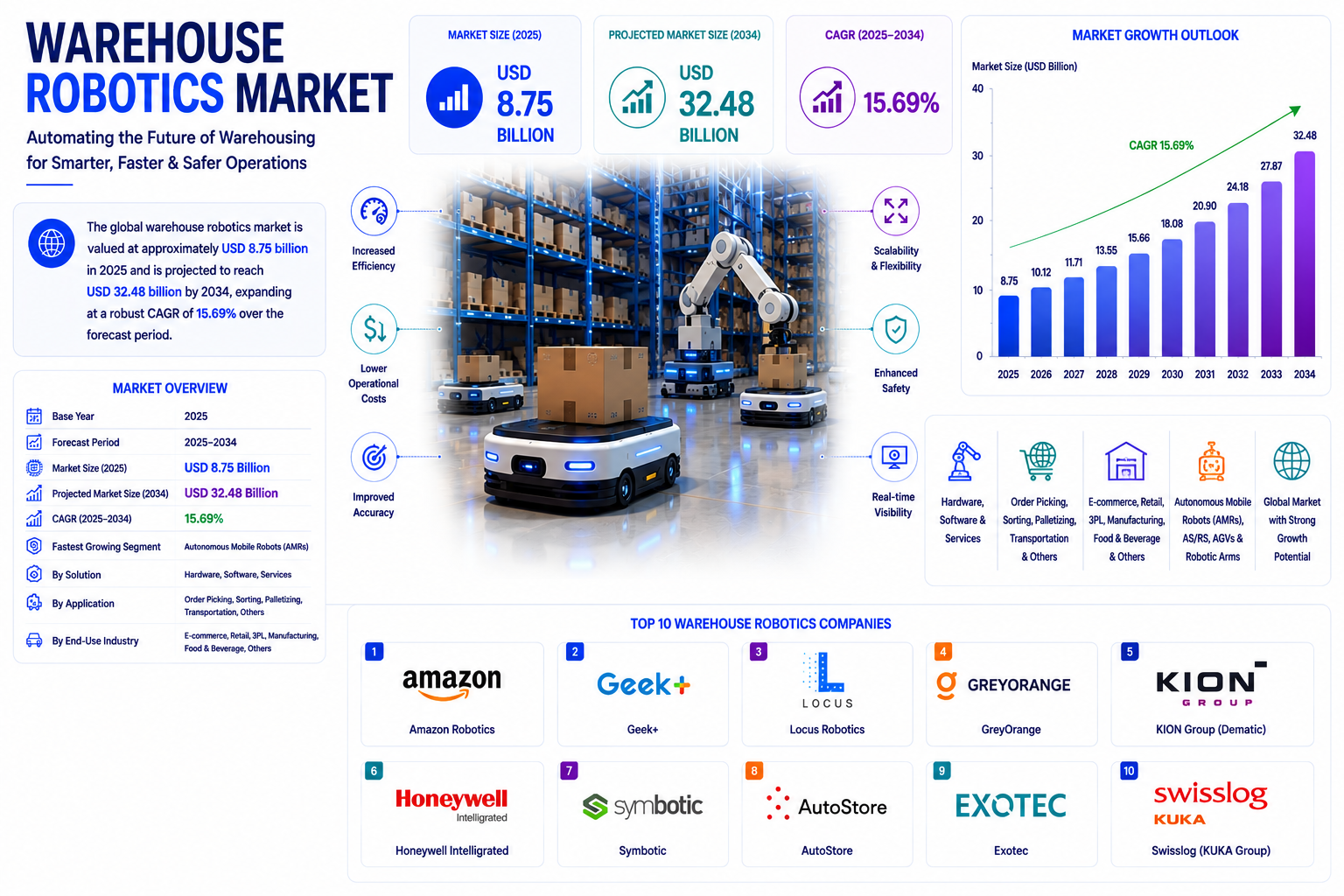
Top 10 Companies in the Global Warehouse Robotics Market Driving Industry Growth in 2026
The global logistics industry is undergoing a profound transformation, and at the heart of this evolution sits one of the fastest-growing technology categories in modern supply chains warehouse robotics. From the sprawling fulfillment centers powering same-day e-commerce delivery to the mid-sized distribution hubs serving regional retailers, robots are increasingly doing the walking, lifting, sorting, and picking once performed entirely by human labor.
The global warehouse robotics market is valued at approximately USD 8.75 billion in 2025 and is projected to reach USD 32.48 billion by 2034, expanding at a robust compound annual growth rate (CAGR) of 15.69% over the forecast period. These figures tell a compelling story: warehouse robotics is no longer an experimental technology reserved for logistics giants it has become a mainstream operational necessity for businesses of nearly every size.
So what exactly counts as a warehouse robot? The category spans a wide range of technologies, including autonomous mobile robots (AMRs) that navigate warehouse floors without fixed infrastructure, automated guided vehicles (AGVs) that follow predefined paths to move pallets, robotic picking arms that use computer vision and machine learning to handle irregular items, goods-to-person (G2P) systems that bring inventory directly to workers, and automated storage and retrieval systems (AS/RS) that maximize vertical storage density.
Several powerful forces are propelling this market forward in 2026 and beyond. First, the relentless expansion of e-commerce continues to demand faster, more accurate, and more flexible order fulfillment, as warehouses shift from large-pallet shipments toward millions of small, multi-SKU orders that are far better suited to automation than manual picking.
Second, persistent labor shortages and rising wage costs across major logistics markets particularly in North America and parts of Europe are pushing operators to automate repetitive, physically demanding tasks rather than compete for an increasingly scarce warehouse workforce.
Third, the emergence of Robotics-as-a-Service (RaaS) business models is dramatically lowering the barrier to adoption. Rather than committing tens of millions of dollars in upfront capital expenditure, operators can now deploy robotic fleets through monthly subscription pricing that scales with operational volume.
Finally, rapid advancement in AI-powered computer vision and machine learning is enabling robots to handle increasingly complex tasks from picking irregularly shaped items to navigating dynamic, ever-changing warehouse layouts expanding the range of operations that can be automated.
Understanding which companies lead this dynamic, rapidly expanding market is critical for investors, logistics operators, and supply chain technology buyers alike.This article provides an overview of the top companies in the global warehouse robotics market, covering their strategies, market positions, key products, and competitive advantages, alongside a regional and competitive landscape review.
Market Overview
|
Parameter |
Details |
|---|---|
|
Market Size (2025) |
USD 8.75 Billion |
|
Projected Market Size (2034) |
USD 32.48 Billion |
|
CAGR (2025–2034) |
15.69% |
|
Base Year |
2025 |
|
Forecast Period |
2025–2034 |
|
Leading Product Segment |
Autonomous Mobile Robots (AMRs) |
|
Leading Application Segment |
E-commerce and Retail Fulfillment |
|
Fastest-Growing Region |
Asia-Pacific (regional CAGR of approximately 16%) |
|
Dominant Region (Adoption Volume) |
Asia-Pacific |
|
Key Growth Drivers |
E-commerce growth, labor shortages, SKU proliferation, Robotics-as-a-Service adoption |
|
Key Challenges |
High upfront capital costs, system integration complexity, safety and certification standards |
|
Key Opportunities |
RaaS subscription models, AI-powered picking, multi-vendor fleet orchestration software |
Note: Market sizing estimates vary across research providers depending on scope and methodology; figures above reflect a 2026 forecast (USD 8.75B base year, 15.69% CAGR through 2040) re-based to a 2025–2034 window for consistency with this report's format, and should be cross-checked against the original source before use in financial or investment decisions.
Why the Warehouse Robotics Market is Growing
1. E-commerce Expansion and SKU Proliferation
The shift from large, predictable pallet-based orders to millions of small, diverse SKU orders is reshaping warehouse operations. Over half of businesses are expected to increase the number of SKUs they carry to meet long-tail consumer demand, a trend that strongly favors automated mini-load storage, retrieval, and picking systems over traditional manual fulfillment methods.
2. Persistent Labor Shortages and Rising Wage Costs
Warehousing and logistics operators across North America and parts of Europe continue to struggle with chronic labor shortages and rising wage pressures. Automating repetitive, physically demanding tasks — walking, lifting, and sorting — allows operators to maintain throughput without depending on an increasingly difficult-to-staff workforce.
3. Robotics-as-a-Service (RaaS) Adoption
The emergence of subscription-based RaaS pricing models is transforming the economics of warehouse automation. Rather than requiring large upfront capital investment, operators can deploy robotic fleets for a predictable monthly fee that scales with operational volume, significantly lowering the barrier to adoption for small and mid-sized warehouse operators.
4. AI and Computer Vision Advancements
Continued progress in machine learning and computer vision is enabling robots to handle increasingly complex tasks, including picking irregularly shaped items and adapting to dynamic warehouse layouts in real time. This is expanding the range of fulfillment operations that can be automated beyond simple, repetitive movements.
5. Warehouse Footprint Expansion
Average warehouse facility sizes have grown substantially in recent years as operators consolidate inventory and pursue economies of scale. Larger facilities increase the return on investment for automation, as fixed robotic infrastructure and software systems can be amortized across greater throughput volumes.
6. Multi-Vendor Fleet Orchestration Software
The emergence of fleet orchestration platforms capable of managing robots from multiple manufacturers under a single control layer is reducing vendor lock-in and accelerating adoption, as operators can mix and match best-in-class hardware while maintaining unified operational visibility.
Top 10 Companies in the Global Warehouse Robotics Market
- Amazon Robotics
- Geek+
- Locus Robotics
- GreyOrange
- KION Group (Dematic)
- Honeywell Intelligrated
- Symbotic
- AutoStore
- Exotec
- Swisslog (KUKA Group)
1. Amazon Robotics
Headquarters: North Reading, Massachusetts, USA | Founded: 2003 (as Kiva Systems; acquired by Amazon in 2012, renamed Amazon Robotics in 2015) | Industry Focus: Fulfillment Center Automation, AMRs, Robotic Picking | Global Presence: Deployed exclusively across Amazon's global fulfillment network
Company Overview: Amazon Robotics is the largest single deployer of warehouse robotics in the world, operating hundreds of thousands of robots across Amazon's fulfillment center network. Originally founded as Kiva Systems, the company pioneered the goods-to-person model that reshaped modern fulfillment center design.
Key Products and Services: Amazon Robotics' portfolio includes mobile drive units that bring inventory shelves to workers, the Sparrow robotic picking arm, the Cardinal sorting robot, and the Proteus autonomous mobile robot capable of operating safely alongside human workers.
Market Position: Amazon Robotics holds an unmatched scale advantage, with deep integration into Amazon's proprietary fulfillment software, though its systems remain exclusive to Amazon's own operations rather than sold externally.
Recent Developments: Continued expansion of AI-driven picking and sorting capabilities, broader deployment of the Proteus AMR platform, and ongoing integration of robotics with Amazon's broader fulfillment and logistics software stack.
Strategic Advantages: Unmatched operational scale, tight integration between hardware and fulfillment software, and a decade-plus head start in deploying robotics across a vast, data-rich operating environment.
2. Geek+
Headquarters: Beijing, China | Founded: 2015 | Industry Focus: AI-Powered Autonomous Mobile Robots, Goods-to-Person Systems | Global Presence: Operations across Asia, Europe, and North America serving e-commerce, retail, and manufacturing customers
Company Overview: Geek+ has emerged as one of the fastest-growing warehouse robotics companies globally, maintaining a leading share of the goods-to-person AMR market for multiple consecutive years. The company serves e-commerce, retail, and manufacturing organizations with AI-based robotic systems.
Key Products and Services: Geek+ offers a range of autonomous mobile robots for goods-to-person picking, sorting robots, and AI-driven warehouse management software, with flexible Robotics-as-a-Service deployment options.
Market Position: Geek+ is a global leader in goods-to-person robotic solutions, with a customer base spanning major international retail and logistics brands.
Recent Developments: Continued international expansion beyond its home China market, broadened RaaS offerings, and ongoing investment in AI-driven fleet optimization software.
Strategic Advantages: Cost-competitive hardware manufacturing scale, flexible deployment models, and rapid international expansion supported by strong execution in its home market.
3. Locus Robotics
Headquarters: Wilmington, Massachusetts, USA | Founded: 2014 | Industry Focus: Autonomous Mobile Robots for Order Picking | Global Presence: Deployments across North America, Europe, and Asia-Pacific
Company Overview: Locus Robotics was spun out of Quiet Logistics following Amazon's acquisition of Kiva Systems, filling the market gap left for third-party AMR solutions. The company has become one of the most widely deployed independent AMR providers serving third-party logistics (3PL) operators, retailers, and e-commerce brands.
Key Products and Services: Locus Robotics' core product is its LocusBot fleet of collaborative AMRs, designed to work alongside human pickers to dramatically increase picking productivity, supported by its software platform for fleet management and analytics.
Market Position: Locus Robotics holds a leading position among independent AMR providers, with one of the largest installed bases of collaborative picking robots outside of Amazon's own network.
Recent Developments: Continued expansion of its RaaS subscription offerings, new robot platform releases aimed at higher-throughput facilities, and growing partnerships with major 3PL operators.
Strategic Advantages: A mature, widely proven collaborative robot model, strong RaaS-based customer economics, and a large reference base of enterprise logistics customers.
4. GreyOrange
Headquarters: Atlanta, Georgia, USA, and Gurugram, India (dual headquarters) | Founded: 2011 | Industry Focus: AI-Powered Fulfillment Automation, AMRs | Global Presence: Operations across North America, Europe, and Asia
Company Overview: GreyOrange provides AI-driven warehouse automation and fulfillment optimization technology, combining robotic hardware with its GreyMatter software platform to orchestrate inventory movement and order fulfillment in real time.
Key Products and Services: GreyOrange's portfolio includes its Ranger family of autonomous mobile robots for sorting and goods-to-person fulfillment, alongside its GreyMatter fulfillment orchestration software.
Market Position: GreyOrange is recognized as a strong AI-software-led player in the warehouse robotics market, differentiating through its orchestration and optimization software layer.
Recent Developments: Continued investment in AI-driven fulfillment optimization software and expansion of its robotic hardware portfolio to serve a broader range of warehouse formats.
Strategic Advantages: A strong software-first approach to fulfillment optimization, dual-market presence across North America and Asia, and an integrated hardware-software platform.
5. KION Group (Dematic)
Headquarters: Frankfurt, Germany | Founded: 2006 (KION Group); Dematic brand with a long heritage in material handling systems | Industry Focus: Industrial Trucks, Automated Storage and Retrieval Systems, Warehouse Automation | Global Presence: Global operations across Europe, North America, and Asia
Company Overview: KION Group is a global leader in industrial trucks and warehouse automation solutions. Through its Dematic subsidiary, the company provides large-scale automated storage and retrieval systems, conveyors, and sorting solutions for major distribution centers worldwide.
Key Products and Services: KION's portfolio includes Dematic-branded automated storage and retrieval systems (AS/RS), conveyor and sortation systems, and a broad range of forklifts and industrial trucks under multiple brands.
Market Position: KION Group is one of the largest material handling and warehouse automation conglomerates globally, with deep relationships across large-scale distribution and logistics operators.
Recent Developments: Continued integration of robotics and software across its Dematic automation portfolio, and expansion of large-scale automated fulfillment center projects globally.
Strategic Advantages: Massive scale in industrial material handling, a long-established global distribution and service network, and the ability to deliver fully integrated large-scale automation projects.
6. Honeywell Intelligrated
Headquarters: Mason, Ohio, USA (Intelligrated); parent Honeywell headquartered in Charlotte, North Carolina, USA | Founded: 2001 (Intelligrated); acquired by Honeywell in 2016 | Industry Focus: Warehouse Automation, Sortation, Robotics Integration | Global Presence: Global operations leveraging Honeywell's broader industrial footprint
Company Overview: Honeywell Intelligrated provides integrated warehouse automation solutions, combining robotics, conveyance, and software under the broader Honeywell industrial technology umbrella.
Key Products and Services: Honeywell Intelligrated's offerings include robotic piece-picking systems, sortation and conveyance automation, and warehouse execution software integrated with Honeywell's broader supply chain technology portfolio.
Market Position: Honeywell Intelligrated benefits from deep integration with Honeywell's broader industrial and supply chain technology businesses, positioning it as a one-stop automation partner for large enterprise customers.
Recent Developments: Continued expansion through acquisitions and digital platform investment to strengthen its integrated warehouse automation offerings.
Strategic Advantages: Strong enterprise relationships through Honeywell's broader industrial business, integrated hardware-software-service offerings, and significant R&D resources backed by a large parent company.
7. Symbotic
Headquarters: Wilmington, Massachusetts, USA | Founded: 2007 | Industry Focus: Fully Automated Warehouse Systems, AS/RS Robotics | Global Presence: Deployments primarily across North America with expanding international footprint
Company Overview: Symbotic provides end-to-end automated warehouse systems combining high-density automated storage and retrieval with fleets of autonomous robots, originally developed for large-scale grocery and retail distribution.
Key Products and Services: Symbotic's core offering is its integrated robotic AS/RS platform, which uses autonomous robots operating within a structured storage grid to receive, store, and retrieve inventory at high speed and density.
Market Position: Symbotic has established itself as a leading provider of fully automated, high-throughput warehouse systems for large retail and grocery distribution customers.
Recent Developments: Continued scaling of deployments with major retail customers and expansion of its software-driven warehouse orchestration capabilities.
Strategic Advantages: A highly engineered, fully integrated system architecture purpose-built for high-volume distribution, and deep strategic relationships with major retail customers.
8. AutoStore
Headquarters: Nedre Vats, Norway | Founded: 1996 | Industry Focus: Cube Storage Automation | Global Presence: Global network of system integrator partners across more than 50 countries
Company Overview: AutoStore pioneered the cube storage automation model, in which small robots travel across the top of a dense storage grid to retrieve and deliver bins to workstations, dramatically increasing storage density compared to traditional shelving.
Key Products and Services: AutoStore's core product is its grid-based cube storage system, supported by an extensive global network of system integrator partners who design and deploy customized installations.
Market Position: AutoStore holds a leading position in the cube storage automation category, with one of the largest installed bases of grid-based robotic storage systems worldwide.
Recent Developments: Continued expansion of its global integrator partner network and ongoing development of higher-throughput robot models for its storage grid platform.
Strategic Advantages: A proven, highly space-efficient storage technology, an extensive global partner ecosystem, and strong brand recognition within the cube storage automation niche.
9. Exotec
Headquarters: Lille, France | Founded: 2015 | Industry Focus: Goods-to-Person Robotic Storage Systems | Global Presence: Operations across Europe, North America, and Asia
Company Overview: Exotec has rapidly grown into a leading provider of goods-to-person warehouse automation, known for its Skypod system that combines vertical and horizontal robot movement within standard racking infrastructure.
Key Products and Services: Exotec's flagship Skypod system uses robots capable of climbing storage racks to retrieve totes at height, alongside its Skypicker robotic arm for automated item picking.
Market Position: Exotec has established itself as a fast-growing innovator in the goods-to-person automation segment, competing for large-scale fulfillment center contracts against more established players.
Recent Developments: Continued international expansion and ongoing development of robotic picking arm technology to extend automation deeper into the picking process.
Strategic Advantages: A space-efficient vertical storage design compatible with standard racking, strong recent growth momentum, and continued innovation in robotic picking technology.
10. Swisslog (KUKA Group)
Headquarters: Buchs/Aarau, Switzerland | Founded: Long-established material handling heritage; part of KUKA Group, which is majority owned by Midea Group | Industry Focus: Warehouse Automation, Robotics Integration | Global Presence: Global operations across Europe, North America, and Asia-Pacific
Company Overview: Swisslog provides integrated warehouse automation solutions spanning robotics, software, and material handling systems, operating as part of the broader KUKA Group of industrial automation companies.
Key Products and Services: Swisslog's portfolio includes automated storage and retrieval systems, robotic item-picking solutions, and warehouse management software designed for large-scale distribution and fulfillment operations.
Market Position: Swisslog holds an established position as an integrated warehouse automation provider, benefiting from its association with KUKA's broader industrial robotics expertise.
Recent Developments: Continued integration of KUKA's robotics technology into Swisslog's warehouse automation solutions, and expansion of its software-driven fulfillment orchestration capabilities.
Strategic Advantages: Deep robotics engineering expertise inherited from KUKA, a long-established presence in large-scale material handling, and strong global service and integration capabilities.
Competitive Landscape
The global warehouse robotics market exhibits a fragmented but rapidly consolidating competitive structure. A handful of players — Amazon Robotics, Geek+, and KION Group — operate at exceptional scale, while a broad field of well-funded independents and industrial conglomerate subsidiaries compete for the rest of the market.
The competitive landscape is shaped by several key dynamics:
Hardware Versus Software Differentiation: As robotic hardware becomes increasingly commoditized, leading providers are differentiating through fleet orchestration software, AI-driven picking algorithms, and fulfillment optimization platforms rather than hardware specifications alone.
The Rise of Robotics-as-a-Service: RaaS pricing models are reshaping competitive dynamics, lowering switching costs for customers and intensifying competition among providers offering flexible, subscription-based deployment.
Industrial Conglomerate Consolidation: Established industrial automation conglomerates — including Honeywell, KION Group, and KUKA — continue to acquire or integrate robotics-native startups, combining engineering scale with newer AI-driven robotics capabilities.
Multi-Vendor Interoperability: The emergence of fleet orchestration platforms capable of managing robots from multiple manufacturers is reducing vendor lock-in, intensifying competitive pressure on providers to differentiate beyond proprietary ecosystems.
Regional Manufacturing Advantages: Chinese providers such as Geek+ benefit from cost-competitive manufacturing scale, enabling aggressive international pricing that is reshaping competitive dynamics in price-sensitive markets.
Regional Analysis
North America
North America's warehouse robotics market is estimated at approximately USD 4.39 billion in 2025, growing at a CAGR of around 12% through 2030. The region is being reshaped by surging e-commerce demand, persistent labor shortages, and a push toward streamlined, 24/7 fulfillment operations, with third-party logistics providers increasingly catching up to retail and e-commerce leaders in automation adoption.
Europe
Europe maintains a strong base of established material handling and robotics expertise, anchored by companies such as KION Group, Swisslog, and Exotec. Strict labor regulations and high wage costs continue to support strong automation adoption across the region's distribution and logistics sectors.
Asia-Pacific
Asia-Pacific represents the fastest-growing and largest-volume region in the global warehouse robotics market, with a regional CAGR of approximately 16%, driven by rapid e-commerce expansion and manufacturing leadership in China, Japan, India, and South Korea. China-based providers, including Geek+, benefit from substantial domestic deployment scale and cost-competitive manufacturing capabilities.
Latin America
Latin America represents a smaller but emerging market, supported by growing e-commerce penetration and gradual modernization of regional distribution infrastructure, though automation adoption remains at an earlier stage than in North America, Europe, or Asia-Pacific.
Middle East & Africa
Smart logistics initiatives and growing investment in regional distribution infrastructure are creating early-stage opportunities for warehouse robotics adoption, particularly as e-commerce penetration increases across the Gulf region.
Emerging Trends in the Warehouse Robotics Market
1. Robotics-as-a-Service Expansion: Subscription-based deployment models are converting upfront capital expenditure into predictable monthly costs, accelerating adoption among small and mid-sized operators.
2. AI-Powered Robotic Picking: Advances in computer vision and machine learning are enabling robotic arms to handle increasingly irregular and varied items, expanding the range of automatable picking tasks.
3. Multi-Vendor Fleet Orchestration: Unified control software capable of managing robots from multiple manufacturers is reducing vendor lock-in and enabling mixed-fleet deployments across large facilities.
4. Mobile Robot Growth Outpacing Fixed Automation: Mobile robotic platforms are growing faster than traditional fixed industrial automation, favored for the layout flexibility they offer in greenfield fulfillment projects.
5. Software and Subscription Revenue Growth: Software and managed-service revenue streams are growing faster than hardware sales, as operators recognize that intelligent orchestration is required to fully realize hardware utilization gains.
6. Emerging Humanoid and Legged Robotics: Early-stage commercial deployment of humanoid and legged robotic platforms is beginning to extend automation into tasks — such as tote handling and mixed-case manipulation — that have historically resisted automation.
Future Outlook (2026–2034)
The global warehouse robotics market's trajectory toward roughly USD 32.48 billion by 2034 is supported by a convergence of durable structural trends. Continued e-commerce growth, persistent labor market tightness, and the maturation of AI-powered robotic picking technology are expected to sustain double-digit growth across the forecast period.
Key investment themes include the continued expansion of RaaS subscription models, growth in fleet orchestration and warehouse execution software, increasing adoption of AI-powered picking robots capable of handling irregular items, and early-stage commercialization of humanoid and legged robotics for specialized warehouse tasks.
For investors, the warehouse robotics market offers exposure to the secular growth of e-commerce and supply chain automation, with significant upside concentrated in companies that successfully combine robotic hardware with differentiated, AI-driven software orchestration. Leading companies — Amazon Robotics, Geek+, and Locus Robotics — are likely to continue capturing substantial deployment volume, while software-differentiated and industrial conglomerate-backed players offer more diversified exposure to the category's long-term growth.
Frequently Asked Questions (FAQ)
1. What is the current size of the global warehouse robotics market? The global warehouse robotics market is valued at approximately USD 8.75 billion in 2025. It is projected to grow at a CAGR of 15.69%, reaching USD 32.48 billion by 2034, though estimates vary across research providers.
2. Who are the top companies in the global warehouse robotics market? Leading companies include Amazon Robotics, Geek+, Locus Robotics, GreyOrange, KION Group (Dematic), Honeywell Intelligrated, Symbotic, AutoStore, Exotec, and Swisslog.
3. Which region dominates the warehouse robotics market? Asia-Pacific leads the market in adoption volume and growth rate, driven by China, Japan, India, and South Korea, while North America and Europe remain large, mature markets.
4. What is the forecast CAGR for the warehouse robotics market? One widely cited estimate puts the CAGR at 15.69% from 2025 to 2034; other research providers' estimates vary, generally ranging from roughly 10% to 18% depending on market scope and methodology.
5. What are the primary types of warehouse robots? Key categories include autonomous mobile robots (AMRs), automated guided vehicles (AGVs), robotic picking arms, goods-to-person (G2P) systems, and automated storage and retrieval systems (AS/RS).
6. What is driving growth in the warehouse robotics market? Key drivers include e-commerce expansion, SKU proliferation, persistent labor shortages, the rise of Robotics-as-a-Service pricing models, and advances in AI-powered robotic picking.
7. What challenges does the warehouse robotics market face? Key challenges include high upfront capital costs for traditional deployments, system integration complexity, and evolving safety and certification standards across different regions.
8. What is Robotics-as-a-Service (RaaS)? RaaS is a subscription-based pricing model in which operators pay a recurring fee for robotic hardware and software rather than a large upfront capital purchase, lowering the barrier to automation adoption.
9. How is AI impacting warehouse robotics? AI and computer vision advances are enabling robots to handle increasingly complex and irregular picking tasks, adapt to dynamic warehouse layouts, and support predictive maintenance and fleet optimization.
10. What investment opportunities exist in the warehouse robotics market? Opportunities span robotic hardware manufacturers, fleet orchestration and warehouse execution software providers, AI-powered picking technology, and emerging humanoid and legged robotics platforms.
Conclusion
The global warehouse robotics market stands at an inflection point, transitioning from an early-adopter technology used primarily by logistics giants to a mainstream operational necessity across the broader supply chain industry. With a projected market size of roughly USD 32.48 billion by 2034 and sustained double-digit growth, the sector offers compelling opportunities for operators, investors, and technology providers alike.
The top companies in the warehouse robotics market — led by Amazon Robotics, Geek+, and Locus Robotics — are not merely competing on robot hardware specifications. They are competing on software orchestration, AI-driven picking capability, deployment flexibility, and total cost of ownership. The companies that successfully combine proven robotic hardware with intelligent, interoperable software while capturing the shift toward Robotics-as-a-Service will define the industry's leadership landscape through 2030 and beyond.