
Top 10 Leading Companies in the Global Wi-Fi 7 Market 2025
Author:
Intellectual Market Insights Research
Published Date:
14 Oct 2026
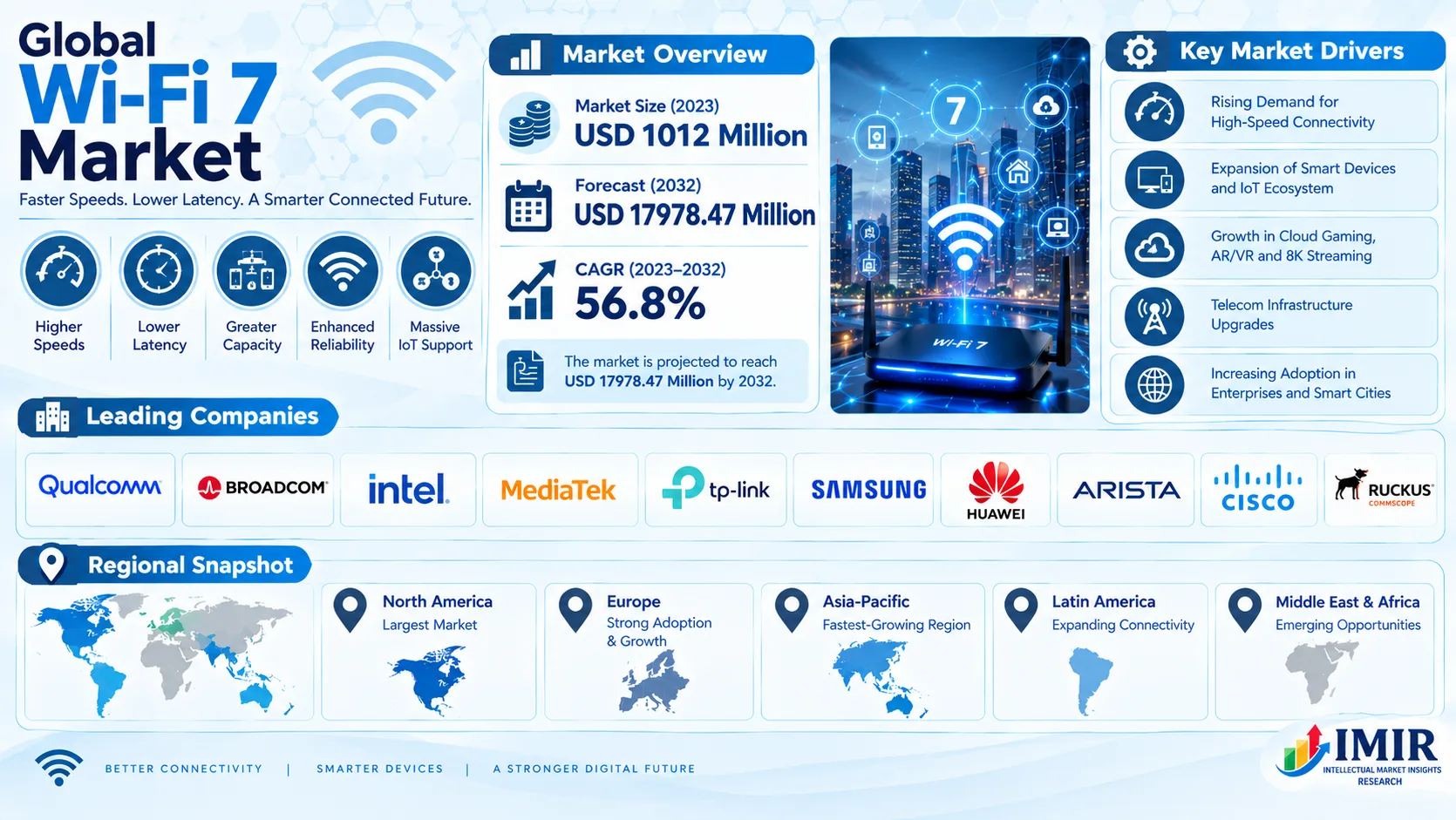
Global Wi-Fi 7 Market: Size, Leading Companies, Trends and Outlook (2025–2034)
Market Overview and Forecast: According to IMIR, the global Wi-Fi 7 market was valued at USD 1,012 million in 2023 and is projected to reach USD 17,978.47 million by 2032, with a stated CAGR of 56.8%.
Introduction
Wi-Fi 7 (IEEE 802.11be, marketed as "Extremely High Throughput") is the seventh generation of Wi-Fi. It adds 320 MHz channels in the 6 GHz band, 4096-QAM modulation, Multi-Link Operation (MLO, which lets a device use several bands at once) and better scheduling, which together bring higher speeds, lower latency and more reliable connections in crowded places.
Adoption has moved faster than many expected. Phones, PCs and routers with Wi-Fi 7 are now mainstream, and in enterprise access points Wi-Fi 7 has already become the largest single category by revenue. At the same time, the market has met new obstacles in 2026: global memory shortages that raise prices, and a US decision to stop certifying new foreign-made consumer routers. This blog covers the size of the market, what is driving it, the companies named by IMIR, and the outlook.
Why the Wi-Fi 7 Market Is Growing
1. Equipment refresh cycle. Many enterprises still run Wi-Fi 5 and early Wi-Fi 6 gear. IDC says Wi-Fi 7 prices have become competitive across market tiers, which is pulling refresh projects forward.
2. AI and bandwidth-hungry applications. AI tools, cloud apps, video conferencing, cloud gaming and AR/VR raise throughput and latency requirements. IDC lists AI adoption as one of the main drivers of 2026 purchases.
3. Devices are arriving. Flagship smartphones, PCs, TVs and game consoles now ship with Wi-Fi 7 chips from Qualcomm, MediaTek, Broadcom and Intel, which gives routers and access points something to connect to.
4. Better performance in dense places. MLO and wider channels help in stadiums, airports, campuses, hospitals and factories, which suits IoT and Industry 4.0 use.
5. 6 GHz spectrum opening. More countries are opening or de-licensing the 6 GHz band (for example, India has released 6 GHz for Wi-Fi), which is needed for the full benefit of Wi-Fi 7.
6. Fibre and multi-gig broadband. Home internet plans of 2.5 Gbps and above need routers that can use them. Multi-gig and 10 Gbps access-point shipments are growing quickly.
7. Service-provider and enterprise upgrades. Telecom operators, cable companies and managed-service providers are including Wi-Fi 7 gateways in new offers.
Headwind: memory costs. An industry-wide memory shortage linked to the AI infrastructure boom is lengthening lead times and raising prices, and several vendors have raised list prices. Dell'Oro says the full price impact had not yet shown in vendor revenues in early 2026.
Companies Associated with the Wi-Fi 7 Market
IMIR names 23 companies: Qualcomm, Broadcom, TP-Link, ZTE, MediaTek, Keysight Technologies, MaxLinear, Huawei, CommScope, Vantiva, LitePoint, Rohde & Schwarz, Intel, HFCL, Netgear, SDMC Technology, Senscomm Semiconductor, H3C, VVDN Technologies, Actiontec Electronics, ADB Global, Ruijie Networks and Edgewater Wireless Systems. IMIR's separate blogs also profile Cisco, ASUS and Aruba (HPE). The main companies are profiled below in bullet form and then compared in a table.
Qualcomm Technologies Inc.

- Headquarter: San Diego, USA
- Founded: 1985
- Employees: ~51,000
- Revenue 2024: $35.8B
- Regional Focus: North America, Asia-Pacific
- Strength: Leading Wi-Fi 7 chipsets with MLO support & AI networking
Broadcom Inc.

- Headquarter: San Jose, USA
- Founded: 1961
- Employees: ~20,000
- Revenue 2024: $39B
- Key Markets: USA, Taiwan, China
- Strength: Premier semiconductor and SoC supplier for Wi-Fi 7 routers
MediaTek Inc.

- Headquarter: Hsinchu, Taiwan
- Founded: 1997
- Employees: ~19,000
- Revenue 2024: $18.8B
- Key Markets: Asia-Pacific Focused
- Strength: Leading Wi-Fi 7 solutions in smartphones & smart TVs
Intel Corporation

- Headquarter: Santa Clara, USA
- Founded: 1968
- Employees: ~120,000
- Revenue 2024: $54.2B
- Focus: North America, EU
- Strength: Wi-Fi 7 integration into next-gen laptops and PC chipsets
Cisco Systems Inc.

- Headquarter: San Jose, USA
- Founded: 1984
- Employees: ~83,000
- Revenue 2024: $54.7B
- Enterprise Wi-Fi Focus
- Strength: End-to-end enterprise Wi-Fi 7 hardware and WaaS (Wi-Fi-as-a-Service)
TP-Link Technologies Co., Ltd.

- Headquarter: Shenzhen, China
- Founded: 1996
- Employees: ~30,000
- Revenue 2024: ~$3.4B
- Global Distribution (esp. Europe, Asia)
- Strength: Cost-effective Wi-Fi 7 mesh routers and consumer devices
ASUS (ASUSTeK Computer Inc.)

- Headquarter: Taipei, Taiwan
- Founded: 1989
- Employees: ~15,000
- Revenue 2024: $19.3B
- Gaming and Consumer Focus
- Strength: Wi-Fi 7 gaming routers and ROG product line
ZTE Corporation

- Headquarter: Shenzhen, China
- Founded: 1985
- Employees: ~80,000
- Revenue 2024: ~$16B
- Focus on Telecom & Smart Cities
- Strength: Wi-Fi 7 backhaul and IoT device integration
Netgear Inc.

- Headquarter: San Jose, USA
- Founded: 1996
- Employees: ~700
- Revenue 2024: ~$860M
- Focus: North America & Europe
- Strength: Consumer-grade Wi-Fi 7 mesh and Orbi line
Aruba Networks (Hewlett Packard Enterprise)

- Headquarter: California, USA
- Founded: 2002
- Employees: ~7,000
- Revenue (part of HPE): $29B
- Enterprise & Education
- Strength: AI-powered Wi-Fi 7 for campuses, hospitals, airports
Competitive Landscape
- Layered market. Chip makers (Qualcomm, Broadcom, MediaTek, Intel, MaxLinear) supply the silicon; device and infrastructure vendors (Cisco, HPE-Aruba, Ubiquiti, Huawei, TP-Link, Netgear, Ruckus) sell access points and routers; service-provider gear makers (Vantiva, ZTE, HFCL) supply gateways; and test companies (Keysight, Rohde & Schwarz, LitePoint) support certification.
- Enterprise concentration. In Q2 2026 Cisco held 39.0% of enterprise WLAN revenue, HPE/Juniper 17.2%, Ubiquiti 12.8% and Huawei 10.5%, so the top four took roughly 80%.
- Ownership shifts. Ruckus moved from CommScope/Vistance to Belden, and HPE completed its Juniper purchase, so IMIR's older company names need updating.
- US policy reshaping consumer routers. In March 2026 the FCC added foreign-produced consumer routers to its Covered List and stopped certifying new models, with a route to conditional approval for makers building US manufacturing capacity. The measure applies to new models, not routers already on sale. Together with the Commerce Department's investigation of TP-Link, this creates uncertainty for brands that make products abroad.
- Memory-driven price rises. Component shortages favour vendors with strong supply contracts and raise prices for everyone. Vantiva's revenue fell 14.7% in H1 2026 while citing memory constraints.
- Next-generation race. Qualcomm has already announced Wi-Fi 8 chips. Wi-Fi 8 products are expected in 2027, Wi-Fi Alliance certification around January 2028 and final IEEE approval around May 2028, which means Wi-Fi 7 will have a shorter "peak" than earlier generations.
Regional Analysis
IMIR's regional percentages are placeholders, so this section is qualitative. IMIR names North America and Asia-Pacific (with Japan and China as home to key companies) as the focus regions.
North America is the largest region by enterprise WLAN revenue (the Americas had USD 1.5 billion in Q2 2026, up 21.6%, per IDC). Demand is led by enterprise refresh, fibre broadband and new devices, while US router regulation is a major uncertainty for consumer products.
Europe shows the fastest enterprise growth in IDC's Q2 2026 data (EMEA USD 1.0 billion, up 32.2%). Policy debates over 6 GHz allocation continue, and service providers are major buyers.
Asia-Pacific has strong chip and device manufacturing (China, Taiwan, Japan, South Korea) and fast-growing demand in India and Southeast Asia (APJ enterprise WLAN USD 708 million, up 15.2%). India's release of the 6 GHz band for Wi-Fi supports adoption.
Latin America. Growing, supported by fibre rollouts and rising device sales, though price-sensitive and slower to adopt 6 GHz.
Middle East & Africa. Gulf states invest in smart-city, stadium and hospitality Wi-Fi, creating early demand for Wi-Fi 7 in high-density places.
Emerging Trends
- Enterprise Wi-Fi 7 is now mainstream. It is the largest enterprise access-point category by revenue as of Q2 2026.
- Multi-Link Operation and 6 GHz. MLO and wide 6 GHz channels are the features that deliver the promised low latency.
- AIOps and AI-native networks. Vendors differentiate with AI-based monitoring, troubleshooting and security.
- Multi-gig and 10 Gbps access points. These raise demand for campus switch upgrades.
- Wi-Fi 8 preparation. Wi-Fi 8 (802.11bn) focuses on reliability rather than raw speed. Chips are shipping to partners and standards are expected to complete around 2028.
- Smart home and IoT. Wi-Fi 7 supports dense device environments, though many IoT devices will stay on older Wi-Fi for years.
- Supply-chain localisation. US rules push vendors to build or contract manufacturing in the US or approved locations.
- Price increases from memory costs. Vendors are raising prices, which may slow low-end consumer adoption in 2026–2027.
Future Outlook (2025–2034)
IMIR's forecast runs to USD 17,978 million in 2032, from USD 1,012 million in 2023, at a stated 56.8% CAGR (implied about 38%). IMIR does not publish figures beyond 2032/2033, so 2033–2034 below is a qualitative extension of the trend.
- 2025–2027. Enterprise refresh and device adoption push Wi-Fi 7 to a majority of new enterprise access points. Consumer growth is held back by memory-driven prices and, in the US, router regulation.
- 2028–2030. Wi-Fi 7 becomes the default in new devices and access points, while the first Wi-Fi 8 products arrive and begin to compete for premium spending.
- 2031–2034. Growth slows as Wi-Fi 7 reaches maturity and spending shifts to Wi-Fi 8 and managed services, but the installed base keeps expanding.
Risks: memory shortages and price rises, US and other trade or security restrictions on foreign-made routers, 6 GHz regulatory fragmentation, a short generation lifespan if Wi-Fi 8 arrives in 2027–2028, and economic caution in enterprise IT budgets.
Opportunities: enterprise campus refresh, managed Wi-Fi services, test and certification, AI-based network operations, and service-provider gateways in Asia and Europe.
FAQ
Q1. How big is the global Wi-Fi 7 market?
IMIR values it at USD 1,012 million in 2023, rising to USD 17,978.47 million by 2032.
Q2. What is the expected growth rate?
IMIR states 56.8%, though the report's endpoints imply about 38% a year. Either way, Wi-Fi 7 is one of the fastest-growing segments in networking.
Q3. What makes Wi-Fi 7 different from Wi-Fi 6?
320 MHz channels, 4096-QAM, Multi-Link Operation and better latency, delivering much higher speed and reliability.
Q4. Who are the leading companies?
Qualcomm, Broadcom, MediaTek and Intel lead in chips; Cisco, HPE-Aruba, Ubiquiti and Huawei lead enterprise access points; TP-Link, Netgear and ASUS lead consumer routers.
Q5. How fast is Wi-Fi 7 being adopted?
IDC says Wi-Fi 7 made up 53.0% of enterprise access-point revenue in Q2 2026, and Dell'Oro says it was 37% of indoor access-point shipments in Q1 2026.
Q6. What are the main challenges?
Memory shortages that raise prices, 6 GHz spectrum rules that vary by country, and US restrictions on new foreign-made consumer routers.
Q7. What is Wi-Fi 8 and does it replace Wi-Fi 7?
Wi-Fi 8 (802.11bn) focuses on reliability and is expected to reach products in 2027 and final standard approval around 2028. Wi-Fi 7 will remain in use for years.
Q8. Which applications use Wi-Fi 7?
Streaming and gaming, AR/VR, smart homes, telemedicine, IoT and Industry 4.0, and dense public venues.
Q9. Have any listed companies changed?
Yes. CommScope was split and renamed Vistance Networks, and Ruckus was sold to Belden in July 2026.
Conclusion
Wi-Fi 7 is moving from early adoption to mainstream use faster than most earlier generations. IMIR projects the market to grow from about USD 1 billion in 2023 to USD 18 billion by 2032, and 2026 data from IDC and Dell'Oro confirm very fast growth, especially in the enterprise.
The next two years will be shaped less by technology and more by supply and policy: memory costs, US router rules and 6 GHz regulation. Vendors with strong chips, supply contracts and enterprise services are best placed, while buyers should plan refreshes with Wi-Fi 8 on the horizon in mind and focus on total network performance rather than the standard alone.