
Top 10 Zero Liquid Discharge Companies in the Market An Overview of Innovations
Author:
Intellectual Market Insights Research
Published Date:
19 Aug 2026
Introduction
As freshwater grows scarcer and industrial wastewater regulations tighten worldwide, a technology once reserved for the most water-stressed corners of heavy industry is becoming mainstream: zero liquid discharge (ZLD). ZLD systems treat industrial wastewater through a combination of filtration, evaporation, and crystallization so thoroughly that no liquid effluent is released into the environment at all, recovering usable water and valuable salts for reuse instead. From coal-fired power plants in water-stressed regions of China to chemical, textile, and semiconductor facilities worldwide, ZLD has moved from a compliance-driven niche to a strategic tool for industrial water security.
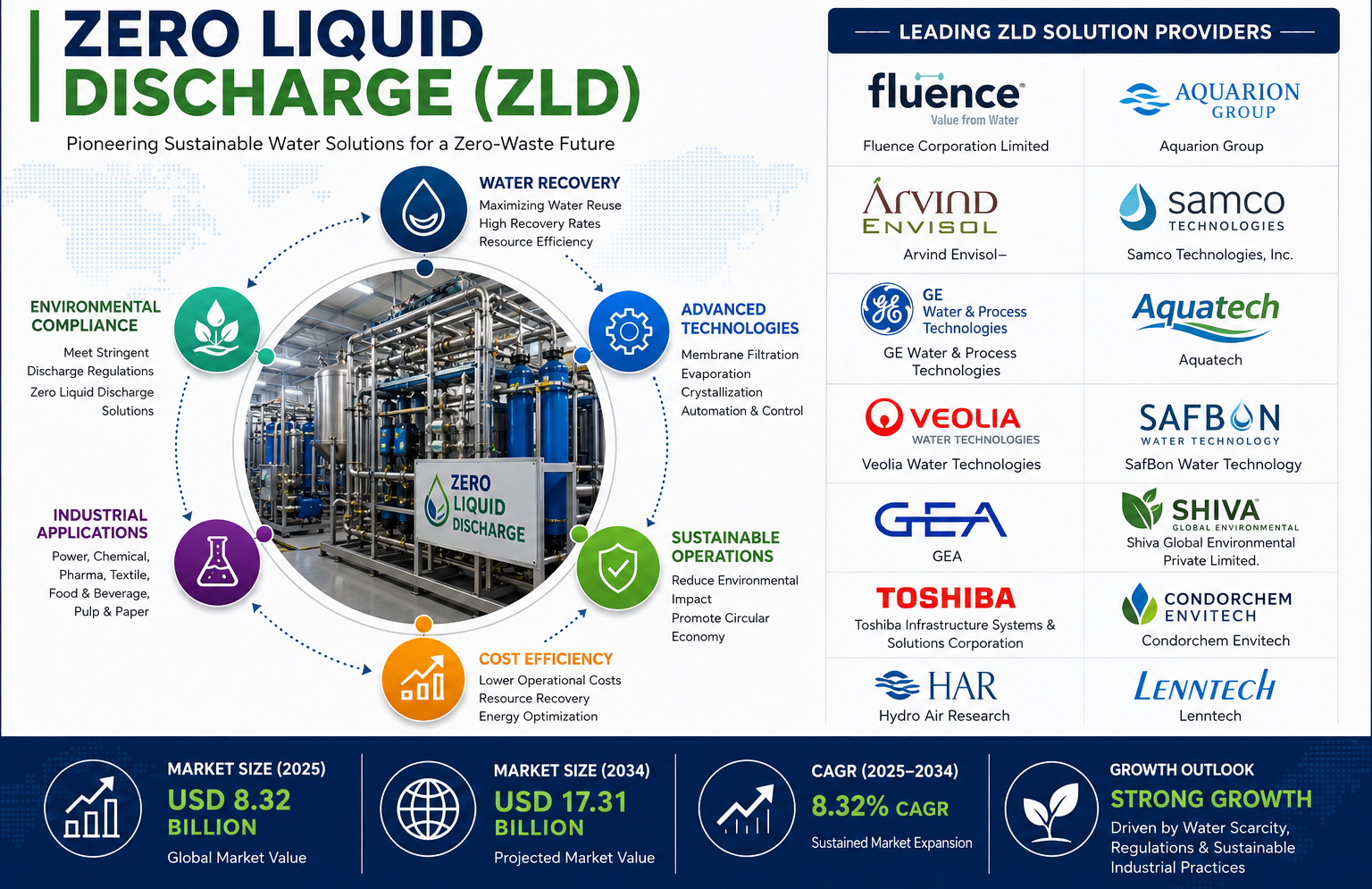
The global zero liquid discharge market was valued at approximately USD 8.32 billion in 2025 and is projected to reach USD 17.31 billion by 2034, expanding at a compound annual growth rate (CAGR) of 8.32% over the forecast period, according to Intellectual Market Insights Research. This growth reflects intensifying water scarcity, tightening environmental discharge regulations, and rising industrial adoption of water recycling and reuse technologies across power generation, chemicals, and other water-intensive sectors.
The competitive landscape spans diversified global environmental services giants, specialized water treatment engineering firms, and industrial equipment manufacturers that have built dedicated ZLD product lines. Because ZLD systems, particularly evaporation and crystallization technology, require substantial upfront capital investment and deep process engineering expertise, the market rewards companies that can combine technical depth with the balance-sheet strength to execute large, customized industrial projects.
Understanding which companies lead this technically demanding but strategically vital market is essential for industrial water managers, utilities, and environmental engineering professionals. This article provides a research-based analysis of the top companies in the global zero liquid discharge market, their positioning, flagship offerings, and the regional and technological forces shaping the competitive landscape.
Market Overview
|
Parameter |
Details |
|---|---|
|
Market Size (2025) |
USD 8.32 Billion |
|
Projected Market Size (2034) |
USD 17.31 Billion |
|
CAGR (2025–2034) |
8.32% |
|
Base Year |
2024 |
|
Forecast Period |
2025–2034 |
|
Leading Region |
Asia-Pacific (9.83% CAGR forecast, largest shareholder) |
|
Fastest-Growing Region |
Asia-Pacific |
|
Key Growth Drivers |
Increasing water scarcity, tightening environmental regulations, rising water recycling and reuse adoption |
|
Key Challenges |
High initial investment costs, particularly for evaporation and crystallization systems |
|
Key Opportunities |
Hybrid system adoption, pre-treatment segment growth, expansion in semiconductor and electronics manufacturing |
Why the Zero Liquid Discharge Market Is Growing
1. Increasing Global Water Scarcity
Population growth and expanding industrial activity are placing growing strain on freshwater supplies, pushing manufacturers to reduce freshwater use and their overall water footprint, with ZLD systems offering a practical solution by recovering water and salts for internal facility reuse.
2. Tightening Environmental Regulations
Governments worldwide are imposing stricter limitations on effluent discharge, pollutant levels, and water quality, requiring industries to deploy advanced wastewater treatment solutions like ZLD systems to achieve total elimination or minimal discharge of liquid waste and avoid regulatory penalties.
3. Rising Adoption of Water Recycling and Reuse Technologies
Industries across chemicals, power generation, textiles, and electronics are increasingly turning to membrane filtration, evaporation, crystallization, and reverse osmosis technologies to achieve high water recovery rates and reduce liquid waste production.
4. Water-Energy Nexus in Power Generation
The electricity generation sector, particularly coal-fired power plants, dominates ZLD demand given its complex, water-intensive discharge profile; with nearly 70% of China's electricity coming from coal-fired plants often located in water-scarce regions, ZLD adoption is directly tied to reconciling energy demand with water availability.
5. Cost Efficiency of Onsite Water Reuse
Reusing water onsite reduces the risk and expense of water procurement, lowers the need for extensive treatment, and cuts down on the trucking and off-site disposal of wastewater, along with the associated emissions and community road safety risks.
6. Growth in Water-Intensive Manufacturing
Expanding global chemical, steel, and semiconductor manufacturing capacity, particularly in China and India, is directly increasing the addressable market for ZLD systems as these industries seek compliant and cost-effective wastewater management solutions.
Top 10 Companies in the Zero Liquid Discharge Market
- Veolia Water Technologies
- Aquatech International
- Fluence Corporation Limited
- GEA Group
- GE Water & Process Technologies
- Aquarion Group
- Arvind Envisol
- Samco Technologies, Inc.
- Toshiba Infrastructure Systems & Solutions Corporation
- SafBon Water Technology
|
Category |
Details |
|---|---|
|
Company Name |
Veolia Water Technologies (a division of Veolia Environnement S.A.) |
|
Headquarters |
Saint-Maurice, France (parent Veolia headquartered in Aubervilliers, France) |
|
Founded |
1853 (as Compagnie Générale des Eaux; Veolia Water Technologies brand established 2013) |
|
Employees |
Approx. 6,500–10,500 (Water Technologies division); Approx. 215,000 (Veolia group-wide) |
|
Revenue |
Approx. USD 2.7–3.6 Billion (Water Technologies division); €44.4 billion (Veolia group-wide, 2025) |
|
Company Overview |
Veolia Water Technologies is the water treatment technology arm of Veolia, the world's largest environmental services company, offering ZLD systems alongside its broader wastewater treatment, desalination, and industrial water portfolio. |
|
Key Products |
Evaporation and crystallization-based ZLD systems, membrane filtration technology, and integrated industrial water reuse solutions. |
|
Market Position |
One of the largest global suppliers of ZLD and industrial water treatment technology, leveraging over 170 years of water industry heritage and Veolia's global service network. |
|
Recent Developments |
Veolia completed full ownership of its Water Technologies and Solutions business in 2025, buying out its remaining minority partner to accelerate value creation in the segment. |
|
Strategic Advantages |
Unmatched global scale and service network, deep engineering heritage, and integration with Veolia's broader water, waste, and energy service businesses. |
|
Category |
Details |
|---|---|
|
Company Name |
Aquatech International Corporation |
|
Headquarters |
Canonsburg, Pennsylvania, United States |
|
Founded |
1981 |
|
Employees |
Approx. 600–800 |
|
Revenue |
Approx. USD 500 Million – 1 Billion (privately held; estimate) |
|
Company Overview |
Aquatech is a privately held, employee- and family-founded water technology company specializing in desalination, water reuse, and zero liquid discharge, serving large industrial and utility customers across more than 60 countries. |
|
Key Products |
HERO (High Efficiency Reverse Osmosis), SmartMOD modular evaporators, HEVAP high-efficiency evaporation technology, and MoVap mobile evaporation systems purpose-built for ZLD applications. |
|
Market Position |
A leading specialist ZLD and industrial water technology provider, particularly strong in oil and gas, power, and heavy industrial applications requiring complex, customized water solutions. |
|
Recent Developments |
Continued expansion into critical minerals processing and lithium recovery, including recent acquisitions strengthening its ZLD and lithium extraction capabilities. |
|
Strategic Advantages |
Four decades of specialized ZLD and desalination engineering expertise, deep customer relationships in energy and heavy industry, and a growing critical minerals processing capability. |
3. Fluence Corporation Limited
|
Category |
Details |
|---|---|
|
Company Name |
Fluence Corporation Limited |
|
Headquarters |
New York, United States (with major operations hub in Minneapolis, Minnesota) |
|
Founded |
2017 (formed through the merger of Emefcy and RWL Water) |
|
Employees |
Approx. 250–300 |
|
Revenue |
Approx. USD 80–100 Million |
|
Company Overview |
Fluence is a publicly listed water and wastewater treatment company specializing in fast-to-deploy, decentralized, and packaged treatment solutions, with a product portfolio spanning municipal and industrial water reuse applications. |
|
Key Products |
Aspiral, NIROBOX, SUBRE, and Nitro smart packaged treatment product lines, alongside build-own-operate and recurring service solutions relevant to industrial water reuse and ZLD-adjacent applications. |
|
Market Position |
A mid-sized, technology-focused global water treatment provider with a track record across more than 7,000 installations in 70 countries, particularly strong in modular and decentralized deployment models. |
|
Recent Developments |
Continued strategic refocus toward higher-margin, proprietary product solutions and recurring revenue streams, moving away from large custom construction projects. |
|
Strategic Advantages |
Modular, standardized product design enabling faster deployment than custom-engineered systems, and a global installed base spanning both municipal and industrial customers. |
4. GEA Group
|
Category |
Details |
|---|---|
|
Company Name |
GEA Group AG |
|
Headquarters |
Düsseldorf, Germany |
|
Founded |
1881 |
|
Employees |
Approx. 18,600+ |
|
Revenue (2025) |
Approx. USD 6 Billion (€5.5 billion) |
|
Company Overview |
GEA is a global technology group best known for equipment serving the food, beverage, and pharmaceutical industries, with a process engineering portfolio that includes evaporation and crystallization systems applicable to industrial ZLD applications. |
|
Key Products |
Industrial evaporation and crystallization equipment, alongside broader process technology and separation systems used in ZLD system design. |
|
Market Position |
A significant equipment supplier to the ZLD value chain, leveraging deep process engineering expertise from its core food, beverage, and pharmaceutical equipment business. |
|
Recent Developments |
Continued strong financial performance under its "Mission 26" strategy, with growing revenue and profitability across its process technology and equipment segments. |
|
Strategic Advantages |
Deep process engineering and thermal separation expertise built over more than a century, strong global manufacturing footprint, and cross-industry technology transfer from its core food and pharma business. |
5. Toshiba Infrastructure Systems & Solutions Corporation
|
Category |
Details |
|---|---|
|
Company Name |
Toshiba Infrastructure Systems & Solutions Corporation |
|
Headquarters |
Kawasaki, Japan |
|
Founded |
2017 (as a Toshiba Corporation subsidiary; Toshiba itself founded 1875) |
|
Employees |
Approx. 20,000+ (subsidiary; parent Toshiba group substantially larger) |
|
Revenue |
Approx. USD 8–9 Billion (subsidiary segment estimate) |
|
Company Overview |
Toshiba Infrastructure Systems & Solutions is a major Japanese infrastructure engineering company whose water and environmental systems business includes water treatment and ZLD-relevant technology for industrial and municipal customers. |
|
Key Products |
Industrial water treatment systems, water recycling and reuse technology, and infrastructure engineering services applicable to ZLD project design and implementation. |
|
Market Position |
A significant infrastructure engineering player in the Asia-Pacific water treatment market, leveraging Toshiba's broader industrial technology and systems integration expertise. |
|
Recent Developments |
Continued investment in water and environmental infrastructure projects as part of Toshiba's broader infrastructure systems and solutions strategy across Asia-Pacific markets. |
|
Strategic Advantages |
Deep systems integration and infrastructure engineering expertise, strong presence in the fast-growing Asia-Pacific ZLD market, and backing from Toshiba's broader industrial technology base. |
Competitive Landscape
The global zero liquid discharge market is moderately fragmented, spanning large diversified environmental services and industrial technology companies such as Veolia and GEA, specialized water treatment engineering firms such as Aquatech, and regional infrastructure and industrial conglomerates such as Toshiba Infrastructure Systems.
Capital Intensity as a Barrier to Entry: ZLD systems, particularly evaporation and crystallization technology, require substantial upfront capital investment and specialized engineering expertise, favoring established players with the balance-sheet strength and technical depth to execute large, customized industrial projects.
Specialization vs. Diversification: Specialist firms like Aquatech compete on deep, singular focus on desalination and ZLD engineering, while diversified players like Veolia and GEA compete on the ability to bundle ZLD within broader water, process, or environmental service offerings.
Modular Solutions Gaining Ground: Companies like Fluence are increasingly competing on standardized, packaged treatment products that deploy faster and at lower cost than fully custom-engineered systems, appealing particularly to mid-sized industrial customers.
Power Generation as the Anchor End Market: Given the electricity generation sector's dominant role in ZLD demand, particularly in coal-heavy, water-scarce markets like China, companies with strong utility and power sector relationships hold a structural advantage in capturing large-scale ZLD contracts.
Regional Analysis
Asia-Pacific
Asia-Pacific is the largest and fastest-growing regional market, with a forecast CAGR of 9.83%, driven by China's massive chemical and steel manufacturing output and India's expanding industrial base, including major downstream steel processing investments requiring extensive water management infrastructure.
Europe
Europe is projected to grow at a 7.29% CAGR, generating an estimated USD 1,626.86 million over the forecast period, led by Germany's large chemical sector, which accounts for more than 70% of European chemical exports and drives substantial ZLD demand from major chemical manufacturers.
North America
North America represents a mature but steadily growing market, supported by strict environmental discharge regulations and significant industrial water treatment investment across the chemicals, power, and semiconductor sectors.
Latin America and MEA
These regions represent smaller but developing markets, with growth tied to expanding industrial capacity and increasing regulatory attention to industrial wastewater management, particularly in water-scarce areas of the Middle East.
Emerging Trends in the Zero Liquid Discharge Market
1. Hybrid System Adoption: Combining conventional and advanced treatment technologies into hybrid ZLD systems is helping industries balance upfront capital costs against long-term operational efficiency and reliability.
2. Pre-Treatment Segment Growth: The pre-treatment segment is expected to grow at the fastest rate as industries increasingly optimize the full ZLD treatment train to reduce downstream evaporation and crystallization costs.
3. Expansion Beyond Traditional Heavy Industry: ZLD adoption is broadening beyond its traditional base in power generation and chemicals into semiconductor, electronics, and pharmaceutical manufacturing, sectors with increasingly stringent water purity and discharge requirements.
4. Modular and Mobile ZLD Solutions: Growing demand for faster-to-deploy, modular ZLD technology, including mobile evaporation units, is helping reduce the traditionally high upfront investment barrier associated with custom-engineered systems.
5. Resource Recovery Integration: ZLD systems are increasingly being designed not just to eliminate liquid discharge but to actively recover valuable salts, minerals, and even critical minerals like lithium, turning a compliance cost into a potential revenue stream.
Future Outlook (2025–2034)
The global zero liquid discharge market's trajectory toward USD 17.31 billion by 2034 reflects the structural, long-term nature of the water scarcity and regulatory pressures driving adoption. The 8.32% CAGR forecast through 2034 assumes continued tightening of environmental discharge regulations, ongoing expansion of water-intensive manufacturing capacity in Asia-Pacific, and steady progress in reducing the high upfront costs that remain the sector's primary adoption barrier.
Key investment themes include continued growth in hybrid and modular ZLD system adoption, expansion into new end-use sectors such as semiconductors and electronics, and growing integration of resource and critical minerals recovery into ZLD system design. Leading companies including Veolia Water Technologies, Aquatech, and GEA are likely to retain their strong market positions, while specialist and regional players continue to compete for share as water-intensive industrial capacity continues to expand globally.
Frequently Asked Questions (FAQ)
1. What is the current size of the global zero liquid discharge market?
The global zero liquid discharge market was valued at approximately USD 8.32 billion in 2025 and is projected to reach USD 17.31 billion by 2034, growing at a CAGR of 8.32%.
2. Who are the top companies in the zero liquid discharge market?
Leading companies include Veolia Water Technologies, Aquatech International, Fluence Corporation, GEA Group, GE Water & Process Technologies, Aquarion Group, Arvind Envisol, Samco Technologies, Toshiba Infrastructure Systems & Solutions, and SafBon Water Technology.
3. Which region dominates the zero liquid discharge market?
Asia-Pacific leads the market and is expected to grow at the fastest rate, driven by China's chemical and steel manufacturing output and India's expanding industrial base.
4. What is the forecast CAGR for the zero liquid discharge market?
The market is forecast to grow at a CAGR of 8.32% from 2025 to 2034.
5. What are the main growth drivers for this market?
Key drivers include increasing global water scarcity, tightening environmental discharge regulations, and rising industrial adoption of water recycling and reuse technologies.
6. What challenges does the zero liquid discharge industry face?
The industry's primary challenge is the high initial investment required for ZLD technologies, particularly evaporation and crystallization systems, which can discourage adoption among small and medium-sized enterprises.
7. Which industry sector drives the most ZLD demand?
The electricity generation sector, particularly coal-fired power plants, dominates ZLD demand, given the complex, water-intensive nature of power plant wastewater and the frequent location of thermal power plants in water-scarce regions.
Conclusion
The global zero liquid discharge market sits at the intersection of two powerful and durable forces: worsening freshwater scarcity and tightening environmental regulation. With a projected size of USD 17.31 billion by 2034 at a 8.32% CAGR, the sector offers substantial growth potential for companies that can combine deep process engineering expertise with the capital strength to execute large, customized industrial water projects.
Companies led by Veolia Water Technologies, Aquatech, and GEA are leveraging decades of water and process engineering heritage, while newer entrants like Fluence compete on faster, modular deployment models better suited to mid-sized industrial customers. The companies that successfully reduce the upfront cost barrier, expand into new end-use sectors like semiconductors, and integrate resource recovery into their systems will define market leadership through 2034 and beyond.