
Top 20 Leading Companies in the Global Ligation Devices Market
Author:
Intellectual Market Insights Research
Published Date:
02 Jul 2026
Introduction
Surgery has quietly become far less bloody than it used to be, and a large part of that shift comes down to a category of instruments that rarely gets headline attention: ligation devices. These are the clips, bands, ties, and energy-based sealing tools surgeons use to close off blood vessels, ducts, and other tubular tissue structures during a procedure — the difference between a clean, controlled operation and one complicated by bleeding.
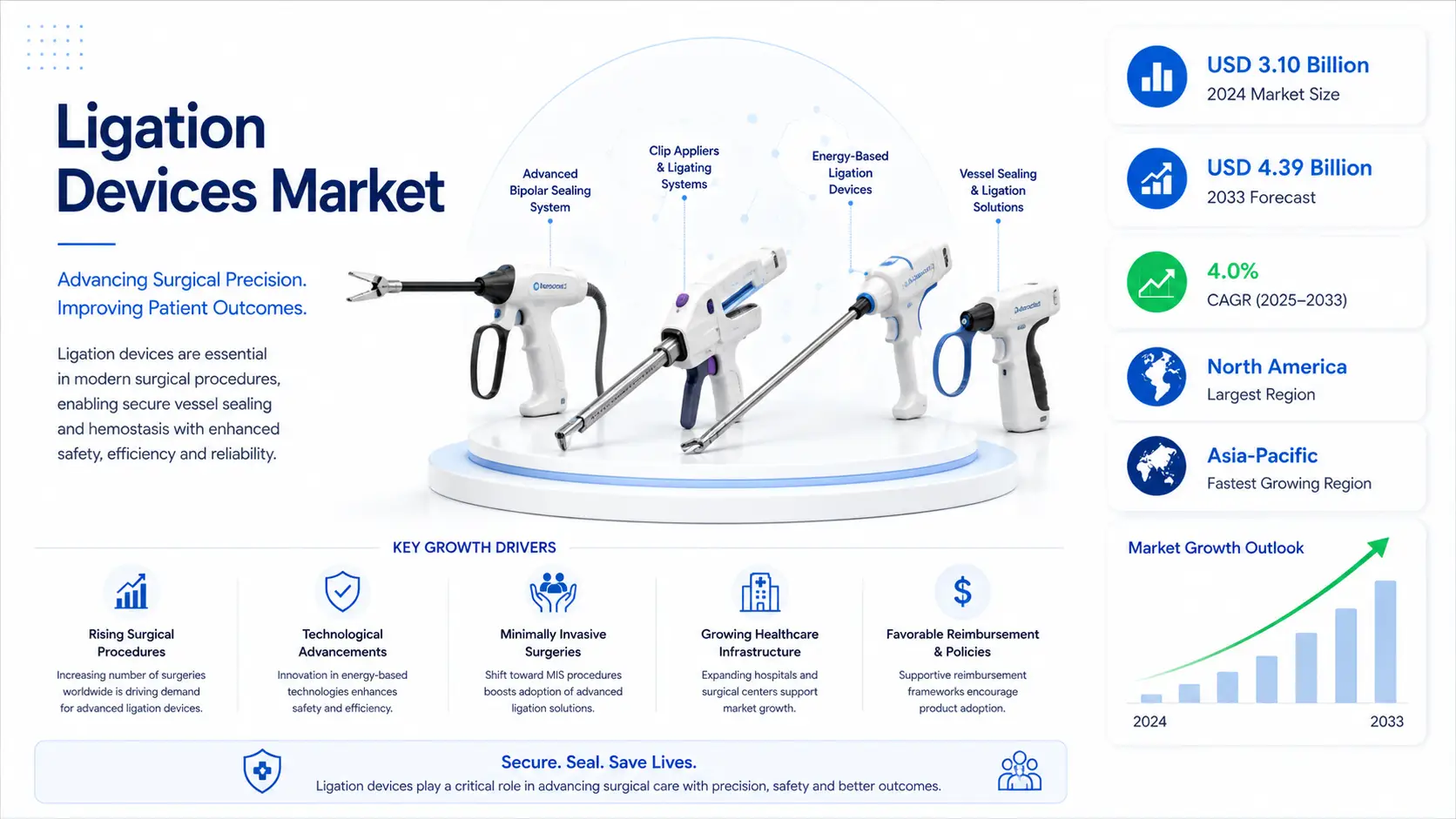
Third-party industry estimates put the global ligation devices market in a broad range of roughly USD 1.2–1.6 billion in 2024, with most forecasts converging on a compound annual growth rate (CAGR) of roughly 6.5–7.5% through the early 2030s, pushing the market toward USD 2–3 billion by 2033–2034. The spread across estimates reflects differences in scope — some trackers isolate laparoscopic or endoscopic ligation devices specifically, while others fold in the full accessories ecosystem (clip appliers, cartridges, disposable clips, bands, and ties). What every estimate agrees on is the direction: steady, mid-to-high single-digit growth driven by one dominant force — the global shift toward minimally invasive surgery (MIS).
That shift is not a niche trend. Hospitals and ambulatory surgical centers have restructured entire surgical departments around laparoscopic and endoscopic workflows because they mean shorter hospital stays, fewer complications, and faster patient turnaround. Every one of those procedures — from a routine laparoscopic cholecystectomy to a complex bariatric or gynecological operation — needs a reliable way to seal a vessel or duct before it's cut, and that's precisely where ligation devices sit.
Several forces are converging on this market at once. The volume of gastrointestinal and abdominal procedures continues to climb alongside an aging population and rising rates of GI disorders, gastric varices, and hemorrhoidal disease. Bariatric and gynecological surgery volumes are growing on the back of rising obesity rates and expanding access to elective procedures. Meanwhile, the broader push toward single-use, disposable surgical instruments — driven by infection-control protocols established during the pandemic era and never really abandoned — has reshaped purchasing patterns toward disposable clip appliers over reusable systems.
On the innovation side, manufacturers are moving beyond simple mechanical clips toward integrated devices that combine clipping, cutting, and energy-based sealing in a single instrument, along with early movement toward biodegradable and bioresorbable clip materials that address both patient safety (eliminating retained foreign material concerns in imaging) and hospital sustainability goals. Robotic-assisted surgery platforms are also creating a new sub-segment of ligation tooling built specifically for robotic arms, a category most forecasters flag as the fastest-growing over the next decade.
Geographically, North America holds the largest share of the market today, a function of high surgical volumes, established reimbursement pathways, and dense adoption of minimally invasive and robotic platforms. Asia Pacific is consistently identified as the fastest-growing region, propelled by expanding hospital infrastructure, rising healthcare spending, and a growing base of patients gaining access to modern surgical care in countries like China and India.
None of this growth is without friction. Regulatory approval pathways for surgical devices in the U.S. and Europe remain lengthy and costly, and the price sensitivity of ligation instruments — particularly disposable accessories — puts pressure on margins in cost-constrained healthcare systems. Still, the underlying demand driver (more surgeries, performed less invasively, by a system that increasingly prizes disposables) gives this market a durable growth runway.
The rest of this report breaks down the ligation devices market by product, procedure, application, and end user; walks through the technology and sustainability trends reshaping the competitive landscape; profiles the companies leading the space; and looks region by region at where the next decade of growth is likely to concentrate.
Market Overview by Segment
By Product Type: Hand-Held Instruments vs. Accessories
The market splits broadly into hand-held ligation instruments (clip appliers, ligators, and applicator devices) and accessories (the clips, bands, cartridges, and sutures those instruments deploy). Accessories consistently represent the larger share — commonly cited between roughly 65–70% of global revenue — because they are consumed with every procedure, unlike the reusable or semi-durable applier itself. This consumable-driven revenue model is a familiar pattern across surgical device categories, similar to the dynamics seen in the surgery forceps market and the broader disposable syringes market, where recurring, single-use consumption underpins long-term revenue stability far more than one-time capital equipment sales.
By Procedure Type: Minimally Invasive Surgery vs. Open Surgery
Minimally invasive procedures dominate, commanding an estimated 80%+ share of ligation device usage in several recent industry reports. Laparoscopic and endoscopic techniques require precision-engineered ligation tools with articulating tips and reliable one-handed deployment, since surgeons are working through small ports rather than a direct incision. Open surgery still matters, particularly in cardiothoracic procedures such as coronary artery bypass grafting, where traditional suture ligation and larger clip systems remain standard — a segment closely tied to demand trends in the heart valve repair and replacement market and the transcatheter aortic valve replacement (TAVR) market.
By Application: GI/Abdominal, Gynecology, Cardiovascular, and Urology
Gastrointestinal and abdominal surgery is typically identified as the largest application segment, commonly holding around 29–30% of total market revenue. This is driven by the rising volume of bariatric surgery, colorectal cancer resections, and endoscopic band ligation used to treat esophageal varices and hemorrhoids. Gynecological procedures — hysterectomies, oophorectomies, and tubal ligation for sterilization — form the second major application pillar, while cardiovascular applications (vessel ligation during cardiac and vascular surgery) and urological procedures round out the segment mix. Each of these surgical specialties is itself supported by a broader ecosystem of adjacent instrumentation, including the surgical sealants and adhesives market and the ultrasonic scalpel system market, which are frequently used alongside ligation instruments in the same procedure.
By End User: Hospitals vs. Ambulatory Surgical Centers
Hospitals remain the dominant purchasing channel, accounting for well over half of global demand given their high surgical volumes and broader procedural mix. Ambulatory surgical centers (ASCs) are the fastest-growing end-user segment, however, as outpatient surgery volumes rise on the back of favorable reimbursement shifts and patient preference for same-day discharge. This mirrors broader durable medical equipment market trends, where care is steadily migrating out of the traditional hospital setting.
Key Industry Trends Shaping the Ligation Devices Market
Minimally invasive and robotic-assisted surgery. The single biggest structural trend in this market is the continued migration from open to minimally invasive procedures, and increasingly toward robotic platforms. Robotic-compatible ligation instruments — designed for precision articulation through a robotic arm rather than a surgeon's hand — are widely flagged by industry analysts as the fastest-growing product sub-segment, even though they still represent a small share of total volume today.
Disposable and single-use instrumentation. Infection-control priorities that intensified during the pandemic have not receded. Hospitals and ASCs continue to favor single-use clip appliers and disposable accessories over reusable systems that require sterilization cycles, a trend that raises per-procedure consumable spend even as it reduces cross-contamination risk.
Multi-functional, integrated devices. Rather than a standalone clip applier, manufacturers are increasingly building devices that combine clipping, cutting, and energy-based sealing into a single instrument — reducing instrument exchanges during a procedure and shortening operating time.
Biodegradable and bioresorbable materials. A meaningful engineering shift is underway toward clips and bands made from bioresorbable polymers rather than permanent titanium or polymer materials. These dissolve naturally in the body over time, addressing both long-term patient safety (avoiding retained foreign-body artifacts in later imaging) and growing hospital sustainability mandates around medical waste. This mirrors the broader materials trajectory already visible in the bioresorbable stents market.
Rising surgical volumes tied to chronic disease. Cardiovascular disease, obesity-driven bariatric procedures, and gastrointestinal cancers are all rising in global prevalence, and each drives procedural demand for ligation instruments. The oncology surgical pipeline in particular — closely tracked in the oncology clinical trials market — is a long-term structural tailwind, since surgical resection remains a first-line treatment for many solid tumors.
Expansion of ambulatory and outpatient surgery. As reimbursement models and patient preference push more procedures out of hospitals and into ASCs, device manufacturers are optimizing for compact, easy-to-stock, cost-efficient ligation kits suited to high-throughput outpatient settings.
Digital and data-enabled surgical tools. While still early-stage in this specific category, broader operating-room digitization — connected instruments, procedure analytics, and AI-assisted surgical guidance — is beginning to touch adjacent categories such as point-of-care ultrasound and is likely to eventually extend into smart ligation and sealing devices that log procedural data automatically.
Top 20 Leading Companies in the Global Ligation Devices Market
A note on sourcing: headquarters, product names, and business descriptions below are verified, public facts. Where a specific recent development is cited, it's backed by a real, dated source (Medtronic's LigaSure RAS CE Mark, Boston Scientific's Speedband/Captivator lines, etc.). I have not invented ligation-specific revenue figures, market-share percentages, or patent counts for any company — that data isn't publicly disclosed for this product line at any of these companies, since ligation devices are almost always a small sub-segment inside a much larger surgical portfolio, not a standalone reported business unit.
1. Medtronic plc
Headquarters: Galway, Ireland (operational HQ; also maintains a principal executive office in Minneapolis, Minnesota, USA)
Company Overview Medtronic is the world's largest pure-play medical technology company by revenue, with a surgical portfolio spanning energy-based vessel sealing, stapling, and robotic-assisted surgery. Its LigaSure™ platform is one of the best-known branded ligation/vessel-sealing technologies globally, used across general, gynecologic, urologic, thoracic, and colorectal surgery.
Core Products / Services LigaSure™ vessel-sealing devices (blunt tip, Maryland jaw, L-hook, and open sealer-divider variants), Sonicision™ ultrasonic dissectors, and the Valleylab™ FT10 energy platform that powers LigaSure instruments.
Market Position Medtronic holds one of the strongest brand positions in energy-based vessel sealing globally, competing directly with Ethicon's Harmonic/Enseal lines and Olympus's Thunderbeat platform.
Technology & Innovation LigaSure technology fuses tissue using the body's own collagen and elastin rather than relying solely on mechanical clips, sealing vessels up to 7mm. Nano-coated jaw technology reduces tissue sticking and eschar buildup on newer-generation devices.
Sustainability Initiatives Medtronic has published enterprise-wide environmental targets covering emissions and packaging, though it has not disclosed sustainability commitments specific to the ligation/vessel-sealing product line.
Competitive Advantages Deep clinical evidence base built over two decades of LigaSure use, an extensive global sales and surgeon-training infrastructure, and integration of LigaSure technology into Medtronic's Hugo™ robotic-assisted surgery platform.
Recent Developments In 2025, Medtronic received CE Mark for its LigaSure™ RAS vessel-sealing instrument for use on the Hugo™ robotic surgery system in Europe, and submitted a 510(k) filing to the FDA for the same technology in the U.S., with urology as the initial target indication and hernia/gynecology filings following in 2026.
2. Johnson & Johnson MedTech (Ethicon)
Headquarters: Raritan, New Jersey, USA (Ethicon is J&J MedTech's surgical division)
Company Overview Ethicon has been a foundational name in surgical ligation and wound closure since its founding in the early 20th century, and today its portfolio spans mechanical ligation clips, advanced energy vessel sealing, and stapling technology used across general, bariatric, thoracic, and gynecological surgery.
Core Products / Services LIGACLIP™ and other ligating clip appliers, the HARMONIC™ ultrasonic scalpel family, and the ENSEAL™ bipolar tissue-sealing platform.
Market Position Ethicon is one of the two or three largest global suppliers of surgical ligation and vessel-sealing technology, with particular strength in general and bariatric surgery given J&J MedTech's broader stapling and mesh portfolio in the same procedure suites.
Technology & Innovation Ethicon has continued to refine ultrasonic (HARMONIC) and advanced bipolar (ENSEAL) sealing technologies, and has been active in developing more sustainable clip and instrument materials as part of J&J's broader medtech innovation pipeline.
Sustainability Initiatives J&J has set company-wide health and environmental sustainability goals, including reductions in medical device packaging waste; specific ligation-product sustainability disclosures are not separately published.
Competitive Advantages Scale of J&J MedTech's global commercial footprint, breadth of the surgical portfolio (clips, energy devices, staplers, mesh) sold as an integrated system to hospitals, and a long clinical evidence base.
Recent Developments Ethicon has continued to expand its energy-based sealing portfolio alongside J&J MedTech's broader push into robotic and digital surgery through its Ottava™ robotic system program, positioning ligation and sealing instruments for eventual robotic compatibility.
3. Boston Scientific Corporation
Headquarters: Marlborough, Massachusetts, USA
Company Overview Boston Scientific is a leading global medical device company with a strong endoscopy and gastroenterology franchise, where its band ligation devices are widely used to treat esophageal varices and hemorrhoidal disease.
Core Products / Services The Speedband Superview Super 7™ Multiple Band Ligator for endoscopic variceal and hemorrhoid ligation, and the Captivator™ EMR device used for ligation-assisted endoscopic mucosal resection.
Market Position Boston Scientific and Cook Medical are the two dominant suppliers of endoscopic multi-band ligation devices used in U.S. gastroenterology practice, per FDA MAUDE postmarket surveillance data comparing the two companies' devices.
Technology & Innovation Continued refinement of band deployment mechanisms and visualization to improve first-pass ligation success in variceal banding and EMR procedures.
Sustainability Initiatives Boston Scientific publishes enterprise ESG targets on emissions and product stewardship; no ligation-specific sustainability metrics are separately disclosed.
Competitive Advantages Deep specialization in gastroenterology and endoscopy, strong hospital and ambulatory endoscopy center relationships, and a broad complementary GI product line (suturing, hemostasis, resection) sold into the same procedure suites.
Recent Developments Boston Scientific has continued to expand its GI portfolio around its OverStitch™ endoscopic suturing platform alongside its established band ligator line, positioning the company across both mechanical ligation and endoluminal closure technologies.
4. Olympus Corporation
- Headquarters: Tokyo, Japan
- Company Overview
- Core Products / Services
- Market Position
- Technology & Innovation
- Sustainability Initiatives
- Competitive Advantages
- Recent Developments
5. Teleflex Incorporated
- Headquarters: Wayne, Pennsylvania, USA
- Company Overview
- Core Products / Services
- Market Position
- Technology & Innovation
- Sustainability Initiatives
- Competitive Advantages
- Recent Developments
Market Drivers, Restraints, and Opportunities
Growth drivers:
- Rising global surgical volumes, particularly in gastrointestinal, bariatric, gynecological, and cardiovascular procedures
- Continued conversion from open to minimally invasive and robotic-assisted surgery
- Growing preference for single-use, disposable instruments to reduce infection risk
- Expansion of ambulatory surgical centers and outpatient procedure volumes
- Rising prevalence of chronic conditions — cardiovascular disease, obesity, and cancer — that require surgical intervention
Market restraints:
- High cost of advanced, disposable, and robotic-compatible ligation instruments relative to traditional suture ligation
- Lengthy and costly regulatory approval pathways for new surgical devices in the U.S. and EU
- Reimbursement pressure in cost-sensitive healthcare systems, which can slow adoption of premium disposable products
- Continued reliance on low-cost suture ligation in resource-constrained settings, limiting upgrade cycles
Emerging opportunities:
- Robotic-compatible ligation tooling as robotic surgery platforms expand into new specialties beyond urology and gynecology
- Bioresorbable and eco-friendly clip materials aligned with hospital sustainability procurement targets
- Growth in emerging markets across Asia Pacific and Latin America as surgical infrastructure and insurance coverage expand
- Integrated multi-function instruments that reduce operative time and instrument-exchange complexity
Regional Analysis
North America holds the largest share of the global ligation devices market, commonly cited around 40%+ of global revenue. This reflects high surgical procedure volumes, well-established reimbursement infrastructure, dense adoption of minimally invasive and robotic surgery, and the concentration of leading device manufacturers headquartered in the region. The United States alone drives the bulk of this regional demand.
Europe is a mature, steady-growth market underpinned by strong public healthcare systems, stringent device regulation under the EU Medical Device Regulation (MDR), and an aging population that continues to require cardiovascular and GI surgical intervention. Germany, the UK, and France represent the largest individual markets within the region.
Asia Pacific is consistently flagged as the fastest-growing region. Expanding hospital infrastructure, rising healthcare expenditure, and a growing base of patients gaining access to modern surgical care — particularly across China, India, Japan, and South Korea — are driving above-average growth. China's rapidly expanding healthcare investment and rising cancer incidence are especially significant contributors to regional demand.
Latin America is a smaller but growing market, with Brazil and Mexico leading regional adoption as private and public healthcare infrastructure expands and surgical volumes rise.
Middle East & Africa represents the smallest current share but is seeing steady investment in hospital infrastructure across the GCC states in particular, supporting gradual growth in advanced surgical instrumentation adoption.
Related Markets
The ligation devices market sits within a much broader ecosystem of surgical and medical device categories. The following related markets are worth tracking for anyone researching this space:
- Surgery Forceps Market — hand-held instruments frequently used alongside ligation devices in general and specialty surgery.
- Surgical Sealants and Adhesives Market — complementary hemostasis technology often paired with mechanical ligation.
- Ultrasonic Scalpel System Market — energy-based cutting and sealing devices competing with, and complementing, traditional ligation.
- Insufflation Devices Market — essential equipment for the laparoscopic procedures that drive ligation device demand.
- Atherectomy Catheters Market — adjacent vascular intervention devices used in cardiovascular procedures.
- Heart Valve Repair and Replacement Market — cardiac surgery segment reliant on vessel ligation techniques.
- Transcatheter Aortic Valve Replacement (TAVR) Market — minimally invasive cardiac procedure category with overlapping surgical demand drivers.
- Bioresorbable Stents Market — shares the same materials-science trajectory toward bioresorbable implantable technology.
- Infusion Pumps and Accessories Market — perioperative and postoperative care equipment used in the same surgical settings.
- You can browse the complete catalog of related studies across the Medical Device industry reports category and the Healthcare category on Intellectual Market Insights.
Frequently Asked Questions
What is the ligation devices market? It's the global market for surgical instruments and accessories — clips, bands, ties, and sealing tools — used to close off blood vessels, ducts, or tubular tissue structures during surgical procedures.
How big is the global ligation devices market? Third-party industry estimates place the market in a range of roughly USD 1.2–1.6 billion in 2024, projected to reach approximately USD 2–3 billion by 2033–2034, depending on the scope of devices included.
What is the growth rate (CAGR) of the ligation devices market? Most published forecasts cluster around a CAGR of roughly 6.5–7.5% through the early-to-mid 2030s.
What is driving growth in the ligation devices market? The primary driver is the ongoing shift toward minimally invasive and robotic-assisted surgery, combined with rising surgical volumes tied to gastrointestinal disease, bariatric surgery, gynecological procedures, and cardiovascular conditions.
Which segment holds the largest share of the ligation devices market?
Which region leads the global ligation devices market?
Who are the leading companies in the ligation devices market?
What types of ligation devices are used in surgery?
Are disposable ligation devices replacing reusable ones?
How are robotics affecting the ligation devices market?
What role does bioresorbable technology play in this market?
What are the biggest restraints on market growth?
Future Outlook (2025–2034)
Over the next decade, the ligation devices market is likely to keep compounding at a mid-to-high single-digit rate, propelled less by any single breakthrough technology and more by the steady structural march toward minimally invasive, outpatient-centered surgical care. As robotic surgery platforms expand beyond their current strongholds in urology and gynecology into general surgery, colorectal, and bariatric procedures, expect robotic-compatible ligation and sealing instruments to grow meaningfully faster than the category average, even from a small current base.
Materials science will be a quieter but equally important storyline. Bioresorbable clips and bands are likely to move from a niche innovation to a mainstream product tier over the coming years, as hospital sustainability procurement criteria harden and surgeons continue to favor materials that don't leave permanent artifacts behind in future imaging studies. Expect continued convergence between mechanical ligation and energy-based sealing, with more instruments combining clipping, cutting, and thermal or ultrasonic sealing into a single device to reduce operative time.
Regionally, Asia Pacific's growth trajectory looks durable given the scale of ongoing hospital infrastructure investment across China and India, alongside rising insurance penetration that is bringing more of the population within reach of modern surgical care. North America and Europe will likely see slower but steady growth, driven more by procedure-mix shifts (more MIS, more robotics, more disposables) than by raw volume expansion, given already-mature healthcare systems.
The companies best positioned for the next decade will likely be those that can offer a full ecosystem — ligation instruments integrated with their broader robotic and energy-device platforms — rather than standalone ligation product lines, since hospital purchasing increasingly favors platform consolidation over best-of-breed component sourcing. At the same time, specialist players with deep expertise in a single surgical specialty (gastroenterology, gynecology) are likely to retain defensible niches where procedural nuance matters more than platform breadth.
For organizations tracking capital planning, R&D investment, or competitive positioning in this space, the combination of steady underlying procedure-volume growth, a clear technology roadmap (robotics, bioresorbables, multi-function integration), and a moderately consolidated competitive field makes ligation devices a market worth monitoring closely alongside the broader surgical instrumentation and minimally invasive surgery-adjacent categories covered across the wider medical device industry.
Conclusion
Ligation devices sit in that unglamorous but essential category of medical technology that makes modern surgery safer without ever making headlines. The market's growth story isn't driven by a single dramatic innovation — it's the compounding effect of several steady structural shifts happening at once: more surgeries being performed globally, more of them done laparoscopically or robotically rather than through open incisions, and a hospital purchasing mindset that increasingly favors disposable, infection-resistant instruments over reusable ones.
That combination is why forecasts converge on solid mid-to-high single-digit growth through the early 2030s even though the specific dollar figures vary by source. The direction is the reliable part; the precise number is less important than understanding why it's moving that way — rising GI, bariatric, gynecological, and cardiovascular procedure volumes, a slow but real pivot toward bioresorbable materials, and the early build-out of robotic-compatible ligation tooling.
For manufacturers, the competitive edge is shifting toward companies that can offer ligation instruments as part of a broader integrated surgical platform rather than a standalone product line — which is also why the biggest names in this space (Medtronic, J&J MedTech, Boston Scientific, Olympus) are the same names leading in energy-based sealing and robotic surgery more broadly. For hospitals and ASCs, the calculus is mostly about balancing the higher per-unit cost of disposable, advanced instruments against the safety and efficiency gains they deliver.
North America will likely keep its lead through sheer procedure volume and reimbursement maturity, but Asia Pacific is where the real expansion is happening — and where manufacturers, investors, and researchers should be watching most closely over the next decade.