
Automotive Cybersecurity Market: Growth Drivers, Key Players, and Outlook Through 2034
Author:
Intellectual Market Insights Research
Published Date:
24 Sep 2026
Automotive Cybersecurity Market: Growth Drivers, Key Players, and Outlook Through 2034
Introduction
Modern vehicles have quietly become rolling computer networks — packed with connected infotainment systems, telematics units, over-the-air update capabilities, and increasingly autonomous driving features. That connectivity brings convenience, but it also opens a growing attack surface for hackers. Automotive cybersecurity — the tools and services built to protect vehicles and their connected systems from unauthorized access and cyberattacks — has become one of the most closely watched segments in automotive technology. This article breaks down the current state of the automotive cybersecurity market, what's fueling its growth, who the major players are, and where the industry is headed over the next decade.
Market Overview
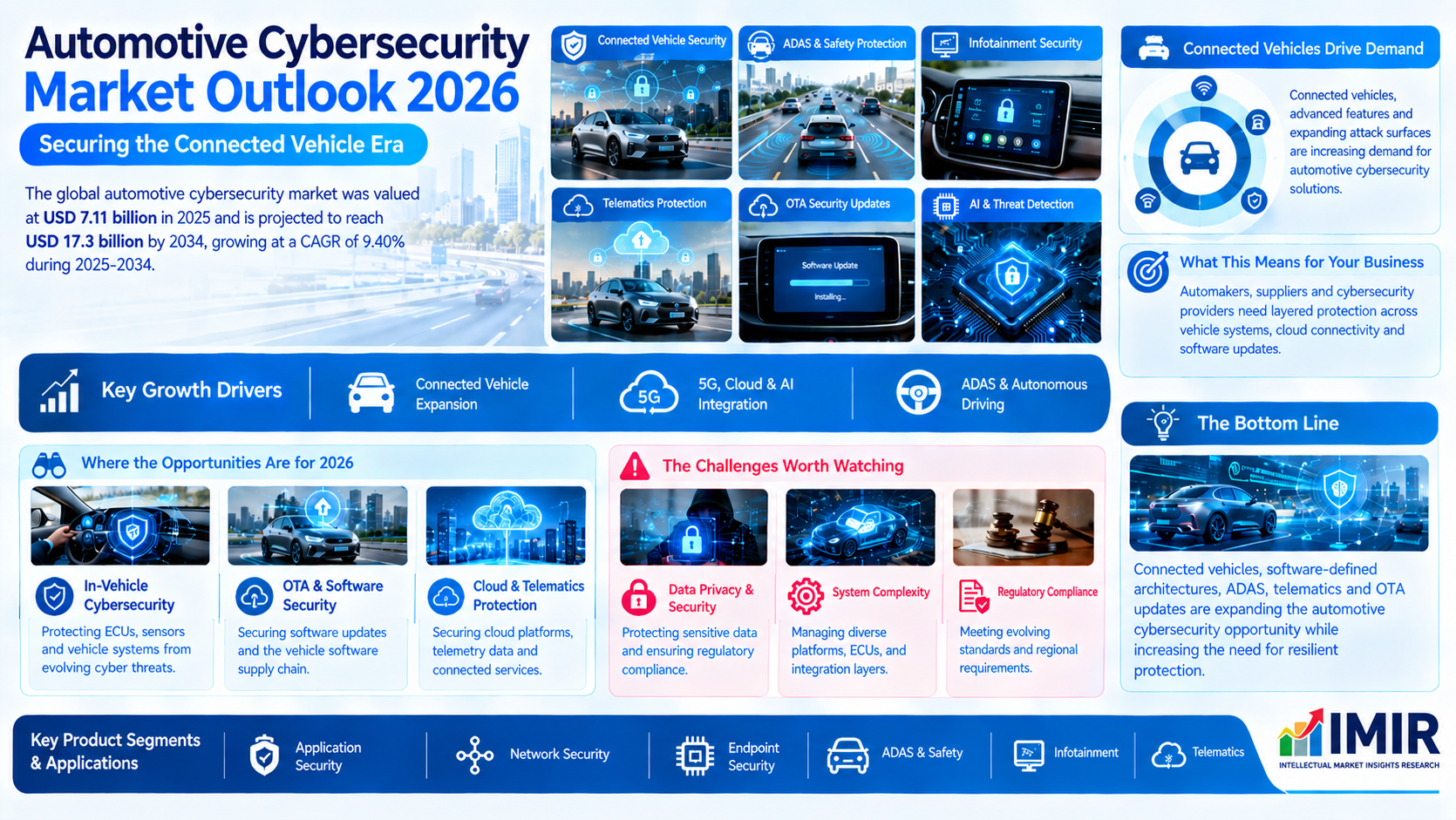
According to Intellectual Market Insights Research, the global automotive cybersecurity market was valued at approximately $5.10 billion in 2022, rising to around $7.11 billion in 2025, and is projected to reach roughly $17.3 billion by 2034 — a CAGR of about 9.40% over the 2023–2031 forecast period. Growth is expected to normalize toward pre-pandemic trend lines as broader economic disruption from COVID-19 continues to ease.
Automotive cybersecurity covers the full range of measures used to protect vehicle components — electronic control units (ECUs), infotainment systems, telematics units, sensors, and communication modules — from unauthorized access, data breaches, and malicious attacks. As vehicles add more connected features, from advanced driver-assistance systems (ADAS) to autonomous driving capability, the number of potential entry points for attackers grows alongside them.
The market is typically segmented by:
- Security type: Application Security, Network Security, and Endpoint Security
- Offering: Hardware and Software
- Form: In-Vehicle and External Cloud Services
- Application: ADAS & Safety Systems, Infotainment, Body Electronics, Powertrain, and Telematics
- Vehicle type: Passenger Cars, Commercial Vehicles, and Electric Vehicles
- Region: North America, Europe, Asia-Pacific, and LAMEA (Latin America, Middle East & Africa)
Why the Automotive Cybersecurity Market Is Growing
Rising vehicle connectivity. As more vehicles incorporate infotainment systems, telematics, and autonomous driving technology, they also rely more heavily on wireless networks, cellular connections, and vehicle-to-vehicle (V2V) and vehicle-to-infrastructure (V2I) communication — each representing a potential entry point for attackers seeking unauthorized access or remote control of vehicle systems.
5G rollout. Faster, more reliable vehicle-to-cloud and vehicle-to-infrastructure communication over 5G networks brings real performance benefits, but the added network complexity and higher data-transfer rates introduce new vulnerabilities that require dedicated security measures to manage.
AI and machine learning integration. As AI and ML are woven into autonomous driving, ADAS, and cybersecurity systems themselves, these same technologies can become attack targets — pushing manufacturers to secure not just traditional software but the AI models running inside vehicles.
Regulatory and safety pressure. Growing awareness of cyber risk in vehicles is driving investment in dedicated security infrastructure, including initiatives like the Vehicle Security Operation Center (VSOC) launched by Denso and NTT Communications in October 2022 to monitor, detect, and respond to vehicle cyber threats in real time.
Over-the-air (OTA) update adoption. As more automakers roll out OTA update capability, allowing them to remotely patch vulnerabilities without a physical recall, cybersecurity has become a built-in, ongoing part of vehicle lifecycle management rather than a one-time consideration.
Working against faster adoption, the sheer pace of technological change in the industry is itself a headwind: as vehicles grow more complex and interconnected, the number of potential vulnerabilities grows too, making it harder for manufacturers and suppliers to identify and close every gap.
Companies Associated with the Automotive Cybersecurity Market
| Company | Headquarters | Notable Area of Focus |
|---|---|---|
| Argus Cyber Security | Israel | Vehicle and fleet-level cybersecurity solutions |
| Arilou Automotive Cybersecurity | Israel | In-vehicle network security |
| Broadcom Inc. | United States | Semiconductor and infrastructure security |
| Continental AG | Germany | Automotive components and embedded security |
| Denso Corporation | Japan | Vehicle security monitoring (co-founder of VSOC) |
| Green Hills Software | United States | Secure embedded operating systems |
| Guard Knox Cyber-Technologies Ltd. | Israel | Vehicle cybersecurity hardware and software |
| Harman International Industries | United States | Connected car and infotainment security |
| Honeywell International, Inc. | United States | Industrial and automotive security systems |
| Intel Corporation | United States | Automotive-grade security silicon |
| NXP Semiconductors N.V. | Netherlands | Secure automotive chips and V2X hardware |
| Robert Bosch GmbH | Germany | Automotive components and embedded cybersecurity |
| SafeRide Technologies | Israel | AI-based vehicle cybersecurity |
| Secunet AG | Germany | IT security solutions |
| Vector Informatik GmbH | Germany | Automotive software tools and security |
This list reflects companies named in the source report and is illustrative rather than exhaustive.
Competitive Landscape
Competition in automotive cybersecurity is shaped heavily by partnerships, technology licensing, and targeted product launches rather than pure market-share battles between rival platforms:
- Joint monitoring infrastructure: Denso and NTT Communications launched a Vehicle Security Operation Center in October 2022 to jointly monitor and respond to cyber threats across vehicle fleets in real time — a model other automakers and suppliers are likely to replicate.
- Operating system partnerships: Elektrobit partnered with SUSE in April 2021 to supply its EB corbos Linux operating system to automakers and Tier 1 suppliers in China, reflecting how embedded OS security has become a competitive differentiator.
- Hardware security modules: Infineon Technologies introduced a plug-and-play V2X hardware security module (the SLS37) in October 2021, aimed at simplifying secure vehicle-to-everything communication for manufacturers.
- National capability building: In January 2023, India's International Centre for Automotive Technology (ICAT) invested in a dedicated facility to build domestic automotive cybersecurity capabilities, signaling growing government-level recognition of the issue outside of North America and Europe.
The overall pattern favors companies that can combine semiconductor-level security (secure chips, hardware security modules) with software and monitoring capability — a combination that increasingly requires collaboration between traditional automotive suppliers and cybersecurity specialists.
Regional Analysis
North America holds a leading position in the market, supported by a strong base of automotive manufacturers, technology companies, and cybersecurity firms operating in the region, along with high adoption rates of cybersecurity solutions across the industry.
Europe is a prominent market as well, shaped by a robust automotive manufacturing base and a strong regulatory focus on vehicle safety, with Germany, France, the UK, Italy, and Spain among the region's key markets.
Asia-Pacific is expected to see rapid growth, driven by increasing adoption of connected vehicles, ongoing advances in automotive technology, and the expanding automotive markets in China, Japan, and South Korea — economies that are also home to several major automotive cybersecurity companies.
Latin America, the Middle East, and Africa (LAMEA) represent a comparatively smaller but emerging market, with growth tied to increasing cybersecurity awareness and adoption across the automotive sector in the region.
Emerging Trends in the Automotive Cybersecurity Market
- Wider OTA update adoption: More manufacturers are building the infrastructure to deploy security patches remotely, reducing dependence on physical recalls and shortening the time between vulnerability discovery and resolution.
- AI-driven threat detection: Machine learning models are increasingly used to detect anomalous vehicle network behavior in real time, complementing traditional rule-based security systems.
- V2X-specific hardware security: Purpose-built hardware security modules for vehicle-to-everything communication are becoming more common as 5G-enabled connectivity expands.
- Dedicated security operation centers: Automakers and technology partners are standing up centralized monitoring hubs — following the VSOC model — to track threats across entire vehicle fleets rather than one vehicle at a time.
- Growing government and regulatory involvement: National investment in automotive cybersecurity infrastructure, such as India's ICAT facility, points to rising regulatory attention beyond the traditional North American and European markets.
Future Outlook (2025–2034)
Looking ahead, automotive cybersecurity is likely to keep growing at a steady, high-single-digit pace, with the shape of that growth shifting in several ways:
- Security built in from design, not bolted on: As vehicles grow more software-defined, cybersecurity is likely to move earlier into the vehicle design and development process rather than being addressed after the fact.
- Expansion of software-based revenue: As hardware security matures, growth is likely to increasingly come from software, monitoring services, and OTA-delivered security updates rather than one-time hardware sales.
- Asia-Pacific as a key growth engine, as connected vehicle adoption accelerates across China, Japan, India, and South Korea.
- Deeper AI integration on both sides: As AI becomes more central to both vehicle functionality and the attackers targeting it, AI-driven defense will likely become a standard, rather than premium, feature of automotive cybersecurity platforms.
- Consolidation and cross-industry partnerships, as traditional automotive suppliers continue partnering with semiconductor firms, telecoms, and pure-play cybersecurity companies to cover the full stack from chip to cloud.
By the early-to-mid 2030s, automotive cybersecurity is likely to be treated as a baseline requirement across nearly all new vehicles, rather than a differentiator reserved for premium or highly connected models.
Frequently Asked Questions (FAQ)
How large is the global automotive cybersecurity market? The market was valued at approximately $66.10 billion in 2022 and $70.48 billion in 2023, and is projected to reach around $117.83 billion by 2031, growing at a CAGR of about 6.90%.
What is driving growth in this market? Key drivers include rising vehicle connectivity, the rollout of 5G networks, growing integration of AI and machine learning into vehicle systems, adoption of over-the-air update capability, and increasing regulatory and safety focus on cyber risk.
Which region leads the automotive cybersecurity market? North America currently holds a leading position, supported by a strong automotive and technology industry base, while Asia-Pacific is expected to see the fastest growth, driven by China, Japan, and South Korea.
Who are the major companies in this market? Key players include Argus Cyber Security, Continental AG, Denso Corporation, Harman International, Infineon Technologies, Intel Corporation, NXP Semiconductors, Robert Bosch, and Vector Informatik, among others.
What challenges does the market face? The rapid pace of technological advancement in vehicles is itself a challenge — as systems become more complex and interconnected, it becomes harder to identify and address every potential vulnerability.
Conclusion
Automotive cybersecurity sits at the center of the industry's shift toward connected, software-defined, and increasingly autonomous vehicles. As connectivity expands the attack surface, and as 5G and AI introduce both new capabilities and new risks, the market is on track for steady growth through the early 2030s — moving from a specialized add-on toward a standard, built-in requirement for vehicles worldwide.