
Top 20 Leading Companies in the Global Anti-Drone Market
Author:
Intellectual Market Insights Research
Published Date:
18 Jul 2026
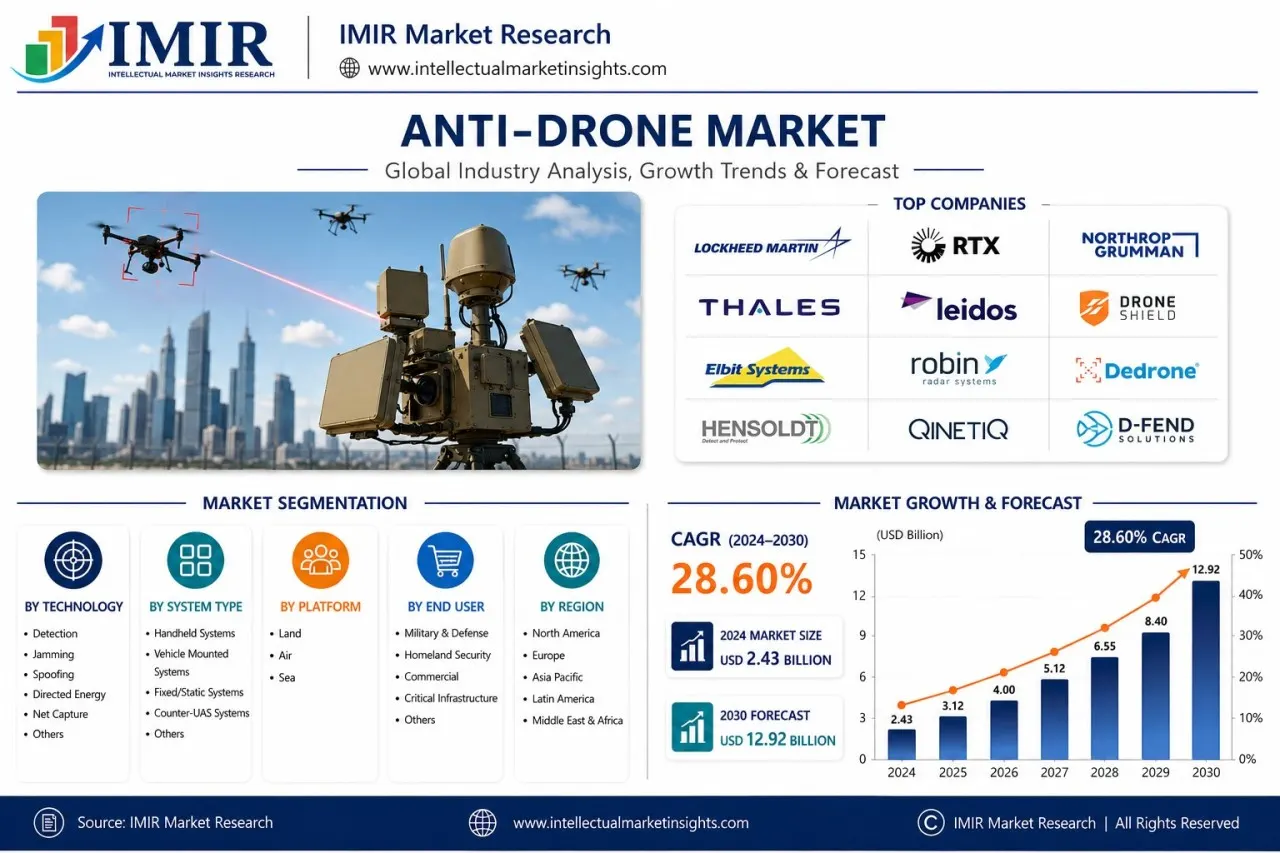
Top 20 Companies in the Global Anti-Drone (Counter-UAS) Market Driving Industry Growth in 2026
Introduction
Low-altitude airspace has quietly become one of the most contested security domains on the planet. Airports have suspended runway operations over unauthorized sightings, militaries have watched inexpensive commercial quadcopters neutralize assets worth many times their cost, and operators of power plants, prisons, and stadiums now treat drone intrusion as a routine part of physical security planning rather than an edge case.
According to market intelligence compiled by Intellectual Market Insights Research (IMIR), the global anti-drone (counter-UAS) market was valued at roughly USD 3.1–4.5 billion in 2025 and is projected to climb to somewhere between USD 14.5 billion and USD 19.8 billion by 2030–2033, expanding at a sustained rate in the mid-20% range annually placing it among the fastest-growing segments of the broader defense and homeland-security industry.
At its core, the anti-drone market covers all the sensors, software, and neutralization hardware used to detect, classify, track, and defeat unauthorized unmanned aerial systems. Core technology categories include radar, radio-frequency (RF) detection, electro-optical/infrared sensing, acoustic sensing, RF jamming, directed-energy weapons (lasers and high-powered microwave), and kinetic interceptor drones each contributing a layer to what the industry now calls a "detect-then-defeat" architecture.
The market's growth is being driven by several converging forces. First, drones have shifted from a novelty nuisance to a genuine asymmetric weapon, a lesson reinforced repeatedly by the Russia–Ukraine conflict, where low-cost quadcopters have disabled far more expensive conventional military assets. Second, defense ministries across NATO, the United States, and Asia-Pacific are formally rewriting air-defense doctrine to account for drone swarms and loitering munitions. Third, aviation regulators and border agencies are mandating detection infrastructure as a matter of compliance, not choice.
Perhaps most importantly, the economics of counter-drone defense are being reshaped by directed-energy technology. Traditional interceptor missiles can cost USD 100,000–500,000 per shot against drones that cost only a few hundred dollars to build an unsustainable cost asymmetry that is pushing capital toward lasers, high-powered microwave systems, and software-defined jamming, where the marginal cost per intercept approaches zero.
The industry also faces real headwinds: export controls under ITAR/EAR restrict how quickly electronic-warfare technology can move across borders, aviation-safety rules complicate deployment near civil airspace, and spectrum-licensing requirements slow commercial rollout. Even so, the long-term trajectory remains firmly upward, underpinned by the simple reality that low-altitude airspace can no longer be left unmonitored.
This comprehensive article profiles the top 20 companies shaping the global anti-drone market in 2026, provides an in-depth competitive landscape analysis, examines regional dynamics and emerging trends, and offers a forward-looking outlook for the industry through 2035.
Market Overview
|
Parameter |
Details |
|---|---|
|
Market Size (2025) |
USD 3.1–4.5 Billion (est.) |
|
Market Size (2030–2033) |
USD 14.5–19.8 Billion (est.) |
|
CAGR |
Mid-20% range annually |
|
Forecast Period |
2025–2033 |
|
By System Type |
Radar-Based, RF Detection, Electro-Optical/Infrared, Acoustic, Hybrid/Fused Systems |
|
By Effector Type |
RF Jamming, Directed-Energy (Laser/Microwave), Kinetic Interceptors, Net-Capture Drones |
|
By Platform |
Ground-Based, UAV-Based (Interceptor Drones) |
|
By Application |
Detection, Tracking/Identification, Disruption/Neutralization |
|
By End Use |
Government & Defense, Airports, Critical Infrastructure, Commercial & Public-Event Security |
|
By Range |
Short-Range, Medium-Range, Long-Range |
|
Key Regions |
North America, Europe, Asia-Pacific, Latin America, Middle East & Africa |
|
Dominant Region |
North America (~30% share) |
|
Fastest Growing Region |
Asia-Pacific |
Key Market Drivers:
- Rising drone incursions and asymmetric battlefield use, accelerated by lessons from the Russia–Ukraine conflict
- Defense modernization programs across NATO, the U.S. Department of Defense (including the Replicator initiative), and Asia-Pacific militaries
- Growing adoption of AI-enabled threat classification and sensor fusion to cut false-alarm rates and response times
- Surging venture and government funding into specialist counter-drone firms
- Expanding population of legitimate and rogue commercial drones across delivery, agriculture, and inspection use cases
Key Market Opportunities:
- Shift toward directed-energy weapons (lasers, high-powered microwave) offering near-zero marginal cost per intercept
- Software-defined, subscription-based business models for detection and jamming platforms
- Growth of commercial and public-event security as a standalone demand segment (stadiums, summits, critical infrastructure)
- Indigenous procurement programs in Asia-Pacific reducing reliance on imported systems
- Integration of counter-UAS capability into broader integrated air-defense and homeland-security architectures
Key Market Challenges:
- Export controls (ITAR/EAR) on electronic-warfare technology restricting international sales
- Aviation-safety and spectrum-licensing regulations slowing commercial deployment
- High cost asymmetry between legacy kinetic interceptors and low-cost hostile drones
- Difficulty of a single sensor type reliably covering the full range of drone sizes, speeds, and materials
- Rapidly evolving swarm and loitering-munition threats that outpace current detection doctrine
Why the Anti-Drone Market Is Growing
The anti-drone market's trajectory reflects a structural shift in how governments and infrastructure operators think about low-altitude airspace from an open, largely unmonitored layer of sky to contested territory requiring active defense.
1. Asymmetric Threats Have Gone Mainstream
The conversion of low-cost commercial drones into surveillance or strike tools has turned counter-UAS from a niche capability into a frontline defense priority. Recent conflicts have repeatedly shown cheap quadcopters neutralizing conventional assets worth many times more, directly reshaping military procurement priorities worldwide.
2. Defense Modernization and Government Programs
NATO members, the U.S. Department of Defense, and Asia-Pacific militaries including China, India, Japan, and South Korea are all funding dedicated counter-UAS programs. Initiatives such as the U.S. Replicator program are accelerating investment specifically in AI-driven autonomous interceptors.
3. AI and Sensor Fusion Adoption
AI-enabled threat classification, automated tracking, and multi-sensor fusion are reducing false-alarm rates and cutting response times a critical advantage given how little reaction time small, fast-moving drones allow defenders.
4. Surging Investment and Funding Momentum
Venture and government funding into specialist counter-drone firms has accelerated sharply, with companies such as Epirus and DroneShield posting major funding or revenue increases over the past two years, signaling strong investor confidence in the segment's long-term growth.
5. Proliferation of Commercial Drones
As commercial drone adoption expands across delivery, agriculture, and inspection applications, the addressable population of both legitimate and rogue UAVs grows in parallel, widening demand for detection and de-confliction technology even outside military settings.
6. High-Profile Events and Public-Space Security
Large public gatherings from the Olympics to G7 summits now routinely deploy temporary counter-drone perimeters, while energy, oil & gas, and correctional facilities increasingly treat drone intrusion as a standard element of physical security planning.
Top 20 Companies in the Global Anti-Drone Market
- RTX Corporation
- Lockheed Martin Corporation
- Northrop Grumman Corporation
- Thales Group
- Leonardo S.p.A.
- Saab AB
- Israel Aerospace Industries
- Rafael Advanced Defense Systems
- Elbit Systems Ltd.
- Dedrone
- DroneShield Limited
- Anduril Industries
- CACI International Inc.
- SRC, Inc.
- QinetiQ Group plc
- Hensoldt AG
- Rohde & Schwarz
- CerbAir
- BlueHalo
- Fortem Technologies
1. RTX Corporation
|
Category |
Details |
|---|---|
|
Company Name |
RTX Corporation |
|
Headquarters |
Arlington, Virginia, USA |
|
Founded |
2023 (formed through the merger of Raytheon Technologies' defense businesses) |
|
Industry Focus |
Aerospace & Defense, Counter-UAS |
|
Global Presence |
Operations serving defense customers across North America, Europe, Middle East, and Asia-Pacific |
|
Company Overview |
RTX is one of the world's largest aerospace and defense companies, supplying integrated counter-unmanned aerial system (C-UAS) technology for military, homeland-security, and critical-infrastructure protection. Its defense units develop radar, electronic-warfare systems, command-and-control software, and precision interceptors capable of detecting, tracking, and neutralizing hostile drones. |
|
Key Products & Services |
Integrated radar systems, electronic-warfare suites, command-and-control software, kinetic and non-kinetic interceptors, layered air-defense architectures. |
|
Market Position |
A preferred supplier to armed forces worldwide, with a comprehensive, multi-layered counter-drone portfolio spanning detection through neutralization. |
|
Recent Developments |
Continued expansion of AI-enabled battlefield technology and integration of counter-UAS capability into broader air-defense contracts with allied militaries. |
|
Strategic Advantages |
Advanced radar and electronic-warfare capabilities, deep global defense customer relationships, and proven battlefield deployment experience. |
2. Lockheed Martin Corporation
|
Category |
Details |
|---|---|
|
Company Name |
Lockheed Martin Corporation |
|
Headquarters |
Bethesda, Maryland, USA |
|
Founded |
1995 |
|
Industry Focus |
Aerospace & Defense, Directed-Energy and Counter-UAS Systems |
|
Global Presence |
Major U.S. Department of Defense partner with programs supporting allied militaries globally |
|
Company Overview |
Lockheed Martin is among the world's largest defense contractors and a leading innovator in directed-energy counter-drone technology. The company develops advanced surveillance radars, AI-powered command systems, high-energy laser weapons, and electronic-warfare platforms built to defend military bases and strategic infrastructure against UAV threats. |
|
Key Products & Services |
High-energy laser weapons, integrated air-defense radar, AI-enabled target identification systems, electronic-warfare platforms. |
|
Market Position |
A key player in modern C-UAS programs, distinguished by its integrated air-defense capability and directed-energy expertise. |
|
Recent Developments |
Ongoing scale-up of laser-weapon programs and continued integration of AI target-identification software into fielded air-defense systems. |
|
Strategic Advantages |
Directed-energy weapon expertise, strong U.S. DoD partnerships, and large-scale defense manufacturing capacity. |
3. Northrop Grumman Corporation
|
Category |
Details |
|---|---|
|
Company Name |
Northrop Grumman Corporation |
|
Headquarters |
Falls Church, Virginia, USA |
|
Founded |
1994 |
|
Industry Focus |
Aerospace & Defense, Counter-UAS |
|
Global Presence |
Global defense contractor supporting U.S. and allied military programs |
|
Company Overview |
Northrop Grumman develops sophisticated anti-drone systems built on advanced radar, artificial intelligence, electronic warfare, and integrated command platforms, specializing in protecting military installations and critical infrastructure from increasingly complex drone threats. |
|
Key Products & Services |
AI-powered surveillance radar, electronic-warfare systems, integrated command-and-control platforms for automated threat neutralization. |
|
Market Position |
A leading supplier of battlefield-surveillance and air-defense technology with a strong base of military contracts. |
|
Recent Developments |
Continued R&D investment in early-detection and rapid-tracking capability aimed at complex, multi-drone threat scenarios. |
|
Strategic Advantages |
AI-powered surveillance systems, cutting-edge electronic warfare, and integrated air-defense expertise. |
4. Thales Group
|
Category |
Details |
|---|---|
|
Company Name |
Thales Group |
|
Headquarters |
Paris, France |
|
Founded |
2000 |
|
Industry Focus |
Defense & Security, Counter-UAS |
|
Global Presence |
Strong presence across Europe with growing deployments in other global markets |
|
Company Overview |
Thales Group offers integrated anti-drone systems combining radar, electro-optical sensors, RF detection, AI analytics, and electronic jamming. Its C-UAS platforms protect airports, military installations, and critical infrastructure primarily across Europe. |
|
Key Products & Services |
Multi-sensor radar and RF-detection systems, AI-assisted analytics, electronic countermeasures, integrated command-and-control platforms. |
|
Market Position |
A leading European supplier of scalable, multi-sensor C-UAS architecture serving both defense and civil-aviation customers. |
|
Recent Developments |
Expansion of sovereign European counter-drone capability alongside partners such as Rheinmetall and Saab under European Defense Fund-backed programs. |
|
Strategic Advantages |
AI-assisted drone detection, multi-sensor surveillance systems, and a strong European defense footprint. |
5. Leonardo S.p.A.
|
Category |
Details |
|---|---|
|
Company Name |
Leonardo S.p.A. |
|
Headquarters |
Rome, Italy |
|
Founded |
1948 |
|
Industry Focus |
Aerospace & Defense, Counter-UAS |
|
Global Presence |
Serves military organizations, airports, and government agencies globally |
|
Company Overview |
Leonardo develops comprehensive anti-drone solutions integrating radar surveillance, electro-optical tracking, AI analytics, RF sensors, and electronic countermeasures, serving military organizations, airports, government agencies, and critical-infrastructure operators worldwide. |
|
Key Products & Services |
Integrated radar surveillance, electro-optical tracking systems, AI-based target classification, electronic countermeasures. |
|
Market Position |
A proven European counter-drone supplier with deep radar expertise and broad government customer relationships. |
|
Recent Developments |
Continued investment in AI-based target-classification capability supporting NATO modernization and airport-security programs. |
|
Strategic Advantages |
Strong radar expertise, advanced AI-based target classification, and established European defense leadership. |
Competitive Landscape
The global anti-drone market is characterized by a two-tier competitive structure: a small group of diversified defense primes with the scale and government relationships to win large national programs, and a fast-growing tier of specialist firms competing on software, AI, and directed-energy innovation.
Among the primes RTX, Lockheed Martin, Northrop Grumman, Thales, Leonardo, and Saab competitive advantage rests on decades of radar and missile-defense expertise, existing government relationships, and the ability to bundle counter-UAS capability into broader air-defense contracts. Specialist firms such as DroneShield, Anduril, Dedrone, and Epirus are instead competing on speed of iteration, AI-first detection software, and directed-energy or software-defined jamming that sidesteps the cost economics limiting traditional kinetic interceptors.
Key Competitive Trends:
Legacy Scale vs. Specialist Agility: Traditional defense primes bring existing government relationships and deep radar/missile-defense expertise that newer entrants cannot easily replicate. But specialist firms betting on software-defined, AI-first, and directed-energy approaches are growing fastest by sidestepping the cost economics that make legacy kinetic interceptors impractical against cheap drones.
Sovereign Capability Building: European Defense Fund-backed programs are pushing firms like Thales, Rheinmetall, and Saab to build sovereign counter-drone capability, reducing reliance on U.S. suppliers in response to NATO's post-Ukraine air-defense posture.
Subscription-Based Business Models: Following approaches such as DroneShield's SentryCiv platform, software-defined and subscription-based pricing models are beginning to reshape how counter-drone technology is sold, moving the industry away from one-off hardware sales.
Startup Momentum: Venture-backed specialists including Anduril, Epirus, DroneShield, and ParaZero have grown quickly by focusing exclusively on software-defined and specialist counter-drone technology, in some cases out-innovating larger, slower-moving primes.
Regional Analysis
North America
North America is the largest regional anti-drone market, holding roughly 30% of global share. Growth is driven by high U.S. defense spending, TSA-reported drone sightings near airports, and rapid adoption of layered counter-UAS architectures across military and homeland-security agencies.
Europe
Europe's growth is closely tied to NATO's air-defense posture following the Russia-Ukraine conflict, reinforced by European Defense Fund-backed programs pushing sovereign capability through firms including Thales, Rheinmetall, and Saab, aimed at reducing reliance on U.S. technology.
Asia-Pacific
Asia-Pacific is projected to post the fastest regional CAGR, driven by China's military modernization alongside matching investment from India, Japan, South Korea, and Australia. India has scaled indigenous procurement including Bharat Electronics Limited-linked programs alongside border-security deployments.
Latin America
Latin America remains a smaller but emerging market, with growth concentrated around critical-infrastructure protection in energy and oil & gas, along with select national border-security initiatives.
Middle East & Africa
Demand across the Middle East and Africa is shaped by high-profile regional conflicts and the need to protect energy infrastructure. Israeli and Gulf-state procurement of counter-drone systems, including Israeli-developed platforms deployed for allied nations, is a notable regional driver.
Emerging Trends Shaping the Anti-Drone Market
- AI-Driven Sensor Fusion Becomes Standard. Fusing radar, RF, electro-optical, and acoustic data into a single AI-assisted detection stack is moving from a differentiator to table stakes, as no single sensor type reliably covers the full range of drone sizes, speeds, and materials.
- Directed-Energy Weapons Go Mainstream. As reliability improves and costs fall, laser and high-powered-microwave systems are shifting from experimental to mainstream deployment, offering near-zero marginal cost per intercept versus traditional missile-based interceptors.
- Software-Defined, Subscription-Based Models. Counter-drone technology is increasingly sold as a service rather than a one-time hardware purchase, following approaches pioneered by firms like DroneShield, potentially reshaping industry pricing and deployment models.
- UAV-Based Interceptors Gain Ground. Drones designed specifically to intercept other drones are growing steadily as swarm-defense doctrine matures, complementing ground-based detection and neutralization infrastructure.
- Commercial and Public-Event Security Expansion. As counter-drone technology becomes more affordable and portable, adoption is expanding beyond military and government use into stadiums, summits, and other large public gatherings.
- Sovereign and Indigenous Procurement. Both Europe and Asia-Pacific are investing in domestically developed counter-UAS capability to reduce reliance on imported systems, reshaping competitive dynamics for U.S.-based suppliers.
Future Outlook (2026–2035)
The global anti-drone market is positioned for sustained, rapid growth through the 2026–2035 period, underpinned by structural shifts in how governments and infrastructure operators treat low-altitude airspace.
Growth Projections: Based on current trajectory, the market is expected to reach the higher end of current forecasts approaching or exceeding USD 19.8 billion by the early 2030s assuming continued mid-20% annual growth. Asia-Pacific will likely post the fastest regional growth, while North America retains the largest overall share.
Investment Opportunities: The most compelling opportunities lie in directed-energy weapons (lasers and high-powered microwave), AI-driven sensor-fusion software, UAV-based interceptor platforms, and subscription-based detection-as-a-service models targeting commercial and public-event security.
Industry Transformation: The anti-drone industry is increasingly resembling a software-and-AI-driven sector rather than a traditional hardware-only defense business. Companies that combine defense-grade reliability with the iteration speed of a software company are best positioned to capture disproportionate value.
Future Technologies: Key technologies likely to reshape the industry over the next decade include next-generation high-powered-microwave weapons, autonomous swarm-defense coordination software, low-cost software-defined jamming, and AI-driven predictive threat classification.
Regulatory Evolution: Export-control regimes (ITAR/EAR), aviation-safety rules, and spectrum-licensing frameworks will continue to shape how quickly counter-drone systems can be sold and deployed internationally. Companies that proactively invest in compliance infrastructure will be best positioned to scale globally.
FAQ Section: Anti-Drone Market
Q1: What is the anti-drone (counter-UAS) market?
It is the industry building systems to detect, track, and neutralize unauthorized drones, spanning radar, RF detection, jamming, directed-energy weapons, and interceptor drones.
Q2: How big is the global anti-drone market?
Estimates vary by research firm, generally placing 2025 market value between roughly USD 3.1 billion and USD 4.5 billion, with most forecasts projecting growth to somewhere between USD 14.5 billion and USD 19.8 billion by 2030–2033.
Q3: Who are the leading companies in the anti-drone market?
Leading companies include RTX Corporation, Lockheed Martin, Northrop Grumman, Thales Group, Leonardo, Saab, Israel Aerospace Industries, Rafael Advanced Defense Systems, Elbit Systems, Dedrone, DroneShield, Anduril Industries, CACI International, SRC Inc., QinetiQ Group, Hensoldt, Rohde & Schwarz, CerbAir, BlueHalo, and Fortem Technologies.
Q4: Which region dominates the anti-drone market?
North America currently holds the largest share, roughly 30%, driven by high defense spending and airport/homeland-security investment. Asia-Pacific is generally forecast to grow fastest through the rest of the decade.
Q5: What are the primary growth drivers of the anti-drone market?
Key drivers include rising drone incursions and asymmetric threats, defense modernization programs across NATO and Asia-Pacific, AI-enabled threat classification, surging venture and government funding, and the growing population of commercial drones requiring detection infrastructure.
Q6: What is the projected growth rate of the anti-drone market?
The market is forecast to grow at a sustained rate in the mid-20% range annually through the early 2030s.
Q7: What technologies are used in anti-drone systems?
Key technologies include radar, RF detection, electro-optical/infrared sensors, acoustic sensors, RF jamming, directed-energy (laser and high-powered microwave) weapons, and kinetic interceptor drones, typically fused into a single AI-assisted detection-and-defeat architecture.
Q8: Why are directed-energy weapons gaining popularity?
Because their marginal cost per intercept is far lower than traditional missile-based systems, which can cost USD 100,000–500,000 per shot against drones that cost only a few hundred dollars to build.
Conclusion
The global anti-drone market stands as one of the fastest-growing and most strategically significant segments within the broader defense and homeland-security landscape. Expanding from an estimated USD 3.1–4.5 billion in 2025 to a projected USD 14.5–19.8 billion by 2030–2033, the market's trajectory reflects a structural shift in how governments and infrastructure operators think about low-altitude airspace from an open, largely unmonitored layer of sky to contested territory demanding active defense.
The companies profiled in this article spanning global defense primes like RTX, Lockheed Martin, Northrop Grumman, Thales, and Leonardo; specialist innovators including DroneShield, Anduril, Dedrone, and Fortem Technologies; and regional champions such as Israel Aerospace Industries, Rafael, and Elbit Systems collectively represent the full ecosystem of innovation, investment, and competitive intensity shaping this market in 2026 and beyond.
For investors, procurement professionals, industry analysts, and strategic decision-makers, understanding the dynamics of this market from the promise of directed-energy cost economics and AI-driven sensor fusion, to the challenges of export controls and evolving swarm threats is essential for identifying where opportunity lies and where risk must be managed. The anti-drone industry is not a niche defense category: it is a rapidly maturing, technology-driven sector whose evolution will shape how governments, airports, and critical infrastructure operators secure the skies for decades to come.


