
Top Companies Blog Global Industrial Absorbents Market 2025
Author:
Intellectual Market Insights Research
Published Date:
20 Aug 2026
Introduction
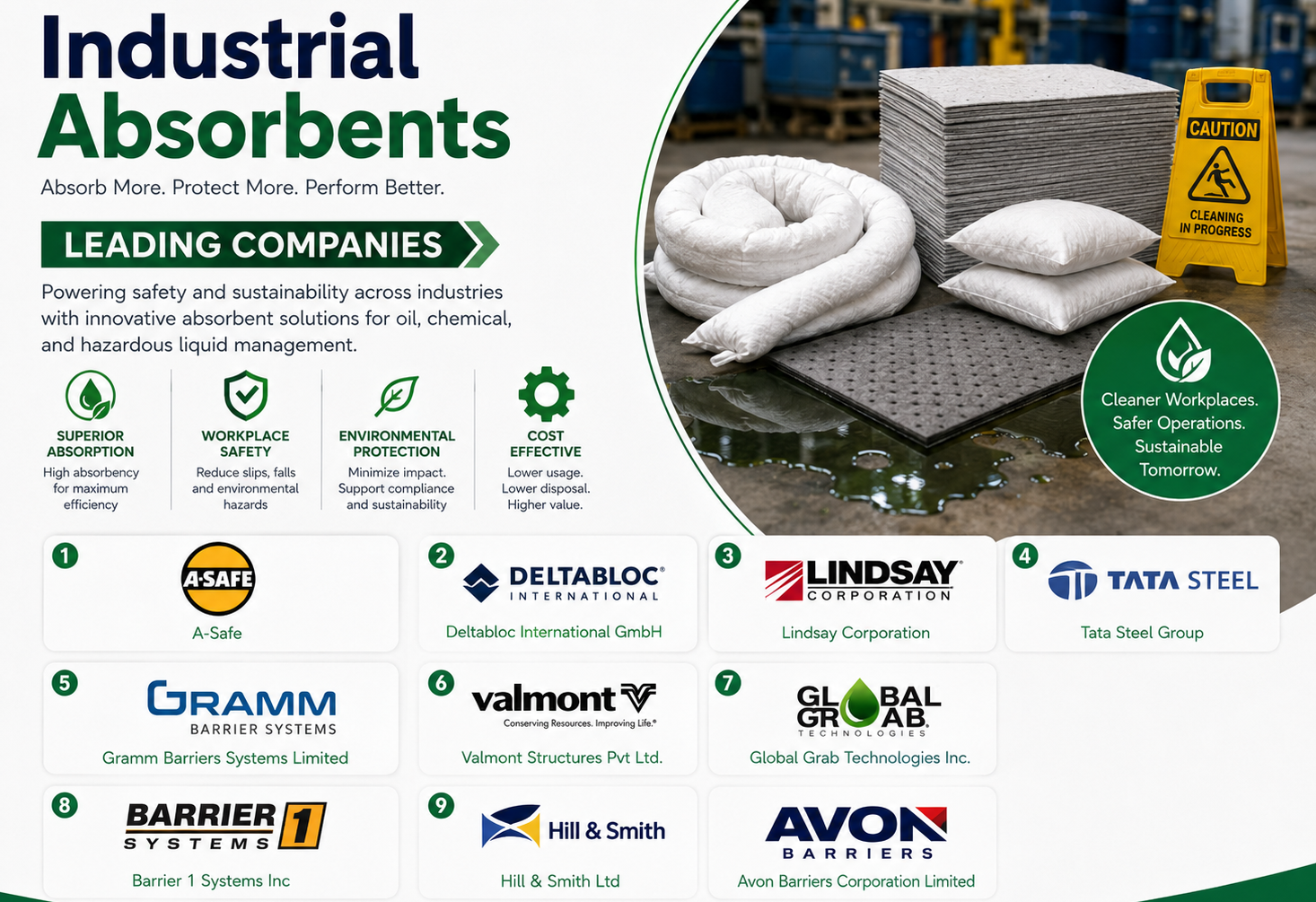
Every industrial facility, from manufacturing plants and warehouses to oil and gas sites and vehicle maintenance shops, eventually deals with the same unglamorous but critical problem: spilled liquids that need to be contained, cleaned up, and disposed of safely. Industrial absorbents, mats, socks, booms, pillows, granular sorbents, and specialty pads engineered to soak up oil, chemicals, and other fluids, are the frontline defense against workplace hazards, environmental contamination, and regulatory violations. What was once a commodity product category built around simple materials like clay and sawdust has evolved into a more sophisticated market shaped by workplace safety regulation, environmental compliance, and specialty sorbent chemistry.
The global industrial absorbents market was valued at approximately USD 4.5 billion in 2025 and is projected to reach USD 6.5 billion by 2034, expanding at a compound annual growth rate (CAGR) of 3.5% over the forecast period, according to Intellectual Market Insights Research. This steady growth reflects continued industrial and manufacturing activity, tightening workplace safety and environmental regulations, and ongoing product innovation in specialty and eco-friendly sorbent materials.
The competitive landscape spans large diversified industrial and safety products conglomerates, specialty sorbent manufacturers built around proprietary mineral or fiber technology, and mission-focused spill-response companies known for their deep product breadth. Because absorbent products serve customers across nearly every industrial sector, from automotive and manufacturing to oil and gas and agriculture, competitive advantage often comes down to distribution reach, product breadth, and the ability to serve both routine maintenance needs and emergency spill response.
Understanding which companies lead this steady, safety-critical market is essential for industrial procurement teams, environmental health and safety professionals, and industry analysts. This article provides a research-based analysis of the top companies in the global industrial absorbents market, their positioning, flagship offerings, and the regional and technological forces shaping the competitive landscape.
Market Overview
|
Parameter |
Details |
|---|---|
|
Market Size (2025) |
USD 4.5 Billion |
|
Projected Market Size (2034) |
USD 6.5 Billion |
|
CAGR (2025–2034) |
3.5% |
|
Base Year |
2024 |
|
Forecast Period |
2025–2034 |
|
Leading Region |
North America |
|
Fastest-Growing Region |
Asia-Pacific (China, Japan, India) |
|
Key Growth Drivers |
Tightening workplace safety and environmental regulation, sustained industrial and manufacturing activity, oil and gas maintenance demand |
|
Key Challenges |
Commoditization and price competition in general-purpose sorbents, raw material cost volatility |
|
Key Opportunities |
Eco-friendly and biodegradable absorbents, specialty chemical-resistant sorbents, e-commerce distribution growth |
Why the Industrial Absorbents Market Is Growing
1. Tightening Workplace Safety and Environmental Regulations
Regulatory bodies overseeing workplace safety and environmental protection continue to enforce strict spill containment, cleanup, and disposal standards, requiring industrial facilities to maintain compliant absorbent products on hand across manufacturing, storage, and maintenance areas.
2. Sustained Industrial and Manufacturing Activity
Continued global industrial output, from automotive assembly to chemical processing and metalworking, generates ongoing demand for routine maintenance absorbents used to manage oil, coolant, and chemical spills as part of standard facility operations.
3. Oil and Gas Sector Maintenance Demand
Upstream, midstream, and downstream oil and gas operations require specialized, high-capacity absorbent products for both routine equipment maintenance and emergency spill response, supporting steady demand from one of the sector's largest end-use industries.
4. Growth in Specialty and Chemical-Resistant Sorbents
Rising use of specialty chemicals across manufacturing and laboratory settings is driving demand for absorbent products engineered for specific chemical compatibility, moving the market beyond general-purpose oil and water absorbents.
5. Increasing Adoption of Eco-Friendly Absorbent Materials
Growing corporate sustainability commitments are pushing manufacturers and end users toward biodegradable, plant-based, and recycled-material absorbents as alternatives to traditional clay- and polypropylene-based products.
6. Expansion of E-Commerce and Direct-to-Facility Distribution
Growing adoption of online industrial supply procurement is improving access to a broader range of absorbent products for small and mid-sized facilities that previously relied on limited local distribution.
Top 10 Companies in the Industrial Absorbents Market
- 3M Company
- New Pig Corporation
- Oil-Dri Corporation of America
- Brady Corporation
- Kimberly-Clark Corporation (Kimtech / WypAll)
- Chemtex International Inc. (Meltblown Technologies)
- Evolution Sorbent Products
- Sellars Absorbent Materials, Inc.
- ESP International, Inc.
- Spilltration Corporation
1. 3M Company
|
Category |
Details |
|---|---|
|
Company Name |
3M Company |
|
Headquarters |
Saint Paul, Minnesota, United States |
|
Founded |
1902 (as Minnesota Mining and Manufacturing Company) |
|
Employees |
Approx. 60,500 |
|
Revenue (2025) |
Approx. USD 24.9 Billion (group-wide; absorbents are a portion of the Safety and Industrial segment) |
|
Company Overview |
3M is a diversified science and manufacturing conglomerate whose Safety and Industrial business segment, its largest by revenue, includes a broad line of industrial sorbent and spill-control products alongside its wider safety and industrial portfolio. |
|
Key Products |
3M High-Capacity and Maintenance sorbent pads, rolls, and socks, alongside broader personal protective equipment and industrial safety product lines. |
|
Market Position |
One of the largest diversified suppliers touching the industrial absorbents category, leveraging its Safety and Industrial segment's scale and its position as 3M's single biggest revenue driver. |
|
Recent Developments |
Continued investment in its Safety and Industrial segment following the 2024 spinoff of its healthcare business (now Solventum), sharpening focus on core industrial and safety product lines. |
|
Strategic Advantages |
Massive global manufacturing and distribution scale, deep materials science R&D capability, and an extensive industrial and safety product ecosystem that supports cross-selling absorbent products. |
2. New Pig Corporation
|
Category |
Details |
|---|---|
|
Company Name |
New Pig Corporation |
|
Headquarters |
Tipton, Pennsylvania, United States |
|
Founded |
1985 |
|
Employees |
Approx. 500–1,000 |
|
Revenue |
Approx. USD 200–500 Million (privately held; estimates vary by source) |
|
Company Overview |
New Pig is a privately held company built entirely around contained absorbents and spill-response products, offering what it describes as the world's largest selection of absorbent mats, socks, booms, pillows, and pans under its distinctive PIG brand. |
|
Key Products |
PIG absorbent mats, socks, booms, pillows, and pans, alongside spill containment, material handling, and workplace safety products. |
|
Market Position |
One of the most recognized specialist brands in the industrial absorbents category, with a product line built specifically and exclusively around spill containment and absorption. |
|
Recent Developments |
Continued new product launches across its absorbent and workplace safety lines, alongside expansion of international offices and distributor partnerships across the UK, Europe, China, and India. |
|
Strategic Advantages |
Deep category specialization and brand recognition built since 1985, the industry's broadest absorbent product catalog, and a distinctive, highly memorable brand identity that stands out in a largely commoditized category. |
3. Oil-Dri Corporation of America
|
Category |
Details |
|---|---|
|
Company Name |
Oil-Dri Corporation of America |
|
Headquarters |
Chicago, Illinois, United States |
|
Founded |
1941 |
|
Employees |
Approx. 900–930 |
|
Revenue (2024) |
Approx. USD 460–490 Million |
|
Company Overview |
Oil-Dri is a publicly traded, vertically integrated sorbent minerals company that controls hundreds of millions of tons of specialty mineral reserves, including calcium bentonite and attapulgite, supplying absorbent products across industrial, agricultural, and consumer markets. |
|
Key Products |
Agsorb and Pure-Flo industrial and agricultural sorbents, alongside its well-known Cat's Pride and Jonny Cat consumer cat litter brands built on the same core sorbent mineral technology. |
|
Market Position |
A leading vertically integrated sorbent minerals producer, differentiated by direct ownership of mineral reserves and mining operations across Georgia, Mississippi, Illinois, and California. |
|
Recent Developments |
Continued product innovation across its Business-to-Business Products Group, including expanded liquid waste absorbent and industrial fluid purification offerings. |
|
Strategic Advantages |
Full vertical integration from mineral reserves to finished product, over eight decades of sorbent minerals expertise, and a diversified revenue base spanning consumer, agricultural, and industrial markets. |
4. Brady Corporation
|
Category |
Details |
|---|---|
|
Company Name |
Brady Corporation |
|
Headquarters |
Milwaukee, Wisconsin, United States |
|
Founded |
1914 |
|
Employees |
Approx. 5,600+ |
|
Revenue |
Approx. USD 1.4 Billion |
|
Company Overview |
Brady is a global manufacturer of identification and safety solutions, including spill containment and absorbent products marketed alongside its broader workplace safety, labeling, and facility identification portfolio. |
|
Key Products |
Spill control absorbent mats, socks, and pillows, alongside safety signage, labeling systems, and facility identification products. |
|
Market Position |
A significant supplier of absorbent and spill-control products within its broader workplace safety and identification product ecosystem, serving industrial and commercial facilities worldwide. |
|
Recent Developments |
Continued portfolio expansion across its workplace safety segment, integrating spill control products with its identification and compliance solutions for industrial customers. |
|
Strategic Advantages |
Established global distribution network, strong brand recognition in industrial safety and compliance products, and the ability to bundle absorbents with broader facility safety solutions. |
Competitive Landscape
The global industrial absorbents market is moderately fragmented, spanning large diversified safety and industrial products conglomerates such as 3M and Brady, vertically integrated sorbent minerals producers such as Oil-Dri, and category-defining specialist brands such as New Pig, alongside a range of smaller regional and private-label manufacturers.
Diversification vs. Specialization: Large diversified players like 3M and Brady compete by bundling absorbents within a much broader industrial and workplace safety product ecosystem, while specialists like New Pig compete purely on category depth, breadth, and brand recognition built exclusively around spill response.
Vertical Integration as a Cost Advantage: Companies like Oil-Dri that directly own and operate mineral reserves and mining operations hold a structural cost advantage in mineral-based sorbent production compared to competitors that purchase raw materials from third parties.
Commoditization Pressure in General-Purpose Products: Standard oil and universal absorbent pads and rolls face significant price competition and private-label substitution, pushing manufacturers toward higher-margin specialty, chemical-resistant, and eco-friendly product lines to defend margins.
Distribution Reach as a Differentiator: Given that absorbent products are needed across nearly every industrial facility type, companies with the broadest distributor networks and e-commerce presence, including both direct-to-facility platforms and traditional industrial supply channels, are best positioned to capture routine, recurring maintenance demand.
Regional Analysis
North America
North America holds the largest share of the global industrial absorbents market, supported by extensive manufacturing, oil and gas, and automotive maintenance activity, alongside a mature regulatory framework enforcing strict workplace spill containment and environmental compliance standards.
Asia-Pacific
Asia-Pacific is expected to see significant growth, driven by expanding manufacturing and industrial output across China, India, and Japan, alongside rising regulatory attention to industrial workplace safety and environmental protection in the region's fast-growing economies.
Europe
Europe represents a mature, steady market, underpinned by strict European Union environmental and workplace safety regulations and strong demand for eco-friendly and biodegradable absorbent materials among environmentally conscious industrial customers.
Latin America and MEA
These regions represent smaller but developing markets for industrial absorbents, with growth tied to expanding industrial and oil and gas activity alongside gradually strengthening workplace safety and environmental regulatory frameworks.
Emerging Trends in the Industrial Absorbents Market
1. Eco-Friendly and Biodegradable Absorbents: Rising corporate sustainability commitments are driving demand for plant-based, recycled, and biodegradable absorbent materials as alternatives to traditional polypropylene and clay-based products.
2. Specialty Chemical-Resistant Sorbents: Growing use of specialty and hazardous chemicals across manufacturing and laboratory settings is expanding demand for absorbents engineered for specific chemical compatibility beyond general-purpose oil and water absorption.
3. Compact, High-Capacity Product Design: Manufacturers are increasingly focused on absorbents that combine smaller storage footprints with higher liquid-holding capacity, improving efficiency for facilities with limited storage space.
4. Direct-to-Facility E-Commerce Growth: Expanding online industrial supply procurement is improving product accessibility for small and mid-sized facilities, broadening the customer base beyond traditional distributor relationships.
5. Integration with Broader Facility Safety Programs: Absorbent products are increasingly being bundled and marketed alongside broader workplace safety, signage, and compliance solutions, reflecting customer preference for consolidated vendor relationships.
Future Outlook (2025–2034)
The global industrial absorbents market's trajectory toward USD 6.5 billion by 2034 reflects steady, regulation-anchored demand rather than explosive growth, a category defined by consistent, recurring facility maintenance needs rather than dramatic technological disruption. The 3.5% CAGR forecast through 2034 assumes continued industrial and manufacturing activity, sustained regulatory enforcement of workplace safety and environmental standards, and gradual but steady adoption of eco-friendly and specialty sorbent products.
Key investment themes include continued growth in eco-friendly and biodegradable absorbent materials, expansion of specialty chemical-resistant product lines, and growing direct-to-facility e-commerce distribution reaching smaller industrial customers. Leading companies including 3M, New Pig, and Oil-Dri are likely to retain their strong market positions, leveraging either broad industrial ecosystem integration or deep category specialization, while regional and private-label manufacturers continue to compete on price in general-purpose product segments.
Frequently Asked Questions (FAQ)
1. What is the current size of the global industrial absorbents market?
The global industrial absorbents market was valued at approximately USD 4.5 billion in 2025 and is projected to reach USD 6.5 billion by 2034, growing at a CAGR of 3.5%.
2. Who are the top companies in the industrial absorbents market?
Leading companies include 3M, New Pig Corporation, Oil-Dri Corporation of America, Brady Corporation, Kimberly-Clark, Chemtex International (Meltblown Technologies), Evolution Sorbent Products, Sellars Absorbent Materials, ESP International, and Spilltration Corporation.
3. Which region dominates the industrial absorbents market?
North America leads the market, supported by extensive manufacturing, oil and gas, and automotive maintenance activity, while Asia-Pacific is expected to see significant growth.
4. What is the forecast CAGR for the industrial absorbents market?
The market is forecast to grow at a CAGR of 3.5% from 2025 to 2034.
5. What are the main growth drivers for this market?
Key drivers include tightening workplace safety and environmental regulations, sustained industrial and manufacturing activity, and steady maintenance demand from the oil and gas sector.
6. What challenges does the industrial absorbents industry face?
The industry faces significant price competition and commoditization pressure in general-purpose sorbent products, along with raw material cost volatility affecting both mineral-based and synthetic absorbent manufacturers.
7. What types of industrial absorbents are most widely used?
Oil-only and universal (oil and water) absorbents in mat, pad, sock, and boom formats are the most widely used product types, given their broad applicability across manufacturing, automotive, and facility maintenance settings.
Conclusion
The global industrial absorbents market represents a steady, regulation-anchored category that underpins workplace safety and environmental compliance across nearly every industrial sector. With a projected size of USD 6.5 billion by 2034 at a 3.5% CAGR, the market offers dependable, if modest, growth for manufacturers able to combine broad distribution reach with continued product innovation.
Companies led by 3M, New Pig, and Oil-Dri each compete from a different strategic position, 3M through diversified industrial ecosystem scale, New Pig through pure category specialization and brand recognition, and Oil-Dri through vertical integration into mineral reserves, illustrating the range of viable strategies in this fragmented market. The manufacturers that successfully expand into eco-friendly, specialty, and chemical-resistant product lines while defending against commoditization in general-purpose absorbents will define market leadership through 2034 and beyond.