
Top Companies Blog Global PVC Pipes Market 2025
Author:
Intellectual Market Insights Research
Published Date:
08 Aug 2026
Introduction
PVC pipes have quietly become one of the most relied-upon building blocks of modern infrastructure, carrying drinking water into homes, moving wastewater out of cities, irrigating farmland, and protecting the cables and conduits that keep telecommunications networks running. Made from polyvinyl chloride, a lightweight, corrosion-resistant, and cost-effective thermoplastic, PVC pipes have steadily displaced traditional materials like metal and concrete across plumbing, sewerage, water supply, oil and gas, and irrigation applications, offering a combination of durability, ease of installation, and long service life that few alternative materials can match.
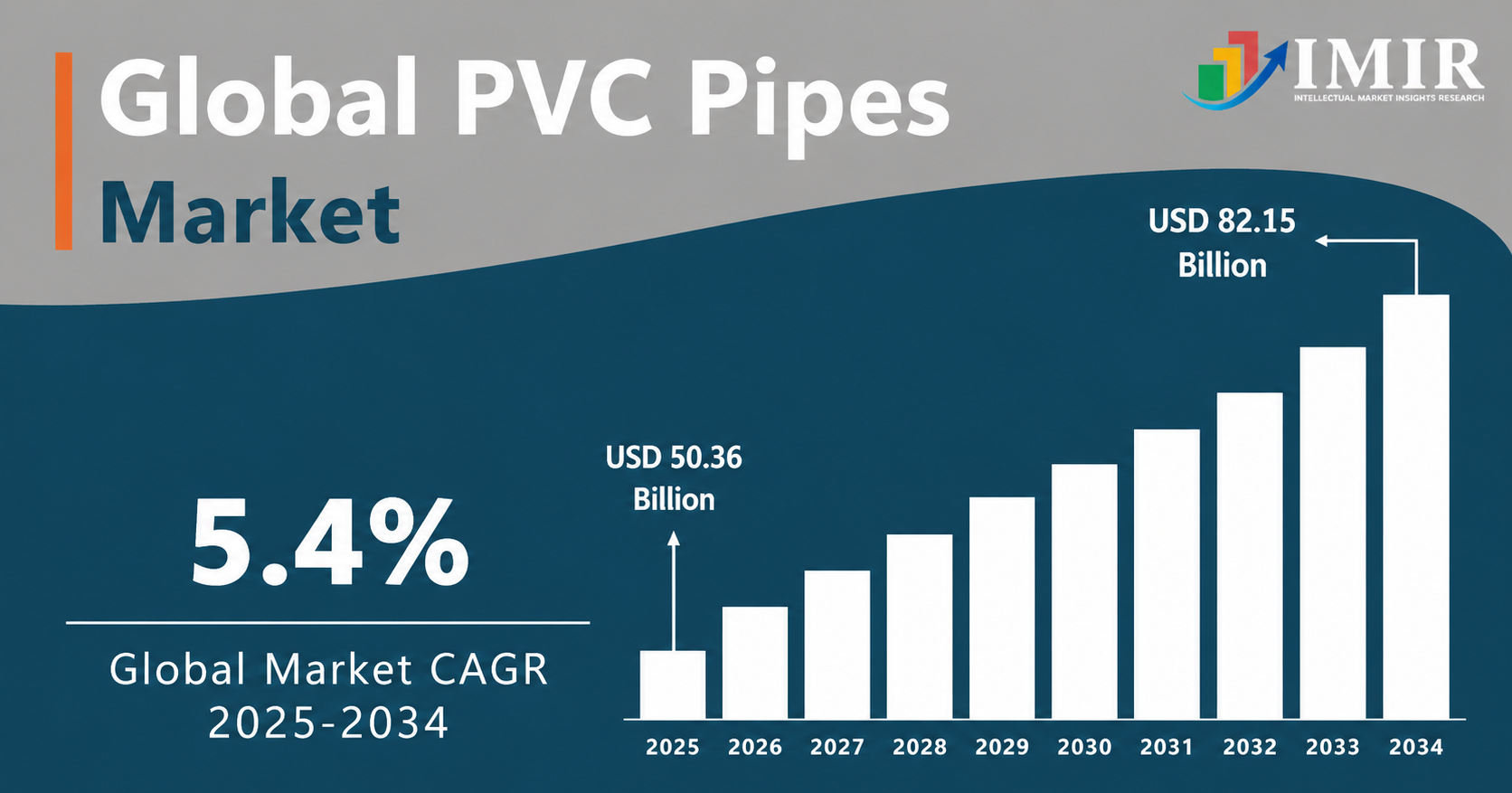
According to a new report from Intellectual Market Insights Research, the global PVC pipes market was valued at approximately USD 50.36 billion in 2025 and is projected to reach USD 82.15 billion by 2034, growing at a compound annual growth rate (CAGR) of 5.4% between 2025 and 2034. That represents sustained, structural growth, reflecting how central PVC piping has become to global water infrastructure investment, urbanization, agricultural modernization, and aging pipeline replacement programs across developed and emerging economies alike.
In this article, we break down what's driving this growth, the challenges holding the market back, where the biggest opportunities lie, how the market is segmented, which regions are leading adoption, and who the major players are. Whether you're an investor, an infrastructure procurement professional, a construction industry supplier, or simply curious about where the PVC pipes market is headed, this guide will give you a clear, structured view of the industry landscape through 2034.
Market Overview
What Are PVC Pipes?
PVC pipes are piping systems manufactured from polyvinyl chloride, a synthetic plastic polymer produced from chlorine and ethylene, formed through an extrusion process into rigid or flexible pipe sections. Their combination of corrosion resistance, low weight relative to metal or concrete alternatives, chemical durability, and relatively low manufacturing and installation cost has made PVC one of the most widely used piping materials across residential, commercial, municipal, industrial, and agricultural applications worldwide.
PVC pipes broadly fall into three types: unplasticized PVC (uPVC), a rigid formulation widely used for water supply, sewerage, and drainage applications; post-chlorinated PVC (CPVC), which offers greater heat and chemical resistance and is commonly used for hot water plumbing and industrial fluid handling; and plasticized PVC, a more flexible formulation used in applications requiring bendability. These pipes serve a wide range of applications, including plumbing, sewerage, water supply, oil and gas, and irrigation, and are used across end-use sectors spanning agriculture, building and construction, and telecommunications, where PVC conduit protects underground and overhead cabling infrastructure.
Current Market Landscape
The PVC pipes space today sits at the intersection of municipal water infrastructure, residential and commercial construction, and agricultural modernization. What began as a material primarily adopted in developed markets to replace aging metal and concrete piping has expanded into a global default choice for new water, sewerage, and irrigation infrastructure, particularly across fast-urbanizing economies in Asia-Pacific and Latin America. Large-scale, vertically integrated manufacturers have steadily expanded production capacity and international distribution networks, widening the addressable customer base from domestic construction and plumbing markets to large-scale municipal, agricultural, and industrial infrastructure projects worldwide.
Industry Background
PVC piping emerged as a commercial building material in the mid-20th century, gradually gaining adoption as an alternative to traditional cast iron, steel, and concrete pipe as manufacturers refined extrusion technology and formulation stability. Over the following decades, PVC's corrosion resistance, lighter weight, and lower installation cost drove steady displacement of legacy piping materials across water supply, sewerage, and drainage applications in developed markets. Over the past two decades, rapid urbanization, large-scale government infrastructure investment, and rising agricultural irrigation modernization across Asia-Pacific, Latin America, and the Middle East have accelerated adoption, setting the stage for PVC pipes' expansion from a developed-market plumbing material into a truly global infrastructure staple.
Key Market Trends
- Accelerating replacement of aging underground infrastructure: Municipalities across developed markets are increasingly prioritizing replacement of decades-old metal and concrete water and sewer pipelines with PVC systems, driven by water loss reduction and infrastructure resilience goals.
- Rapid capacity expansion by leading Asian manufacturers: Large-scale producers, particularly in China and India, continue to expand domestic and overseas production capacity, including new manufacturing bases across Southeast Asia, to serve both regional demand and export markets.
- Growing overseas and localization strategies among major producers: Leading manufacturers are increasingly establishing production facilities directly within target export markets, reducing logistics costs and strengthening competitiveness against regional players.
- Rising adoption in micro-irrigation and agricultural water management: Government-backed water-efficient farming initiatives are expanding demand for PVC piping in drip and sprinkler irrigation systems, particularly across Asia-Pacific and the Middle East.
- Consolidation and product portfolio diversification: Leading players continue to broaden their offerings beyond core PVC pipe into adjacent categories such as fittings, plumbing systems, and allied water management products, supporting more integrated infrastructure solutions.
Market Growth Drivers
Sustained Global Infrastructure Investment: Continued government and private investment in water supply, sewerage, and drainage infrastructure across both developed and emerging markets remains the single largest driver of PVC pipe demand.
Rapid Urbanization in Emerging Markets: Fast-growing urban populations across Asia-Pacific, Latin America, and the Middle East continue to drive new residential and commercial construction activity, expanding demand for plumbing, water supply, and sewerage piping.
Replacement Demand for Aging Pipeline Networks: Deteriorating legacy metal and concrete pipe infrastructure in developed economies is driving substantial replacement demand, as municipalities prioritize reducing water loss and improving system reliability.
Growth in Agricultural Irrigation Modernization: Expanding adoption of efficient irrigation systems, supported by government subsidies and water conservation initiatives, continues to drive PVC pipe demand in the agriculture end-use segment.
Cost and Performance Advantages Over Traditional Materials: PVC's corrosion resistance, lighter weight, easier installation, and long service life relative to metal and concrete alternatives continue to support its ongoing displacement of legacy piping materials.
Market Challenges
Volatility in PVC Resin and Raw Material Prices: PVC pipe manufacturing costs are closely tied to underlying petrochemical feedstock prices, and volatility in resin costs can compress manufacturer margins and create pricing uncertainty for customers.
Intensifying Price Competition Among Manufacturers: As the market matures in developed economies, commodity-grade PVC pipe products face intensifying price competition, particularly from lower-cost regional and domestic producers.
Environmental and Regulatory Scrutiny: Growing regulatory attention to plastic waste, PVC production emissions, and end-of-life disposal is increasing compliance requirements and reputational pressure for manufacturers in some markets.
Real Estate and Construction Sector Cyclicality: PVC pipe demand is closely tied to construction activity, and downturns or recalibration in residential and commercial real estate markets, particularly in large markets like China, can weigh on near-term volume growth.
Competition from Alternative Piping Materials: In select applications, PVC faces growing competition from alternative materials such as HDPE and other high-performance plastics, particularly in large-diameter water conveyance and certain industrial applications.
Market Opportunities
Untapped Emerging Markets: Expanding urban infrastructure investment, growing agricultural modernization, and rising government-backed water and sanitation programs in parts of Asia-Pacific, Latin America, Africa, and the Middle East are opening substantial new territory for PVC pipe adoption.
Aging Infrastructure Replacement Programs: Large-scale municipal infrastructure renewal initiatives across North America and Europe represent a significant, durable replacement-demand opportunity for PVC pipe manufacturers over the coming decade.
Value-Added and Specialty Product Lines: Continued development of higher-margin specialty products, including CPVC systems, advanced fittings, and integrated water management solutions, offers manufacturers a path to differentiate beyond commodity-grade pipe.
Overseas Manufacturing and Localization: As leading producers continue to establish manufacturing bases directly within export markets, there is meaningful opportunity to capture share in fast-growing regional markets while reducing logistics costs and import exposure.
Consolidation and Strategic Acquisitions: As the industry matures, there is ongoing opportunity for scale players to grow through acquisition of regional manufacturers and adjacent product lines, strengthening distribution networks and broadening integrated infrastructure offerings.
Market Segmentation
By Type
- Post-Chlorinated
- Plasticized
- Unplasticized
By Application
- Plumbing
- Sewerage
- Water Supply
- Oil & Gas
- Irrigation
By End-Use
- Agriculture
- Building & Construction
- Telecommunications
- Others
Unplasticized PVC (uPVC) represents the largest type segment given its dominant role in water supply, sewerage, and general construction piping, while post-chlorinated PVC (CPVC) continues to grow as a differentiated, higher-value segment for hot water plumbing and industrial fluid-handling applications requiring greater heat resistance. On the end-use side, building & construction is expected to remain the largest segment given the sheer scale of global residential and commercial construction activity, while agriculture represents one of the fastest-growing end-use segments as irrigation modernization expands across water-stressed regions.
Regional Analysis
North America: North America holds a substantial share of the global PVC pipes market, supported by large-scale municipal infrastructure replacement programs, steady residential and commercial construction activity, and a well-established base of domestic manufacturers.
Europe: Europe represents a mature, steadily growing market, underpinned by aging water and sewerage infrastructure replacement needs, strict water-loss reduction targets, and established regional manufacturing capacity across major economies such as Germany, France, and the U.K.
Asia-Pacific: Asia-Pacific holds the largest share of the global PVC pipes market and is expected to remain among the fastest-growing regions over the forecast period, driven by rapid urbanization, large-scale government infrastructure programs, and the presence of dominant manufacturers in China and India.
Latin America: Latin America remains a significant and expanding market, with Brazil and Mexico leading regional demand as urban infrastructure investment and residential construction activity continue to grow.
Middle East & Africa: The Middle East & Africa region is an emerging opportunity area, with growth concentrated in countries investing heavily in water infrastructure and irrigation modernization, such as Saudi Arabia and the UAE, alongside gradual uptake in South Africa.
Competitive Landscape
The global PVC pipes market features a mix of large-scale vertically integrated manufacturers and established regional players. Key players identified in the market include:
- China Lesso Group Holdings Ltd. (China)
- Astral Polytechnik Limited (India)
- Polypipe Plc (UK)
- Advanced Drainage Systems, Inc. (US)
- Amanco (Brazil)
- National Pipe and Plastics, Inc. (US)
- JM Eagle Inc (US)
- NAPCO (US)
- Finolex Industries Ltd (India)
- IPEX Inc (Canada)
Competition in this space centers on expanding production capacity, strengthening distribution networks, and broadening product portfolios into higher-value specialty and allied product lines. Large-scale players such as China Lesso and JM Eagle benefit from extensive manufacturing footprints and economies of scale, while regional and specialized manufacturers compete on proximity, service, and niche application expertise. As the market matures, continued overseas capacity expansion, localization strategies, and product diversification into fittings and water management systems are expected to shape the competitive landscape through 2034.
1. China Lesso Group Holdings Ltd.
|
Category |
Details |
|---|---|
|
Company Name |
China Lesso Group Holdings Limited |
|
Headquarters |
Shunde, Foshan, China (listed on the Hong Kong Stock Exchange, stock code 2128) |
|
Industry Focus |
Plastic Piping Systems and Building Materials |
|
Global Presence |
More than 30 production bases across roughly 19 provinces in China and multiple overseas facilities across Southeast Asia |
|
Company Overview |
China Lesso is the largest plastic piping manufacturer in China and one of the largest globally, with a diversified business spanning PVC, HDPE, and PPR piping systems alongside building materials, plumbing and sanitary ware, and other adjacent product categories under its flagship SNOW brand. |
|
Key Products & Services |
PVC, HDPE, and PPR pipes and fittings for water supply, sewerage, drainage, and irrigation applications; plumbing and sanitary ware; broader building materials and home improvement product lines. |
|
Market Position |
The leading plastic piping manufacturer in China by scale, with an extensive domestic distribution network and a growing international footprint supporting large-scale infrastructure and municipal projects worldwide. |
|
Recent Developments |
Extrusion workshops at its Indonesia production base were officially put into operation in 2026, accelerating the Group's overseas expansion, as part of a broader strategy of prudent, stable growth focused on consolidating its core plastic piping business and accelerating overseas localization. |
|
Strategic Advantages |
Massive domestic production scale and distribution reach, an expanding international manufacturing footprint across Southeast Asia, and a diversified product portfolio that supports cross-selling across piping, building materials, and home improvement categories. |
2. JM Eagle Inc.
|
Category |
Details |
|---|---|
|
Company Name |
JM Eagle Inc. |
|
Headquarters |
Los Angeles, California, USA |
|
Industry Focus |
Plastic and PVC Pipe Manufacturing |
|
Global Presence |
Extensive manufacturing footprint across the United States with additional international operations |
|
Company Overview |
JM Eagle describes itself as the world's largest plastic and PVC pipe manufacturer, offering a comprehensive line of PVC, polyethylene (PE), and ABS pipe products for water supply, sewerage, irrigation, and other infrastructure applications. |
|
Key Products & Services |
PVC pipe for water, sewer, and drainage systems; polyethylene (PE) pipe; ABS pipe; a broad range of pipe sizes and specifications backed by extensive product testing and a 50-year product warranty. |
|
Market Position |
One of the largest PVC and plastic pipe manufacturers globally by production capacity, with deep penetration across U.S. municipal, residential, and commercial infrastructure markets. |
|
Recent Developments |
Continues to expand its comprehensive plastic pipe product portfolio, leveraging its scale and manufacturing capacity to serve new product categories, materials, applications, and processes across the U.S. infrastructure and construction markets. |
|
Strategic Advantages |
Massive U.S. manufacturing scale and geographic reach, an extensive and diversified product portfolio spanning PVC, PE, and ABS piping, and a long-standing reputation reinforced by an industry-leading 50-year product warranty. |
3. Advanced Drainage Systems, Inc.
|
Category |
Details |
|---|---|
|
Company Name |
Advanced Drainage Systems, Inc. (Advanced Drainage Systems, Inc. is now part of Advanced Drainage Systems, a subsidiary structure operating under ADS) |
|
Headquarters |
Hilliard, Ohio, USA |
|
Industry Focus |
Water Management and Drainage Piping Products |
|
Global Presence |
Manufacturing and distribution operations across North America |
|
Company Overview |
Advanced Drainage Systems is a leading manufacturer of water management products, with a portfolio spanning PVC drainage pipe alongside high-density polyethylene (HDPE) pipe, stormwater chambers, and allied drainage and water quality products. |
|
Key Products & Services |
PVC and HDPE drainage pipe; StormTech stormwater chamber systems; Nyloplast drainage structures; broader stormwater and wastewater management products, including offerings gained through its NDS acquisition. |
|
Market Position |
A leading North American water management and drainage products supplier, recognized for double-digit growth in its higher-value stormwater and allied product lines even as core commodity pipe demand fluctuates with construction cycles. |
|
Recent Developments |
Reported strong fiscal 2026 first-quarter results driven by double-digit expansion in its StormTech chambers, Nyloplast structures, and water quality products, with agricultural pipe sales boosted by customers purchasing ahead of announced price increases; the company was also named to TIME's 2026 list of the World's Most Impactful Companies. |
|
Strategic Advantages |
A diversified water management product portfolio that extends well beyond commodity PVC pipe, a track record of accretive acquisitions such as NDS, and strong positioning in higher-margin stormwater and drainage infrastructure categories. |
4. Astral Limited (Astral Polytechnik)
|
Category |
Details |
|---|---|
|
Company Name |
Astral Limited |
|
Headquarters |
Ahmedabad, India |
|
Industry Focus |
Plastic Piping Systems and Adhesives |
|
Global Presence |
Manufacturing operations across India with export presence in additional international markets |
|
Company Overview |
Astral is one of India's leading plastic piping companies, with a diversified product portfolio spanning PVC, CPVC, and other plastic piping systems used across plumbing, water supply, and industrial applications, alongside a complementary adhesives and sealants business. |
|
Key Products & Services |
PVC, CPVC, and plasticized piping systems for plumbing, water supply, sewerage, and irrigation applications; pipe fittings; adhesives and sealants used in pipe installation and broader construction applications. |
|
Market Position |
A leading Indian PVC and CPVC pipe manufacturer benefiting from India's rapid urbanization and infrastructure investment, with a growing footprint in higher-margin CPVC and specialty piping categories. |
|
Recent Developments |
Continues to expand its manufacturing capacity and product range across India's growing residential, commercial, and infrastructure construction markets, supported by sustained demand for water supply and plumbing piping systems domestically. |
|
Strategic Advantages |
Strong brand recognition and distribution network within India's fast-growing construction and plumbing markets, a diversified product portfolio spanning piping and adhesives, and a growing position in higher-value CPVC piping. |
5. Finolex Industries Ltd.
|
Category |
Details |
|---|---|
|
Company Name |
Finolex Industries Ltd. |
|
Headquarters |
Pune, India |
|
Industry Focus |
PVC Resin, Pipes, and Fittings Manufacturing |
|
Global Presence |
Manufacturing operations concentrated in India, serving domestic agricultural, plumbing, and construction markets |
|
Company Overview |
Finolex Industries is a leading vertically integrated Indian PVC producer, manufacturing PVC resin in-house alongside a broad range of PVC pipes and fittings, giving the company greater control over raw material costs and supply reliability relative to non-integrated competitors. |
|
Key Products & Services |
PVC resin production; PVC pipes and fittings for agricultural irrigation, plumbing, and water supply applications; a broad range of pipe diameters and specifications serving both rural and urban markets. |
|
Market Position |
One of India's leading PVC pipe manufacturers, differentiated by backward integration into PVC resin production, with a particularly strong position in the agricultural irrigation piping segment. |
|
Recent Developments |
Continues to benefit from sustained demand in India's agricultural irrigation and rural infrastructure markets, supported by government-backed water-efficient farming initiatives and ongoing rural construction activity. |
|
Strategic Advantages |
Vertical integration into PVC resin production, providing cost and supply chain advantages over non-integrated pipe manufacturers, a strong brand position in India's agricultural piping segment, and an extensive domestic distribution network. |
Future Outlook
The PVC pipes market is on a steady upward trajectory, with the forecasted CAGR of 5.4% through 2034 reflecting sustained demand across water supply, sewerage, irrigation, and building and construction applications. Growth is expected to be increasingly driven by emerging-market urbanization and aging infrastructure replacement in developed economies, even as the pace of volume growth moderates from the double-digit rates seen in earlier decades of rapid adoption.
Looking ahead, expect continued capacity expansion and overseas localization by leading Asian manufacturers, growing investment in higher-margin specialty and allied water management products, sustained municipal infrastructure replacement spending in North America and Europe, and expanding irrigation modernization across water-stressed emerging markets. Continued consolidation among regional manufacturers and closer integration between pipe producers and adjacent building materials categories are also likely as the industry continues to scale through 2034.
Frequently Asked Questions (FAQ)
Q1: How big is the PVC pipes market currently?
The global PVC pipes market was valued at approximately USD 50.36 billion in 2025.
Q2: How fast is the PVC pipes market expected to grow?
The market is projected to grow at a CAGR of 5.4% from 2025 to 2034, reaching an estimated USD 82.15 billion by 2034.
Q3: What is the difference between unplasticized, plasticized, and post-chlorinated PVC pipes?
Unplasticized PVC (uPVC) is a rigid formulation widely used for water supply and sewerage piping, post-chlorinated PVC (CPVC) offers greater heat and chemical resistance for hot water plumbing and industrial applications, and plasticized PVC is a more flexible formulation used where bendability is required.
Q4: What are the main applications of PVC pipes?
Key applications include plumbing, sewerage, water supply, oil and gas, and irrigation, spanning residential, commercial, municipal, and agricultural use cases.
Q5: Which region leads the PVC pipes market?
Asia-Pacific currently holds the largest market share, driven by rapid urbanization and large-scale infrastructure investment in China and India, and is also expected to see some of the fastest growth over the forecast period.
Q6: Who are the major companies in the PVC pipes market?
Leading players include China Lesso Group, Astral Polytechnik (Astral Limited), Polypipe, Advanced Drainage Systems, Amanco, National Pipe and Plastics, JM Eagle, NAPCO, Finolex Industries, and IPEX.
Q7: What are the biggest challenges facing the PVC pipes market?
Volatility in PVC resin and raw material prices, intensifying price competition among manufacturers, growing environmental and regulatory scrutiny, real estate and construction sector cyclicality, and competition from alternative piping materials are among the primary challenges.
Q8: What end-use sectors rely on PVC pipes?
The main end-use segments are agriculture, building and construction, telecommunications, and other industrial applications.
Q9: Is PVC pipe demand mainly driven by new construction or infrastructure replacement?
Both. New construction and urbanization in emerging markets remain the largest volume drivers, while aging infrastructure replacement programs in developed markets like North America and Europe represent a substantial and growing source of demand.
Q10: What opportunities exist in the PVC pipes market going forward?
Opportunities include expansion into underserved emerging markets, large-scale aging infrastructure replacement programs, growth in higher-margin specialty and CPVC products, overseas manufacturing and localization strategies, and continued consolidation and strategic acquisitions among leading manufacturers.
Conclusion
PVC pipes have evolved from a developed-market alternative to traditional metal and concrete piping into a truly global infrastructure staple, and the numbers reflect that shift. With the market projected to grow from USD 50.36 billion in 2025 to USD 82.15 billion by 2034, the opportunity spans large-scale vertically integrated manufacturers, regional specialists, and the municipal, residential, and agricultural customers that depend on reliable, cost-effective piping infrastructure. While raw material price volatility, intensifying competition, and construction-cycle sensitivity remain real challenges, the underlying demand drivers, namely urbanization, aging infrastructure replacement, and agricultural modernization, show no signs of slowing. For stakeholders across the value chain, understanding regional dynamics, segmentation trends, and the competitive landscape will be key to capturing this growth.