
Top Companies Driving the Lithium Battery Recycling Market 2025
Author:
Intellectual Market Insights Research
Published Date:
09 Oct 2026
Lithium Battery Recycling Market Outlook 2025–2034: Growth, Trends, and Opportunities
Market Overview
The global Lithium Battery Recycling Market is gaining momentum as electric vehicles (EVs), consumer electronics, and renewable energy storage systems become increasingly widespread. Recycling lithium batteries helps recover valuable materials, reduce battery waste, improve resource efficiency, and support a more sustainable battery supply chain.
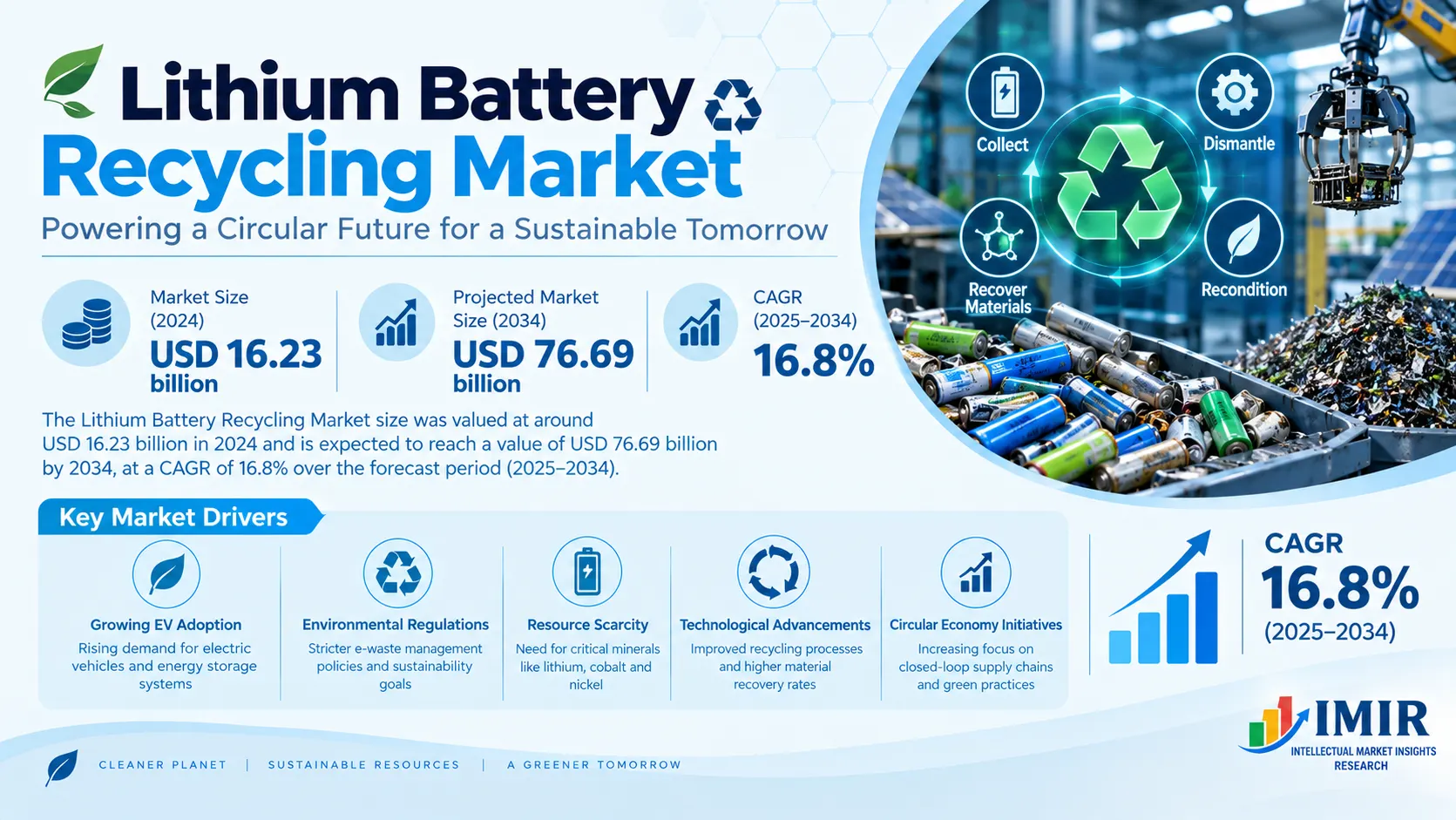
The global Lithium Battery Recycling Market was valued at approximately USD 16.23 billion in 2024 and is projected to reach USD 76.69 billion by 2034, registering a compound annual growth rate (CAGR) of 16.8% during the forecast period from 2025 to 2034.
The growing demand for lithium-ion batteries has increased the need for efficient collection, processing, and recovery of end-of-life batteries. Recovered materials, including lithium, nickel, cobalt, and manganese, can be reused in battery manufacturing and other industrial applications.
As governments, automotive manufacturers, and battery producers prioritize circular economy initiatives, battery recycling is becoming an important part of the global energy transition.
Why Is the Lithium Battery Recycling Market Growing?
1. Increasing Adoption of Electric Vehicles
The growing popularity of electric vehicles is generating greater demand for lithium-ion batteries. As EV adoption expands, the need to manage damaged, retired, and end-of-life battery packs is also increasing.
Automakers and recycling companies are investing in battery collection programs, material recovery facilities, and recycling partnerships to support sustainable EV growth.
2. Rising Demand for Renewable Energy Storage
Solar and wind energy installations increasingly depend on battery energy storage systems to balance electricity supply and demand. Lithium-ion batteries are widely used in these systems because of their energy density and performance.
Recycling these batteries can help recover valuable materials and reduce the environmental impact associated with battery disposal.
3. Environmental Regulations and Sustainability Initiatives
Governments and environmental authorities are strengthening policies related to battery waste management, material recovery, and responsible disposal. Extended Producer Responsibility (EPR) programs in relevant markets encourage manufacturers to take greater responsibility for products at the end of their useful lives.
These initiatives are encouraging businesses to invest in compliant recycling infrastructure and sustainable battery management practices.
4. Recovery of Valuable Battery Materials
Lithium batteries contain valuable materials such as lithium, nickel, cobalt, copper, and manganese. Recycling helps recover these resources for potential reuse, reducing dependence on newly mined raw materials.
Efficient recovery can also improve supply chain resilience and help battery manufacturers manage raw material procurement costs.
5. Technological Advancements in Recycling
Improvements in hydrometallurgical, pyrometallurgical, and physical or mechanical recycling processes are helping companies improve material recovery and processing efficiency.
Ongoing research into direct recycling and improved battery design may further support material reuse and the development of more efficient recycling operations.
Key Market Trends
Several trends are shaping the future of the Lithium Battery Recycling Market:
-
Circular battery supply chains: Manufacturers are increasingly exploring systems that recover materials from used batteries and return them to production.
-
Advanced recycling technologies: Companies are developing processes designed to improve recovery rates and reduce resource consumption.
-
EV battery recycling infrastructure: Investments in collection networks, processing facilities, and partnerships are supporting the growing volume of retired EV batteries.
-
Sustainable manufacturing: Battery producers are focusing on resource efficiency, waste reduction, and environmental performance.
Companies Associated with the Lithium Battery Recycling Market
Companies active in the lithium battery recycling industry include:
-
Li-Cycle Corp. – Focuses on lithium-ion battery resource recovery and recycling solutions.
-
Glencore – Operates in natural resources and metals, including battery material recovery initiatives.
-
Fortum – Provides battery recycling and critical material recovery solutions.
-
Neometals Ltd. – Develops technologies and projects related to battery material recovery.
-
DOWA ECO-SYSTEM Co., Ltd. – Offers environmental management and recycling services.
-
ACCUREC Recycling GmbH – Specializes in battery recycling technologies.
-
Retriev Technologies Inc. – Provides battery collection, recycling, and resource recovery services.
-
Lithion Recycling Inc. – Develops lithium-ion battery recycling technologies.
Competitive strategies across the industry include expanding processing capacity, improving recovery efficiency, developing proprietary technologies, and forming partnerships with battery manufacturers and automotive companies.
Regional Analysis
Asia-Pacific
Asia-Pacific is an important region for lithium battery recycling due to its established battery manufacturing ecosystem, expanding electric vehicle market, and strong electronics production base. China, Japan, South Korea, and India offer opportunities for recycling infrastructure development and battery material recovery.
North America
North America is seeing increased interest in domestic battery supply chains, electric mobility, and critical mineral recovery. Investments in recycling facilities and collaboration between automakers, battery manufacturers, and recycling companies are supporting market development.
Europe
Europe's focus on environmental sustainability, battery traceability, and resource recovery is encouraging investment in battery recycling technologies. Automotive electrification and regulatory initiatives are also creating opportunities for recycling companies.
Latin America, the Middle East, and Africa
These regions offer emerging opportunities as electric mobility, renewable energy storage, and waste management infrastructure develop. Future growth will depend on collection systems, investment, regulatory frameworks, and access to suitable recycling technologies.
Challenges Facing the Lithium Battery Recycling Market
Despite its strong growth potential, the market faces several challenges.
High capital investment: Establishing recycling plants requires specialized equipment, safety systems, and processing infrastructure.
Battery collection and logistics: Collecting used batteries from dispersed locations can increase transportation costs and complicate supply planning.
Safety concerns: Damaged or improperly handled lithium batteries can create fire and other safety risks during storage, transportation, and processing.
Different battery chemistries: Variations in battery composition require adaptable processing methods and can affect material recovery economics.
Commodity price fluctuations: Changes in the prices of lithium, nickel, and cobalt can influence the profitability of recycling operations.
Addressing these challenges through improved technology, effective collection networks, standardized practices, and supportive policies will be important for long-term market development.
Future Outlook (2025–2034)
The Lithium Battery Recycling Market is expected to experience substantial expansion as the global adoption of electric vehicles, renewable energy storage systems, and battery-powered electronics continues.
According to Intellectual Market Insights Research, the market is projected to grow from approximately USD 16.23 billion in 2024 to USD 76.69 billion by 2034, representing a CAGR of 16.8% from 2025 to 2034.
Future opportunities are expected to emerge from advanced material recovery, domestic battery supply chain development, recycling partnerships, and the increasing need for responsible end-of-life battery management.
Companies that invest in efficient processing technologies, reliable battery collection networks, and scalable recycling infrastructure may be better positioned to benefit from the industry's long-term development.
Frequently Asked Questions (FAQ)
1. What is the projected size of the Lithium Battery Recycling Market by 2034?
The market is projected to reach approximately USD 76.69 billion by 2034, according to Intellectual Market Insights Research.
2. What is the expected CAGR of the Lithium Battery Recycling Market?
The market is expected to grow at a CAGR of 16.8% during the forecast period from 2025 to 2034.
3. What are the major factors driving market growth?
Key factors include rising electric vehicle adoption, growing battery waste volumes, renewable energy storage demand, environmental regulations, and the need to recover valuable raw materials.
4. Which materials can be recovered from lithium batteries?
Depending on the battery chemistry and recycling process, recoverable materials may include lithium, nickel, cobalt, manganese, copper, and aluminium.
5. What are the major recycling processes?
The principal processes include hydrometallurgical, pyrometallurgical, and physical or mechanical recycling. Direct recycling is also an area of ongoing technological development.
6. Which regions offer opportunities for lithium battery recycling?
Asia-Pacific, North America, and Europe are important markets, while other regions may offer opportunities as battery adoption and recycling infrastructure expand.
7. What challenges affect battery recycling companies?
Major challenges include high facility costs, safe battery handling, collection logistics, variations in battery chemistry, and fluctuations in recovered material prices.
Conclusion
The Lithium Battery Recycling Market is becoming increasingly important to the global transition toward electric mobility, renewable energy storage, and sustainable manufacturing. The recovery and reuse of valuable battery materials can help reduce waste, support resource efficiency, and strengthen battery supply chains.
With the market projected to reach USD 76.69 billion by 2034, technological innovation, supportive regulations, and investment in recycling infrastructure are expected to create significant opportunities for industry participants.
For detailed market insights, segmentation, regional analysis, competitive intelligence, and forecasts, explore the Lithium Battery Recycling Market Report by Intellectual Market Insights Research.