
Top Electric Commercial Vehicle Companies Overview and Size
Author:
Intellectual Market Insights Research
Published Date:
15 May 2026
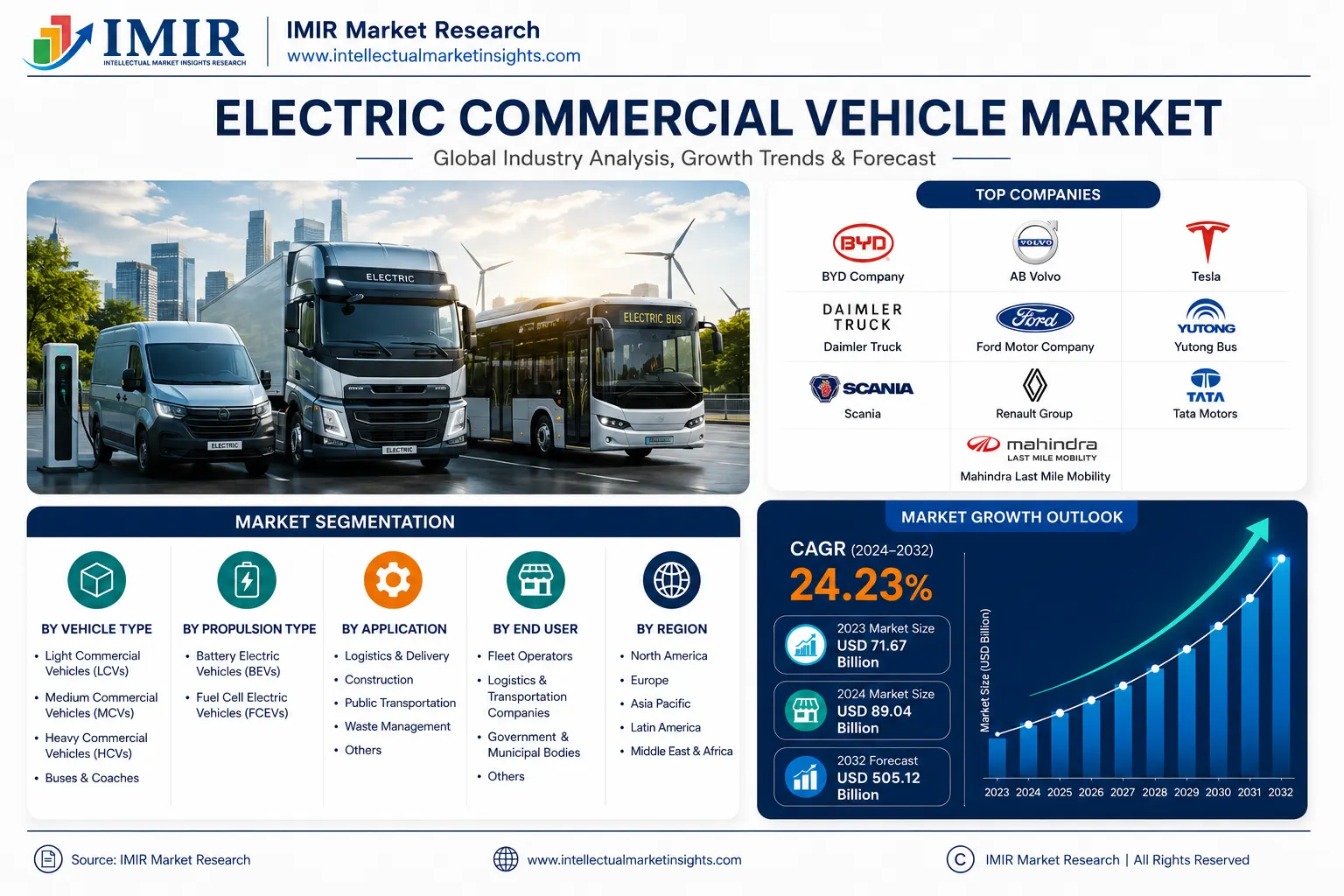
The global electric commercial vehicle market is growing rapidly as governments, logistics providers, and public transportation systems shift toward cleaner and more sustainable mobility solutions. Rising fuel costs, strict emission regulations, advancements in battery technology, and increasing demand for green transportation are accelerating the adoption of electric commercial vehicles worldwide.
Global Electric Commercial Vehicle Market size was valued at USD 71.67 Billion in 2023 and is poised to grow from USD 89.04 Billion in 2024 to USD 505.12 Billion by 2032, growing at a CAGR of 24.23% in the forecast period (2024-2032).
From electric buses and delivery vans to heavy-duty trucks and smart fleet solutions, leading automotive companies are investing heavily in innovation to shape the future of commercial transportation.
Here’s a look at the Top Global Companies in the Electric Commercial Vehicle Market driving this transformation.
Access the Full Report: https://www.intellectualmarketinsights.com/report/electric-commercial-vehicle-market-size-and-share-analysis/imi-008271
Market Investment Opportunities in the Electric Commercial Vehicle Market
The global electric commercial vehicle market is growing rapidly due to increasing demand for sustainable transportation, government incentives, rising fuel prices, and advancements in EV technology. Major companies such as BYD Company, Tesla, AB Volvo, Daimler Truck, and Tata Motors are leading the market through innovations in electric buses, trucks, vans, and smart mobility solutions.
Key investment opportunities exist in:
- Electric buses and public transport
- Electric delivery and logistics vehicles
- Heavy-duty electric trucks
- Battery manufacturing and recycling
- EV charging infrastructure
- Smart fleet management and AI technologies
Emerging markets like India and China are becoming major growth centers due to rapid urbanization and supportive government policies. As businesses and governments continue focusing on carbon reduction and clean mobility, the electric commercial vehicle industry is expected to witness strong long-term growth and investment potential worldwide.
Key Drivers of the Global Electric Commercial Vehicle Market
1. Government Support & Emission Regulations
Governments worldwide are introducing strict emission norms, carbon-reduction targets, and EV incentive programs to accelerate the adoption of electric commercial vehicles. Subsidies, tax benefits, and public transport electrification initiatives are significantly boosting market growth.
2. Rising Fuel Prices
Increasing diesel and gasoline prices are encouraging fleet operators and logistics companies to shift toward electric commercial vehicles, which offer lower operating and maintenance costs over the long term.
3. Growth of E-Commerce & Last-Mile Delivery
The rapid expansion of e-commerce and urban delivery services is driving demand for electric vans, cargo vehicles, and three-wheelers for efficient last-mile transportation solutions.
4. Advancements in Battery Technology
Continuous improvements in lithium-ion batteries, fast charging systems, and battery energy density are increasing vehicle range, reducing charging times, and lowering overall ownership costs.
5. Expansion of Charging Infrastructure
Growing investments in EV charging networks by governments and private companies are improving charging accessibility and supporting large-scale commercial EV adoption.
Top Companies in the Global Electric Commercial Vehicle Market
1. BYD Company
One of the world’s largest electric commercial vehicle manufacturers, specializing in electric buses, trucks, vans, and battery technologies.
BYD Company is one of the world’s leading electric vehicle manufacturers and a major force in the electric commercial vehicle industry. The company has built a strong global presence through its electric buses, trucks, vans, and battery technologies.
BYD’s electric buses operate in multiple countries across Asia, Europe, North America, and Latin America. The company focuses on sustainable urban mobility and continues expanding its electric logistics and transportation portfolio.
Key Highlights
- Global leader in electric buses and commercial EVs
- Operates manufacturing facilities across Asia, Europe, and North America
- Strong presence in battery technology and energy storage systems
- Delivered thousands of electric buses worldwide
- Major supplier for public transportation electrification projects
|
Category |
Details |
|---|---|
|
Founded |
1995 |
|
Headquarters |
Shenzhen, Guangdong, China |
|
Employees |
Approximately 700,000+ |
|
Revenue |
Around USD 85–90 Billion |
|
Industry |
Electric Commercial Vehicles / Batteries |
|
Key Products |
Electric Buses, Trucks, Vans, Battery Systems |
2. AB Volvo
A global leader in commercial transportation solutions, focusing heavily on electric trucks, buses, and sustainable mobility technologies.
AB Volvo is a global leader in commercial transportation solutions and has made significant investments in electric trucks and sustainable mobility technologies. The company offers a growing range of electric heavy-duty trucks designed for logistics, urban transportation, and construction operations.
Volvo is actively supporting the transition toward carbon-neutral transportation through advanced charging infrastructure and smart fleet management systems.
Key Highlights
- Strong EV truck portfolio under Volvo Trucks
- Expanding electric heavy-duty truck production
- Major investments in hydrogen and battery-electric mobility
- Strong presence across Europe and North America
|
Category |
Details |
|---|---|
|
Founded |
1927 |
|
Headquarters |
Gothenburg, Sweden |
|
Employees |
Approximately 100,000+ |
|
Revenue |
Around USD 52–55 Billion |
|
Industry |
Commercial Vehicles / Electric Trucks |
|
Key Products |
Volvo Electric Trucks, Electric Buses, Construction EVs |
3. Tesla
A leading electric vehicle manufacturer expanding into electric commercial transportation through heavy-duty electric trucks.
Tesla has revolutionized the electric vehicle industry and is expanding aggressively into the commercial transportation segment with the Tesla Semi. The company aims to improve freight efficiency using long-range electric trucking solutions powered by advanced battery technology.
Tesla’s innovations in autonomous driving, energy efficiency, and charging infrastructure continue influencing the future of electric commercial mobility.
Key Highlights
- Developer of Tesla Semi electric truck
- Advanced battery and autonomous driving technologies
- Strong global EV brand recognition
- Expanding production capabilities worldwide
|
Category |
Details |
|---|---|
|
Founded |
2003 |
|
Headquarters |
Austin, Texas, USA |
|
Employees |
Approximately 140,000+ |
|
Revenue |
Around USD 95–100 Billion |
|
Industry |
Electric Vehicles / Energy Solutions |
|
Key Products |
Tesla Semi, Battery Systems, EV Platforms |
4. Daimler Truck
One of the world’s largest commercial vehicle manufacturers, investing heavily in electric and hydrogen-powered transportation.
Daimler Truck is among the largest commercial vehicle manufacturers globally and a key player in electric trucking solutions. Through brands like Mercedes-Benz Trucks and Freightliner, the company is introducing innovative electric trucks for regional and urban logistics.
Daimler Truck is heavily investing in battery-electric and hydrogen fuel-cell technologies to support sustainable transportation.
Key Highlights
- Producer of Mercedes-Benz and Freightliner electric trucks
- Strong commercial fleet customer base
- Major investments in zero-emission logistics solutions
- Expanding battery-electric truck production globally
|
Category |
Details |
|---|---|
|
Founded |
2021 (spinoff) |
|
Headquarters |
Leinfelden-Echterdingen, Germany |
|
Employees |
Approximately 100,000+ |
|
Revenue |
Around USD 55–60 Billion |
|
Industry |
Commercial Vehicles / Electric Mobility |
|
Key Products |
eActros, Freightliner eCascadia, Electric Buses |
5. Ford Motor Company
A major automotive company rapidly expanding into electric commercial vans and fleet mobility solutions.
Ford Motor Company is strengthening its position in the electric commercial vehicle market through products like the E-Transit electric van and connected fleet services. The company is focusing on urban delivery solutions and fleet electrification.
Ford’s commercial EV strategy combines electric mobility with digital fleet management platforms to improve operational efficiency for businesses.
Key Highlights
- Developer of E-Transit electric commercial van
- Large fleet customer network globally
- Significant investments in EV manufacturing
- Strong North American commercial vehicle presence
|
Category |
Details |
|---|---|
|
Founded |
1903 |
|
Headquarters |
Dearborn, Michigan, USA |
|
Employees |
Approximately 175,000+ |
|
Revenue |
Around USD 175–180 Billion |
|
Industry |
Automotive / Commercial EVs |
|
Key Products |
E-Transit, Electric Pickup Trucks, Fleet Solutions |
6. Yutong Bus
One of the largest bus manufacturers globally and a major player in electric public transportation.
Yutong Bus is one of the world’s largest bus manufacturers and a major supplier of electric buses globally. The company provides environmentally friendly public transportation solutions with advanced battery technologies and intelligent transport systems.
Yutong’s electric buses are widely adopted in public transit systems across Asia, Europe, Africa, and Latin America.
Key Highlights
- Leading exporter of electric buses
- Strong presence in Asia, Europe, and Latin America
- Focused on smart mobility and sustainable transit
- Delivered large-scale public transport electrification projects
|
Category |
Details |
|---|---|
|
Founded |
1963 |
|
Headquarters |
Zhengzhou, Henan, China |
|
Employees |
Approximately 28,000+ |
|
Revenue |
Around USD 4–5 Billion |
|
Industry |
Electric Buses / Public Transport |
|
Key Products |
Battery Electric Buses, Coaches, Transit Systems |
7. Scania
A premium commercial vehicle company focusing on electric trucks and sustainable transportation technologies.
Scania is recognized globally for its premium commercial vehicles and sustainable transport solutions. The company is developing electric trucks and buses designed to reduce emissions while maintaining high performance and operational reliability.
Scania continues investing in battery-electric mobility and charging ecosystem development.
Key Highlights
- Expanding electric heavy-duty truck lineup
- Focused on sustainable logistics solutions
- Strong European commercial fleet presence
- Investments in battery and autonomous technologies
|
Category |
Details |
|---|---|
|
Founded |
1891 |
|
Headquarters |
Södertälje, Sweden |
|
Employees |
Approximately 58,000+ |
|
Revenue |
Around USD 18–20 Billion |
|
Industry |
Commercial Vehicles / Electric Trucks |
|
Key Products |
Electric Trucks, Hybrid Trucks, Fleet Services |
8. Renault Group
A major European automotive company investing in electric vans and sustainable commercial mobility solutions.
Renault Group is actively expanding its electric commercial vehicle business through innovative vans and urban delivery solutions. The company focuses on sustainable city transportation and connected mobility services.
Renault’s commercial EV lineup supports businesses looking for efficient and low-emission transport solutions.
Key Highlights
- Strong electric light commercial vehicle portfolio
- Expanding EV partnerships across Europe
- Focused on urban logistics electrification
- Established presence in fleet mobility markets
|
Category |
Details |
|---|---|
|
Founded |
1899 |
|
Headquarters |
Boulogne-Billancourt, France |
|
Employees |
Approximately 105,000+ |
|
Revenue |
Around USD 55–60 Billion |
|
Industry |
Automotive / Electric Mobility |
|
Key Products |
Kangoo E-Tech, Master E-Tech, Electric Vans |
9. Tata Motors
One of India’s leading commercial vehicle manufacturers with a rapidly growing electric commercial vehicle portfolio.
Tata Motors is one of India’s leading commercial vehicle manufacturers and a rapidly growing player in the electric commercial vehicle segment. The company offers electric buses, cargo vehicles, and last-mile delivery EVs designed for Indian and global markets.
Tata Motors is actively supporting India’s clean mobility transition through affordable and scalable EV solutions.
Key Highlights
- Strong leadership in India’s electric bus market
- Expanding electric cargo and fleet vehicle lineup
- Supported by government EV initiatives
- Major supplier for public transportation electrification in India
|
Category |
Details |
|---|---|
|
Founded |
1945 |
|
Headquarters |
Mumbai, Maharashtra, India |
|
Employees |
Approximately 90,000+ |
|
Revenue |
Around USD 52–55 Billion |
|
Industry |
Commercial Vehicles / Electric Mobility |
|
Key Products |
Electric Buses, Electric Trucks, Ace EV |
10. Mahindra Last Mile Mobility
A major Indian electric mobility company focused on electric three-wheelers and last-mile transportation solutions.
Mahindra Last Mile Mobility is a leading player in India’s electric last-mile transportation sector. The company specializes in electric three-wheelers and small commercial vehicles widely used for cargo and passenger transportation.
With increasing urbanization and e-commerce growth, Mahindra continues strengthening its position in the electric mobility ecosystem.
Key Highlights
- Market leader in electric three-wheelers in India
- Strong presence in urban delivery mobility
- Expanding EV manufacturing capacity
- Focused on affordable last-mile transportation
|
Category |
Details |
|---|---|
|
Founded |
2023 (subsidiary formation) |
|
Headquarters |
Mumbai, Maharashtra, India |
|
Employees |
Approximately 1,000+ |
|
Revenue |
Part of Mahindra Group EV operations |
|
Industry |
Electric Last-Mile Mobility |
|
Key Products |
Treo EV, Zor Grand, Electric Cargo Vehicles |
Conclusion
The global electric commercial vehicle market is experiencing rapid expansion driven by increasing government support for zero-emission transportation, rising fuel costs, advancements in battery technology, and growing investments in sustainable mobility infrastructure. Major manufacturers are accelerating the development of electric buses, trucks, vans, and last-mile delivery vehicles to meet rising demand across logistics, public transportation, and urban mobility sectors. The market is expected to witness strong long-term growth as fleet electrification becomes a key priority worldwide.